 RSS Subscribe
Who Is Buying Gold and why – AOTH

Bullion
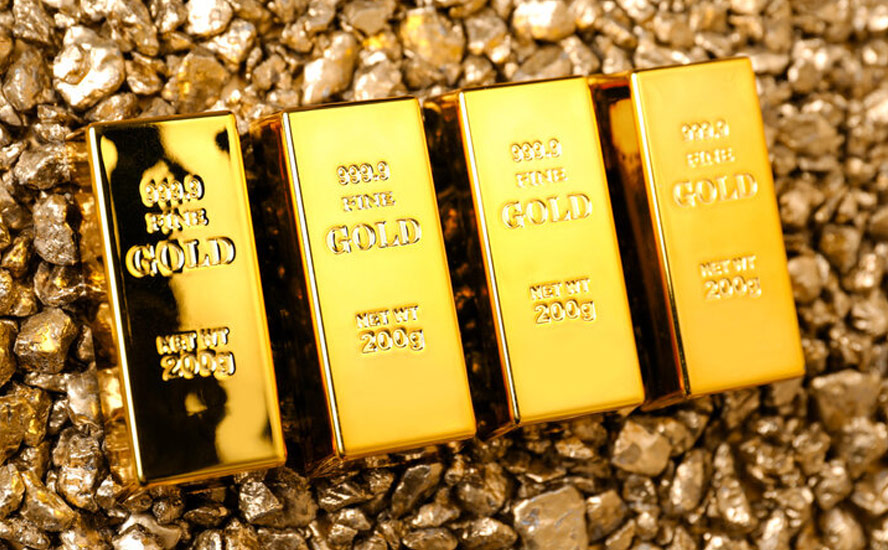
National monetary authorities, governments and central banks, particularly in emerging markets like China, Poland, India, Turkey, and Kazakhstan. have been the largest and most influential net buyers of physical gold in recent years. They purchase bullion to diversify foreign exchange reserves, reduce reliance on the U.S. dollar, and hedge against geopolitical and sovereign debt risks.
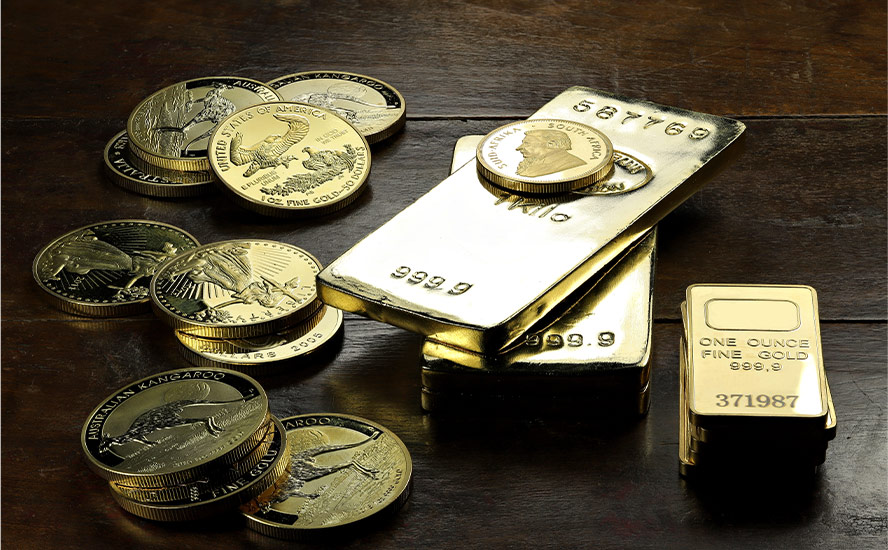
Individuals purchase physical gold coins (such as Canadian Maple Leaf’s, American Eagles, and South African Krugerrands) and small-to-large bars through local precious metals dealers, government mints, or select banks.
Retail physical bar and coin demand has historically been very strong across Asian markets (such as China and India) and has grown significantly among Western households seeking safe havens during periods of inflation and economic uncertainty.
Central Banks stay largely price-insensitive and hold physical bullion for decades as sovereign security.
Paper gold
Pension funds, mutual funds, and large asset managers use physically backed gold ETFs (such as SPDR Gold Shares (GLD) or iShares Gold Trust (IAU)) to gain liquid, cost-effective exposure to gold spot prices without handling physical storage or logistics.
Individual stock-market investors buy gold ETFs through regular brokerage accounts because they offer low entry minimums, high intraday liquidity, and seamless trading just like a standard equity.
Short-to-medium-term market participants actively trade gold ETFs, futures (on COMEX or Shanghai Futures Exchange), and options to capitalize on macroeconomic data, interest rate shifts, and short-term price momentum.
Paper Gold (ETF/Fund) Investors operate on shorter timeframes and are heavily influenced by real interest rates, bond yields, and opportunity costs, frequently liquidating or rotating out of paper funds when interest rates rise.
ETF’s
Investors choose gold Exchange-Traded Funds (ETFs) and Exchange-Traded Commodities (ETCs)—often referred to as “paper gold”—over physical bullion because paper gold prioritizes frictionless trading flexibility, institutional liquidity, and immediate portfolio integration over physical ownership.
While bullion serves as an “enduring security insurance” independent of the financial system, paper instruments are chosen by those who strictly want to capture the financial price movements of gold efficiently.
The choice comes down to a fundamental question: “Do I need to hold the gold, or do I just need the price?” For investors choosing the price, ETFs are the standard vehicle.
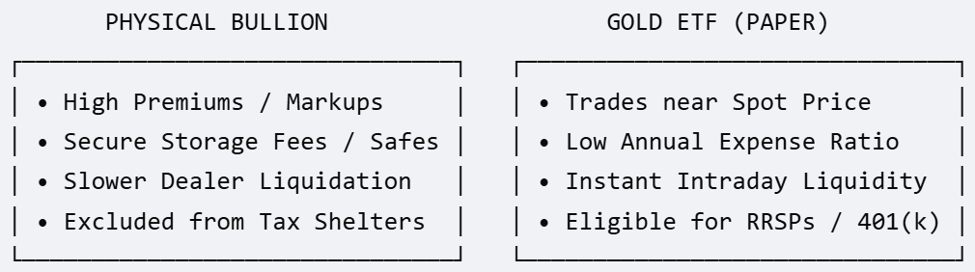
In many countries, physical gold cannot be seamlessly held inside state-regulated retirement tax shelters. In Canada, you cannot easily place home-stored coins into a Registered Retirement Savings Plan (RRSP) or a Tax-Free Savings Account (TFSA).
Gold ETFs can be held directly within standard brokerage retirement accounts. This allows investors to enjoy capital growth on gold tax-deferred or tax-free, without having to set up specialized precious metal IRAs or custodial accounts.
For asset managers utilizing dynamic models, gold acts as a ballast to stocks and bonds. Shifting a portfolio’s allocation by 3% into gold is easily automated via an ETF ticker trade. Rebalancing using physical bars—requiring armor-car transit and manual settlements—is completely impractical for modern wealth management.
The historical performance track record of gold ETFs and spot gold during stock market crashes follows a highly consistent, two-phase psychological pattern: Gold vehicles typically experience an initial, short-lived drop during the peak panic of a crash, followed by an aggressive, decoupling rally that heavily outperforms stocks over the full cycle.
Because physically backed gold ETFs (like GLD) track the spot price of bullion, their historical trajectory mirrors the broader metal. Historically, gold has outperformed the S&P 500 in 7 out of the last 9 major market crashes over the full cycle.
Bullion buyers
Investors, governments, and central banks continue to buy and hold gold because it acts as the ultimate form of systemic financial insurance with zero counterparty risk. While fiat currencies (like the US dollar or Euro) rely entirely on trust in government stability, gold cannot be printed or debased, making it a reliable store of value for thousands of years.
The global rush for gold is being driven by structural motivations specific to each type of buyer.
Central banks have bought historic amounts of gold, driven by a structural shift in global reserve management.
Following the 2022 freezing of $300 billion in Russian foreign reserves by G7 countries, central bank reserve managers globally realized that electronic currencies held in Western banks carry political vulnerability. Gold stored domestically cannot be frozen, hacked, or blocked by foreign sanctions.
Major emerging market central banks (such as China, Turkey, India, and Poland) are actively trying to reduce their over-reliance on U.S. Dollar reserves.
According to the 2026 World Gold Council Central Bank Survey, 89% of central banks expect global reserves to keep increasing, citing gold’s excellent performance during global crises.
Governments hold vast sovereign gold reserves as a fundamental national backstop to protect public wealth from collapse.
With global government deficit spending hitting all-time highs, concerns over the long-term sustainability of Western fiscal policies have mounted. Gold acts as a hard anchor against the threat of sovereign default or currency debasement.
Nations are physically bringing their gold back home. European monetary institutions, such as the Dutch Central Bank (De Nederlandsche Bank), have relocated significant tonnage out of foreign vaults (like New York) back to domestic soils to ensure immediate tradability and “crisis preparedness.”
For private capital, gold serves as a tool to protect purchasing power and smooth out investment portfolio returns.
Unlike a stock, corporate bond, or bank deposit, a physical bar of gold does not rely on a company or bank staying solvent to maintain its worth. It cannot go bankrupt.
While paper money steadily loses value due to inflation, the purchasing power of gold has historically proven to survive over the long term.
Gold has a low correlation to conventional stocks and bonds. When geopolitical shocks or energy supply disruptions trigger sudden market panics, such as the recent conflicts in the Middle East, investors funnel capital into gold ETFs and physical coins to hedge against broader equity losses.
Conclusion
Over thelong term, gold has systematically and heavily outperformed every major fiat currency in existence.
Because fiat currencies like the U.S. Dollar (USD), Euro (EUR), British Pound (GBP), and Japanese Yen (JPY) can be printed in unlimited quantities by central banks, they naturally suffer from an irreversible long-term decline in purchasing power. In stark contrast, gold has a strictly limited global supply, meaning its nominal price rises exponentially over the decades as the fiat currencies used to buy it lose value
The true modern performance comparison begins in 1971, when U.S. President Richard Nixon severed the last ties of the U.S. dollar to gold (ending the Bretton Woods system).
Prior to 1971, the U.S. dollar was legally defined as 1/35th of an ounce of gold. Once that constraint was removed, the global money supply expanded parabolically.
Since fully decoupling from gold in 1971, major world currencies have experienced a massive collapse in purchasing power when priced in gold.
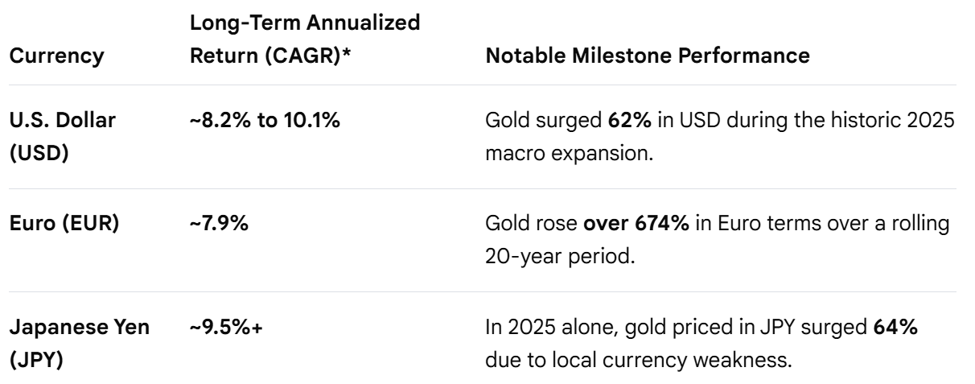
*Data captures standard annualized performance baselines ranging from 1969/1980 through recent 2025/2026 market audits
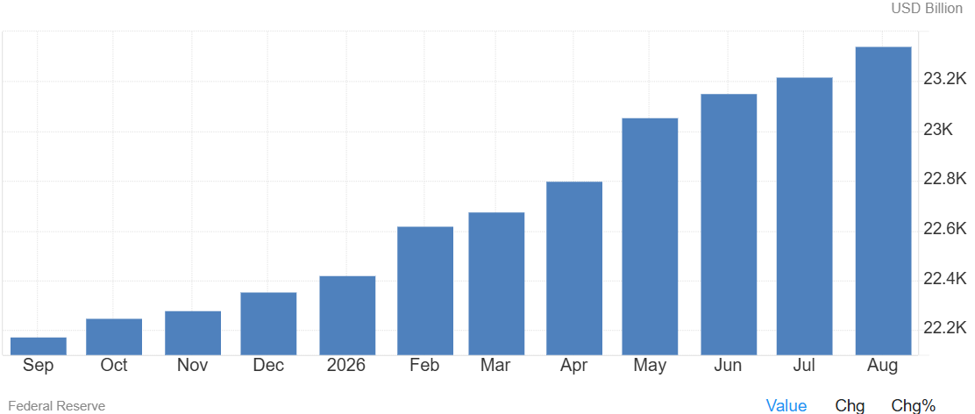
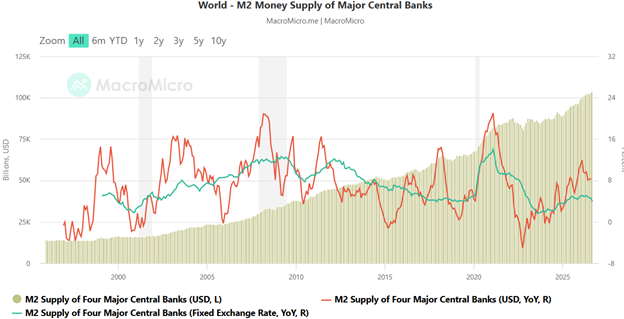
Gold’s price appreciation tracks the exponential expansion of global M2 money supply. Central banks can print trillions of dollars, euros, or yen via quantitative easing, but they cannot print physical gold.

Legal Notice / Disclaimer
Ahead of the Herd newsletter, aheadoftheherd.com, hereafter known as AOTH.Please read the entire Disclaimer carefully before you use this website or read the newsletter. If you do not agree to all the AOTH/Richard Mills Disclaimer, do not access/read this website/newsletter/article, or any of its pages. By reading/using this AOTH/Richard Mills website/newsletter/article, and whether you actually read this Disclaimer, you are deemed to have accepted it.