 RSS Subscribe
Copper and silver usage in data centers, robotics and solid state batteries – AOTH
2026.09.16
Major tech companies are on track to spend between $745 billion and $760 billion on capital expenditures in 2026, driven largely by artificial intelligence and data center expansion.
Microsoft, Alphabet (Google), Meta and Amazon collectively spent about $413 billion in 2025.
According to PwC Global Investment in AI Infrastructure, worldwide spending on AI infrastructure could reach $31.6 trillion through 2050. Annual data center capital expenditure is forecast to climb from around $800 billion to $1.8 trillion by 2050.
Data center growth is highly concentrated geographically. More than 85% of new data center capacity additions over the next 10 years are expected to be in the United States, China and the European Union, according to the International Energy Agency (IEA).
The US currently accounts for roughly 40% of the global data center market.
A McKinsey analysis finds the United States is also expected to be the fastest-growing market for data centers, from 25 gigawatts of demand in 2024 to more than 80 GW of demand in 2030.
This growth is fueled by the continued increase in data, compute and connectivity from digitalization, and cloud migration, as well as the scaling of new technologies — the most important of which is AI.
Copper
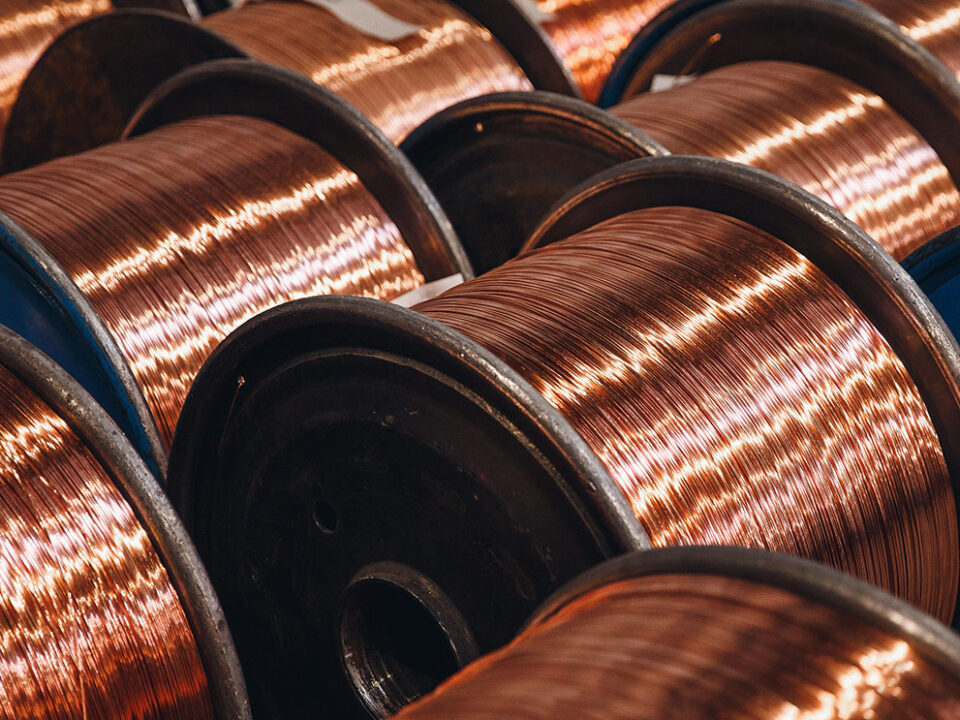
Data centers rely heavily on copper for electrical conductivity, power distribution and heat management. Where copper is used:
- Power Distribution: Thick copper busbars, transformers, and switchgear deliver high-volume current with minimal energy loss.
- Hardware & Circuitry: Server boards, internal wiring, power connectors, and chips use copper for reliable electrical paths.
- Thermal Management: Cooling systems and heat sinks use copper’s thermal properties to dissipate heat from high-density GPUs.
A standard data center uses 5,000 to 15,000 tons of copper, while large AI hyperscale sites — the kind built to run artificial intelligence — can require more than three conventional facilities, up to 50,000 tons.
Driven by the AI boom, data center demand is expected to push global copper consumption significantly higher through the decade. The IEA believes that data centers could be consuming more than half a million tonnes annually by 2030, at which time they would gobble up 3% of the world’s electricity supply, twice that of the United Kingdom currently.
One of the most interesting things about data centers is that they are largely indifferent to copper prices. According to Wood Mackenzie, a commodities consultancy, the metal accounts for less than 0.5% of total project costs, meaning that data centers will be built whether copper is trading at $10,000 or $20,000 a ton ($5 or $6 a pound).
Other materials
But it isn’t just copper that is being used widely by data centers. Among the materials needed for their servers, power distribution and cooling systems are aluminum, used in electrical transmission, wiring, and heat sinks to manage high operating temperatures; steel, used for structural framing, server enclosures and mounting systems; and silicon, refined from quartz and used as the foundational substrate for all semiconductors.
Arsenic, gallium, germanium, indium, and tantalum are critical trace materials required for advanced microchips and optical transceivers.
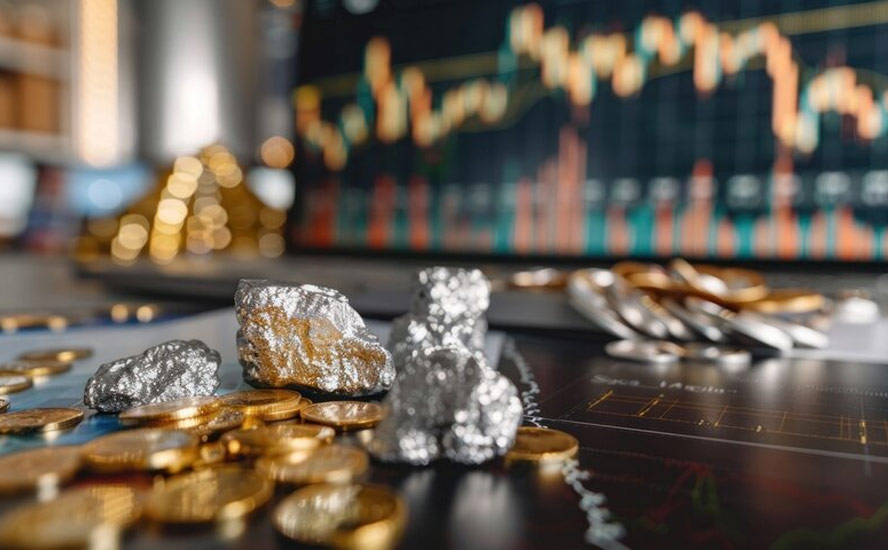
Silver, tin and gold are vital for electrical conductivity, circuitry and soldering server boards.
Silver
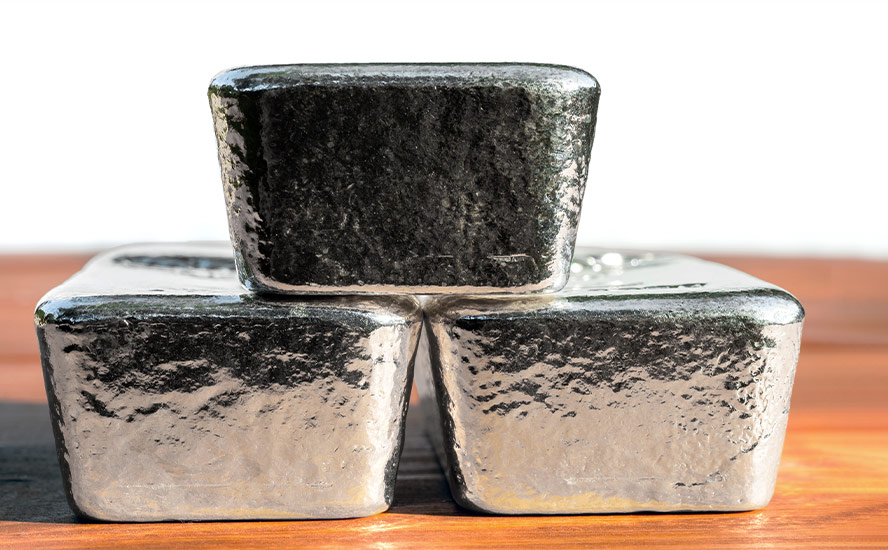
A modern AI training server uses about 180 to 210 grams of silver, while a large hyperscale data center can consume between 1 and 25 metric tons of the metal.
Silver use per server:
- Traditional Servers: A standard enterprise server uses roughly 60 grams of silver.
- AI-Optimized Servers: A modern AI training server uses 180 to 210 grams of silver. This is about three times more than a traditional server because AI hardware requires denser graphics processing units (GPUs) and advanced cooling components.
Silver use per facility:
- Switchgear and Power: Medium-voltage switchgear that routes power through a facility uses silver-tungsten and silver-nickel alloys. A single large data center can hold 5 to 50 kilograms (160 to 1,600 troy ounces) just in its switchgear.
- Total Facility Demand: Major data center sites contain thousands of specialized servers and extensive power infrastructure, bringing total silver consumption to massive industrial scales.
Where the silver goes:
- Circuit Boards: Silver-based conductive inks trace electrical pathways on high-frequency printed circuit boards.
- Connectors and Relays: Silver resists oxidation and handles millions of rapid electrical switches without losing conductivity.
- Capacitors: Tiny multilayer ceramic capacitors use silver-palladium electrodes to manage dense power loads on AI boards.
Global IT power capacity — used by The Silver Institute as a proxy for silver going into data centers — jumped 5,252% in five years, from 0.93 gigawatts in 2020 to nearly 50 GW in 2025.
The institute’s December 2025 report names data centers and AI as one of three structural growth pillars for industrial silver over the next five years, alongside solar and EVs.
But there is a problem. The US relies on imports for 64% of the silver connectors and parts needed to build data centers.
There is valid concern that there will not be enough silver to satisfy data center demand for it. Consider that US data center construction spending reached a monthly $45.1 billion in December 2025, up 85% in two years. According to Mining Visuals, a meaningful share of planned 2026 capacity is expected to slip because grid interconnection and construction cannot keep pace. The bottleneck has shifted from software to the physical plant, the layer where silver lives.
Solid-state batteries and robotics
Solid-state batteries and robotics could consume tens of thousands of metric tons of silver annually if next-generation technologies achieve widespread adoption, heavily straining a global mining market that produces roughly 25,000 to 26,000 metric tons per year.
Next-generation solid-state batteries (SSBs), such as designs utilizing silver-carbon (Ag-C) composite anodes pioneered by Samsung SDI, require significantly higher quantities of silver than traditional lithium-ion batteries.
A standard 100 kWh solid-state EV battery pack can use up to 1 kilogram (about 32.1 ounces) of silver, compared to just 25–50 grams in a conventional liquid lithium-ion EV.
If solid-state batteries capture 20% of global car production (roughly 16 million vehicles out of 80 million annual production), it would generate an incremental annual demand of 16,000 metric tons of silver. This single sector would absorb over 60% of total annual global mine production.
The rise of advanced automation, sensor-heavy industrial machinery, and humanoid robotics relies heavily on precision electronics, semiconductors, and high-conductivity wiring.
Estimates suggest individual advanced humanoid or sensor-dense robots could require 20 to 30 grams of silver per unit.
Scaling production to ambitious long-term targets—such as building 3 billion robots globally—would require an estimated 75,000 metric tons of silver, tripling total current yearly global mine output on that volume alone
Conclusion
The amount of copper and silver demanded by data center buildouts feeds into the under-supply narrative for both metals.
Copper is not only used in data centre construction, it is important in the facilities that generate power for them and in the infrastructure that delivers this power to them.
The world consumes roughly 77,000 to 82,000 metric tons of refined copper every single day.
This figure is calculated from total global consumption, which recently surpassed 30 million metric tons annually for the first time.
BMI (Fitch Solutions) notes that ongoing mining disruptions at top operations like Grasberg and Kamoa, alongside delayed projects, are pushing the market into a structural shortage. They view the current tight market as the start of a multi-year structural deficit.
J.P. Morgan holds one of the most aggressive deficit forecasts on Wall Street, projecting a 330,000-metric-ton shortfall for 2026. This is largely driven by a massive, immediate demand spike from power-dense AI data centers.
Copper mine replacement by acquisition — Richard Mills
Global silver fabrication already faces persistent structural deficits as industrial offtake (driven heavily by solar PV and AI data infrastructure) consumes upward of 56% to 80% of yearly supplies.
Because roughly 70% of silver is mined as a byproduct of lead, zinc, copper, or gold mining, output cannot easily or rapidly scale to match sudden spikes in technological demand.
Other sectors are growing rapidly, acting as the new primary drivers of silver consumption.
Will the silver mining industry be able to produce, or discover, enough silver that it’s able to meet future demand?
The silver market is experiencing a severe structural deficit, with demand consistently outstripping both primary mining output and recycling, leading to a sixth consecutive year of shortages.
The Silver Institute and Metals Focus forecast a 46.3 million-ounce silver deficit in 2026.
The silver shortage is real — Richard Mills

Legal Notice / Disclaimer
Ahead of the Herd newsletter, aheadoftheherd.com, hereafter known as AOTH.Please read the entire Disclaimer carefully before you use this website or read the newsletter. If you do not agree to all the AOTH/Richard Mills Disclaimer, do not access/read this website/newsletter/article, or any of its pages. By reading/using this AOTH/Richard Mills website/newsletter/article, and whether you actually read this Disclaimer, you are deemed to have accepted it.