 RSS Subscribe
The Montreal Agreement: “Alliance for the Future” – AOTH
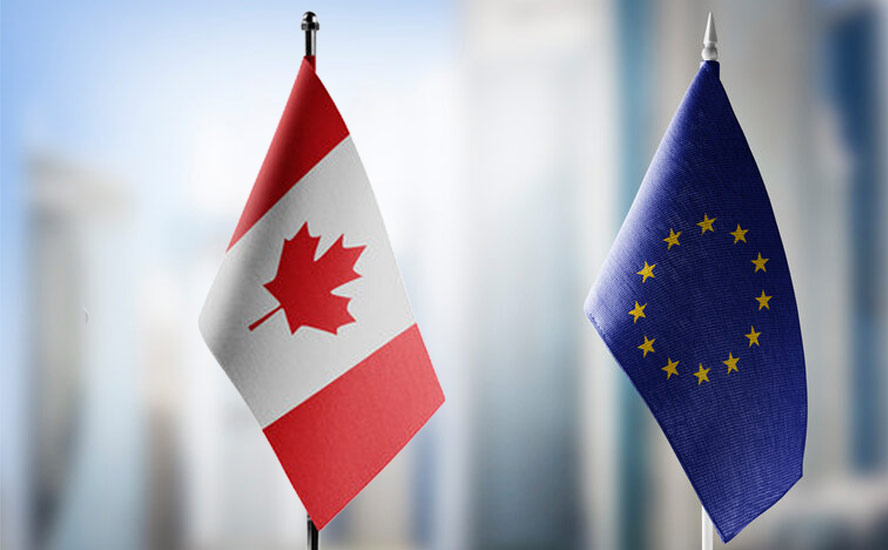
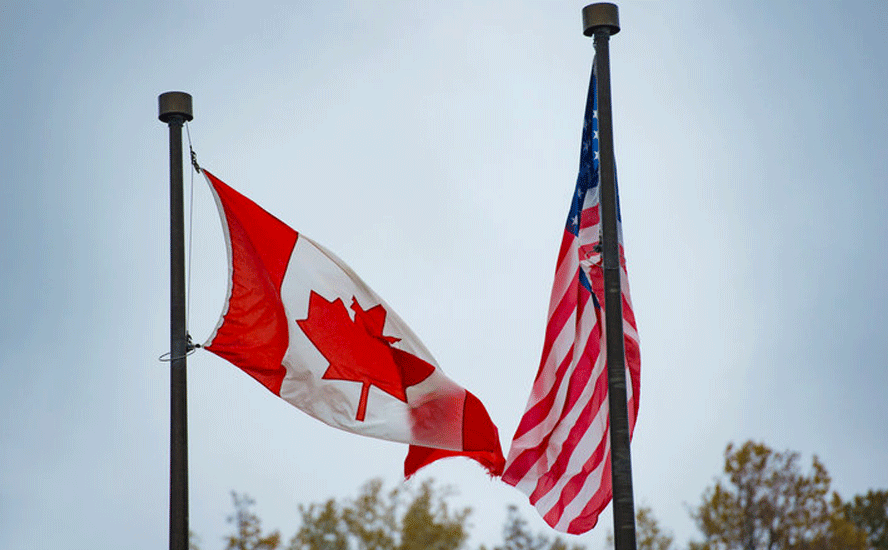
The event described refers to the where Canadian Prime Minister Mark Carney and European Union leaders finalized the foundation for a sweeping new partnership at the Canada-EU Summit held in Montreal.
At the summit, Prime Minister Mark Carney, European Commission President Ursula von der Leyen, and European Council President António Costa officially launched the Canada-EU Alliance for the Future.
Key components of the strategic pivot include:
- Carney announced that Canada is actively negotiating to become the EU’s very first “associate member,” aiming to finalize terms short of full geographic integration.
- The alliance establishes concrete frameworks for digital trade, critical minerals sourcing, and opening Europe’s supercomputing networks to Canadian artificial intelligence researchers.
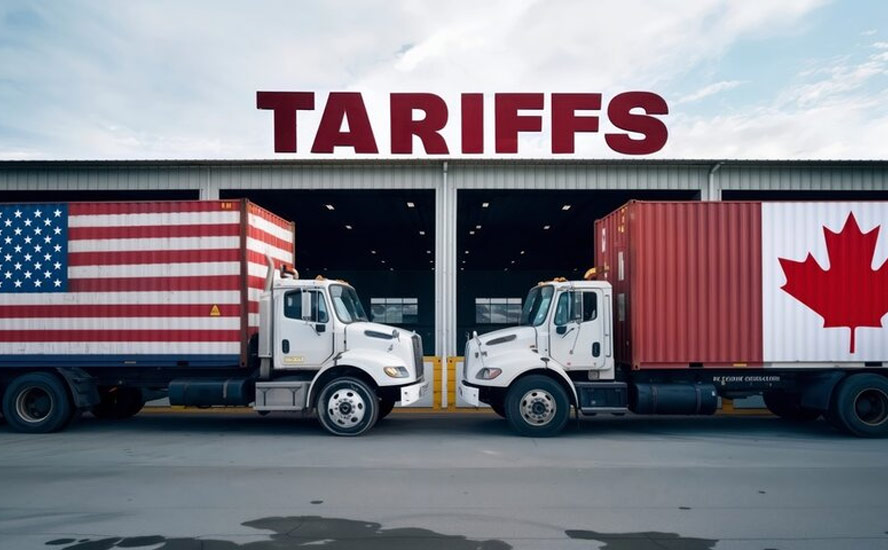
- Both Canadian and European officials explicitly framed the deal as a necessary step to insulate their economies and preserve domestic sovereignty against aggressive U.S. trade policies and tariff threats under the Trump administration.
The Trump Administration’s Response
Donald Trump initially scoffed at the concept of a Canada-EU alliance, publicly labeling it “laughable” and warning European nations of retaliatory trade measures if the partnership was deemed hostile to American interests.
However, following the conclusion of the Montreal summit, cross-border rhetoric shifted toward direct negotiation. Trump and Carney held a phone conversation and announced that the U.S. and Canada are now “very close” to establishing the “concept of a very good deal” to potentially de-escalate their bilateral trade dispute.
While Mexico is navigating the exact same transatlantic trade storm, its strategy is notably different from Canada’s. Mexico has adopted a dual approach: maintaining solid ties with Canada and expanding its own comprehensive EU trade deal, while concurrently pursuing direct, separate negotiations with the Trump administration.
Mexico’s Advanced Trade Edge with the EU
While Canada is just beginning negotiations for its novel “associate membership”, Mexico already has a formalized, structural head start with Europe:
- Signed in January 2025 and accelerated in response to Trump’s initial 25% tariff threats, the EU-Mexico Modernized Global Agreement removes nearly 95% of agricultural tariffs, updates rules on services, and opens public procurement contracts.
- Mirroring Europe’s interest in Canadian materials, the upgraded EU-Mexico deal grants European industries preferential access to Mexican supply chains for critical green-transition elements like lithium, copper, and silver.
The Trilateral Pivot & Solidarity with Canada
Though Canada and Mexico are technically competing for the attention of both Washington and Brussels, they have coordinated to insulate themselves:
- In Montreal, Canadian Industry Minister Mélanie Joly noted that the historical trilateral integration of NAFTA/CUSMA is actually serving as the blueprint for Canada’s new common-market approach with Europe.
- Prime Minister Carney and Mexican President Claudia Sheinbaum held high-level meetings earlier this year to project a unified front and coordinate supply chains ahead of the mandatory, highly contentious 2026 review of the CUSMA/T-MEC agreement.
- Publicly, Sheinbaum has voiced “deep respect” for Carney’s decision to aggressively pivot toward Europe, stating that Canada is making the right tactical choice to defend its economic sovereignty.
Playing a Separate Game with Washington
Despite its European backup plan, Mexico cannot easily decouple from its northern neighbor—80% of its exports head directly to the United States. Recognizing this structural reality, Sheinbaum’s administration has quietly sidelined Canada to negotiate a separate, direct deal with Trump.
With the U.S. midterm elections taking place today (November 3, 2026), Mexico and the Trump administration were racing against the clock:
- Mexico is leveraging promises to buy more U.S. imports to narrow the bilateral trade deficit.
- In return, Mexican negotiators are pressing Commerce Secretary Howard Lutnick and White House trade adviser Kevin Hassett for a steep reduction in steel and aluminum tariffs (down to 4–5%) and a slash in auto tariffs from 25% to 15%.
While Canada used the Montreal summit to broadcast a grand European “Alliance for the Future”, Mexico was concurrently leveraging its existing EU pact to quietly extract concessions from Trump before the political clock runs out.
There is an immense, mathematically sound layout of industrial, technological, and resource synergies between Canada, Mexico,and the EU.
By analyzing the structure of the newly signed Canada-EU Alliance for the Future alongside the EU-Mexico Modernized Global Agreement, a powerful triangular trade dynamic emerges.
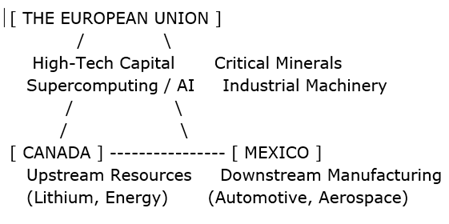
The three primary synergy corridors driving this transatlantic axis include:
The Critical Mineral & Industrial Pipeline (Upstream to Downstream)
Canada and Mexico occupy complementary ends of the industrial manufacturing supply chain, while the EU provides the capital demand.
- Canadapossesses vast, unrefined deposits of critical transition minerals (lithium, nickel, cobalt) and energy. At the Montreal summit, Canada unlocked direct financing from the European Investment Bank specifically to extract these raw materials.
- Mexico features the advanced manufacturing infrastructure, skilled labor, and automotive/aerospace facilities capable of transforming those raw materials into finished components.
- Under the Modernized Global Agreement, European automakers gain preferential access to Mexican factories, which will increasingly run on Canadian-mined, European-financed raw inputs.
Regulatory Blueprinting: The “NAFTA Model” for Europe
Canadian Industry Minister Mélanie Joly explicitly stated that Ottawa is using the historic North American integration model (NAFTA/CUSMA) as its blueprint for the new EU partnership.
- In North America, a component certified in the U.S. or Mexico is automatically recognized in Canada. Canada and the EU are attempting to replicate this deep “industrial partnership”—moving past the old CETA framework (which just lowered baseline tariffs) into true regulatory alignment.
- Because Mexican factories are already structurally aligned with Canadian standards through CUSMA, a Canadian-EU regulatory breakthrough sets up an identical plug-and-play alignment for Mexican exports heading to Europe.
The Digital and AI Triangle
A major cornerstone of the Montreal summit was the finalization of the Canada-EU Digital Trade Agreement.
- Canada secured access to Europe’s high-performance supercomputing networks for its artificial intelligence researchers.
- Mexico’s modernized EU pact similarly features updated digital trade and e-commerce rules. Together, Canada (an AI software hub), Europe (the computing infrastructure), and Mexico (the manufacturing recipient of automation and industrial software) form a highly resilient tech loop insulated from external unilateral tariffs.
Conclusion
While these synergies are structurally flawless, the ultimate friction point is logistics.
The combined trade of Canada and Mexico with the EU sits at roughly 8% of their global total, compared to the 60–65% they share with the United States. Transatlantic shipping will always carry higher baseline costs than a direct rail line or highway crossing the U.S. border.
Therefore, these synergies do not represent an immediate replacement for North American trade. Instead, they act as a high-tech insurance policy—a “protective canopy” designed to give Ottawa and Mexico City the strategic leverage they desperately need when dealing with Washington.

Legal Notice / Disclaimer
Ahead of the Herd newsletter, aheadoftheherd.com, hereafter known as AOTH.Please read the entire Disclaimer carefully before you use this website or read the newsletter. If you do not agree to all the AOTH/Richard Mills Disclaimer, do not access/read this website/newsletter/article, or any of its pages. By reading/using this AOTH/Richard Mills website/newsletter/article, and whether you actually read this Disclaimer, you are deemed to have accepted it.