 RSS Subscribe
Gold is one major macro-policy failure or localized supply escalation away from complete, permanent decoupling – AOTH
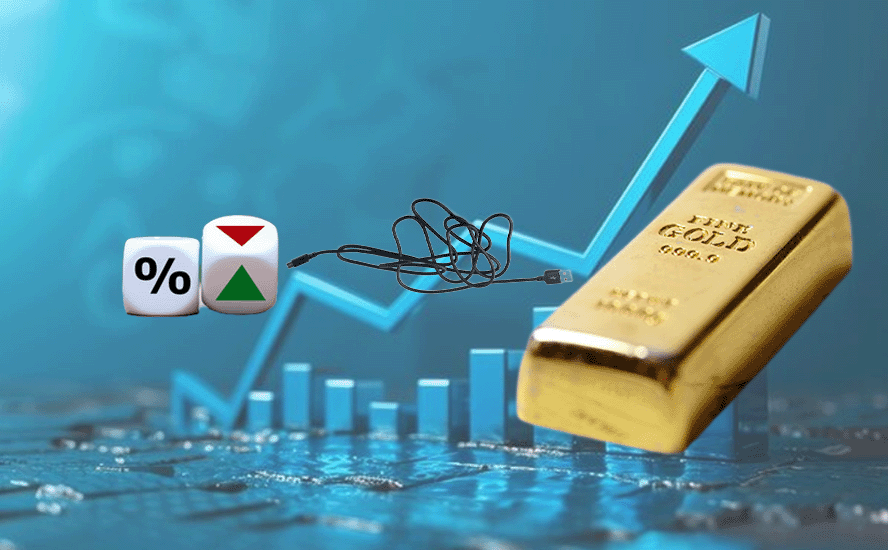
The hottest economic topics globally are the Iran conflict’s impact on oil prices and inflation, central bank interest rate decisions (including U.S. Federal Reserve policy meetings), and shifting global growth and trade forecasts.
Each of these macroeconomic drivers acts as a distinct lever on the gold market. While gold traditionally acts as a historical safe haven, the net effect on gold prices depends on whether geopolitical anxiety overrides the drag from higher interest rates and a strong U.S. dollar.
Oil Price Shocks & Inflation
Tensions and conflict involving Iran, Israel, and the U.S. have driven energy supply shocks, pressuring global inflation to stay higher for longer as polled by Reuters.
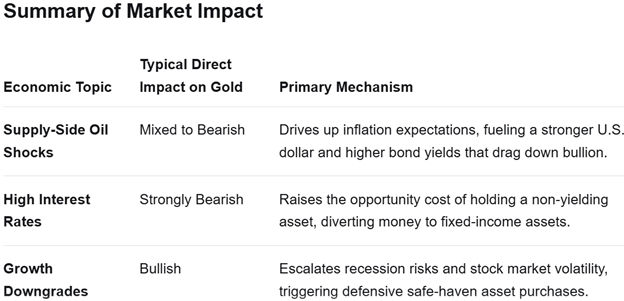
Supply-driven oil spikes have a dual, conflicting effect on gold.
Because crude oil is priced in U.S. dollars, a supply shock forces countries to scramble for dollar liquidity. This triggers a strong U.S. dollar and pushes Treasury yields higher, which directly pressures non-yielding gold.
On a short-term basis, severe geopolitical disruptions (like the choking of the Strait of Hormuz) prompt immediate safe-haven inflows into gold from investors seeking insulation from sudden global instability.
Central Bank Policy
Central banks, highlighted by the U.S. Federal Reserve under Chair Warsh, are actively navigating interest rate trajectories amid persistent cost-of-living frustrations and sticky price pressures as covered by PBS NewsHour.
Monetary policy is generally the most aggressive, direct catalyst for gold pricing.
Gold pays no yield or dividends. When central banks keep interest rates elevated or shift to a hawkish stance to fight sticky inflation, fixed-income assets (like government bonds) become much more attractive.
With the Federal Reserve holding interest rates higher for longer to combat energy-driven cost pressures, the rising opportunity cost acts as a persistent headwind, capping gold’s upward rallies.
Growth Revisions
International bodies and forecasters, including the IMF and Oxford Economics, continue to adjust worldwide GDP growth projections while monitoring geopolitical risks and trade policy shifts.
Downgrades or upgrades to worldwide economic growth dictate investor sentiment and risk appetite.
If international growth forecasts are slashed due to structural shocks, equities face pressure, and capital flows toward safety. If inflation remains high while growth slows (stagflation), gold benefits significantly as a capital preservation tool.
Conversely, if global growth projections are revised upward, investors rotate out of defensive safety nets and reallocate capital toward higher-risk, growth-oriented assets like stocks.
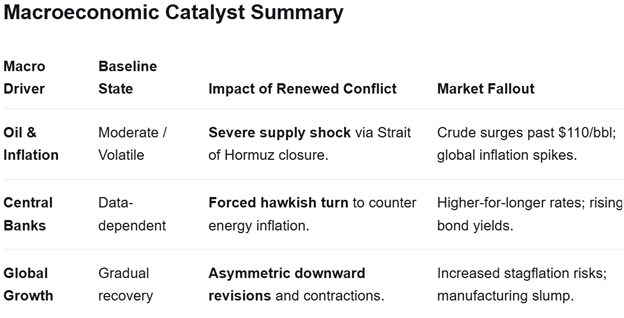
An escalation of military strikes involving the U.S., Israel, and Iran immediately disrupts the global economy by targeting critical energy infrastructure and maritime chokepoints. Data from the initial phase of the 2026 Iran conflict demonstrates that a resurgence of active warfare triggers a chain reaction across all three major macroeconomic drivers.
Renewed bombing directly threatens the Strait of Hormuz, a vital maritime chokepoint handling roughly 20% of the world’s petroleum and liquefied natural gas (LNG).
Past escalations caused Brent crude to jump over 57% within a single month, skyrocketing from $71 to more than $111 per barrel as a hefty “war premium” is priced into every shipment.
The resulting surge in energy, freight, and insurance costs flows directly into consumer prices. Analyses indicate that energy shocks from this conflict can instantly drive U.S. inflation up by a full percentage point or more, pushing headline inflation past 4%.
The surge in energy-driven inflation leaves central banks with very little room to maneuver, forcing a defensive policy posture.
Even if the underlying economy shows signs of weakness, central banks like the U.S. Federal Reserve are forced to prioritize fighting unanchored inflation expectations.
To prevent the oil shock from spilling into core prices, central banks are compelled to increase interest rates or delay planned cuts. This pushes up sovereign bond yields, raises debt-servicing burdens globally, and tightens credit access for businesses and consumers alike.
Higher input costs combined with elevated interest rates severely damage global productivity, forcing institutions like the IMF to slash global GDP growth projections.
The combination of stalling growth and spiking inflation creates a textbook stagflationary environment. While net energy exporters like Canada or Norway can sometimes see short-term trade benefits, major energy-importing regions, especially Europe, Japan, and South Korea, face sharp economic contractions.
Fragile developing countries face intense pressure. The double-whammy of high fuel import costs and rising global bond yields increases the risk of sovereign debt defaults, often requiring emergency intervention from international lenders
Gold
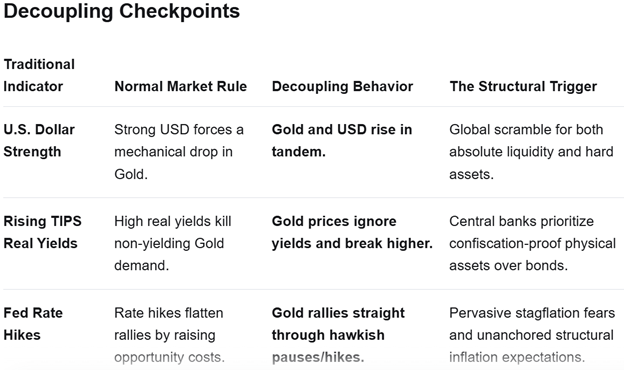
Gold historically decouples from traditional macro pressures and enters an independent bull market when systemic lack of trust and structural regime shifts override basic opportunity-cost mathematics.
While standard financial textbooks state that high interest rates and a strong dollar should fundamentally suppress a non-yielding asset, gold has broken this paradigm multiple times—most notably during the massive rally through late 2024 and early 2025, when it surged above $5,500.
The ultimate catalyst for a true decoupling is the loss of trust in Western financial infrastructure.
When the U.S. and its allies freeze or seize G7 fiat reserves (as seen with Russia), non-aligned central banks change their risk definitions.
Central banks across Asia and the Middle East aggressively pivot from purchasing U.S. Treasuries to accumulating physical gold. This structural institutional buying happens regardless of Fed fund rates, effectively placing an unbreakable floor beneath global gold demand.
When real yields push higher not because the economy is booming, but because a government is running unsustainable deficits, gold decouples.
If the market begins pricing in risk or credibility downgrades for the world’s major economies, government bonds stop acting as a risk-free safe haven.
Investors realize that high nominal yields are simply a reflection of fiscal distress. Gold then begins to rally alongside the U.S. dollar, functioning as an insurance policy against broad monetary debasement and a broken debt cycle.
In standard downturns, geopolitical fear fades once the Fed keeps financial conditions tight. However, gold breaks free when a conflict reaches a flashpoint that directly threatens the structural supply chain of the planet.
If active warfare (like a full-scale direct conflict involving major nuclear or energy-producing powers) threatens the physical movement of global trade, the immediate necessity to hedge against kinetic risk completely overpowers the interest rate environment.
Investors stop caring about earning 5% in a bank account when they are terrified about the fundamental preservation of absolute capital.
Conclusion
Financial markets are currently in a partial decoupling state, where a temporary return to traditional trading physics is battling immense, underlying structural changes.
After an unprecedented structural rally that peaked earlier in the year, gold has entered a cooling-off period—demonstrating that while the decoupling forces are incredibly close to the surface, the U.S. Federal Reserve and a strong dollar still possess the mathematical gravity to pull gold back down.
Right now, the market is experiencing a correction that proves traditional economic drivers are not dead.
Ahead of the central bank’s policy meeting, spot gold has retreated to the $4,045 per ounce range.
Investors are bracing for a potential interest rate hold at 3.75%–4.00%, but the true headwind is that traders are pricing in an 85% probability of another rate hike in December.
Combined with a bond market selloff and high real interest rates, a slightly firmer U.S. dollar index (holding around 102.42) continues to mechanically exert downward pressure on bullion.
Despite a 25% correction from its all-time peak, gold is consolidating at historically high levels—above $4,000 and $4,500 depending on the instrument—proving that the structural floor has permanently shifted.
Central banks are actively keeping the decoupling alive. They accumulated a staggering 244b tonnes in Q1 alone, explicitly prioritizing physical gold as core collateral over U.S. Treasuries.
Historically, tight financial conditions and high geopolitical risks moved in opposite directions. However, financial institutions like the Bank for International Settlements (BIS) note a rare decoupling trend where gold responds purely to systemic, non-aligned reserve accumulation rather than Western interest rate changes
We are one major macro-policy failure or localized supply escalation away from complete, permanent decoupling.
The current landscape is a tug-of-war. Gold’s short-term movements remain tightly bound to what the Fed says or does. Yet, because of global fiscal deficits (averaging a projected 7% of GDP) and surging interest expense, the structural faith in Western debt is paper-thin. If inflation pressures force the Fed into a hawkish corner while global growth collapses, the market will transition from a cyclical correction back into a full-scale, structural flight to hard assets.

Legal Notice / Disclaimer
Ahead of the Herd newsletter, aheadoftheherd.com, hereafter known as AOTH.Please read the entire Disclaimer carefully before you use this website or read the newsletter. If you do not agree to all the AOTH/Richard Mills Disclaimer, do not access/read this website/newsletter/article, or any of its pages. By reading/using this AOTH/Richard Mills website/newsletter/article, and whether you actually read this Disclaimer, you are deemed to have accepted it.