 RSS Subscribe
White Gold receives first assays from 2026 drill program; extends high-grade core at Golden Saddle deposit and extends high-grade mineralization at VG deposit – Richard Mills

Initial results from the first diamond drill program at White Gold’s TSXV:WGO, OTCQX:WHGOF, FRA:29W) project of the same name in the Yukon Territory have intersected high-grade gold mineralization in multiple lenses on both the Golden Saddle and VG deposits and successfully validate the company’s belief that these deposits remain open for continued growth that will further enhance its recently published robust Preliminary Economic Assessment (PEA).
White Gold Project’s PEA highlights 41% IRR with 1.5-year payback — Richard Mills
Drilling expanded the high-grade core at Golden Saddle by intersecting 5.13 g/t gold over 7.9m within a longer 38.1-m intersection reporting 1.47 g/t gold. The drill also significantly extended the VG deposit’s high-grade mineralization by 90m to 320m down plunge across 150m of strike length intersecting 2.53 g/t gold over 18.9m.
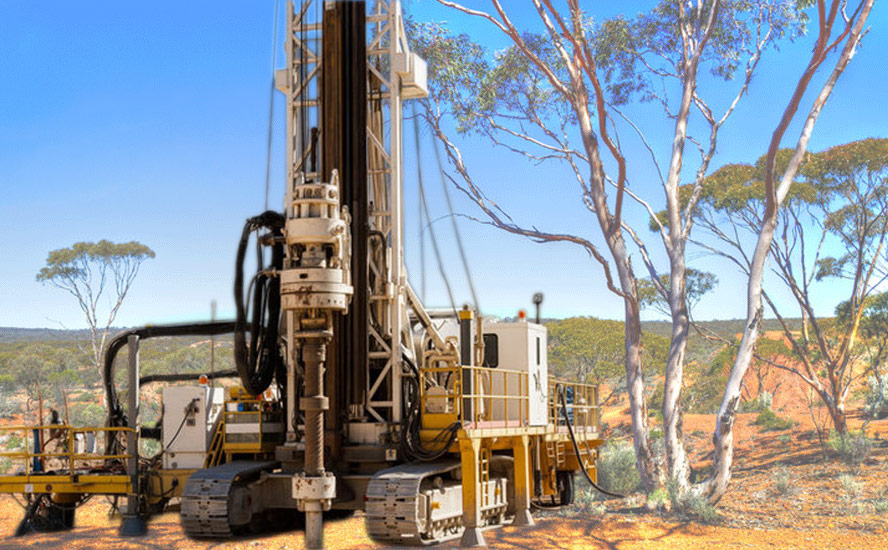
The White Gold Project is located within the White District, Yukon. The 2026 diamond drill program supported by strategic partners including Agnico Eagle Mines is the company’s largest ever on its flagship deposits, and equivalent to approximately 20% of the roughly 92,000 meters drilled across Golden Saddle, Arc, VG and Ryan’s Surprise deposits prior to 2026.
This news release reports the first set of diamond drillhole results from the Golden Saddle and VG deposits. Assays are pending from an additional 49 holes which were designed to increase known resources and make new discoveries on the White Gold Project.
Highlights:
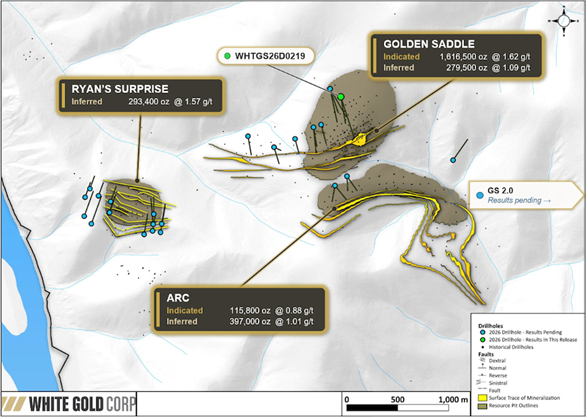
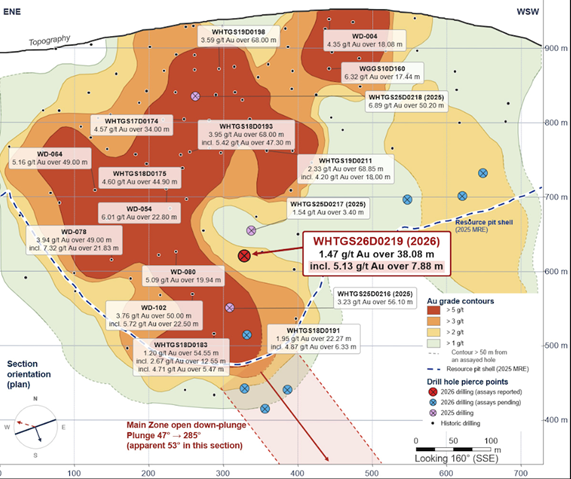
- Golden Saddle High-Grade Core Expanded ~50m: Hole WHTGS26D0219 intersected 1.47 g/t Au over 38.08m from 397.12m, including 5.13 g/t Au over 7.88m, extending the high-grade core of the main zone approximately 50m to the west, at a vertical depth of 300m – well within the resource pit shell (Figure 4). This hole also builds on the success of WHTGS25D0216 drilled in 2025 which also successfully expanded high-grade gold mineralization, returning 3.23 g/t Au over 56.10m at a vertical depth of 350m and was not included in the current resource or PEA.
- Golden Saddle Additional Zones: The same hole WHTGS26D0219 also returned 1.16 g/t Au over 12.60m in the shallow hanging wall mineralization from 140.5m, and 4.05 g/t Au over 1.97m in the footwall, expanding and highlighting the continued potential for stacked zones above and below the main zone.
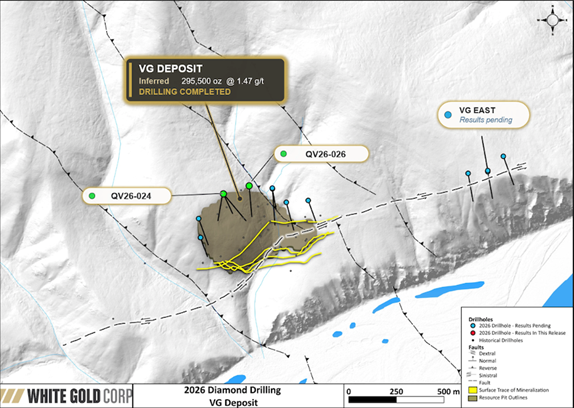
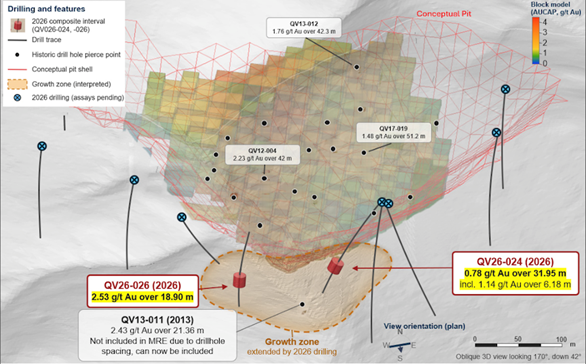
- VG Mineralization Extended from 230m to 320m Down-Plunge: Hole QV26-026 intersected 2.53 g/t Au over 18.90m from 172.1m, and hole QV26-024 intersected 0.71 g/t Au over 38.45m, including 1.14 g/t Au over 6.18m. Together these holes extend drilled mineralization at VG well beyond the previous deepest intercept in QV13-010 and beyond the limits of the current mineral resource estimate, over a strike length of approximately 150m (Figure 3).
- VG Historical High-grade Intercept Now Connected to Resource: The 2026 holes importantly also bridge an approximately 120m gap to historical hole QV13-011 which returned 2.43 g/t Au over 21.36m, including 3.40 g/t Au over 12.54m, establishing continuity of mineralization at VG to approximately 350m down-plunge, which remains open.
- Outlook: All four deposits of the White Gold Project remain open in multiple directions. Results from these holes will be incorporated into future mineral resource updates.
“Further to the very strong PEA recently released, these initial results are another major accomplishment in our goal of making 2026 a transformative year for White Gold Corp. Successfully intersecting high grade gold in multiple areas validates our conviction that the White Gold Project has the potential to continue to grow substantially and that we are in the early days of demonstrating the abundant mineralization at the White Gold Project and across our truly district-scale land package in the prolific White Gold District. With these early results and our observations on the additional holes drilled in 2026, we are very optimistic about the potential for meaningful additional growth and look forward to all the additional results from this significantly larger program,” White Gold’s CEO David D’Onofrio stated in the Oct. 20 news release.
“These results continue to show the significant growth potential of our flagship White Gold Project,” stated Donovan Politt, President and Director. “At Golden Saddle, hole 219 has expanded the high-grade core of the Main Zone by about 50 metres, which supports our view that this is one of the highest-grade undeveloped open-pittable gold deposits in Canada. At VG, the 2026 holes to date have already pushed mineralization well beyond the footprint of its current resource while also intersecting grades higher than many historical holes at similar elevations, with more holes to come. Just as importantly, they also bridge the gap to the high-grade intercept in QV13-011, which takes drilled mineralization at VG to about 350 meters down-plunge. VG is growing, and we see it as a significant source of potential new high-grade ounces for our next resource update. With every deposit still open, and a lot more results to come, we look forward to building on this momentum as we continue to grow ounces across the project.”
“Similar to the idea behind hole 216 in 2025, hole 219 in 2026 was designed to test the western extent of the high-grade core at Golden Saddle, and it delivered both strong grade and width where the model predicted,” stated Dylan Langille, Vice President of Exploration. “This positive result further validates the technical team’s interpretations of structures and controls on high-grade ore shoots and overall mineralization. At VG, holes QV26-024 and QV26-026 confirm that mineralization continues further down-plunge and bridge a gap of approximately 120 meters to the historical QV13-011 intercept which is not in the current resource.”
White Gold Project
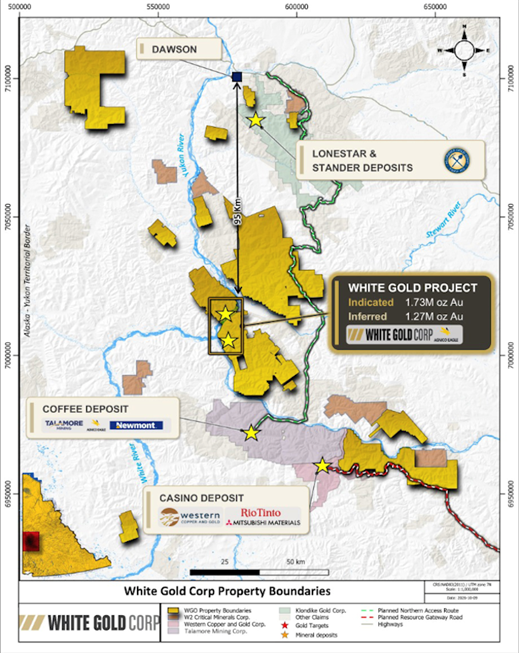
The White Gold project hosts four near-surface gold deposits, which collectively contain an estimated 1,732,300 gold ounces in the indicated category (35.2 million tonnes grading 1.53 grams per tonne gold) and 1,265,900 ounces of gold inferred (32.2 million tonnes grading 1.22 g/t Au). based on open pit and underground resource estimates.
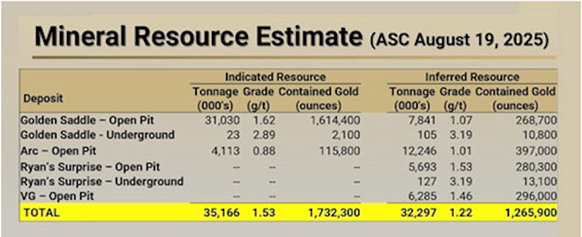
The four deposits are Golden Saddle, Arc, Ryan’s Surprise and VG. All four are interpreted to represent structurally controlled orogenic gold systems.
The 2026 drill program was designed to drill each of these deposits and new targets in close proximity to demonstrate the continued growth potential.
White Gold Corp is the largest landholder in the Klondike Gold District of Canada’s Yukon Territory, with a portfolio of 15,364 quartz claims across 21 properties, covering approximately 30,000 hectares or 3,000 square kilometers.
This represents about 40% of the Yukon’s White Gold District, which first came to the attention of resource investors during the White Gold area play of 2010, and is emerging as one of the most important new gold camps in Canada.
The Toronto-based company was co-founded by acclaimed prospector Shawn Ryan, whose unique soil sampling technique earned him several awards, including the 1998 Yukon Chamber of Mines Prospector of the Year, and the 2011 PDAC Prospector of the Year.
Golden Saddle deposit drill results
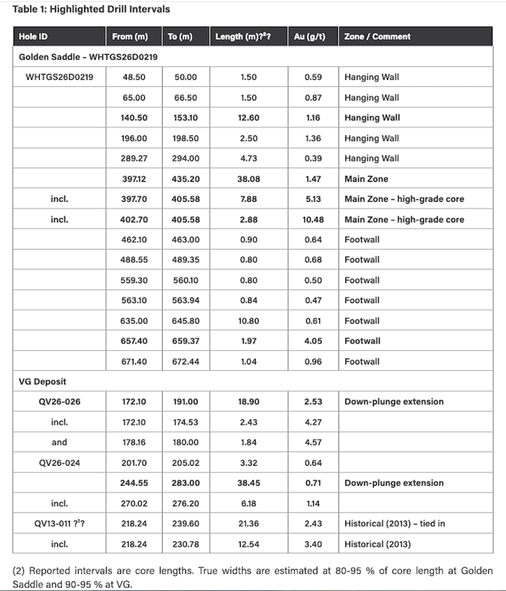
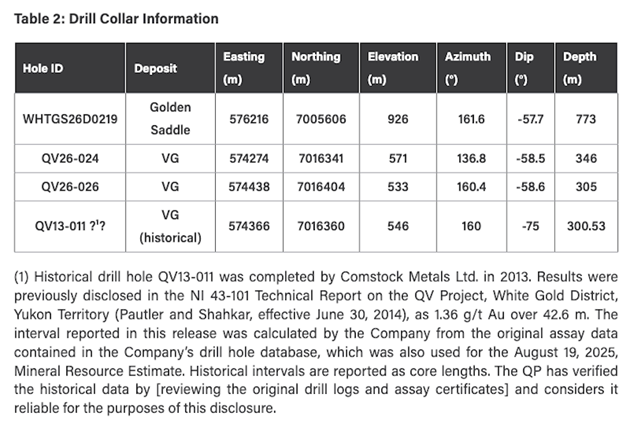
Hole WHTGS26D0219 was drilled at an azimuth of 161.6° and a dip of -57.7° to a final depth of 777.3m to test the western extension of the high-grade core of the Golden Saddle Main Zone. The hole intersected 1.47 g/t Au over 38.08m from 397.12m depth, including 5.13 g/t Au over 7.88m, with a higher-grade core of 10.48 g/t Au over 2.88m (Figure 4). The intercept extends the high-grade (greater than 5 g/t Au) core of the Main Zone approximately 50m to the west and is expected to extend and upgrade the surrounding blocks within the current mineral resource model. The main zone intercept is hosted in intensely sericite-silica altered and brecciated felsic orthogneiss with gold hosted in quartz-pyrite veins (Figure 6). The high-grade core coincides with the most strongly veined portion of the zone, comprising the strongest pyrite mineralization disseminations, along fractures, and on vein margins.
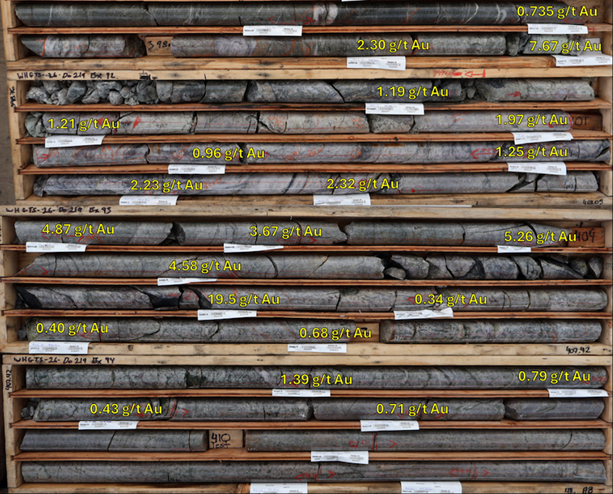
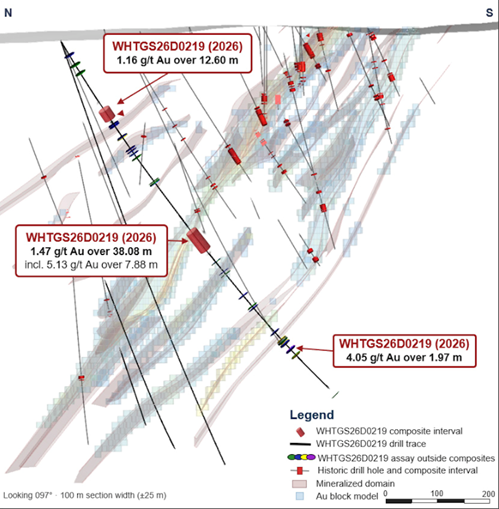
Above the Main Zone, hole WHTGS26D0219 intersected several hanging wall zones, including 1.16 g/t Au over 12.60m from 140.50m and 1.36 g/t Au over 2.50m from 196.00m. The hanging wall zones occur within hematite and sericite altered biotite-feldspar-quartz gneiss cut by pyrite-bearing quartz veins. Below the Main Zone, the hole intersected two footwall intervals: 0.61 g/t Au over 10.80m from 635.00m and 4.05 g/t Au over 1.97m from 657.40m. The 4.05 g/t Au interval corresponds to the footwall breccia, an intensely silicified, dark grey to black, clast-supported breccia hosted in a strongly sericite-carbonate altered, quartz-rich felsic unit with graphite-filled fractures (Figure 5). All intervals are shown in Table 1.
VG deposit drill results
The 2026 drilling at VG was designed to test the down-plunge continuity of the deposit beyond the limits of the current mineral resource estimate (Figure 7). Prior to this program, the deepest intercept within the VG deposit block model was in hole QV13-010, approximately 230m down-plunge from surface. Historical hole QV13-011 intersected 2.43 g/t Au over 21.36m, including 3.40 g/t Au over 12.54m, approximately 350m down-plunge. However, an approximately 120m gap in the drilling left QV13-011 isolated from the modeled mineralization and as such it was excluded in the resource.
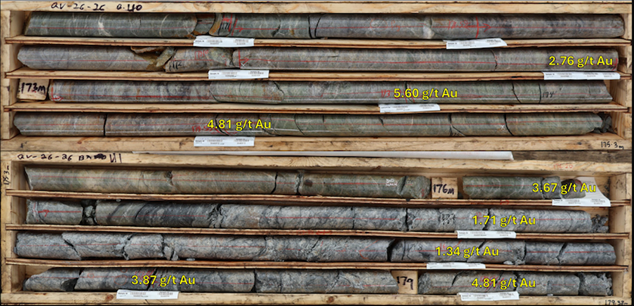
The 2026 holes were designed to test this gap and successfully intersected broad zones of gold mineralization well beyond the 230m limit. QV26-026 intersected 2.53 g/t Au over 18.90m from 172.10m, including 4.27 g/t Au over 2.43m and 4.57 g/t Au over 1.84m, approximately 320m down-plunge. This interval is higher grade than many historical holes at a similar elevation, demonstrating the continuation of strong grades at depth. It also extends the mineralization approximately 45m east of the current block model. QV26-024, collared about 175m to the west, intersected an upper interval of 0.64 g/t Au over 3.32m from 201.70m, followed by 0.71 g/t Au over 38.45m from 244.55m, including 1.14 g/t Au over 6.18m, approximately 300m down-plunge. Together, the two holes extend continuous mineralization at VG from approximately 230m to 320m down-plunge over a strike length of approximately 150m.
In hole QV26-026, mineralization is hosted in strongly sericite-chlorite-silica altered biotite-feldspar-quartz gneiss cut by abundant quartz carbonate veins and veinlets, with 1-5% disseminated pyrite throughout the interval (Figure 8). Both higher grade sub-intervals are associated with increased albite alteration.
With the gap now drilled, QV13-011 can be tied into the VG geological model, establishing continuity of mineralization from approximately 230m to 350m down-plunge. Based on the search parameters used in the current mineral resource estimate, this has the potential to extend the VG resource from approximately 310m to 430m down-plunge, subject to an updated mineral resource estimate. VG remains open down-plunge. The growth zone shown in Figure 7 is interpretive and will be tested by future drilling and incorporated into future mineral resource updates.
White Gold Corp.
TSXV:WGO, OTCQX:WHGOF, FRA:29W
2026.10.20 Share Price: Cdn$1.56
Shares Outstanding: 226m
Market Cap: Cdn$351.8m
WGO website
Richard Mills
aheadoftheherd.com

Subscribe to AOTH’s free newsletter
Richard does not own shares of White Gold TSXV:WGO. WGO is a paid advertiser on his site aheadoftheherd.com
This article is issued on behalf of WGO
Legal Notice / Disclaimer
Ahead of the Herd newsletter, aheadoftheherd.com, hereafter known as AOTH.Please read the entire Disclaimer carefully before you use this website or read the newsletter. If you do not agree to all the AOTH/Richard Mills Disclaimer, do not access/read this website/newsletter/article, or any of its pages. By reading/using this AOTH/Richard Mills website/newsletter/article, and whether you actually read this Disclaimer, you are deemed to have accepted it.