 RSS Subscribe
Precious metals market currently a battleground – AOTH
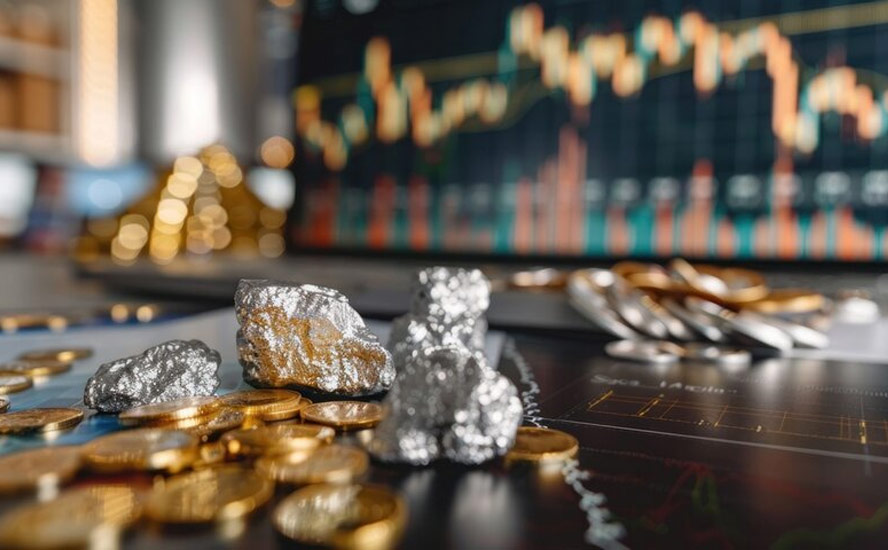
Current conditions that favor gold and silver buying include high global fiscal deficits, sticky inflation/hot CPI and PPI prints, persistent debt sustainability concerns, and structural demand from central banks and ETF investors, even as short-term price action faces pressure from elevated Treasury yields and a strong U.S. dollar.
The precious metals market is currently a battleground between bullish secular fundamentals (surging national debts, sticky inflation, and steady institutional buying) and bearish short-term cyclical headwinds (elevated real yields and a strong dollar).
Deficits
Global fiscal deficits are under severe pressure, driven by historically high public debt, escalating defense spending, and a global surge in government borrowing costs. Data from the International Monetary Fund (IMF) Annual Report reveals that the average global fiscal deficit hovers around 5.1% of GDP.
The global fiscal landscape faces compounding challenges: major economies have failed to rein in pandemic-era spending, while a structural “bond glut” has pushed sovereign borrowing yields to multi-decade highs. Consequently, global public debt has surpassed $100 trillion and is on track to hit 100% of global GDP by 2029.
Data prints
The recent September 2026 CPI and PPI data prints delivered a dual blow to the market, confirming that inflation remains stubborn and highly sticky. A massive surge in wholesale energy costs combined with persistent service-sector momentum has essentially stalled the Federal Reserve’s progress toward its 2% target, forcing Wall Street to aggressively price in higher-for-longer interest rate risks.
Headline CPI printed hot at +0.65% month-over-month (+3.7% year-over-year). Core CPI (excluding food and energy) rose +0.34% m/m (+2.6% y/y).
Headline wholesale inflation exploded by +1.3% month-over-month, more than double the forecast of +0.6%. This sent the year-over-year wholesale print screaming up to +6.3%.
The Atlanta Fed’s Sticky-Price CPI, which tracks slow-to-change items like housing, medical care, and education—grew at an annualized rate of 3.5% in September. This confirms that structural price pressures are entrenching themselves deeper into the economy.
The global September 2026 inflation data prints reveal an increasingly bifurcated and uneven macroeconomic landscape, with severe regional disparities. While the United States is grappling with an aggressive flare-up in wholesale and consumer prices driven by strong domestic services, other major economies are experiencing a different reality, ranging from commodity-driven factory pressures with weak consumer demand to a broader global acceleration caused by energy supply shocks.
Debt
Persistent debt sustainability concerns arise when a borrower, most critically a sovereign nation, consistently struggles to maintain its debt obligations without requiring a major fiscal correction or defaulting. This structural economic risk undermines investor confidence, devalues currency, and suppresses long-term economic growth.
When a government’s debt grows faster than its gross domestic product (GDP), the interest payments begin to consume an unsustainable portion of national revenues.
When global central banks tighten monetary policy, borrowing costs rise globally. If a nation’s economic growth slows simultaneously, debt dynamics instantly turn toxic. Capital flight forces bond yields up, dramatically increasing the cost of refinancing old debt and triggering rapid devaluation, escalating the local cost of foreign-denominated debt.
Skyrocketing debt-servicing costs directly crowd out public spending on health, education, and infrastructure. Domestic banks heavily exposed to government bonds suffer balance sheet damage, freezing private lending.
Gold demand
Structural gold demand from central banks and ETF investors has become the foundational dual-pillar framework supporting the long-term gold market. While speculative futures trading and macro headwinds like a strong U.S. dollar or elevated interest rates cause short-term price volatility, the consistent physical absorption of supply by central banks and institutional/retail ETF investors forms a durable price floor.
Together, these two pillars represent distinct but complementary market forces: central banks accumulate bullion for long-term strategic reserve management, while ETF investors utilize gold as an easily accessible, liquid vehicle for macroeconomic portfolio diversification.
Central bank accumulation is widely regarded by institutions like Goldman Sachs and the World Gold Council (WGC) as the long-term structural bull case for gold. Rather than trading on near-term monetary policy, official institutions buy gold as a foundational reserve asset.
Following the 2022 freeze on Russia’s foreign currency reserves, central banks initiated a historic “Plan B” to diversify away from traditional fiat systems, mitigating the risk of asset freezing.
In contrast to central banks’ slower, decade-long structural allocations, gold-backed Exchange-Traded Funds (ETFs) represent dynamic investment capital. However, they have evolved into a major structural mechanism, offering a highly liquid, transparent alternative to holding physical bars and coins.
Despite short-term price corrections forced by hawkish Fed policy, physically-backed gold ETFs attracted a record $31 billion in inflows in Q3 2026.
Regional momentum has expanded beyond North America. The United Kingdom recorded its strongest quarter on record for gold ETF accumulation in Q3 2026, alongside heavy passive fund inflows in Asia (led by China and India).
Yields and the Dollar
Elevated Treasury yields and a strong U.S. dollar are currently reshaping global financial markets, with the 10-year U.S. Treasury yield hovering near multi-year highs at 5.11% and the U.S. Dollar Index (DXY) trading firmly around 101.79. This dual macroeconomic force is driven by resilient U.S. economic growth, persistent inflation concerns, aggressive Federal Reserve policy guidance, and massive capital demands stemming from artificial intelligence investments. Together, they create a challenging environment for global borrowing, corporate valuations, and alternative assets.
Gold and silver prices drop during periods of elevated Treasury yields and a strong U.S. dollar primarily because they are non-yielding assets priced globally in greenbacks. When government bond yields rise, investors shift their capital out of precious metals to capture guaranteed interest income. Concurrently, a stronger dollar makes these metals more expensive for foreign buyers, reducing international physical demand.
Conclusion
Instead of a temporary spike, higher borrowing costs have solidified into the dominant macroeconomic framework, fundamentally changing capital allocation, sovereign debt management, and investment strategies.
This “higher-for-longer” macroeconomic regime will only break when specific global financial circuit breakers trigger a reversal in capital flows. Market data indicates that a combination of a structural U.S. economic slowdown, systemic debt stress, or an aggressive pivot to Federal Reserve rate cuts will serve as the primary catalysts to halt the strong dollar and revive precious metals.

Legal Notice / Disclaimer
Ahead of the Herd newsletter, aheadoftheherd.com, hereafter known as AOTH.Please read the entire Disclaimer carefully before you use this website or read the newsletter. If you do not agree to all the AOTH/Richard Mills Disclaimer, do not access/read this website/newsletter/article, or any of its pages. By reading/using this AOTH/Richard Mills website/newsletter/article, and whether you actually read this Disclaimer, you are deemed to have accepted it.