 RSS Subscribe
Gold interest rate trade dead, long live the debasement trade – AOTH

2026.09.18
The traditional inverse relationship between gold and real interest rates has fundamentally decoupled. Historically, higher interest rates meant higher bond yields, raising the opportunity cost of holding non-yielding gold and causing its price to drop.
Recent market dynamics have broken this playbook.
Gold has successfully transitioned into what macro analysts call the “debasement trade” and is acting as a structural sovereign safety net, shrugging off aggressive central bank interest rate hikes.
The breakdown of the traditional interest rate trade is driven by a few critical factors:
The sovereign debt & fiscal deficit crisis
Global investors are increasingly looking past interest rates and focusing heavily on ballooning sovereign debt and fiscal deficits. With government debt at historic highs, there is a growing concern about long-term currency debasement. Investors are buying gold not as an interest-rate play, but as systemic insurance against fiat currency devaluation.
Aggressive central bank accumulation
Global central banks have become some of the largest net buyers of gold, aggressively shifting their reserve assets. Following the weaponization and freezing of dollar-denominated reserves in recent geopolitical conflicts, foreign central banks are intentionally diversifying away from U.S. Treasuries and into physical gold to de-risk their portfolios.
This massive, non-commercial demand creates a permanent price floor that functions completely independently of Federal Reserve rate decisions.
Escalating geopolitical volatility
With ongoing conflicts and trade friction worldwide, gold’s role as a geopolitical safe haven has dramatically overshadowed its role as a macro monetary asset.
Meaning when geopolitical risks spike, capital flows into gold for pure wealth preservation, rendering the interest-rate environment a secondary concern.
Macro impact summary
| Metric | Historical Playbook | Current Market Reality |
| Rising Interest Rates | Gold prices fall as bond yields rise | Gold prices remain resilient or rise alongside yields |
| Primary Driver | Real yield movements and opportunity cost | Global debt fears, central bank buying, and safe-haven demand |
| Asset Identity | Speculative macro asset & inflation hedge | Sovereign risk insurance and a core reserve asset |
Debasement trade
The debasement trade is an investment strategy centered on buying hard assets to protect wealth from the structural decline in the purchasing power of fiat currencies.
When investors run with a debasement playbook, they are wagering that governments will expand the money supply and run massive fiscal deficits faster than the economy can grow. This floods the financial system with currency, making every individual dollar, euro, or yen worth less over time.
To understand the trade, it helps to understand why debasement happens in the modern financial system:
- Governments accumulate immense sovereign debt. To service the interest on this debt without drastically hiking taxes or cutting spending, they rely on central banks to keep liquidity high and effectively monetize the debt.
- If your cash or government bonds yield 4%, but the structural inflation and money supply expansion are running at 6%, your real purchasing power is compounding downward.
- When market participants realize that major global powers have no viable path to balance their budgets, they lose faith in the long-term stability of government paper and cash.
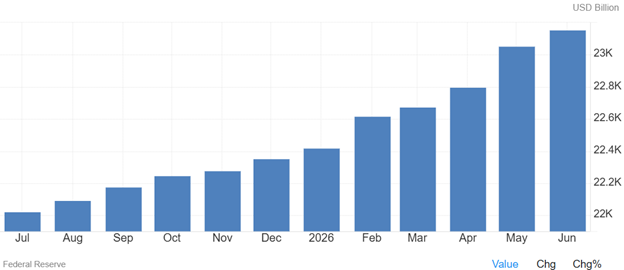
In the United States, core structural inflation is currently running at 2.4% as of August 2026, while the M2 money supply growth rate has expanded to 5.6% year-over-year.
Current economic indicators breakdown
| Indicator | Current Rate (Year-over-Year) | Context / Details |
| Core Inflation (Structural) | 2.4% (August 2026) | Excludes volatile food and energy costs. It has normalized down to its lowest level since March 2021. |
| Headline CPI Inflation | 3.4% (August 2026) | Includes all consumer items. Driven upward by a 16.3% surge in energy indexes over the past year. |
| M2 Money Supply Expansion | 5.6% (Mid-2026) | Reflects a multi-year high in annual growth after hitting negative territory during the Fed’s aggressive tightening cycles. |
Underlying dynamics
Despite a general downward trend in underlying core structural components, structural stickiness remains due to lingering tariff effects and persistent domestic shelter costs (~3.0% YoY).
The recovery in money supply growth (rebounding from a record low of -4.6% in 2023) indicates expanding liquidity conditions within the commercial banking system and shifts in Fed balance sheet operations.
Global structural inflation trends have shifted significantly due to major geopolitical disruptions and technological transitions. According to the July 2026 World Economic Outlook Update, the broad global disinflation trend that marked 2024 and 2025 has stalled. Global headline inflation is projected to rise to 4.7% before structural forces and cooling labor markets are anticipated to bring it down toward 3.9%
The structural macro drivers: ‘The Five Ds’
Economists track five secular, long-term structural factors that are actively replacing the “cheap era” of hyper-globalization with stickier, higher baseline inflation:
- Deglobalization & Fragmentation: Rising tariff implementations and supply chain onshoring mean companies are prioritizing geopolitical resilience over absolute lowest costs.
- Decarbonization (Greenflation): The capital expenditure needed to transition global energy grids to renewables, alongside rising carbon pricing, creates direct structural costs.
- Demographics: Aging working populations in advanced Western economies and China are shrinking labor pools, exerting structural upward pressure on wages despite a softer near-term job market.
- Digitalization & Artificial Intelligence: While AI infrastructure may eventually deliver immense disinflationary productivity gains, its near-term reality is highly inflationary. It has driven massive, non-deflating capital expenditures into energy grids, tech sectors, and hardware investments.
- Debt: Massively expanded public debt loads across the G20 mean governments face higher fiscal financing costs, structurally underpinning higher long-term bond yields.
The combination of re-accelerating money supply growth (5.6% M2 expansion) and sticky structural inflation creates a classic macro thesis for a currency debasement trade.
When central banks allow the supply of money to expand faster than real economic growth, the purchasing power of that fiat currency decreases.
Investors globally use the debasement trade to shelter their capital by moving out of cash and fixed-income assets and into hard, scarce, or productive assets.
Debasement trade playbook
Historically, a debasement environment favors assets with programmatic scarcity or tangible physical utility. Investors typically allocate across four distinct categories.
Hard assets & store-of-value commodities
Gold: The historic anchor of the debasement trade. It carries no counterparty risk, cannot be arbitrarily printed by central banks, and thrives when real interest rates (nominal rates minus inflation) are low or negative.
Silver & Platinum: Grouped with precious metals but benefit from a dual demand shock—acting as a monetary hedge while seeing heavy structural demand from green transition infrastructure (solar panels and electric grids).
Digital scarcity & alternative monies
Bitcoin: Often referred to as “digital gold,” Bitcoin has integrated into institutional portfolios as an algorithmic debasement hedge. Its strictly capped supply of 21 million coins positions it as a direct alternative to expanding fiat liquidity.
High-quality equities with pricing power
Monopoly or Oligopoly Businesses: Companies with massive competitive moats (e.g., tier-1 technology infrastructure, essential consumer staples) can pass rising structural costs directly onto the consumer. Their earnings adapt to inflation, preserving real shareholder value.
Commodity Producers: Energy, mining, and agricultural corporations that own the underlying physical resources being debased.
Hard real estate & infrastructure
Physical Assets: Income-generating real estate or private infrastructure assets. These provide dual protection: the physical asset revalues higher with nominal inflation, while rental yields can be adjusted upward over time.
Why gold claims the crown
Gold has emerged as the ultimate debasement hedge and is the highest-performing asset of the current modern debasement trade.
In a geopolitically fragmented world, central banks have aggressively bought gold to diversify away from the U.S. dollar.
Gold acts as a tactical hedge against short-term consumer price shocks (inflation) and an ultimate macro defense against the compounding expansion of the M2 money supply over decades (debasement).
The Federal Reserve’s shift to raising interest rates and tightening monetary policy will create a short-term cyclical headwind for the debasement trade, but it is highly unlikely to break the long-term structural thesis.
The Fed recently raised its benchmark interest rate by 25 basis points to a target range of 3.75%–4.00%—its first increase since 2023—driven by stubbornly high inflation, oil supply shocks, and a hawkish stance from Chair Kevin Warsh.
While macro textbook rules say tightening should crush gold, the real-world impact boils down to a battle between short-term liquidity and long-term solvency.
The long-term reality: Why the structural trade survives
Despite the Fed’s aggressive hawkish turn, the debasement trade has remained incredibly resilient—Gold futures just broke back above $4,400 per ounce right after the rate hike. This is because macro investors are looking past the Fed to a broader threat, fiscal dominance.
Total U.S. federal government debt has topped $40 trillion. Every time the Fed raises rates, it forces the U.S. government to issue new debt at much higher yields to pay off old debt. The government’s interest bill is skyrocketing, which means the structural fiscal deficit expands even faster because of the Fed’s hikes.
The market knows the Fed is trapped. If it raises rates too high to kill inflation, it threatens to trigger a U.S. Treasury market crisis or a banking system collapse. To prevent that, the Treasury Department is already stepping in with bond buybacks to stabilize the system. Investors see this and realize the ultimate outcome is inevitable: the government will eventually have to print more money to keep the system solvent.
For foreign central banks, Fed tightening doesn’t change the fact that holding U.S. debt carries geopolitical risk. They continue to accumulate physical gold as an alternative sovereign reserve asset, ignoring the Fed’s interest rate path entirely.
Conclusion
The core risk of the debasement trade is unexpected fiscal austerity or aggressive monetary tightening. If governments suddenly slash deficits, balance their budgets, and central banks successfully drain liquidity from the system to backstop the currency, hard assets will rapidly deflate because the structural threat to cash disappears. However, given global debt trajectories, most macro investors view that pivot as highly unlikely.
Expect increased volatility and sharp price pullbacks in debasement assets in the near term as speculative, leveraged money gets shaken out by higher borrowing costs. However, as long as sovereign debt expands faster than economic growth, any dip caused by Fed tightening is viewed by macro managers as a buying opportunity for the structural debasement trade.
In many major economies today, sovereign debt is expanding faster than economic growth.
Why debt outpaces growth
- Persistent Deficits: Governments often spend more money than they collect in taxes, requiring them to borrow more.
- Crises and Spending: Major events like the COVID-19 pandemic and rising costs for aging populations have forced governments to increase borrowing.
- Slower Growth Correlation: Studies show that when public debt climbs higher than 75% to 80% of a country’s Gross Domestic Product (GDP), it can actually slow down future economic growth.
According to reports from the International Monetary Fund, public debt is rising faster than economic output in roughly 80% of the global economy.
Got Gold?

Legal Notice / Disclaimer
Ahead of the Herd newsletter, aheadoftheherd.com, hereafter known as AOTH.Please read the entire Disclaimer carefully before you use this website or read the newsletter. If you do not agree to all the AOTH/Richard Mills Disclaimer, do not access/read this website/newsletter/article, or any of its pages. By reading/using this AOTH/Richard Mills website/newsletter/article, and whether you actually read this Disclaimer, you are deemed to have accepted it.