 RSS Subscribe
A Debt Spiral, Breaking Point, Doom Loop and Hard Landing. Got Gold? – Richard Mills

The Federal Reserve’s September 2026 interest rate hike and subsequent hawkish commentary have fundamentally shifted market sentiment and is heavily penalizing non-yielding bullion.
Following three interest rate cuts in 2025, the Federal Open Market Committee (FOMC) unanimously voted 12–0 on September 16 to raise the benchmark federal funds rate by 25 basis points to a target range of 3.75% to 4.00%—marking the Fed’s first interest rate hike since 2023.
The official FOMC statement noted that while geopolitical developments have elevated economic uncertainty, “domestic spending has been resilient,” productivity growth is strong, and capital investment remains robust. Driven heavily by spiraling energy costs from the prolonged U.S.-Iran conflict alongside tariff implementations and the massive AI data center boom, the Fed upgraded its macroeconomic projections:
- PCE Inflation: Adjusted upward to 3.7% for 2026 (up from the 3.6% projected in June).
- GDP Growth: Lifted to 2.3% for 2026.
The September Summary of Economic Projections signaled that this policy tightening cycle is far from a one-off adjustment – 16 out of 18 FOMC participants now project at least one more rate hike before the end of 2026, aiming for a median target rate of 4.1%.
The median participant also indicated that rates would remain completely unchanged at 4.1% through all of 2027, completely eliminating any hopes for early rate cuts and cementing a restrictive “higher-for-longer” reality.
Public remarks following the decision have amplified the central bank’s tightening bias. Newly appointed Fed Chair Kevin Warsh delivered an explicitly hawkish press conference, stating that broader financial conditions are not yet restrictive enough and establishing his firm hawkish credentials.
Furthermore, Fed Governor Michael Barr stated that “further rate hikes are likely needed,” emphasizing that risks to achieving the 2% inflation target have escalated while labor market risks have faded.
Historically, gold struggles when real yields and the U.S. dollar (USD) surge simultaneously. Because gold pays no interest or dividends, its opportunity cost skyrocketing alongside nominal and real yields usually drives investors toward cash and fixed-income assets instead.
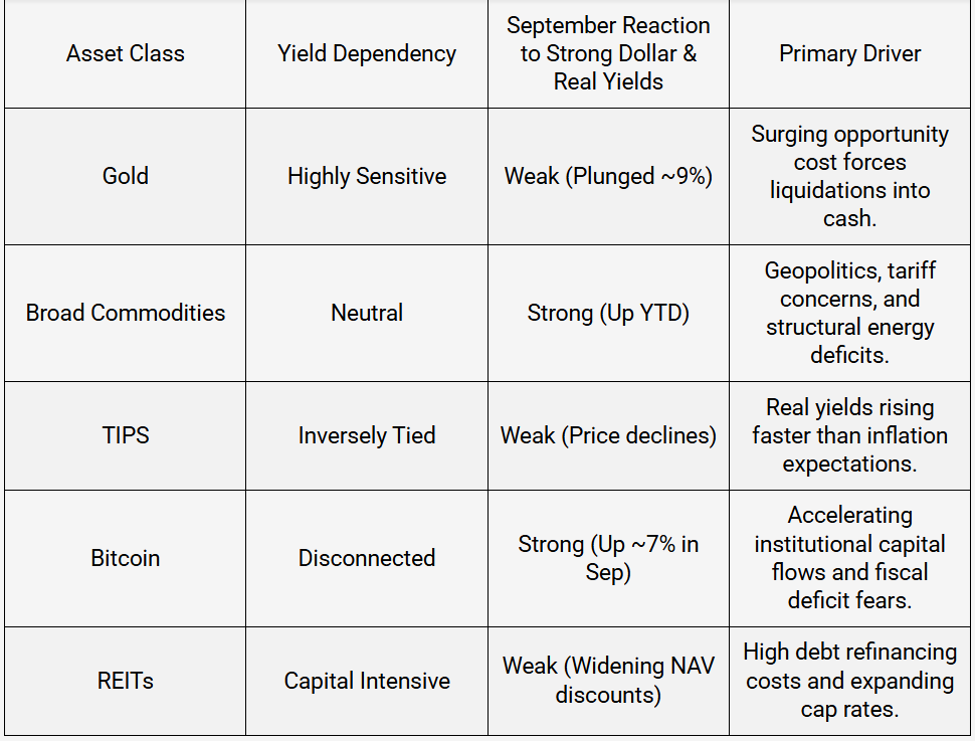
The unexpected pivot from the Federal Reserve hammered precious metals sentiment. Spot gold prices, which had comfortably traded between $4,300 and $4,400 an ounce earlier in the month, plunged roughly 9% in September, testing multi-month lows near $4,114 to $4,150 per ounce.
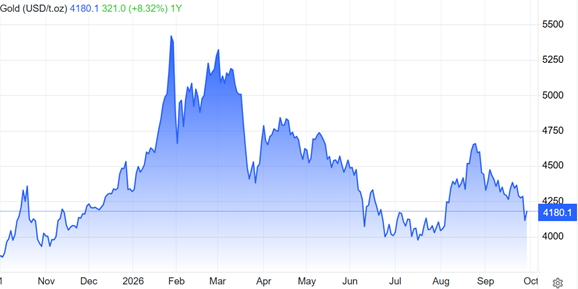
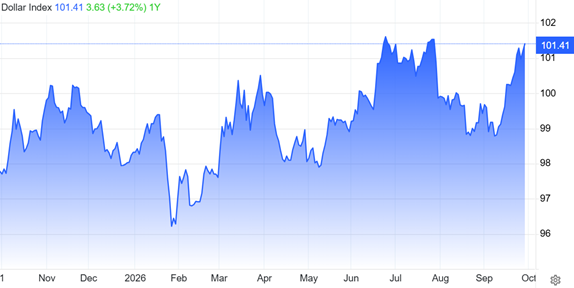
Because the 10-year Treasury yield has surged toward the 5% threshold, the opportunity cost of holding zero-yield bullion has ballooned. Concurrently, the U.S. Dollar Index (DXY) climbed to a two-month high, creating a powerful dual headwind for the precious metal.
Alternative inflation-hedge assets
The Bloomberg Commodity Index is up roughly 32% year-to-date.
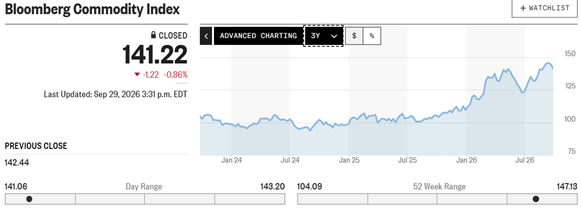
The broader commodity complex has proven highly resilient to the stronger dollar, primarily because it is being driven by the exact same supply-side shocks causing the sticky inflation in the first place.
Other alternative inflation-hedge assets are reacting to this macro pressure cooker in vastly divergent ways.
Sledgehammered
It is a brutal reality of central banking—the Federal Reserve’s primary tool to fight inflation is effectively a sledgehammer to economic growth.
By raising the benchmark rate to 3.75%–4.00%, the Fed is deliberately making borrowing more expensive to cool down demand. This tightening cycle triggers a painful domino effect across multiple layers of the economy, transforming how households spend, how businesses invest, and how the government manages its balance sheet.
Consumer
For the average household, higher rates act like an invisible, recurring tax on any debt that isn’t locked into a fixed rate.
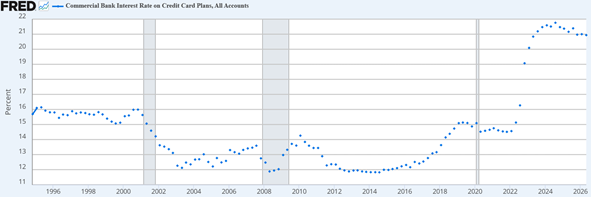
With credit card annual percentage rates (APRs) hitting historic highs, carrying a monthly balance is draining consumer disposable income faster than at any point in the last two decades.
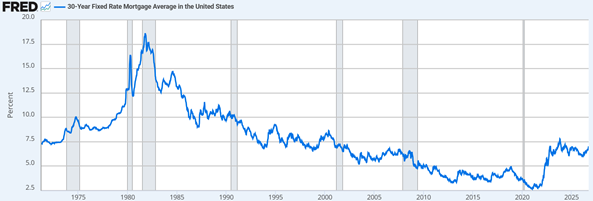
Prospective homebuyers are facing a double-whammy. Mortgage rates tracking higher yields have priced millions out of the market, while existing homeowners refuse to sell and give up their older, low-rate mortgages—completely paralyzing housing inventory.
Auto loan rates have climbed significantly, forcing consumers to take on much higher monthly payments or defer essential vehicle purchases entirely.
Business
Businesses rely heavily on cheap credit to fund day-to-day operations, expand facilities, and hire workers. Under a restrictive monetary policy, that growth engine stalls.
Many corporations that took out cheap, short-term debt during the pandemic are now hitting a refinancing wall. Reissuing that debt at today’s near-4% federal funds rate dramatically increases their interest expenses.
While large, cash-rich companies have been insulated by massive cash buffers, the broader market is experiencing a significant rise in interest expenses:
According to the OECD Global Debt Report, outstanding global corporate debt has ballooned to roughly $59.5 trillion. Companies and governments are projected to borrow a record $29 trillion from bond markets, with borrowing costs remaining at multi-decade highs.
U.S. non-financial corporate bonds face a structured maturity schedule where near-term walls have been pushed out, but a massive $4.3 trillion total maturity wall kicks off heavily starting in 2027.
Capital expenditure (Capex) budgets are the first to get slashed when the added cost starts to bite. When the cost of capital eclipses the projected return on an expansion project, companies shelf their growth plans.
As profit margins are squeezed by the much higher debt servicing costs, corporate leadership shifts from hiring mode to economic survival, leading to hiring freezes and restructuring layoffs.
Banking
The banking sector acts as the intermediary for economic liquidity, and it is highly vulnerable to rapid rate hikes.
Banks hold massive portfolios of older Treasury bonds and mortgage-backed securities that were purchased when interest rates were near zero. As rates rise, the market value of these existing bonds plunges, leaving banks sitting on severe unrealized balance sheet losses.
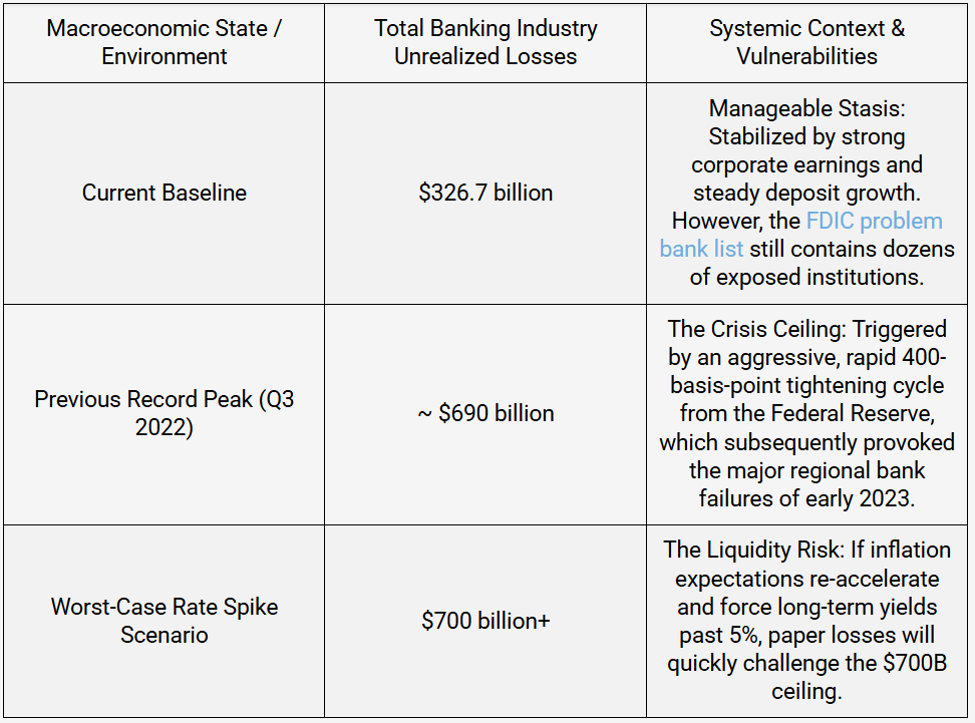
According to the most recent FDIC Quarterly Banking Profile, aggregate unrealized losses on investment securities across all FDIC-insured U.S. banks stood at $326.7 billion.
If long-term Treasury yields surge back toward or exceed their recent cyclical highs, these paper losses could easily scale back toward their worst historical baselines:
Ultimately, these paper losses only crystalize into catastrophic, real-world destruction if a bank experiences sudden, aggressive depositor flight. When forced to sell these underwater securities prematurely to meet immediate cash withdrawals, the unrealized losses transform into permanent capital destruction.
To prevent depositors from fleeing to high-yield money market funds, banks are forced to pay higher interest on savings accounts. This pinches their profit margins, causing them to severely tighten their lending standards. Consequently, small businesses and individuals find it much harder to get a loan approved.
The Explosive Government Debt Burden
The macroeconomic impact extends all the way to the federal level, altering fiscal policy and long-term economic stability.
Just like corporations, the U.S. government must constantly roll over maturing national debt by issuing new Treasury bonds. At current elevated yields, the cost to service the national debt is ballooning rapidly, eating up tax revenue that would otherwise fund infrastructure, social programs, or defense.
According to data evaluated by the House Budget Committee, net interest absorbed roughly 19% of all federal revenue in 2026 and is projected to consume 26% by 2036. This creates a dangerous feedback loop: the government must issue new debt simply to pay the interest on old debt.
When the government runs multi-trillion-dollar deficits, it must aggressively compete with corporations for a finite pool of global savings. The Congressional Budget Office (CBO) models that every single dollar of federal deficit spending reduces private business investment by roughly 33 cents.
Hard Landing
Economists are deeply divided on how to fix inflation without triggering a recession, and this is the structural risk that keeps economists and central bankers awake at night.
What is known in economics as a “hard landing”—a scenario where the Federal Reserve raises interest rates too high or leaves them elevated for too long, accidentally suffocating economic activity and triggering an outright recession.
Historically, this is the rule rather than the exception. Because changes in monetary policy operate with what economists call “long and variable lags,” the true economic damage of a 4% interest rate takes 12 to 18 months to fully ripple through the system. By the time the Fed realizes the economy is breaking, the momentum toward a recession is often already unstoppable.
Crisis mitigation
The institutional lag between economic deterioration and the Federal Reserve’s official response is one of the most predictable anomalies in macroeconomic history. On average, it takes the Federal Reserve 5 to 8 months from the actual quantitative beginning of a recession to explicitly acknowledge it and pivot policy.
This systematic delay occurs because the Fed relies on heavily lagging macroeconomic data (like the backward-looking Unemployment Rate and revised GDP prints). By the time the central bank realizes the “long and variable lags” of its rate hikes have broken the economic engine, contractionary momentum is already self-sustaining.
When the Fed recognizes that an economic collapse is underway, its operational framework switches instantly from inflation-fighting to aggressive crisis mitigation and liquidity injection:
The FOMC abruptly stops tightening and initiates rapid, often multi-point interest rate cuts to lower commercial borrowing costs.
If short-term interest rates are near the zero-bound, the Fed activates its balance sheet to launch large-scale asset purchases. It floods the banking system with liquidity by buying hundreds of billions in U.S. Treasuries and Mortgage-Backed Securities (MBS) to forcibly depress long-term yields.
Acting as the ultimate lender of last resort, the Fed opens its discount window and establishes specialized lending facilities to prevent regional or systemic bank runs.
Which Asset Classes Benefit From the Realization and Pivot?
The transition from peak hawkishness to an outright recessionary panic fundamentally reshuffles asset class performance. The cycle typically plays out across two distinct phases:
[ Fed Realization / Early Recession ] ──> Long-Term Treasuries & Cash Outperform
│
▼
[ Aggressive Fed Pivot / Active QE ] ──> Gold, Tech/Growth Equities & Bitcoin Surge
Phase 1: The Early Recession / Panic Phase
Before the Fed’s liquidity injections can filter into the real economy, defensive long-Term U.S. Treasuries are the absolute best-performing asset class in this window. As investors rush to safety and anticipate rate cuts, nominal yields collapse, causing the underlying prices of long-term government bonds to surge exponentially.
Cashand short-term T-bills protect capital from equity drawdowns while preserving dry powder.
Phase 2: The Active Liquidity / QE Phase
Once the Fed begins aggressively cutting rates and printing money, fiat currency debasement fears take over, favoring non-yielding alternative assets.
The dual headwinds of high real yields and a strong dollar evaporate instantly as yields plunge and the USD weakens, lowering gold’s opportunity cost and driving massive institutional inflows.
High-growth stocks with long-dated cash flows benefit immensely from a lower discount rate, causing a sharp rebound in the stock market.
Bitcoin and digital assets capitalize directly on systemic liquidity expansions and structural debt monetization concerns as the central bank balance sheet expands again.
Debt Doom Loop
While Volcker could forcefully raise the federal funds rate to 19% to 20% to crush inflation in the early ‘80’s, doing so today would not just cause a deep recession—it would bankrupt the federal government.
The structural constraint preventing the Federal Reserve from pushing interest rates dramatically higher is the math behind the U.S. National Deficit.
As of September 2026, the total gross national debt has breached $40.10 trillion. Because the federal government runs an active structural deficit (spending roughly $1.4 trillion more than it collects in tax revenues via year-to-date figures), it must continuously borrow money just to keep the lights on and pay off older, maturing bonds.
If the Fed matches Volcker-era interest rates, the fiscal math collapses via a three-step Debt Doom Loop:
[ Elevated Interest Rates ] ──> Roll Over Maturing Debt at Higher Coupons
│
▼
[ Ballooning Net Interest ] ──> Outlays Exceed Revenues (Crowds Out Discretionary Spend)
│
▼
[ Massive Deficit Issuance ] ──> Government Borrows Even More Just to Pay Interest
The U.S. Treasury does not hold debt forever; it constantly rolls over trillions of dollars of short-term Treasury bills and notes into new securities. The average interest rate on total marketable U.S. debt sits at 3.475%. If interest rates were forced up into the double digits to battle sticky inflation, trillions of dollars in maturing debt would instantly reprice at those higher rates, causing interest expenditures to spiral out of control.
Annualized net interest payments on the national debt have already surged past $1 trillion ($1.02T through August 2026):
- Net interest is officially the second-largest spending category in the entire United States government, trailing only Social Security.
- The U.S. currently spends more money on interest payments than it does on its entire national defense budget.
- Roughly 18.5% of all federal tax revenues collected are immediately consumed by interest payments rather than infrastructure, technology, or services.
The Breaking Point
According to data from the Congressional Budget Office (CBO), just a sustained 1% increase in the projected interest rate path adds an extra $1.4 trillion to net interest costs over the next decade.
If rates approached Volcker-like metrics, interest spending alone would quickly consume 60% of all federal revenues, driving the annual deficit to over 14% of GDP. The government would be forced to print and borrow massive sums of capital just to pay the interest on its past debts—creating a hyper-inflationary fiscal spiral that completely neutralizes the Fed’s tightening efforts.
Based on current macroeconomic models and sovereign debt math, the tipping point where interest rates would fundamentally break the U.S. economy sits between 4.50% and 5.00% on the federal funds rate, corresponding with a 10-year Treasury yield sustained above 5.25% to 5.50%.
While the current economy is absorbing the Fed’s hike to 3.75%–4.00%, pushed through by Chair Kevin Warsh, bond markets are signaling that the ceiling is incredibly close. The 10-year Treasury note has already breached 5.25%, and the 30-year yield sits at a pre-2008 high of 5.12%. Pushing benchmark rates beyond 4.50% would likely transition the economy from an “unbalanced slowdown” into a violent credit and fiscal break.
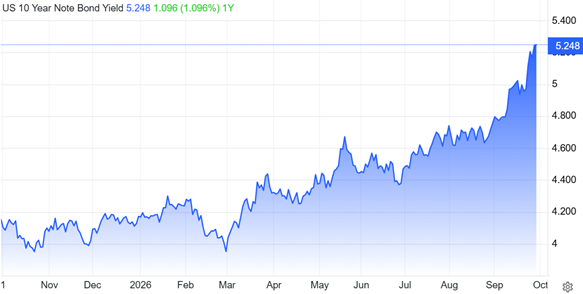
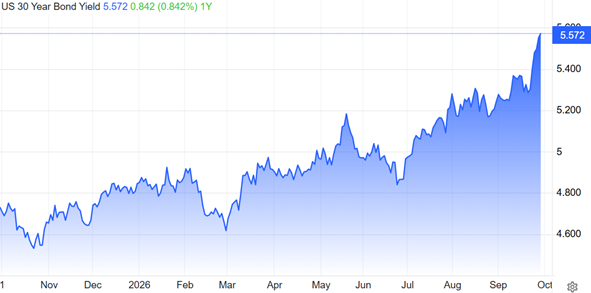
With national debt hitting $40.10 trillion and annualized interest payments already devouring $1.02 trillion, pushing the average blended cost of debt past 4.5% would expand net interest outlays past $1.5 trillion. This would consume nearly 25% of all federal tax revenue, creating an inescapable “debt spiral” where the Treasury must borrow exponentially just to avoid defaulting on past obligations.
Gold
Holding gold as the economy approaches its breaking point is historically one of the most effective ways to preserve capital, but the real magic of the asset happens right at the pivot.
When you track gold through a structural monetary break, you are positioning yourself for an asset class that effectively front-runs the central bank’s panic. The lifecycle of gold during a “hard landing” unfolds in two distinct, highly predictable macro phases:
The Pre-Break Liquidity Crunch
Right before the economy officially fractures, the system experiences peak hawkishness—which is exactly where we are sitting right now.
High real yields and a powerful U.S. dollar temporarily suppress bullion. Because non-yielding gold competes directly with safe 5% bond yields, speculative institutional desks temporarily liquidate their positions to hide in cash.
To the untrained eye, gold looks weak. In fact, during the initial weeks of a sudden economic break (like the 2008 Lehman collapse or the March 2020 pandemic freeze), gold can briefly experience a “waterfall decline” because institutions are forced to sell everything—including their liquid gold holdings—to cover margin calls on their failing stock portfolios.
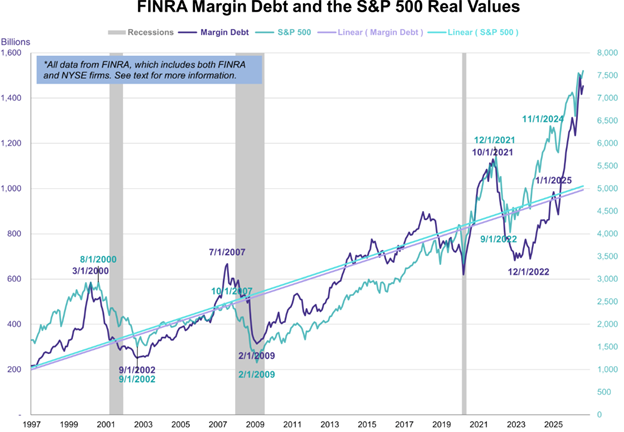
The structural setup for a massive margin liquidation has built up behind the scenes. Total market margin debt surged to a staggering $1.45 trillion, crossing 4.5% of GDP—a level of systemic leverage that exceeds the peak of the dot-com bubble.
The Post-Break Volatility Spike Where Gold Explodes
The short-lived liquidity dip is historically the ultimate buying window before the Fed acts. The second the systemic break forces the Fed’s 5-to-8-month lag to catch up, the macroeconomic headwinds completely flip into raging tailwinds.
As the Fed panic-cuts interest rates back down toward the zero-bound to rescue regional banks and consumers, nominal and real yields plunge. The opportunity cost of holding gold instantly evaporates.
To patch up a broken $40 trillion national debt market, the Fed will inevitably restart Quantitative Easing (QE). Flooding the banking system with trillions of freshly minted digital dollars triggers intense institutional anxiety regarding long-term fiat purchasing power.
Ahead of the Herd (AOTH) defines QE plainly as “money printing” where central banks create money out of thin air to purchase sovereign debt and mortgage-backed securities. We frequently warn that using QE to monetize ever-growing government debt results in a “debasement trade“—deliberately inflating away debt by repaying loans with lower-purchasing-power currency.
Because QE distorts interest rates and erodes the value of fiat currency, AOTH treats the implementation (or even the hint) of QE as an incredibly bullish indicator for hard assets. Historically, when the Federal Reserve launched aggressive QE during crises like the 2008 financial crash, fear of fiat debasement drove gold from $700 to $1,900/oz.
Capital fleeing a collapsing equity market rushes into uncorrelated tangible assets. Because gold acts as a mirror to macroeconomic pessimism, central bank buying and global sovereign wealth diversification push bullion prices exponentially higher.
[ Phase 1: Peak Restrictive Rates ] ──> Gold Under Pressure / Temporary Margin Selloff
│
▼ (The Economic Break & Fed Pivot)
[ Phase 2: Yields Collapse + QE ] ──> Gold Capitalizes on Safe-Haven Demand & Debasement
What makes gold an even more potent asset in today’s specific breaking point—as opposed to the 1980s—is the unprecedented scale of the U.S. national deficit.
If the economy breaks and the government is forced to issue trillions more in debt while the Fed suppresses interest rates artificially to prevent a sovereign default, traditional bonds will offer negative real yields. Under a structural sovereign debt crisis, gold acts as the ultimate global release valve for institutional capital looking to completely step outside of the fiat banking architecture
Conclusion
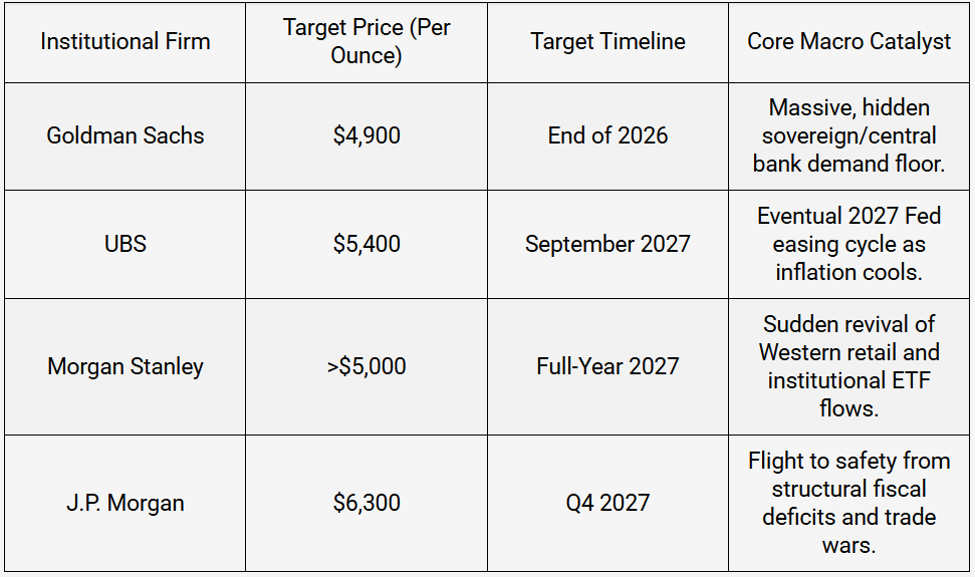
At AOTH we believe major institutional macro desks and investment banks are positioning for a massive, multi-staged gold breakout as this Federal Reserve rate cycle hits its absolute peak.
Institutional fund managers are looking past the temporary gold price drops triggered by Fed Chair Kevin Warsh’s hawkish tone. Instead, they treat current pullbacks as a major strategic accumulation zone.
The explicit, forward-looking price targets set by Wall Street’s largest macro teams show a clear consensus:
Summary of Institutional Targets
Owning gold right now comes down to a single reality: We are rapidly approaching the mathematical limit of how long the Federal Reserve can keep interest rates at these elevated levels without triggering a sovereign debt crisis or an economic collapse.
When you own gold you are holding the ultimate insurance policy against a centralized financial system running out of good options.
The government structurally cannot afford to let the Federal Reserve leave interest rates at 4% for much longer. When the Fed is eventually forced to slash interest rates to save the Treasury from a debt spiral, cash yields will collapse, and gold will skyrocket.
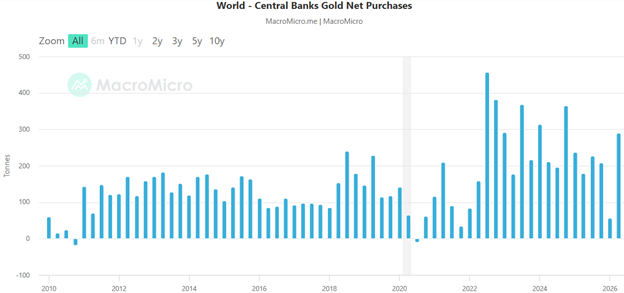
The world’s most powerful financial institutions are hoovering up gold’s supply at record rates. They are aggressively buying physical gold to diversify their reserves away from the U.S. dollar and shield themselves from weaponized financial sanctions.
This massive, price-insensitive institutional buying creates an unshakeable floor under the market. When the biggest players in the game are swapping digital currency for physical bars, I want to be on the same side of the trade.
The Fed operates on lagging data, usually taking 5 to 8 months to realize it has accidentally broken the economy. By the time an outright recession or credit freeze hits the headlines and the Fed panic-cuts interest rates, gold will have already made its move.
Owning gold right now means I am positioned before the liquidity gates open. When fiat currency debasement and panic-printing inevitably restart to rescue the economy, my purchasing power will remain completely insulated outside the fractional banking architecture.
Richard (Rick) Mills
aheadoftheherd.com

Legal Notice / Disclaimer
Ahead of the Herd newsletter, aheadoftheherd.com, hereafter known as AOTH.Please read the entire Disclaimer carefully before you use this website or read the newsletter. If you do not agree to all the AOTH/Richard Mills Disclaimer, do not access/read this website/newsletter/article, or any of its pages. By reading/using this AOTH/Richard Mills website/newsletter/article, and whether you actually read this Disclaimer, you are deemed to have accepted it.