 RSS Subscribe
Graphite One awarded Defense Logistics Agency program to evaluate domestically sourced advanced carbon materials from its Graphite Creek deposit for high-temperature defense thermal management applications – Richard Mills

Graphite One (TSXV:GPH, OTCQX:GPHOF) has received an award from the Defense Logistics Agency (DLA) to develop and evaluate domestically sourced advanced carbon materials for high-temperature defense thermal management applications.
The demonstration project will evaluate advanced carbon-based composite materials derived from domestic resources to support the industrial base and develop resilient domestic supply chains for high-temperature systems. This award represents the third defense logistics development agreement received by Graphite One since 2023.
The initiative’s objective is to demonstrate the performance of domestically sourced materials in high-temperature applications and support the development of advanced materials for specialized defense and industrial platforms. The project will encompass material processing, thermal evaluation and performance reporting. Graphite One will partner with national laboratory facilities and industry consultants for technical evaluation and stakeholder engagement.
“Advanced thermal management is a critical focus for high-temperature material development. With thermal management representing a key focus area for systems operating in extreme high-temperature environments, evaluating and qualifying domestic material sources remains an essential part of strengthening supply chain resilience,” said Dr. Vaibhav Jain, Program Manager, DLA R&D, in the Oct. 26 news release.
Anthony Huston, Graphite One’s President and CEO, stated, “This new program underscores our commitment to advancing domestic supply chains capable of delivering specialized advanced carbon materials. Working alongside national laboratory researchers and defense logistics stakeholders, we look forward to demonstrating how domestically sourced materials can meet rigorous high-temperature performance requirements.”
The company will manage this project through Graphite One Advanced Systems (G1x), its platform for developing next-generation graphite technologies and supply systems for the energy, technology and national security sectors.
Domestic supply chain strategy
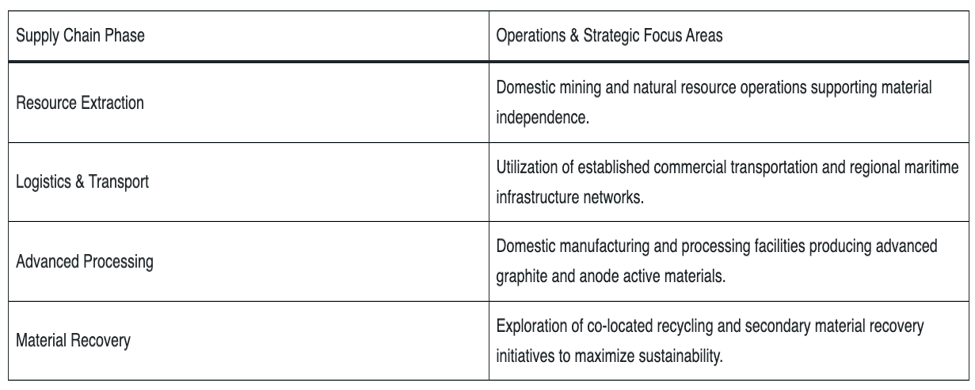
To support resilient domestic supply chains for natural graphite and advanced carbon products, Graphite One is advancing a comprehensive domestic supply chain strategy, subject to project financing, which is designed to provide a secure source of materials across multiple key industrial sectors:
Circular economy mining platform
Graphite One is framing its business model around a “circular economy mining” platform. Rather than operating as a traditional miner that extracts ore and exits the value chain, Graphite One is designing a vertically integrated, closed-loop US graphite supply chain.
The four core pillars of their strategy — the mine, manufacturing plant, advanced technology division and recycling facility — interlock to create a circular ecosystem.
This ecosystem is anchored by the Graphite Creek deposit in Alaska, recognized by the United States Geological Survey as the largest known natural graphite resource in the United States.
The primary extraction serves as the initial domestic baseline of raw material feedstock. By controlling the primary source, the company can standardize graphite purity from day one, which makes downstream processing and eventual end-of-life recycling highly efficient.
Raw concentrate from Alaska will be shipped to a planned Active Anode Materials (AAM) facility to be located in Conneaut, Ohio.
This manufacturing facility is engineered to run on a dual-feedstock input system. It is designed to blend primary mined material from Alaska with secondary, reclaimed materials recovered from their co-located recycling processes.
Other graphite products will also be manufactured at the Ohio plant, including graphene.
When processing graphite into battery-grade spherical materials, traditional manufacturing often generates significant “waste” fractions (byproducts that do not meet exact battery physical size specifications). Graphite One’s Advanced Systems Division intends to upcycle these ultra-pure carbon byproducts and off-spec materials into specialized, high-value graphene formulations, thermal management materials, and inputs for the defence, space, and national security sectors. This maximizes the utilization of every gram of extracted carbon, minimizing industrial waste.
A proposed battery recycling facility co-located at the Ohio manufacturing site, developed in collaboration with engineering partners like Lab 4 Inc., is the final link of their circular economy strategy. The facility will ingest end-of-life EV and lithium-ion batteries, black mass and manufacturing scrap.
While most battery recyclers prioritize high-value metals like cobalt and lithium, Graphite One’s specialized focus includes reclaiming the degraded graphite. The recovered graphite and battery materials will be fed directly back into the adjacent manufacturing plant to be re-engineered into fresh anode materials.
The FAST-41 Dashboard: permitting speed
Historically, navigating US federal mining permits, specifically in Alaska, is an unpredictable multi-year bottleneck. In June 2025, Graphite One’s Graphite Creek project was approved as a “covered project” under FAST-41 (Title 41 of the Fixing America’s Surface Transportation Act). It became the first Alaska mining project in history to be placed on the Federal Permitting Dashboard.
FAST-41 drastically accelerates capital deployment through three mechanisms.
Under FAST-41, a Coordinated Project Plan (CPP) was finalized by lead agencies (such as the U.S. Army Corps of Engineers).
Under the Spotlight – Graphite Creek Mine Project, Graphite One (TSXV:GPH)
Traditionally, an infrastructure project must clear reviews from separate agencies sequentially (e.g., waiting on the Army Corps of Engineers, then starting from scratch with the Fish and Wildlife Service, then NOAA). FAST-41 forces all cooperating federal bodies to review the data simultaneously under a unified master timetable.
The federal dashboard functions as an open public tracker. If a federal agency misses a milestone deadline by even a few weeks, it triggers an automated escalation mechanism. The agency must formally justify the delay to the Federal Permitting Improvement Steering Council (FPISC), effectively eliminating bureaucratic foot-dragging.
By utilizing the Federal Permitting Dashboard, Graphite One bypasses the notorious seven-to-10-year regulatory limbo that typically kills junior mining projects. This regulatory predictability gives institutional investors and the EXIM Bank the confidence to unlock their billions in debt, knowing that construction permits are on a fast-tracked, federally mandated rails system.
By pairing primary extraction with secondary recycling under a single corporate umbrella, Graphite One aims to solve a major issue for EV manufacturers: the reliance on volatile foreign supply chains. When primary mining output eventually scales down decades from now, the manufacturing and recycling footprint is built to transition into a permanent, self-sustaining loop of recycled domestic battery materials.
Graphite One Inc.
TSXV:GPH, OTCQX:GPHOF
2026.10.26 Share Price: Cdn$0.99
Shares Outstanding: 208.9m
Market Cap: Cdn$206.8m
GPH website
Richard (Rick) Mills
aheadoftheherd.com

Subscribe to AOTH’s free newsletter
Richard does not own shares of Graphite One Inc. (TSXV:GPH). GPH is a paid advertiser on his site aheadoftheherd.com
This article is issued on behalf of GPH
Legal Notice / Disclaimer
Ahead of the Herd newsletter, aheadoftheherd.com, hereafter known as AOTH.Please read the entire Disclaimer carefully before you use this website or read the newsletter. If you do not agree to all the AOTH/Richard Mills Disclaimer, do not access/read this website/newsletter/article, or any of its pages. By reading/using this AOTH/Richard Mills website/newsletter/article, and whether you actually read this Disclaimer, you are deemed to have accepted it.