 RSS Subscribe
Silver North intersects 4.41m of 1,669 g/t silver, 0.34 g/t gold, 3.33% lead and 2% zinc in step-out drilling at Haldane Silver Property, Yukon – Richard Mills
Silver North Resources (TSXV:SNAG, OTCQB:TARSF) has received results from the first three holes drilled this year at its flagship Haldane Silver Property in the historical Keno Hill Silver District, Yukon.
Results include 4.41 meters (3.87m estimated true width, “TW”) averaging 1,669 g/t silver, 0.34 g/t gold, 3.33% lead and 2% zinc within a larger 12.16m (10.67m TW) intersection of 727 g/t silver, 0.31 g/t gold, 3.20% lead and 2.05% zinc from 241 meters down hole in HLD25-41.
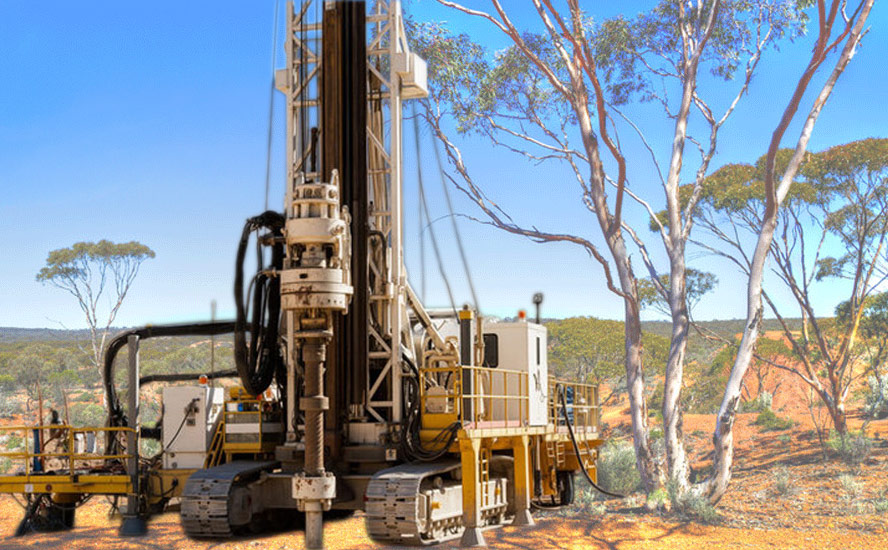
Twenty-four holes totaling 6,169 meters were completed in the 2026 program focusing on expanding silver, gold, lead and zinc mineralization along strike and down dip at the Main Fault target.
The road-accessible 8,579-hectare Haldane property is located 25 km west of Keno City, YT, adjacent to Hecla Mining’s producing Keno Hill silver mine. The project hosts numerous occurrences of silver-lead-zinc-bearing quartz siderite veins resembling the ore-bearing veins being mined at Keno Hill.
“The Main Fault continues to deliver strong silver grades over wide intersections, with HLD26-41 rivaling last year’s hole 31 as the best hole drilled to date at Haldane,” Silver North’s President and CEO Jason stated in the Oct. 14 news release. “We continue to see significant room for expansion of the Main Fault Target as the host structure remains strong in all directions. We know from other deposits in the district that mineralization can be variable, so it is very encouraging to see continued high grades as we move southwest from HLD25-31. We are also encouraged by the opportunity for new discoveries as evidenced by the intersection of previously unknown vein mineralization approximately 120m up hole of the Main Fault that returned 0.58m true width of 1,985 g/t silver. We have work to do to determine the exact significance of this intersection and where it can be targeted for further follow-up. We are looking forward to receiving results of the remaining 21 holes through Q4 of 2026.”
Under the Spotlight – Jason Weber, CEO Silver North TSXV:SNAG
HLD26-39 and 40 tested the Main Zone down dip of HLD25-31, the deepest hole drilled at this target prior to 2026. Both holes intersected a robust host structure, with strong siderite gangue mineralization.
HLD26-41 intersected the Main Fault 34m up dip and 40m along strike to the southwest from HLD25-31. A table of drill hole collar data is on the company’s website.
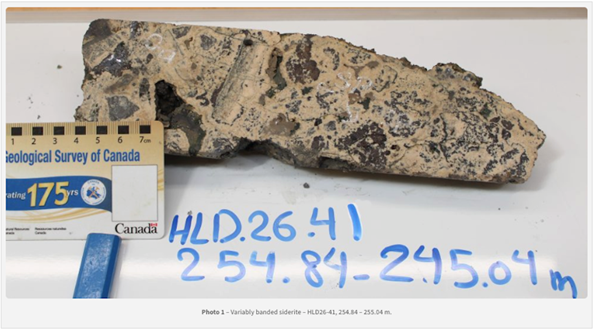
Hole HLD26-41 intersected the Main Fault over a robust 16.20m TW at a depth of 240.59 m and returned 524 g/t AgEq (silver-equivalent) over the entire structure. This hole is strongly mineralized within siderite veins, breccias and stockworks, returning 12.16m (10.67m TW) averaging 727 g/t silver, 0.31 g/t gold, 3.20% lead and 2.05% zinc (776 g/t AgEq) from 241.09m down hole. Several highlight sub intervals exhibit high-grade silver mineralization such as 1,669 g/t silver over 3.87m TW from 243.09m depth. Two intersections within this interval returned 0.30m TW of 4,910 g/t silver and 6,640 g/t silver over 0.41m TW. Higher silver grades in HLD26-41 are associated with relatively lower concentrations of galena, suggesting the presence of silver bearing sulphosalts that, in some cases, appear to be associated with finely colloform banded and variably coloured siderite veining.
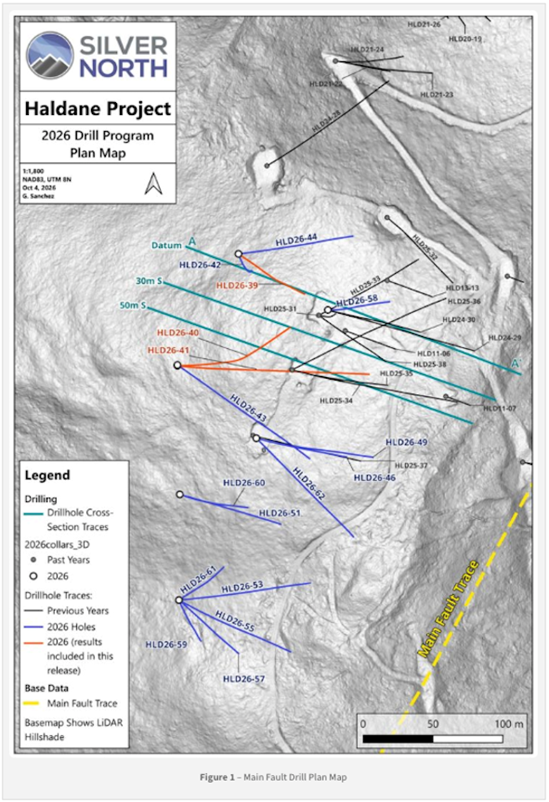
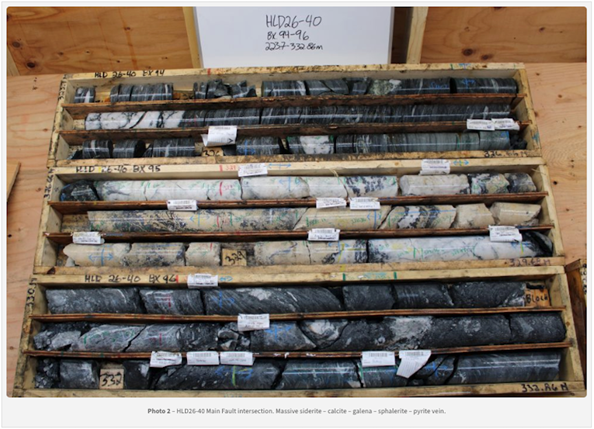
HLD26-40 tested the Main Fault structure approximately 80 meters down dip and 20 meters along strike to the southwest of HLD25-31. The structure is interpreted to be 5.44m wide (3.95m TW) starting at 326.68m down hole.
The entire structure presents as one massive siderite-calcite-galena-sphalerite-pyrite vein and averages 277 g/t silver, 0.21 g/t gold, 6.16% lead, 0.88% zinc (388 g/t AgEq). A sub-interval of 2.94m (2.13m TW) averages 507 g/t silver, 0.36 g/t gold, 11.30% lead and 1.60% zinc (709 g/t AgEq). Interestingly, an oxidized zone of rubble core with clots of galena returned 1,985 g/t silver, 0.49 g/t gold 0.69% zinc over 0.80m from 204.30m down hole, or about 120m up hole from the Main Fault. Due to the rubbly nature of the core, it was impossible to measure an orientation for this mineralization, but its presence warrants further investigation of a potentially new vein target in the Main Fault hanging wall.
In HLD26-39, the Main Fault structure was intersected approximately 50m downdip of HLD25-31 and is interpreted to be approximately 12m wide (TW) containing two zones of siderite veining and breccia separated by 4m of fault influenced phyllitic quartzite within an overall strong structural zone. The entire structure averaged 35 g/t silver, 0.35% lead and 0.40% zinc. The upper intersection measured 2.30m (1.47m TW) averaging 84 g/t silver, 0.17 g/t gold, 0.34% lead and 1% zinc (110 g/t AgEq) from 287.40m down hole. The lower intersection consisted of 2.62m (1.67m TW) of 150 g/t silver, 0.17 g/t gold, 1.78% lead and 1.22% zinc (199 g/t AgEq) from 293.70m down hole.
The recently completed 2026 program was the largest ever undertaken at Haldane, with drilling targeting expansion of the Main Zone mineralization near 2024 and 2025 drilling, distal step-outs to test the Main Zone structure, and additional drilling at the Bighorn target.
AOTH analysis
Silver North has again released spectacular results. Step-out hole HLD26-41 intersected 4.41 meters averaging 1,669 g/t silver, 0.34 g/t gold, 3.33% lead, and 2% zinc contained within a much broader 12.16-meter interval averaging 727 g/t silver.
That is 1.6 kilograms of silver a tonne over a very mineable width, plus gold, lead and zinc credits.
Based on current metal spot prices, the total gross in-situ metal value of this intercept is USD$3,454.61 per metric ton of ore. As expected for the Keno Hill District, the rock is overwhelmingly dominated by silver, which accounts for nearly 95% of the total revenue. (Figures represent the gross in-situ “melt value” of the metal contained within the rock before factoring in mining dilution, mill recovery rates, smelter charges or treatment deductions.)
Pure silver plays are difficult to find; many companies try to convince investors into believing their silver content is more than it is. If AgEq is used, look at the posted silver grade. Too many time’s it is an economic byproduct, not the main value. Silver North is a true silver play, with silver currently comprising over 85% of listed metal value from all drill holes.
The silver is obviously worth a lot of money, but so are the lead, zinc and gold. At these grades, the Zn and Pb comes to about $95 a tonne. As for the gold, even at 0.34 g/t, when converted to Canadian dollars, it comes to almost $70 per tonne. Tabulating all three byproduct metals comes to
USD$150 or just over CAD$200. Remember the production expenses would be in CAD$.
SNAG, or somebody, one day might be mining silver very cheaply because of its high-value other-metal kickers.
At 727 g/t silver across an extremely thick 12.16 meters, Silver North’s new drill hole exceeds the average mining grades of the district. Furthermore, finding continuous mineralization over widths of 12+ meters is quite rare in classic narrow-vein Keno-style structures, making the tonnage potential of this zone highly compelling.
And Hole HLD26-41 closely matches the success of last year’s star hole, HLD25-31, which hit 13.15 meters of 818 g/t silver. Having multiple 12+ meter-thick, ultra-high-grade intercepts spaced along the zone confirms that this isn’t an isolated pocket but a robust system.
Silver North also hit a previously unknown blind vein about 120m up hole of the Main Fault with 0.58m true width of 1,985 g/t silver. Every year of drilling has brought a new discovery.
Before this morning’s release, drilling had already extended the Main Fault structure over 100 meters along strike and 300 meters down dip from surface mineralization. The CEO noted that today’s step-out shows the host structure “remains strong in all directions” as they move southwest. Today’s assays are the first three holes of the 2026 24-hole, 6,169-meter drill program, the largest in the project’s history.
Twenty-one holes are pending from the Main Zone extensions and the nearby Bighorn target. Imo, the Main Fault Zone is shaping up precisely into the type of high-grade system needed to model a stand-alone economic asset. Management’s stated goal has been to map out high-grade blocks capable of matching the 20- to 30 million-ounce deposits typical of Keno Hill.
Banyan Gold, right beside Haldane, is also finding silver. Being road-accessible means a longer drilling season than many Yukon projects.
Hecla is mining next door and the company does not hesitate to buy out its neighbors when it wants a district locked down.
In 2022, Hecla acquired Alexco Resource Corp. exclusively to seize control of the Keno Hill silver mine. By taking over Alexco, Hecla established infrastructure, mill capacity and a massive footprint in the region. Buying Silver North would be a natural extension to consolidate the entire western half of the Keno Hill high-grade silver district.
If Silver North proves up a 20-to-30-million-ounce resource at the Main Fault Zone, they wouldn’t need to build a mill. Hecla could absorb the asset and truck the ultra-high-grade Haldane ore directly to their existing Keno Hill mill facility. This drastically lowers capital expenditures, making the ounces at Haldane worth far more to Hecla than to almost anyone else. While Hecla operates a spectacular asset at Keno Hill, many of the veins in the district are historically narrow (1–5 meters wide), requiring selective underground mining methods.
What makes Silver North’s recent Main Fault assays so disruptive to the status quo is the continuous width — 12.16 meters of 727 g/t silver and last year’s 13.15 meters of 818 g/t silver. Majors love width because thick zones allow for bulk underground mining methods (like long-hole stoping), which significantly lowers the cost per ton to extract the ore. If the remaining 21 holes continue to deliver high grades over these thick 10-to-12-meter intervals across the Main Fault, SNAG’s market capitalization might force Hecla to make a move.
Silver North Resources
TSXV:SNAG, OTCQB:TARSF, FRA:I90
Cdn$0.235 2026.10.15
Shares Outstanding 108.0m
Market Cap Cdn$23.8m
SNAG website
Richard (Rick) Mills
aheadoftheherd.com

Subscribe to AOTH’s free newsletter
Richard owns shares of Silver North Resource (TSX.V:SNAG). SNAG is a paid advertiser on his site aheadoftheherd.com
This article is issued on behalf of SNAG
Legal Notice / Disclaimer
Ahead of the Herd newsletter, aheadoftheherd.com, hereafter known as AOTH.Please read the entire Disclaimer carefully before you use this website or read the newsletter. If you do not agree to all the AOTH/Richard Mills Disclaimer, do not access/read this website/newsletter/article, or any of its pages. By reading/using this AOTH/Richard Mills website/newsletter/article, and whether you actually read this Disclaimer, you are deemed to have accepted it.