 RSS Subscribe
Five obstacles facing junior miners – Richard Mills
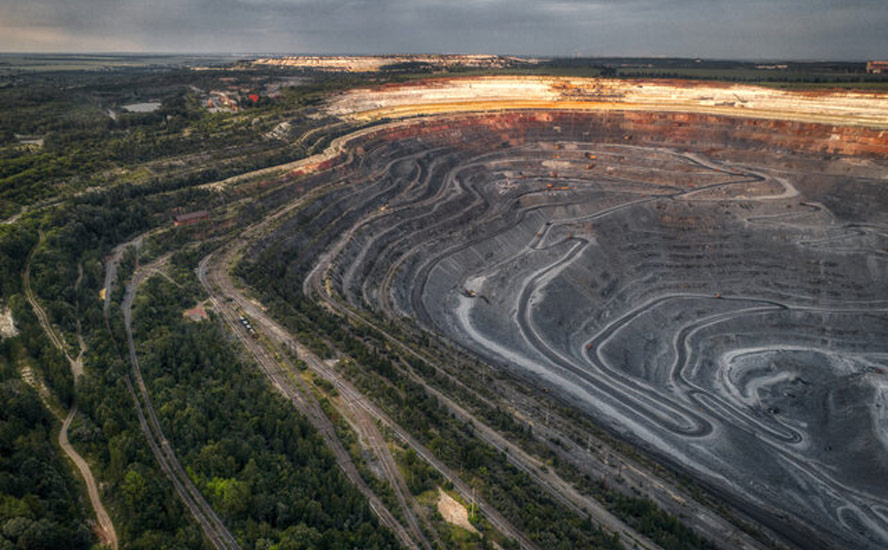
Only about 1 in 1,000 mineral exploration projects ever become mines, goes an old mining adage.
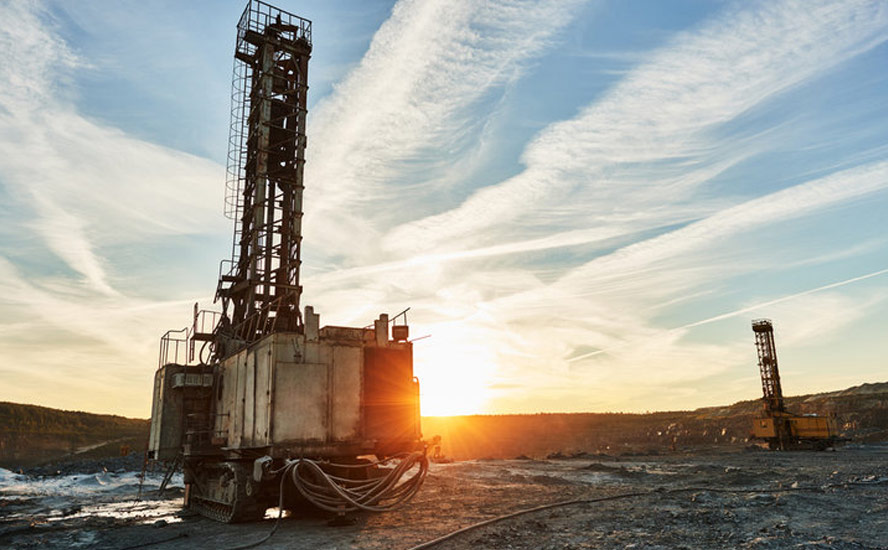
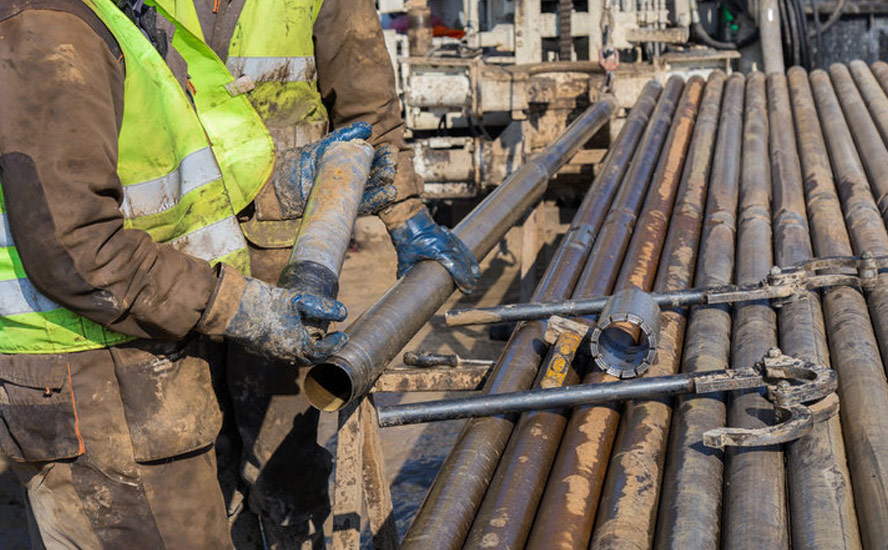
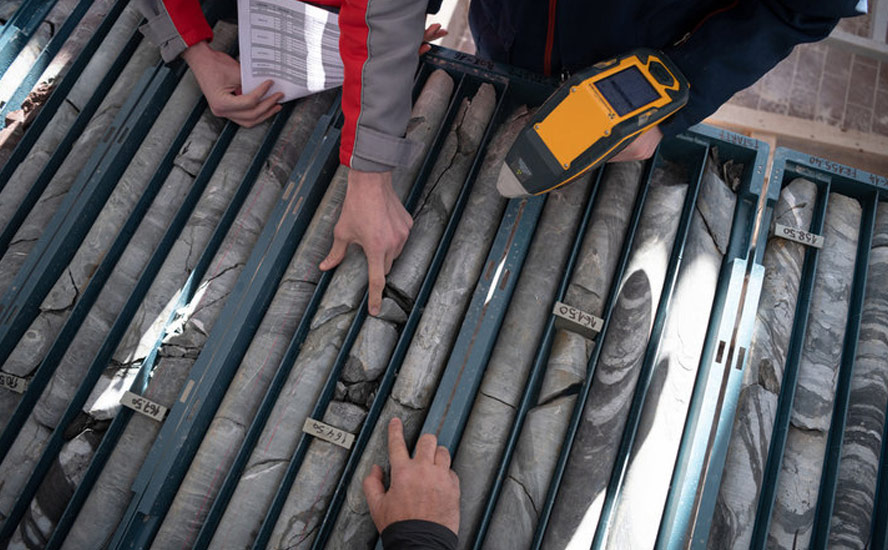
Most early-stage surface sampling never advances to drilling, and only a tiny fraction of drill programs locates a commercially viable deposit.
Even when a deposit is discovered, it must pass rigorous economic, technical, environmental, and indigenous consultation reviews.
Moving a project from initial discovery through regulatory approval and construction often takes plus 20 years in certain jurisdictions like Canada and the US.
Junior mining companies and prospectors face massive upfront capital costs in remote or rugged terrain with no guarantee of a return.
A junior’s role
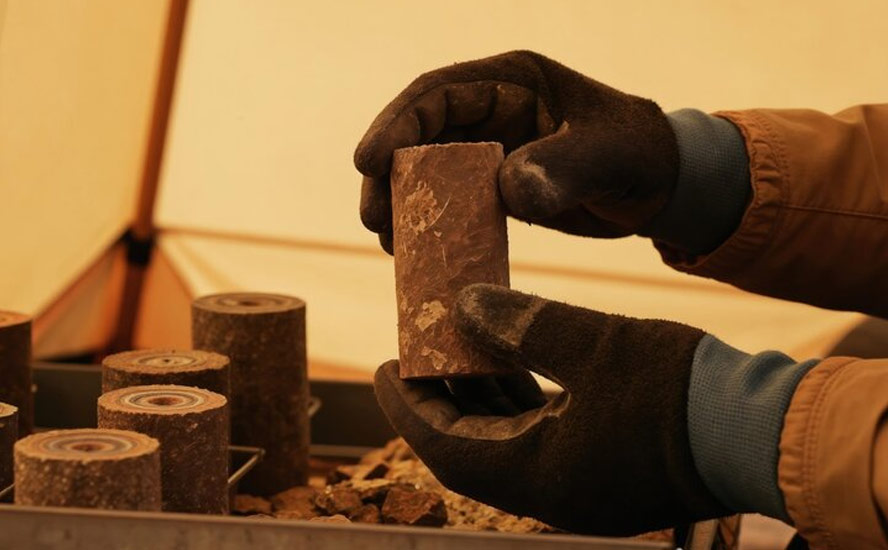
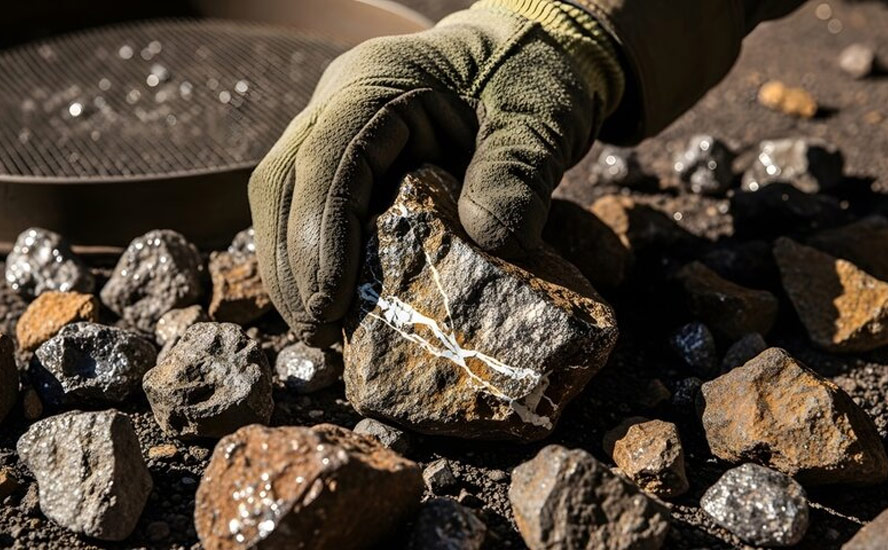
A junior resource company’s place in the food chain is to acquire projects, make discoveries and hopefully advance them to the point when a larger mining company takes it over. Discoveries won’t be made if juniors don’t have boots on the ground, if they aren’t out in the bush poking around and busting rocks.
Indeed, juniors have one of the toughest jobs in the industry. Finding and advancing new projects is difficult and capital-intensive. The kicker is the juniors have no revenue stream to finance their exploration activities; they typically rely on outside sources for funding.
Investing early in the development cycle of the right junior, one that has an excellent project in a safe jurisdiction led by experienced management with the ability to raise money, can reap huge rewards — 5, 10, even 20 times your money isn’t uncommon.
At the beginning, these companies are often financed by accredited investors who buy shares in private placements. The junior then tries to advance its project, beginning with prospecting, through to drilling and completing economic assessments and feasibility studies.
Few exploration companies have the money or technical expertise to “go mining”. For many, the goal is to hit upon a deposit that’s good enough to attract a major who will acquire the asset. Another pathway is for the junior to partner with a larger company. An option or joint venture (JV) agreement is a way for juniors to gain access to the financial and technical resources needed to build the mine.
Juniors are extremely important to major mining companies because they are the firms finding the deposits that will become the next mines. In this way, juniors help the majors to replace the ore that they are constantly depleting in their operating mines. Put another way, juniors find the resources for majors to turn into mineable reserves.
Junior resource companies own the world’s future mines — Richard Mills
‘Indispensable’ mining and juniors’ place in the food chain
Financing
Major mining capital raised across the TSX and TSXV topped $9 billion in the first half of 2026, and secondary financings and private placements continue to close. Active private placements in late October include Omineca Mining, Etruscus Resources and Steadright Critical Minerals.
But funding is not being distributed equally.
Capital has largely flowed into gold and silver and higher-tier junior developers with stronger track records, while early-stage micro-caps and grassroots explorers face tighter conditions.
According to Equity.Guru, “The emerging divide is becoming difficult to ignore:
Companies with producing assets, credible resources, strategic partners and committed financing are attracting serious money.
Earlier-stage juniors? Many are still struggling to raise enough capital to keep exploring.”
Infrastructure
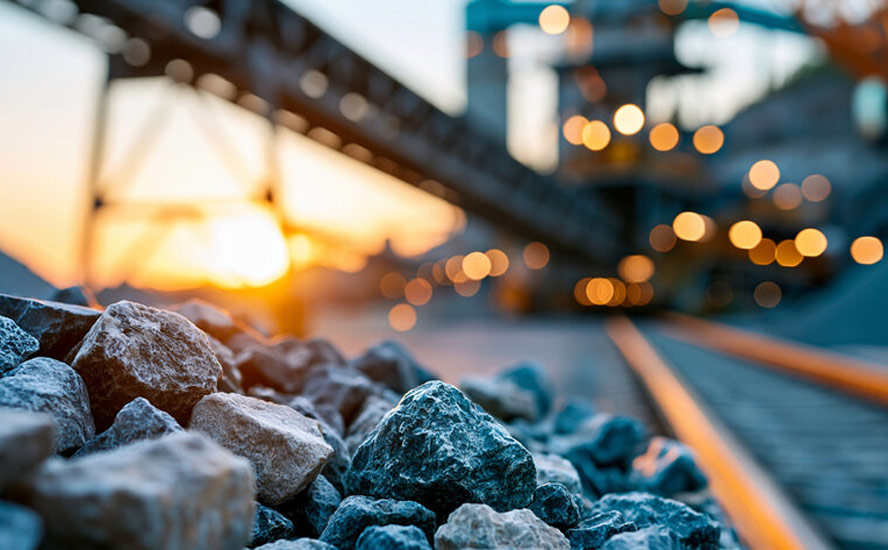
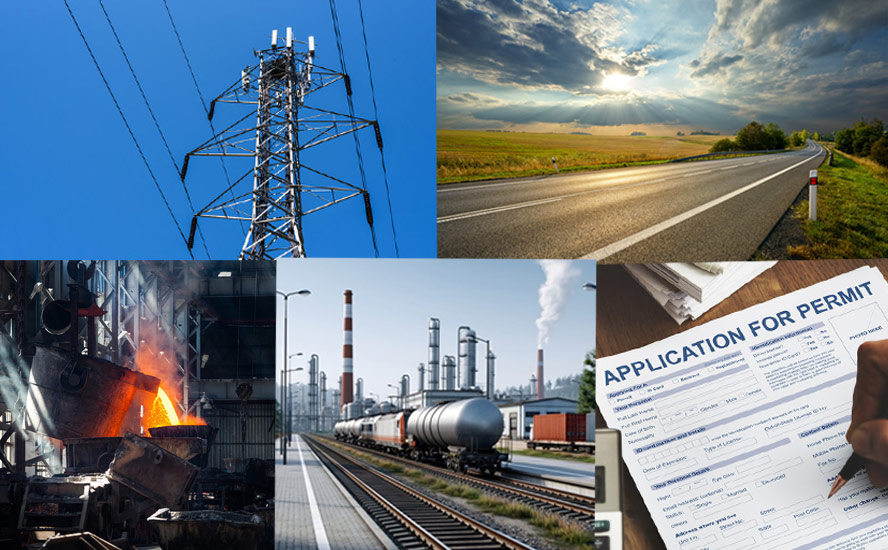
Even if juniors can get financing to explore their projects(s), they face several obstacles to advancing them. The first is adequate mining infrastructure. We’re talking power, water, roads and railways. A deposit in a remote part of Canada is not going anywhere if there is no way transport the concentrate to a port or trans-shipment hub.
Projects in northern and remote regions such as the Northwest Territories and northern British Columbia suffer from chronic deficits in all-weather roads, rail lines, and local energy grids, forcing many mines to rely heavily on expensive diesel generation.
Three examples demonstrate the point.
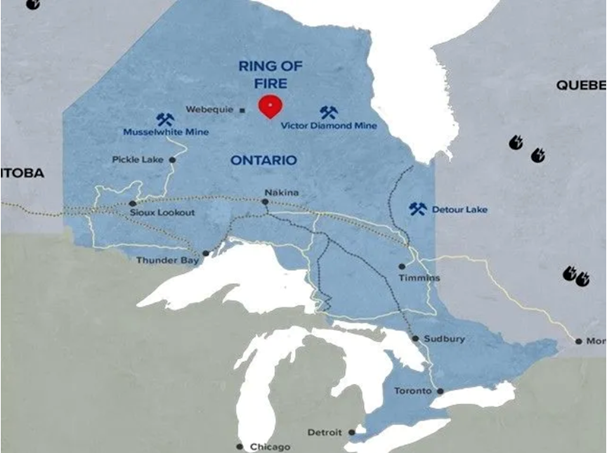
Ring of Fire
The Ring of Fire is one of the most promising opportunities for critical minerals development in the Canadian province of Ontario.
The Sudbury Star notes the Ring of Fire spans an area of Ontario bigger than Quetico Provincial Park — itself nearly as big as Algonquin Park.
According to the Canadian Mining Journal, the number of mining claims in the Ring of Fire has increased by over 28% since September 2022.
The 33,074 claims, as of September 2023, now cover approximately 626,000 hectares, nearly 10 times the size of Toronto.
Privately held Juno Corp currently holds the most claims at 17,000 covering about 333,000 hectares.
Minerals found in the Ring of Fire to date include chromite, copper, zinc, gold, diamonds, nickel and platinum group elements.
Extracting the Ring of Fire’s metals however is far from easy. Nothing can happen without a way to transport material in and out. That statement is easier to appreciate when one considers that this vast, isolated area still has no rail or permanent road access.
The area which consists largely of muskeg is also home to multiple First Nations, that by law must be consulted before any mining or mining infrastructure can take place on their territories.
According to the Canadian Mining Journal, Although chromite, copper, and nickel were discovered in 2007, the area’s remoteness, lack of infrastructure, opposition from some neighbouring First Nations, and bureaucratic red tape have been ongoing issues. The remote location can only be accessed by planes and winter roads (ice roads) only accessible for about two months of the year…
Prime Minister Mark Carney and Ontario Premier Doug Ford recently announced a $1 billion federal funding commitment to match Ontario’s long-standing $1-billion pledge, bringing total joint road infrastructure investment to $2 billion for the Ring of Fire mining region.
The combined federal-provincial funding is part of a larger $8.7-billion package targeting Ontario’s critical minerals, steel and automotive sectors. Road work kicked off last summer, with individual sections of the roughly 500-kilometer corridor scheduled for completion between 2030 and 2031.
But, while Ottawa and Ontario agreed to coordinate permitting and environmental assessments to eliminate duplicate reviews (see next section) — the so-called “one project, one process” — the funding announcement faced swift backlash. Neskantaga First Nation condemned the move, arguing it bypasses Indigenous jurisdiction and regional assessments. Meanwhile, some local communities like Marten Falls have worked with the province on separate economic participation agreements, states The Narwhal.
Golden Triangle
The Golden Triangle of northwestern British Columbia is the popular name for a loosely defined region that includes most of the major gold, silver, and copper deposits in west-central Stikinia — an oceanic arc terrane that extends for about 1,000 km along the length of the Canadian Cordillera. Most deposits in the Golden Triangle are related to the Hazelton Group and affiliated intrusions.
More than 150 mines have operated in the region since prospectors first arrived near the end of the 19th century. Important past-producing mines include Granduc, Eskay Creek, Anyox, Kitsault, Premier/Dilworth, Dolly Varden, and Snip.
Proposed mines included Galore Creek, Premier, KSM and Red Mountain.
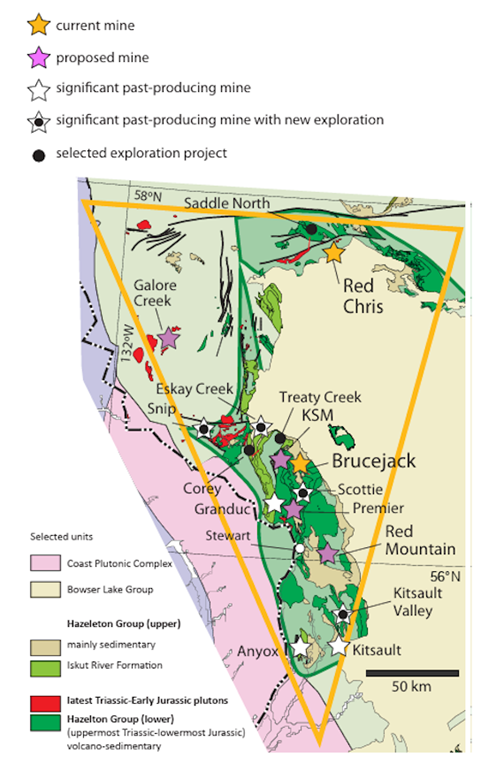
The latest major project scheduled to enter initial production is Skeena Resources’ Eskay Creek Gold-Silver Project, which is targeted for commercial production in Q3 2027.
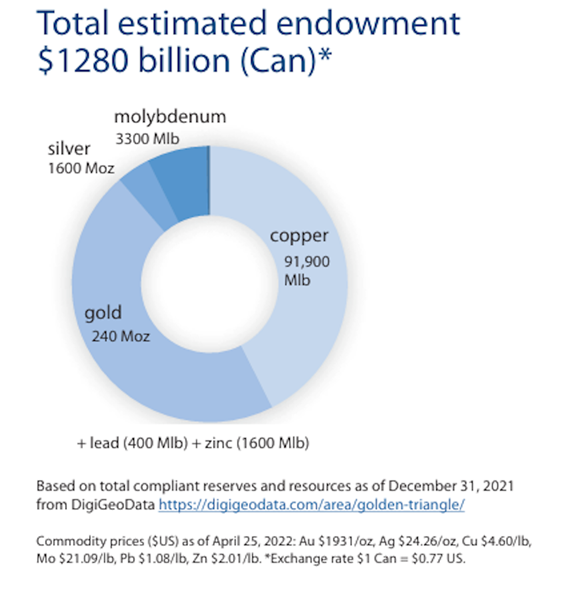
The area has an estimated mineral endowment of CAD$1.280 trillion, including copper, gold, silver and molybdenum. (B.C. Ministry of Energy and Mines, information circular 2022-05)
Road access into the Golden Triangle is primarily through Highway 37, also known as the Stewart-Cassiar Highway. The two-lane paved road skirts the eastern edge of the Golden Triangle connecting Highway 16 in the south to the BC-Yukon border over an 875-km stretch.
The Stewart-Cassiar Highway serves as the main route for haul trucks transporting mineral concentrates from Golden Triangle mines to the port of Stewart.
Highway 37A is a 65-km paved spur road that branches off Highway 37 and runs westward to Stewart.
While a few dirt roads off highways 37 and 37 typically extend 10 to 30 km into the wilderness, the deep interior of the Golden Triangle is inaccessible except by aircraft/ helicopters or private haul/ ice roads. Deposits like KSM, Galore Creek and Schaft Creek have in the works for decades, but they are essentially stranded metal.
There are no active railways penetrating the Golden Triangle. CN is the closest line running along the southern edge of the region through Terrace and Smithers. It handles freight moving to the port of Prince Rupert, but it does not branch northward into the rugged Golden Triangle terrain.
In 1910, a short 15.5-mile rail line was built out of Stewart. It extended up the Bear River Valley to service the Red Cliff mine. But the line fell into disuse shortly after mining declined in the 1910s and 1920s.
The main power grid extends roughly 344 kilometers (214 miles) north from Terrace to Bob Quinn Lake via the Northwest Transmission Line, with a 92-kilometer (57-mile) extension further north toward Tatogga Lake and the Red Chris mine. This line was built by Imperial Metals.
Ground was reportedly broken in September 2026 on the North Coast Transmission Line, a multi-phase expansion from Prince George to Terrace and onward to Bob Quinn Lake, designed to more than double electrical capacity and supply growing mining and LNG demands in the region, states the Canadian government.
The NCTL would power the Eskay Creek mine restart and the Galore Creek Project (The Narwhal). Seabridge Gold reportedly signed an agreement to connect the massive KSM copper-gold-silver project to the line via a switching station near Treaty Creek and Bob Quinn Lake.
The Red Chris mine and the Brucejack gold mine are already hooked up to the line, whose completion isn’t expected until winter 2032.
Golden Triangle mining and advanced development projects currently holding water licenses and water discharge permits include Eskay Creek, KSM, Premier, Red Chris, and Brucejack.
Ambler District
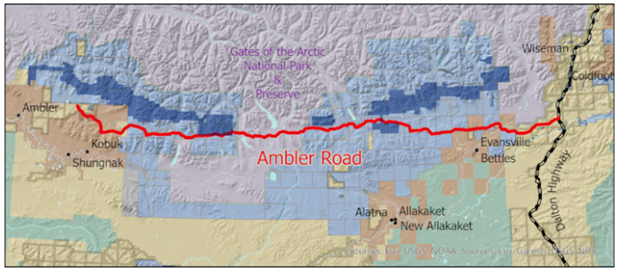
Our third example of a mining infrastructure-challenged region is the Ambler Mining District of northwestern Alaska. While the district spans about 180 kilometers (112 miles) and contains large deposits of copper, zinc, lead, gold, silver and cobalt, it has historically lacked road, rail or barge access.
The area features significant VMS and copper systems including the high-grade Arctic deposit, Bornite, Smucker and Sun.
The proposed Ambler Road Project would connect the district from the Dalton Highway around milepost 61 westward, providing a 211-mile all-season private haul road.
However, the project has faced extensive environmental and tribal reviews. It remains unbuilt due to ongoing state and federal litigation.
There is currently no commercial power grid or electrical transmission infrastructure connected to the Ambler Mining District.
Permitting
It takes an average 20 years to permit, build, and start production at a mine in Canada.
The extended timeline is driven by several factors including dual-level permitting; indigenous consultation; infrastructure deficits due to remote locations; lengthy studies; and trouble raising capital.
We have already discussed financing and infrastructure so let’s take a deep dive into permitting.
Mine permitting in Canada is a shared responsibility between provincial/territorial governments and the federal government.
Each province or territory has its own mining legislation (such as the Mines Act in British Columbia) governing site safety, environmental protection, and operations.
Companies must secure approvals for different phases, ranging from low-impact grassroots exploration to mechanized trenching, full-scale production, and long-term site closure/reclamation.
Many provinces have overhauled their systems to speed up reviews. For instance, British Columbia uses portals like MineSpace, while Ontario has implemented a “one project, one process” framework to coordinate multi-ministry approvals.
The federal government regulates areas that cross provincial borders or fall under national constitutional powers such as fisheries, navigable waters, species at risk, and transboundary environmental impacts.
Major projects may trigger federal environmental or impact assessments.
Under Canadian law, the Crown has a legal duty to consult — and where appropriate, accommodate — indigenous peoples whenever a proposed mining project might impact potential or established aboriginal or treaty rights. This consultation is integrated into both provincial and federal permitting timelines.
Mine permitting in the United States is a multi-agency and multi-stage process involving federal, state and local regulators. Timelines span seven to 10 years, longer than Canada or Australia.
If the mine is on private land, access must be granted by the landowner. Mines on public lands are governed by the General Mining Act of 1972 which allows prospectors to stake claims. Primary oversights falls to the Bureau of Land Management or the U.S. Forest Service. Minerals like coal, oil and gas follow a leasing system under the Mineral Leasing Act of 1920.
An exploration license permits geological survey and limited ground disturbance, whereas an extraction license goes much further. It requires mine developers to submit a detailed Mine Plan of Operations, completing environmental reviews and meeting state-specific zoning.
Next comes an Environmental Review, where federal agencies evaluate the environmental and social impacts of the proposed mine. Before granting approvals, the agencies typically produce a comprehensive Environmental Impact Statement.
The last stage involves the grating of operational and environmental permits. Water discharges and dredge and fill activities are governed by the Clean Water Act, with permits approved by the Environmental Protection Agency and the U.S. Army Corps of Engineers.
State or federal EPA delegations manage air quality and dust emission permits through the Clean Air Act.
To be covered under Mine Safety & Health, developers must comply with Mine Safety and Health Administration regulations.
Finally, state departments of natural resources or environmental quality handle localized land use, water rights, and financial reclamation bonds to ensure the site is restored after closure.
There have been efforts in the United States to streamline mine permitting. FAST-41 refers to Title 41 of the Fixing America’s Surface Transportation (FAST) Act, a US federal law enacted in December 2015. It is designed to make federal environmental reviews and authorization processes for large infrastructure projects more transparent, predictable and timely.
The Canadian federal government has also introduced measures to cut mine permitting timelines. Bill C-39, introduced in September 2026, establishes a target of completing federal reviews and decisions within one year after receiving an application.
A Major Projects Office was established to coordinate federal departments, regional jurisdictions, and indigenous consultations. The office aims to compress federal approvals to a maximum of two years (or 5 years for federally designated projects).
In addition, the government has structured parallel multi-agency reviews, a dedicated permitting coordinator, and legislative changes to eliminate sequential bottlenecks and cut timelines by up to a decade.
Lack of refining/ smelting
North America and other Western regions face a scarcity of local smelting, refining and processing capacity, creating a disconnect between raw exploration and usable metal supply.
The Western critical minerals supply chain is bottlenecked by a severe midstream deficit, leaving North America heavily reliant on foreign refiners despite ample raw resource extraction.
While the United States and Canada possess vast geological reserves and produce significant amounts of raw ore and scrap — such as the US generating enough copper to meet 146% of its internal demand — they lack the domestic smelting and refining facilities to process it.
Consequently, roughly 48% of US mined copper concentrate is exported overseas, primarily to China, which currently controls 60% to 90% of global refining capacity across key energy-transition metals like lithium, cobalt and rare earths.
Canada has lost seven non-ferrous metal smelting and refining facilities between 2016 and 2024 (including closures in Flin Flon, Thompson, Gaspé and Timmins). Over the past decade, domestic refined production dropped drastically (cobalt down 23%, copper down 25%, nickel down 54%, and zinc down 22%).
Most copper concentrate mined in British Columbia, which produces nearly half of Canada’s copper, is exported overseas — primarily to China and other Asian markets like Japan—for smelting and refining.
It makes no economic sense to rail the concentrate to Canada’s only copper smelter and refining complex — Glencore’s Horne smelter in Rouyn-Noranda, Quebec, with final electrolytic refining done at the Canadian Copper Refinery in Montreal.
The lack of refining capacity in the United States and Canada is becoming a problem as demand for certain metals increases and countries are looking inwardly at their mining and manufacturing capabilities. Countries are moving away from interdependent mineral supply chains in favor of those that guarantee security of supply.
China has weaponized rare earths, graphite, and other critical minerals to punish countries dependent on its refined metal products.
The United States is heading towards extreme isolationism as it pursues a mercantilist trade policy defined by import tariffs.
It’s one thing to allocate government money to new critical mineral mines and projects, but quite another to add the other missing pieces: energy to run the mines; roads or preferably, railways to the mines so that they can ship the concentrate out; and refineries to process the ore, thereby making Canada completely independent from current suppliers, mostly China.
In an article earlier this year we looked at the refining bottleneck, illustrated by six metals: aluminum, copper, nickel, zinc, graphite, and rare earths.
Take copper as an example. A new report finds the United States produces more raw copper than it consumes but lacks the processing capacity to turn it into usable metal, leaving manufacturers dependent on foreign refiners.
In fact, the United States is more self-sufficient in raw materials via domestic mining and scrap (recycling) than China, says Benchmark Mineral Intelligence’s copper analyst Albert Mackenzie. The problem is the US doesn’t have the processing capacity.
The main difference between the two countries, Mining.com explains, is that limited US processing capacity means copper from US-owned mines abroad does not return home, while Chinese-owned overseas output more often flows back to Beijing.
Why Canada and the United States need more smelters and refineries — Richard Mills
There are currently two copper smelters in the United States: Freeport-McMoRan’s Miami smelter in Arizona and Rio Tinto’s Kennecott smelter in Utah. Both process copper concentrate. There is also the Hayden smelter in Arizona owned by Asarco (Grupo Mexico), but that has been shut since 2019.
The Amarillo refinery in Texas processes anodes and is linked to Asarco’s Arizona’s operations.
According to the US Geological Survey, the vast majority of US copper mining occurs in Arizona, Utah, New Mexico, Nevada and Montana.
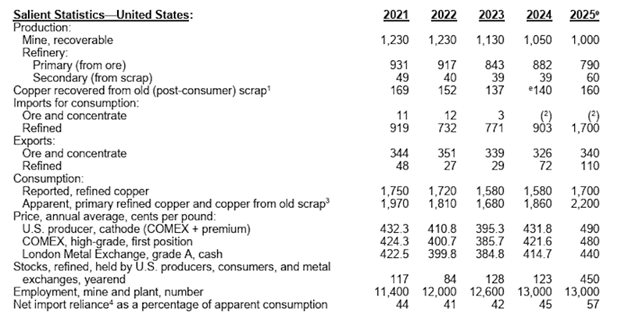
In 2025 the United States refined 790,000 tonnes of copper and exported 110,000 tonnes. Interestingly, total refined copper imports were exactly the same as total refined consumption: 1.7 million tonnes.
Between 2021 and 2024, the most refined copper was imported from Chile (68%), followed by Canada (16%), Peru (7%) and Mexico (6%). Refined copper accounted for 88% of all unmanufactured copper imports.
The first takeaway is that 100% of the refined copper the US imported went to consumption. Only 100,000 tonnes were exported.
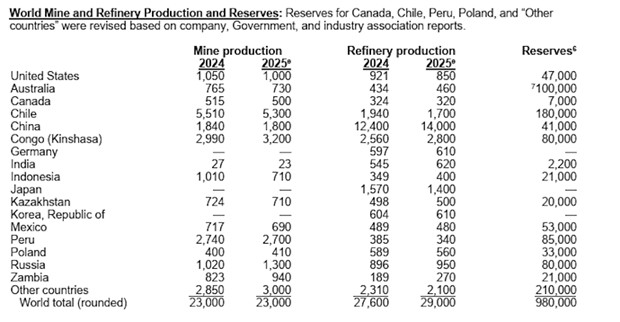
The second takeaway is that China is nowhere to be seen, even though China is by far the world’s largest copper refiner at 14 million tonnes in 2025 versus the United States’ 850,000 tonnes.
In Canada, the only operating copper refinery is Glencore’s Canadian Copper Refinery (CCR) in Montreal, Quebec. It produces 99.99% pure copper cathodes and operates alongside the Horne smelter in Rouyn-Noranda, Quebec, which produces copper anodes.
Canada mined just 500,000 tonnes of copper last year, and refined only 320,000t, compared to global refined production of 29 million tonnes.
In a previous article we discussed the possibility of building a new copper refinery in the Golden Triangle region of British Columbia.
BC’s Golden Triangle is the West’s solution to its copper supply dilemma
BC is Canada’s leading copper producer, outputting about half of the country’s total, yet nearly all the copper mined from British Columbian operations is shipped to Asia. This needs to change.
Lack of manufacturing know-how
Even if Canada and the US were to miraculously build enough railways, powerlines, roads and refineries to make them self-sufficient, both countries lack the manufacturing knowledge base to turn the metal into useable products. Rare earths are a good example.
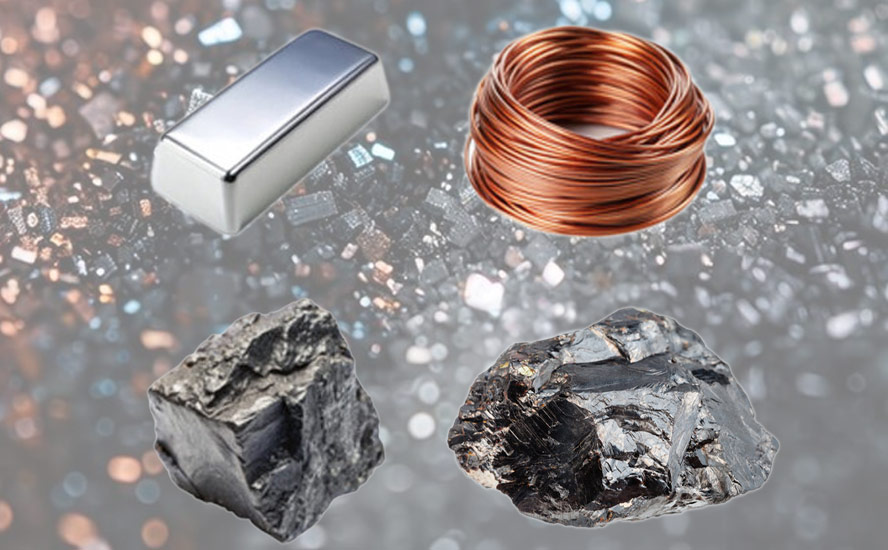
Producing rare earth oxides does not automatically translate to finished magnet production. Making complex permanent magnets such as neodymium-Iron-boron magnets requires specialized factories, equipment, and engineering expertise that are currently missing or extremely limited in Canada. Most processed material is exported to magnet makers rather than built into finished products locally.
In the US, the problem is less the knowledge require to make magnets but the lack of an industrial ecosystem to produce them competitively.
The challenge is not some “secret formula”; it is the multi-stage industrial chain. China spent decades building out complex solvent extraction, molten-salt electrolysis (metallization), alloy production, specialized equipment, and trained labor pools at sub-rational costs that make standalone Western competition difficult. (CNBC)
A similar problem exists for battery anodes. While the US has built significant capacity to assemble battery cells, the domestic supply chain heavily lacks the infrastructure, refining capacity, and commercial scale to manufacture battery-grade anode materials.
Conclusion
Governments have a major role to play in reducing the obstacles junior resource companies face in trying to bring mine development projects along from discovery to commercial production.
Recent experiences show the best approach is not in “picking winners” to finance — a role better suited to the private sector — but instead, investing in shared infrastructure to allow the best projects to move forward.
(The Quebec government lost most of its initial $130 million investment when Nemaska Lithium filed for creditor protection in 2019, the Globe and Mail reported last weekend. In June 2025, Export Development Canada and the Canada Infrastructure Bank provided $165 million in loans to Torngat Metals for its Strange Lake heavy rare earths project. The cost to build the mine and concentrator plant in Nunavik, an access road and port in Labrador, and a separation plant in Quebec has since ballooned from $1.6 billion to $3 billion. And you still do not have magnets.)
Security of supply implies a complete supply chain that begins with mining the minerals and ends with refining the metals into finished products.
We have the minerals. The answer is to build not only more mines, but more transportation and processing infrastructure. We need such infrastructure to connect to future mines, not to ports to export the concentrate, but to smelters and refineries that can process it domestically.
Only then will we be safe from the weaponization of mineral exports countries like China have employed as leverage in trade wars.
Richard (Rick) Mills
aheadoftheherd.com

Legal Notice / Disclaimer
Ahead of the Herd newsletter, aheadoftheherd.com, hereafter known as AOTH.Please read the entire Disclaimer carefully before you use this website or read the newsletter. If you do not agree to all the AOTH/Richard Mills Disclaimer, do not access/read this website/newsletter/article, or any of its pages. By reading/using this AOTH/Richard Mills website/newsletter/article, and whether you actually read this Disclaimer, you are deemed to have accepted it.