 RSS Subscribe
Graphite One: Building a Complete U.S. Graphite Supply Chain to Address America’s Security-of-Supply Gap – Richard Mills
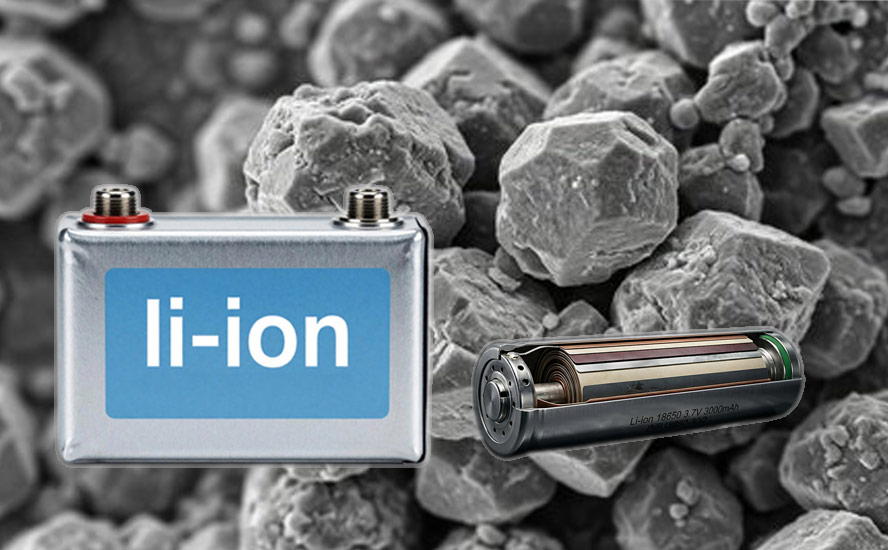
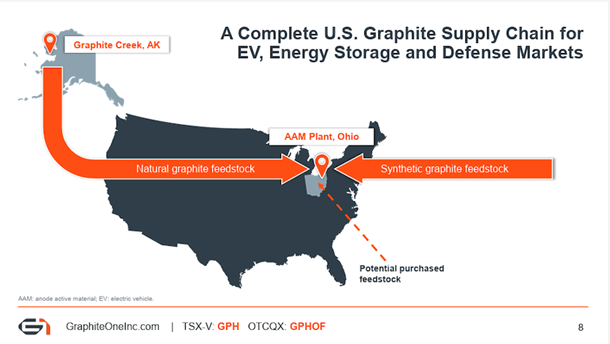
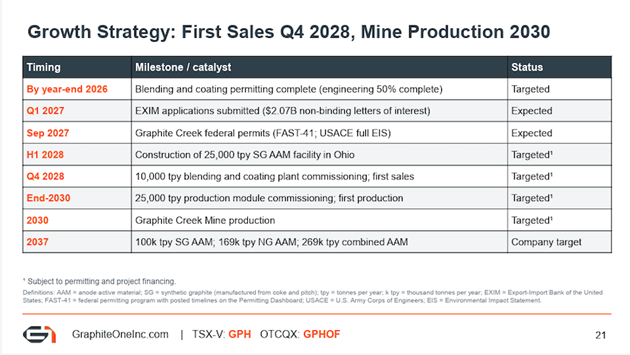
Graphite One Inc. (TSX-V: GPH; OTCQX: GPHOF) is developing a vertically integrated U.S. graphite anode supply chain, from its Graphite Creek deposit in Alaska, the largest known graphite deposit in the United States, to an anode active material (AAM) manufacturing facility in Ohio. The Company aims to be the first U.S. producer of both natural and synthetic graphite anode material. Its phased plan targets first synthetic AAM sales from Ohio in Q4 2028, federal permits for Graphite Creek in 2027 and mine production in 2030, with natural AAM to follow by 2031.
Anode active materials (AAM) are the electroactive components of a battery’s negative electrode; they store and release ions, such as lithium or sodium, and electrons during charge and discharge cycles.
Graphite, both natural and synthetic, is the industry-standard anode material for lithium-ion batteries, accounting for roughly 95% of the anode market.
North American anode demand outlook
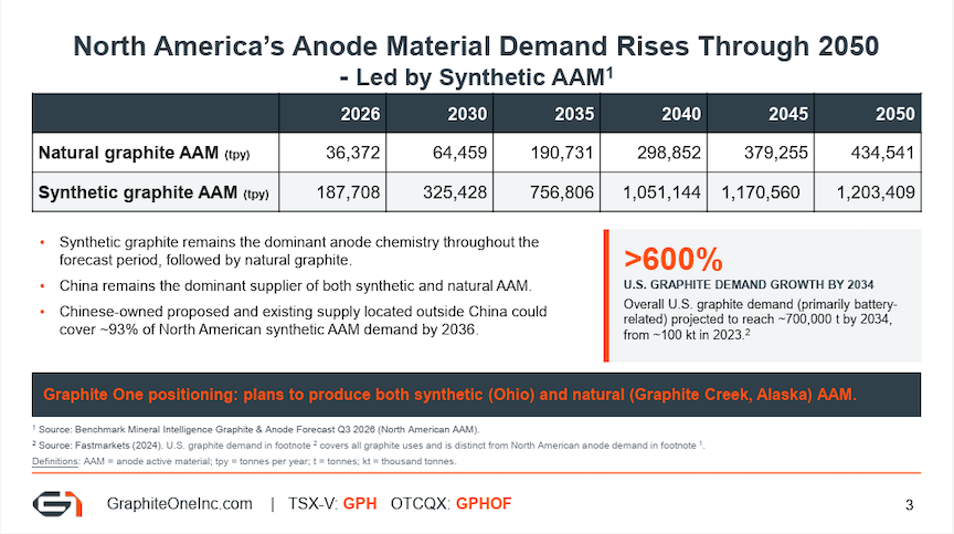
U.S. graphite demand, driven primarily by batteries, is forecast to grow approximately 600% from roughly 100,000 tonnes in 2023 to about 700,000 tonnes by 2034.
Synthetic graphite is expected to remain the dominant anode material throughout the forecast period, followed by natural graphite.
China’s dominance and U.S. import dependence
China is the dominant supplier of both synthetic and natural AAM. Chinese-owned supply outside China, existing and proposed, could cover approximately 93% of North American synthetic AAM demand by 2036.
China controls 97% of refined graphite supply. U.S. dependence on imported graphite, primarily from China, is a strategic risk given graphite’s role in electric vehicle batteries, energy storage and defense.
Graphite is used in defense applications including ammunition, artillery, corvettes, submarines, battle tanks and fighter aircraft.
Graphite One’s strategic plan: revenue before mine investment
Graphite One’s strategy is built on generating revenue before mining graphite at its Graphite Creek deposit in Alaska.
The Company announced on May 19 that it had secured the site for its AAM facility in Conneaut, Ashtabula County, Ohio, through a license of occupation agreement with Bessemer and Lake Erie Railroad Company, a subsidiary of Canadian National Railway (CN).
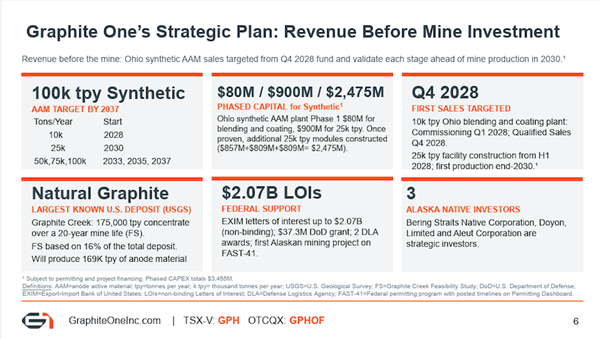
Synthetic AAM sales from Ohio, targeted to begin in Q4 2028, are designed to fund and validate each stage of development ahead of mine production in 2030.
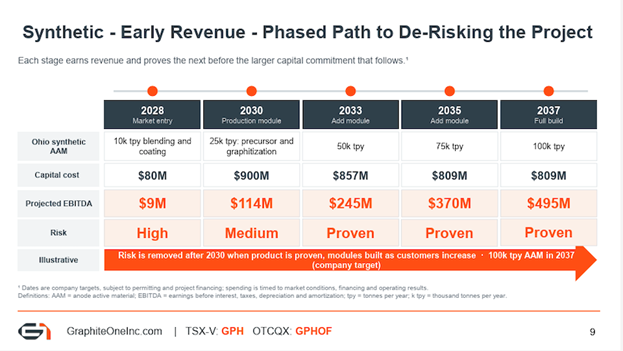
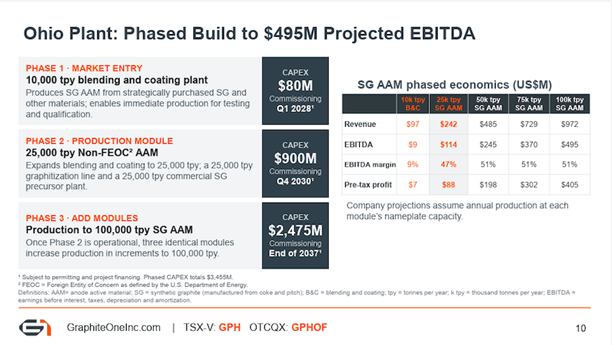
The Company is targeting 100,000 tonnes per year (tpy) of synthetic AAM capacity by 2037, ramping up in phases from 10,000 tpy in 2028. Phase 1 blending and coating is estimated at $80 million of capital, and Phase 2, a 25,000 tpy production module, at $900 million. Once Phase 2 is proven, Phase 3 would add three 25,000 tpy modules at a combined $2.475 billion ($857 million + $809 million + $809 million).
The sequence is synthetic AAM first, natural AAM second and mine production by 2030.
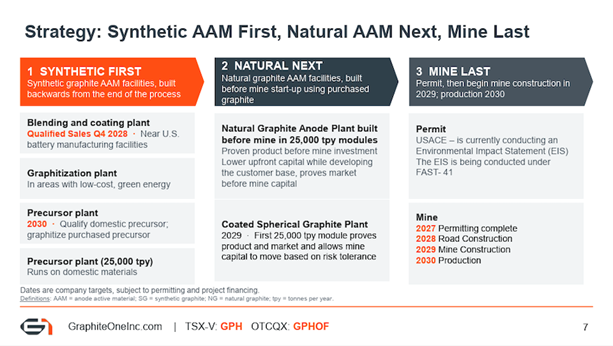
In the first stage, synthetic AAM facilities would be built in reverse process order: the blending and coating plant, located near U.S. battery manufacturers; the graphitization plant, sited where low-cost green energy is available; and a 25,000 tpy precursor plant using domestic materials by 2030.
The second stage would build natural graphite AAM facilities before mine start-up, using purchased graphite. The natural graphite anode plant would be built in 25,000 tpy modules, proving the product and building the customer base before the mine investment while reducing up-front capital.
A coated spherical graphite plant is planned for 2029. Its first 25,000 tpy module is intended to prove the product and the market, allowing the timing of mine capital to reflect risk tolerance.
The result would be a complete U.S. graphite supply chain serving the electric vehicle, energy storage and defense markets.
Each stage is designed to generate revenue and prove the next before the larger capital commitment that follows.
The Ohio plant’s phased build-out targets projected EBITDA of $495 million at full 100,000 tpy capacity.
Graphite One is pursuing two routes to battery-grade anode material.
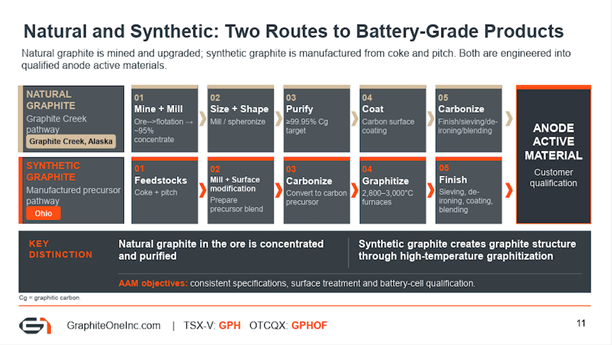
Natural graphite is mined and upgraded; synthetic graphite is manufactured from coke and pitch. Both are engineered into qualified anode active materials.
The key distinction: natural graphite is concentrated and purified from ore, whereas synthetic graphite is created through high-temperature graphitization.
Graphite Creek project
Graphite Creek is the largest known graphite deposit in the United States, according to the U.S. Geological Survey (USGS), and remains open to the west, east and down dip.
Located on Alaska’s Seward Peninsula, the Graphite Creek property comprises 176 State of Alaska mining claims covering 9,600 hectares, entirely on state land.
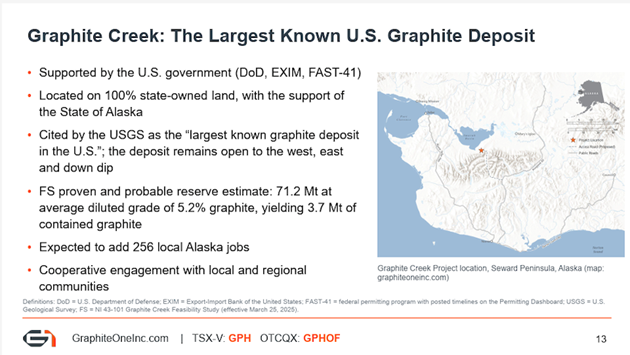
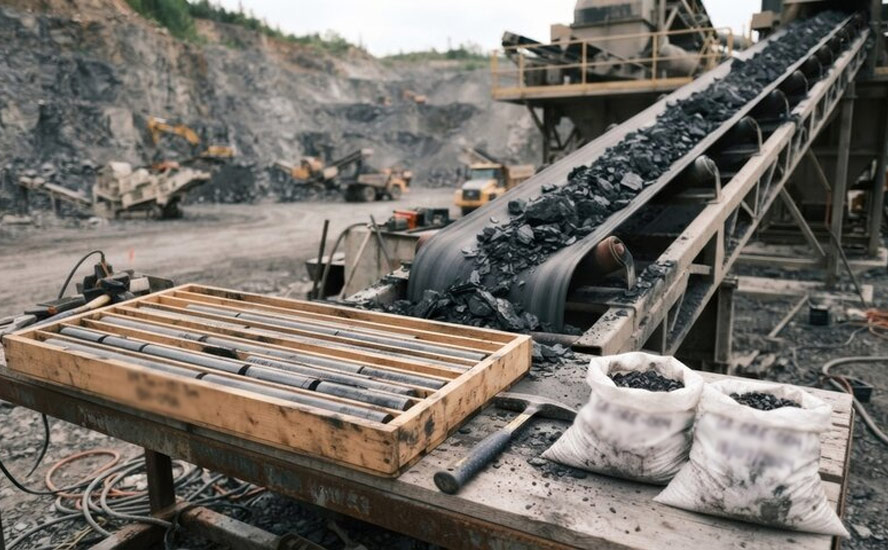
The graphite zone outcrops at surface and strikes east-northeast along the north face of the Kigluaik Mountains. The March 2025 Feasibility Study established proven and probable mineral reserves of 71.2 million tonnes at an average diluted grade of 5.2% graphitic carbon (Cg), containing 3.7 million tonnes of graphite.
The mine is planned to produce an average of 175,000 tpy of graphite concentrate over a 20-year mine life, with initial capital estimated at $949 million.
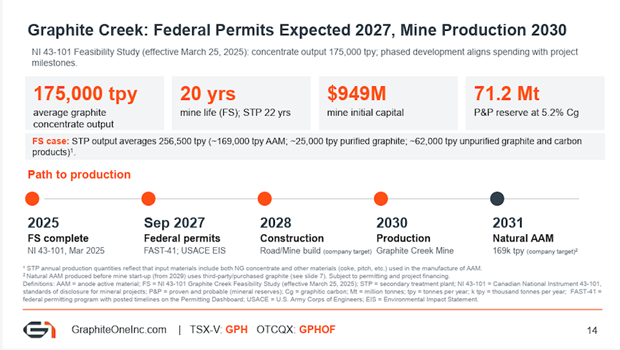
Following completion of the Feasibility Study, federal permits are expected in September 2027 and construction is targeted to begin in 2028. Mine production is targeted for 2030, with natural AAM output of 169,000 tpy by 2031
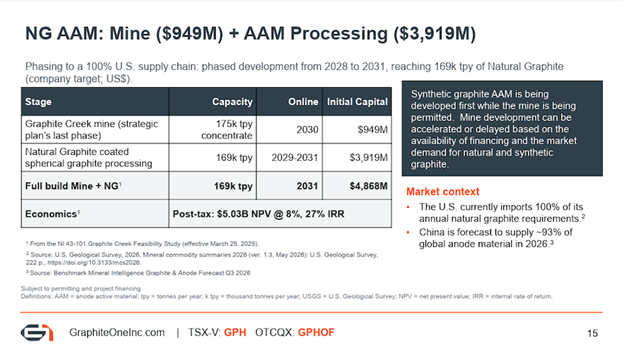
Synthetic AAM is being developed first while the mine advances through permitting. The pace of mine development can be accelerated or deferred depending on financing availability and market demand for natural and synthetic graphite.
The U.S. currently imports 100% of its natural graphite requirements (USGS), and China is forecast to supply approximately 93% of global anode material in 2026 (Benchmark Mineral Intelligence).
A fully domestic natural graphite supply chain would be built in phases from 2028 to 2031. Initial capital is estimated at $949 million for the Graphite Creek mine and $3.919 billion for natural graphite AAM processing, a total of $4.868 billion, to reach 169,000 tpy of natural AAM by 2031.
The Feasibility Study estimates a post-tax net present value (NPV) of $5.03 billion at an 8% discount rate and an internal rate of return (IRR) of 27%.
Government and stakeholder support
Graphite Creek is supported by the U.S. government, including the Department of Defense (DoD), the Export-Import Bank of the United States (EXIM) and the FAST-41 permitting program, as well as by the State of Alaska and three Alaska Native corporations that are strategic investors: Bering Straits Native Corporation; Doyon, Limited; and Aleut Corporation.
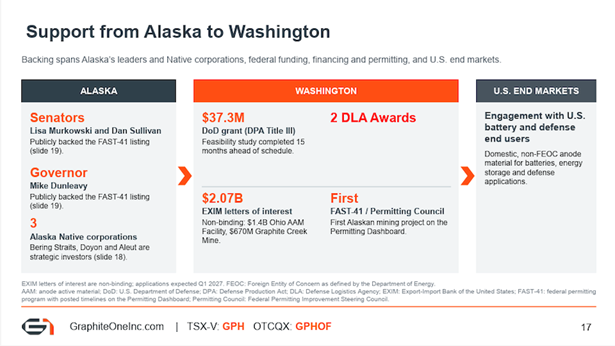
Graphite Creek is the first Alaska mining project on the FAST-41 Permitting Dashboard, which improves the timeliness and predictability of federal permitting through published timelines and procedures.
“As the largest natural graphite deposit in the nation, adding Graphite Creek to the FAST-41 Permitting Dashboard sends a strong signal that Alaska is key to U.S. Critical Minerals development,” said Alaska Governor Mike Dunleavy.
Graphite One received a $37.3 million DoD grant (Defense Logistics Agency Title III) that funded the Feasibility Study, completed 15 months ahead of schedule. It is one of three Defense Logistics Agency awards the Company has received since 2023.
EXIM has issued non-binding letters of interest totaling $2.07 billion: $1.4 billion for the Ohio AAM facility and $670 million for the Graphite Creek mine.
Alaska Senators Lisa Murkowski and Dan Sullivan joined Governor Mike Dunleavy in publicly supporting the FAST-41 listing.
This support positions Graphite One to engage U.S. battery and defense end users as a supplier of domestic, non-FEOC (Foreign Entity of Concern, as defined by the U.S. Department of Energy) anode material for batteries, energy storage and defense applications.
Rare earth element potential
Graphite One has identified rare earth elements (REEs) at Graphite Creek, which could add value to the project once it reaches production.
Geochemical analyses by Activation Laboratories Ltd. (ActLabs) identified REEs in drill core samples of garnet-bearing rock within the planned open pit defined in the Feasibility Study.
Garnet has a strong affinity for REEs and can concentrate them to levels exceeding those in many existing REE ore sources.
As a result, garnet-bearing rocks are considered a potentially important source of REEs, yttrium (Y) and scandium (Sc).
On November 10, 2026, Graphite One announced a research program with Ames National Laboratory to assess and optimize a sustainable process for recovering REEs from Graphite Creek garnet material.
The work, conducted under a Strategic Partnership Project Agreement, will cover garnet preparation and characterization, acid leaching, separation of heavy from light rare earth elements, and product purification.
The three-month program, funded by Graphite One, begins immediately and is intended to develop a preliminary scalable flowsheet and evaluate its mass balance, reagent use, water consumption and waste generation.
“Graphite Creek’s garnets host rare earth elements, including the heavy rare earths and magnet metals that are critical to U.S. technology and the Defense Industrial Base,” President and CEO Anthony Huston stated in the Nov. 10 news release. “Partnering with Ames National Laboratory, the Department of Energy’s premier rare earths research institution with more than 75 years of expertise, gives us a rigorous, independent path to assess their recovery potential. Our objective is clear: to determine how much additional value these rare earths can add to what is already the largest natural graphite deposit in the United States.”
The program will begin with mineralogical and chemical characterization of the garnet material, comminution and mechano-chemical activation, and preliminary acid-leaching tests. Subsequent work will optimize leaching conditions and screen separation approaches, including solvent extraction, stepwise pH adjustment and fractional crystallization. The final phase will assess precipitation and purification of REE group products and prepare an integrated flowsheet and mass balance.
The program builds on 2025 work in which garnet grains were mechanically separated from crushed Graphite Creek drill core at the University of Alaska Fairbanks and analyzed for REE concentrations by ActLabs.
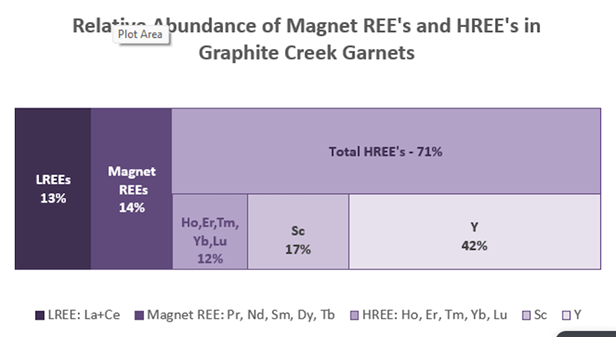
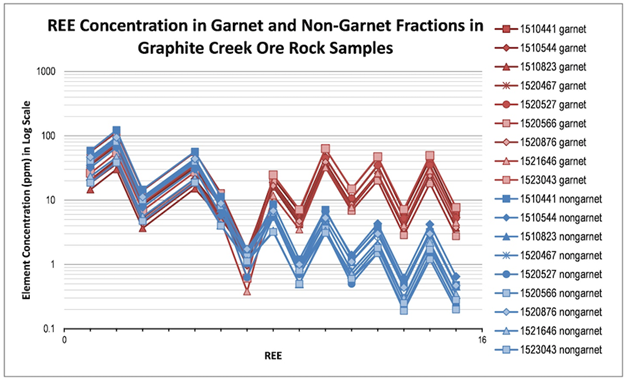
ActLabs found that 85% of the REEs in the tested garnet material were magnet or heavy rare earths, with dysprosium of 32–63 ppm, yttrium of 198–427 ppm and scandium of 84–141 ppm. The garnets appear to host much of the heavy rare earths (HREEs), scandium and yttrium; the separated garnet fraction showed REE concentrations two to six times higher than the remaining material.
Advanced carbon materials
In October 2026, Graphite One received an award from the Defense Logistics Agency (DLA) to develop and evaluate domestically sourced advanced carbon materials for high-temperature defense thermal management applications.
The demonstration project will evaluate advanced carbon-based composite materials derived from domestic resources, supporting the industrial base and resilient domestic supply chains for high-temperature systems. It is the third DLA development agreement awarded to Graphite One since 2023.
The initiative’s objective is to demonstrate the performance of domestically sourced materials in high-temperature applications and support the development of advanced materials for specialized defense and industrial platforms. The project will encompass material processing, thermal evaluation and performance reporting. Graphite One will partner with national laboratory facilities and industry consultants for technical evaluation and stakeholder engagement.
“Advanced thermal management is a critical focus for high-temperature material development. With thermal management representing a key focus area for systems operating in extreme high-temperature environments, evaluating and qualifying domestic material sources remains an essential part of strengthening supply chain resilience,” said Dr. Vaibhav Jain, Program Manager, DLA R&D, in the Oct. 26 news release.
Anthony Huston, Graphite One’s President and CEO, stated, “This new program underscores our commitment to advancing domestic supply chains capable of delivering specialized advanced carbon materials. Working alongside national laboratory researchers and defense logistics stakeholders, we look forward to demonstrating how domestically sourced materials can meet rigorous high-temperature performance requirements.”
Graphite One will manage the project through Graphite One Advanced Systems (G1x), its platform for developing next-generation graphite technologies and supply systems for the energy, technology and national security sectors.
Integrated U.S. supply chain strategy
Graphite One is advancing a vertically integrated domestic graphite strategy designed to reduce U.S. dependence on foreign-sourced graphite and establish an American supply chain extending from raw material through advanced materials manufacturing.
The Company’s strategy includes:
- Mining and processing natural graphite at Graphite Creek, Alaska
- Transporting graphite materials through the Port of Nome
- Manufacturing advanced graphite and anode materials in Ohio
- Potential co-located recycling of graphite and other battery materials
This integrated approach is designed to establish a domestic supply chain spanning resource development, advanced materials manufacturing and potential recycling — supporting the development of a circular U.S. graphite materials economy. The strategy remains subject to project financing.
Graphite One Inc.
TSX-V: GPH; OTCQX: GPHOF
Share price (Nov. 12, 2026): Cdn$0.67
Shares Outstanding: 208.9m
Market Cap: Cdn$140m
GPH website
All dollar figures are U.S. dollars unless otherwise noted; market data are in Cdn$.Targets, timelines and projections are company targets and remain subject to permitting and project financing.
Richard (Rick) Mills
aheadoftheherd.com

Subscribe to AOTH’s free newsletter
Richard does not own shares of Graphite One Inc. TSXV:GPH. GPH is a paid advertiser on his site aheadoftheherd.com This article is issued on behalf of GPH
Legal Notice / Disclaimer
Ahead of the Herd newsletter, aheadoftheherd.com, hereafter known as AOTH.Please read the entire Disclaimer carefully before you use this website or read the newsletter. If you do not agree to all the AOTH/Richard Mills Disclaimer, do not access/read this website/newsletter/article, or any of its pages. By reading/using this AOTH/Richard Mills website/newsletter/article, and whether you actually read this Disclaimer, you are deemed to have accepted it.