 RSS Subscribe
5,000 Years of History vs 15 Years of Code The Battle for Ultimate Reserve Status – AOTH

Gold and Bitcoin are currently experiencing divergent paths due to shifts in institutional flows, macroeconomic pressures, and how each asset reacts to real yields and risk sentiment.
Gold continues to attract steady institutional and central bank attention as a traditional hedge against geopolitical uncertainty and macroeconomic shifts.
Periodic spikes in demand—such as strong buying from international markets (like China) and reactions to U.S. fiscal and debt dynamics—reinforce gold’s status as a classic physical store of value.
Unlike digital assets, physical bullion sees structural long-term accumulation from central banks and sovereign entities looking to diversify reserves away from fiat currency risks.
Digital asset
Following major product launches like spot Bitcoin ETFs, crypto markets have become more tied to institutional risk-management rules. When broader equity markets wobble or risk sentiment cools, institutional funds often rebalance or trim volatile positions faster than physical gold holdings.
Persistent interest rates and elevated bond yields increase the opportunity cost of holding non-yielding assets, hitting high-beta risk and crypto assets more aggressively than traditional precious metals.
Bitcoin has worked through a consolidation phase following earlier volatility cycles, temporarily lagging behind bullion as capital selectively rotates toward defensive or traditional hard-commodity plays.
Bitcoin has historically failed to act as a true, short-term crisis safe haven like gold. Multiple studies and real-world market drawdowns demonstrate that during acute global panic or liquidity squeezes, Bitcoin correlates far more strongly with highly speculative tech stocks and high-beta risk assets than it does with traditional safe havens.
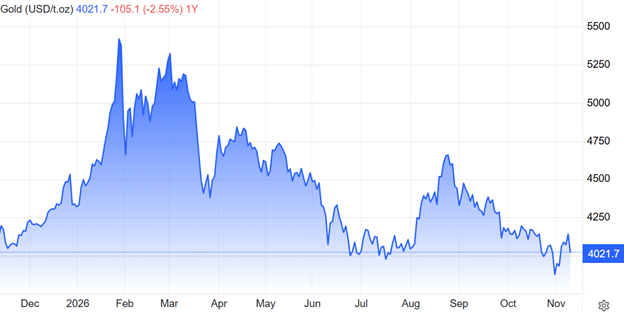
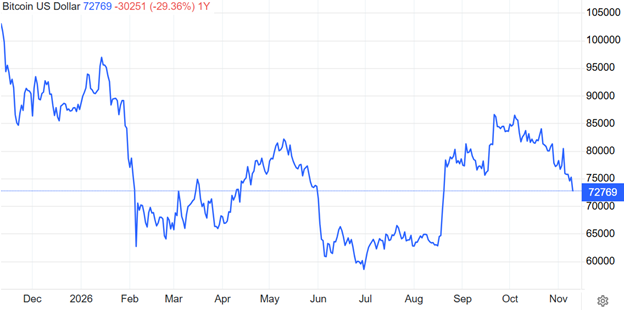
To evaluate if an asset is a “safe haven,” economists measure how it performs when the stock market crashes or global fear spikes. The structural differences between gold and Bitcoin have become highly apparent.
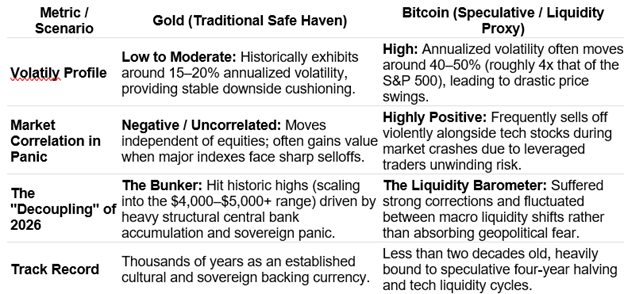
The crypto ecosystem relies heavily on speculative leverage. When global financial uncertainty shocks hit (often measured by a spike in the VIX), institutional investors and hedge funds treat Bitcoin as an open liquidity tap. They sell it aggressively to cover margin calls on their broader equity portfolios.
Rather than a fear hedge, modern institutional allocators have largely categorized Bitcoin as a high-beta play on global money supply (M2) and technology infrastructure. It thrives when global liquidity is expanding and central banks are cutting rates, not when systemic panic sets in.
Interestingly, academic research does note that Bitcoin shows qualities of an inflation hedge against currency debasement over longer time horizons. However, an asset can be a good long-term hedge against a weakening currency while still failing completely as a short-term emergency shelter during a market rout.
Prominent financial institutions like JPMorgan and VanEck now largely treat the two assets as entirely separate buckets. For true, defensive risk-mitigation against geopolitical fires or banking collapses, physical gold remains the primary sovereign bunker.
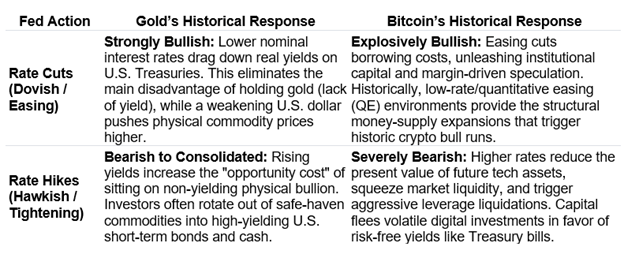
When the Federal Reserve shifts interest rates, gold and Bitcoin react through different financial transmission mechanisms: gold acts as an inverse proxy for bond yields, while Bitcoin acts as a high-beta proxy for global fiat liquidity. Because neither asset pays a dividend or traditional interest coupon, both are fundamentally sensitive to macroeconomic changes, but they process those inputs differently based on risk metrics.
Rate Cuts vs. Rate Hikes
The market behaves dynamically depending on the direction of the Federal Reserve’s adjustments:
Gold is Driven by “Real Yields” and Central Banks
Gold serves as a direct mirror to real interest rates (the nominal interest rate minus the rate of inflation). If the Fed raises interest rates, but inflation rises even faster, real yields remain negative—which is highly supportive of gold.
Gold is heavily shielded from minor Fed adjustments because its largest structural buyers—international central banks—accumulate bullion as a long-term geopolitical and systemic strategy, completely independent of short-term U.S. interest rate changes.
Bitcoin is Driven by global M2 liquidity and risk appetite so it behaves like a highly sensitive barometer for global fiat money supply (M2) and market leverage.
When the Fed hikes rates, banks tighten credit lines. Speculators who use borrowed capital to trade or fund technology plays are forced to unwind their volatile assets first to meet margin calls.
Bitcoin does not just trade against the current interest rate; it trades heavily on the expectation of future policy shifts. A simple hawkish speech from a Fed Governor can erase billions in market value via leveraged liquidations hours before any official rate change occurs.
Central banks systematically avoid buying Bitcoin while aggressively accumulating gold due to three core mandates: safety, absolute liquidity, and political neutrality.
As of late 2026, global central banks hold roughly 36,000 to 40,000 metric tons of physical gold, recently surging with net purchases hitting 321 tons in just the third quarter of this year. In contrast, mainstream central banks hold virtually zero Bitcoin.
The structural divide between these choices stems from distinct institutional mandates.
The primary job of a central bank’s reserve is to defend the nation’s currency and handle sudden economic crises.
Gold exhibits an annualized volatility of about 15%, providing a highly reliable and slow-moving base of value.
Bitcoin’s volatility often surges past 40%. If a central bank needs to dump billions of dollars worth of an asset overnight to defend its domestic economy during a financial panic, it cannot risk that asset being down +40% on a random speculative market swing.
Central banks trade in massive volumes. True liquidity means being able to sell billions of dollars of an asset instantly without causing the price to crash.
Gold boasts one of the deepest, most integrated institutional trading markets on earth. Billion-dollar physical transactions occur seamlessly daily through major global hubs like London, New York, and expanding hubs like Singapore.
Bitcoin’s market depth is far shallower. If a major central bank attempted to liquidate $10 billion worth of Bitcoin during a crisis, it would completely break the order books, trigger algorithmic cascading liquidations, and crater the asset’s price before the sale could finish.
Central banks require absolute ownership over assets, especially as emerging markets seek options outside Western-dominated systems.
Gold has no counterparty risk. It can be flown directly into a nation’s domestic subterranean vaults, entirely immune to foreign cyberattacks, internet outages, or asset freezing.
Bitcoin relies on a borderless, decentralized digital network. For a sovereign nation, routing billions in national wealth through digital keys creates unique vulnerabilities. They risk software bugs, hard fork network splits, quantum computing security updates, or code protocol changes decided by an anonymous open-source developer community rather than a state government.
Gold has thousands of years of established global legal infrastructure, trade treaties, and accounting standards built entirely around it. It is universally classified as a tier-1 risk-free reserve asset. Bitcoin is less than two decades old and still faces active global regulatory battles, tax classification shifts, and structural bans in various jurisdictions.
While a few minor governments hold Bitcoin acquired through law enforcement seizures or minor experiments, systematic accumulation is reserved strictly for physical bullion.
Conclusion
Central banks do not buy gold to get rich or generate short-term trading profits. They buy it to build financial resilience.
Retail investors absolutely can, and do, take a page out of the central bank playbook by using gold as a foundation for long-term portfolio insurance.
For absolute safety against systemic grid failures, purchasing investment-grade government-minted coins (like the American Eagle or Canadian Maple Leaf) remains the gold standard. The key rule is to avoid collectible or numismatic coins, which charge heavily inflated markups that have nothing to do with the actual melting value of the metal.
Physically backed Gold ETFs provide highly liquid, stock-like access to actual vault-secured bullion. Global inflows into gold ETFs have surged significantly, highlighting their popularity as a frictionless proxy.

Legal Notice / Disclaimer
Ahead of the Herd newsletter, aheadoftheherd.com, hereafter known as AOTH.Please read the entire Disclaimer carefully before you use this website or read the newsletter. If you do not agree to all the AOTH/Richard Mills Disclaimer, do not access/read this website/newsletter/article, or any of its pages. By reading/using this AOTH/Richard Mills website/newsletter/article, and whether you actually read this Disclaimer, you are deemed to have accepted it.