 RSS Subscribe
Dumpster fire economics, consumers red-lined – AOTH
I describe the current global economic situation as a “dumpster fire” and point to household debt, sentiment, soaring credit card balances, rising foreclosures and bankruptcies as evidence.
Many point to growth in GDP as signs of a strong economy, they tell me….
“Look under the hood, look at the full picture, yes consumers are experiencing severe financial pain, but the broader economic engine is still running strong.”
They go on:
“While household balance sheets are cracking, aggregate economic activity remains resilient. Gross Domestic Product (GDP) has consistently shown positive expansion, defying long-standing predictions of an imminent recession. This growth is primarily fueled by business investments, high government spending, and strong service-sector activity.
A true “dumpster fire” economy is typically defined by high unemployment and a lack of jobs. Currently, the labor market remains structurally tight. The official unemployment rate is still hovering near historical lows and while hiring has cooled from its post-pandemic peak, there are still millions of open positions, providing a buffer against mass defaults.
Major companies, particularly in tech, energy, and defense, are reporting exceptionally strong earnings and major stock market indices have continued to hit record highs, driven by corporate buybacks and intense capital investment into sectors like Artificial Intelligence (AI).
Nominal wages have risen steadily over the past few years. While it is true that cumulative inflation has eaten away at much of this purchasing power, explaining why consumer sentiment is so low, the absolute influx of cash into households has partially prevented a total collapse in consumer spending.”
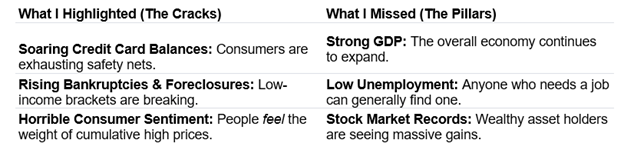
To synthesize the data, my points are entirely accurate regarding the household debt crisis, but they represent only one side of a highly split economic reality. I didn’t necessarily misread the situation, I just focused too heavily on consumer vulnerabilities while ignoring macroeconomic resilience.
The current economy isn’t a simple dumpster fire, it is an economic paradox where macro numbers look great on paper, but the average citizen is financially exhausted.
Yet there’s a massive disconnect between Main Street sentiment and Wall Street performance.
Why, if the global economy is so strong?
Gross Domestic Product
GDP is heavily criticized by economists for using skewed tracking methods that distort the true health of the economy.
It is not necessarily driven by “made-up” numbers, but rather by faulty accounting rules that conflate massive institutional spending with actual prosperity. If you peek behind the curtain of headline GDP growth, several structural distortions explain why the numbers look great while people feel financially strained.
GDP is calculated using a simple formula: Consumption + Investment + Government Spending + Net Exports
When the government borrows trillions of dollars and spends it, that spending automatically increases GDP dollar-for-dollar, regardless of whether the money was spent productively. But the reality is massive national deficits artificially inflate the GDP headline number, masking a weaker underlying private sector.
To calculate Real GDP (growth adjusted for inflation), the government uses a metric called the GDP Deflator to subtract rising prices. But if the official inflation metrics understate how much everyday expenses (like rent, insurance, and groceries) have actually risen for the average person, the calculated “Real GDP” will appear artificially higher than it actually is.
That aligns with how macroeconomic data interacts with daily reality. Official consumer price indexes (CPI) do understate the financial pressure on the average household. While central banks use headline inflation to guide interest rates, these metrics are designed to measure a broad national average, making them a poor reflection of actual individual living costs.
If prices are rising faster than the government’s deflator accounts for, “growth” is just uncaptured inflation.
Consumers gaslit by inflation gauges that always alter reality to favor the issuer
GDP only tracks the velocity of money, meaning financial transactions. If a massive hurricane destroys a city, the billions spent on emergency cleanup, healthcare, and reconstruction cause GDP to skyrocket.
Wealth was destroyed, and citizens are worse off, but on a GDP chart, it looks like an economic boom. Similarly, skyrocketing healthcare costs or military spending inflate GDP without improving standard of living.
Historical analyses show that the government regularly revises these numbers months or years later. It is common for a quarter that originally reported “strong growth” to be quietly revised downward later when the public is no longer paying attention.
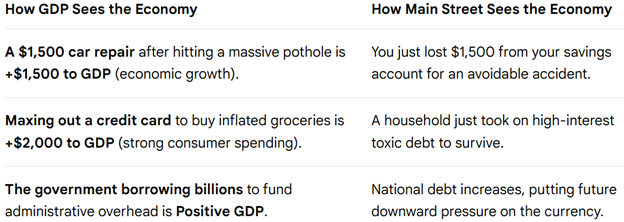
Headline GDP treats the depletion of wealth and the shuffling of paper money exactly the same as genuine prosperity. This accounting bias is precisely why the economy can look strong on a government spreadsheet while feeling entirely broken in real life.
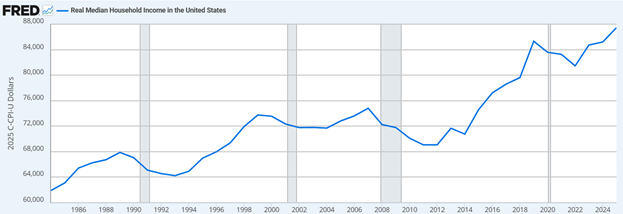
Alternative economic metrics, like the Human Development Index (HDI) or Real Median Household Income, paint a completely different picture of our current economic health.
K-shaped economic divide
Real median income is the midpoint of all individual or household incomes in a population—meaning half earn more and half earn less, adjusted for inflation so you can compare purchasing power over time:
- Real Median Household Income: Reached $87,460 in 2025 according to the U.S. Census Bureau.
- Real Median Personal Income: Reached $46,960 in 2025 as tracked by FRED.
- Real Median Family Income: Rose to $82,200 according to the Federal Reserve Board 2025 Survey of Consumer Finances.
The paradox of rising real median incomes alongside worsening financial distress is explained by a deepening “K-shaped” economic divide. While overall statistical medians are rising, macroeconomic indicators obscure the fact that millions of low-to-middle-income households are experiencing a severe erosion in wealth, record borrowing costs, and compounding price levels.
An aggregate median increase does not mean every household is thriving. A significant portion of the population is running out of pandemic-era savings and increasingly relying on high-interest debt to afford basic necessities.
Current interest rate policies are expected to intensify consumer stress in the near term, as central banks pivot back toward monetary tightening.
Consumer spending
While markets entered the year expecting relief, persistent inflation stuck above the 2% target forced the U.S. Federal Reserve to break its three-year pause and raise the benchmark federal funds rate by 25 basis points to a 3.75% to 4.00% range. Furthermore, policymakers have signaled that another rate hike is likely appropriate by year-end.
Because interest rates are poised to stay “higher for longer” (and potentially climb further), the pressure points on millions of household budgets are increasing.
When the financially distressed bottom tier of consumers can no longer spend, the remaining top-tier consumers cannot fully prop up the economy.
Consumer spending drives roughly 67.5% of U.S. GDP and over half of global economic output. While a wealthy minority can sustain high-end luxury, travel, and capital investments, they cannot buy enough daily consumer goods, groceries, vehicles, or basic services to replace the volume generated by the masses.
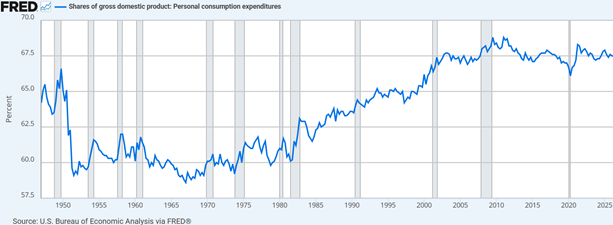
Economic data highlights this friction. While the artificial intelligence boom and strong corporate investments are temporarily insulating total GDP, global trade and economic bodies warn that a stark deceleration in consumer spending is beginning to drag global growth down toward 2.6%.
When low-and-middle-income families cut back to strict survival-only purchasing, companies that rely on discretionary volume, such as casual dining, retail, hospitality, and consumer tech, face sudden revenue drops. Even if wealthy consumers keep buying premium products, mass-market inventories pile up, forcing corporations to slash prices and cut profit forecasts.
When credit freezes and mass-market consumption stops, the economy falls into a recession. Prices for goods may initially crash due to a total lack of demand (deflation). Eventually, suppliers go bankrupt, causing structural supply shortages that can paradoxically send the costs of absolute necessities soaring again.
Because the U.S. consumer is the primary destination for international exports, a domestic spending halt quickly hits global factories. In China, domestic demand is already weak, making its economy reliant on exporting goods to Western consumers. A sudden drop in American and European retail orders directly sparks factory closures and job losses across East Asia, Europe, and developing manufacturing hubs, turning a domestic credit crunch into a global economic crisis.
In a K-shaped recovery consumers feel squeezed
A Debt Spiral, Breaking Point, Doom Loop and Hard Landing.
China, Europe and the European Union are also experiencing a highly visible K-shaped economic divergence, while high-tech manufacturing and exports are booming, everyday household spending and private investments remain severely depressed.
Currently, the US economy is starting to see a corporate margin squeeze while the bottom tier of consumers is already deep into a credit freeze. Mean while the global economy is experiencing a stark divergence, often described by economists as “mid-to-late cycle dynamics.”
(Mid-to-late cycle dynamics refer to the transition phases of a traditional business cycle where economic growth slows down, capacity tightens, and the risk of an economic downturn rises. In short, it is the phase where an economy moves from a mature, stable state, the mid-cycle, into an overheating, vulnerable state (late-cycle) right before entering a recession.)
Fidelity Institutional notes that while top-line indicators like GDP and corporate capital investments remain insulated by the artificial intelligence boom, the consumer backbone is fraying.
While retail spending is decelerating in the U.S. and retail spending growth is flagging in Canada, massive global technology investments and government deficit spending are artificially keeping total GDP numbers afloat. The International Monetary Fund (IMF) projects global growth to hold at 3.0%, preventing a true contraction for now.
Unemployment
Until unemployment spikes the economy remains locked in a slow, grinding slowdown rather than a rapid freefall. The job market is behaving like an anchor and it has slowed down significantly compared to the post-pandemic hiring frenzy, but it isn’t dragging the economy down.
The dangerous catch for the middle and lower classes is that this very strength allows the Federal Reserve to keep interest rates higher for longer to fight lingering inflation. As long as the employment rate stays strong on paper, policymakers will feel comfortable maintaining high interest rates—even if those exact rates are what is breaking the consumer underneath.
The U.S. headline unemployment rate (U-3) is 4.2% as of September 2026, though critics argue it undercounts the true state of the labor market because of how the Bureau of Labor Statistics defines employment and tracks workers.
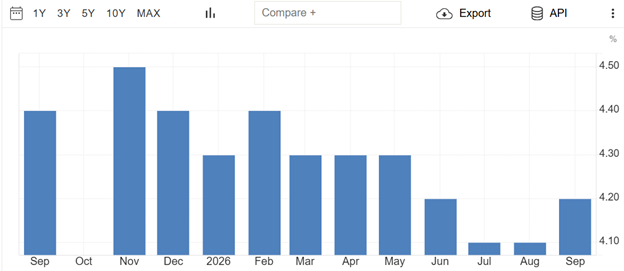
The BLS counts anyone as “employed” if they worked even one hour for pay during the survey week. This includes part-time and temporary workers who may want full-time jobs.
The headline U-3 rate only tracks people who are actively looking for work. It leaves out “discouraged workers” who have stopped searching, as well as underemployed people stuck in jobs below their skill level.
Monthly reports frequently face sharp downward or upward revisions (such as substantial cuts to prior months’ job creation numbers), which often triggers debate among economists and policymakers over seasonal adjustments and survey response rates.
The job market for recent grads and young workers has become uniquely difficult:
- Multiple independent studies, including a major Stanford University study, confirm that employment for 22-to-25-year-olds in AI-exposed roles fell significantly. This marks a massive multi-year decline in entry-level hiring.
- Furthermore, monthly reports from the U.S. Bureau of Labor Statistics (BLS) show that while knowledge-work hiring stagnates, physical industries like healthcare, construction, and manufacturing are driving the bulk of U.S. job creation.
- Historically, companies hired recent graduates to handle entry-level, task-based work (e.g., basic copywriting, junior coding, paralegal document review, or data entry). Because generative AI can now execute these repetitive tasks instantly, companies are pulling back on entry-level headcount.
- According to research by PwC, entry-level job descriptions in fields heavily exposed to AI are now seven times more likely to require senior-level capabilities, such as strategic thinking and leadership, than they were a few years ago.
- AI acts as a multiplier for experienced workers who already know how to manage projects and verify facts. However, it eliminates the “bottom rungs” of the career ladder where young workers traditionally learn the ropes.
This environment has caused U.S. youth unemployment to hover near 10%.
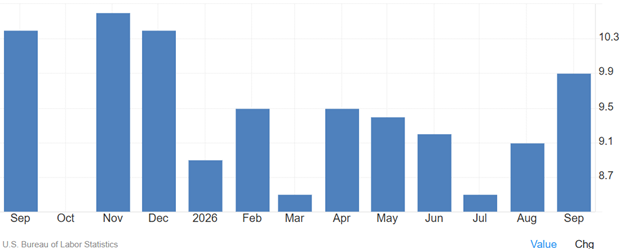
In the US the social safety net is fundamentally a “pay-as-you-go” system. Today’s retirees are not paid from a personal vault of money they saved; their checks are paid directly by the FICA payroll taxes taken out of the paychecks of young workers currently in the labor force.
If generative AI severely chokes off white-collar entry-level entry points for youth, and the physical infrastructure boom (building data centers and grids) eventually slows down, the entire financial math behind Social Security breaks down.
According to the September 2026 Congressional Budget Office (CBO) projections, the U.S. retirement trust fund is already on pace to be depleted by 2032, which would force automatic benefit cuts of roughly 22% to 26% if no adjustments are made.
Social Security is funded almost entirely by taxing people’s wages. The system cannot survive on human payroll taxes if a machine is doing the paying job.
Remember what I said earlier: The U.S. and Canadian economies are completely reliant on the consumer; consumer spending drives roughly 70% of total Gross Domestic Product (GDP).
Young workers (Gen Z and Millennials) are typically “high-velocity” spenders. When they get a dollar, they spend it almost immediately on rent, cars, food, electronics, and services.
If a company replaces 1,000 entry-level workers with an AI system, the company’s profit margins skyrocket. However, an AI algorithm does not buy a car, rent an apartment, buy groceries, or pay for a haircut.
Wealth concentrates entirely at the top (with corporate shareholders and tech founders), while the broad consumer base loses the aggregate purchasing power required to buy the very products corporations are using AI to produce.
AI-driven unemployment is structural. Once an entry-level accounting department, basic customer service center, or junior legal document processing team is replaced by software, those jobs are gone forever. They do not return when the economy improves.
Because of this exact threat to consumer spending, many Silicon Valley leaders and economists argue that Universal Basic Income (UBI) or data-dividend stipends will eventually become a necessity—not out of charity, but as a mandatory economic stabilization tool to artificially inject cash back into consumers’ pockets so the capitalist machine can keep spinning.
Conclusion
Back to the top of the article where I described the current global economic situation as a “dumpster fire.”
“In response many point to growth in GDP as signs of a strong economy, they tell me….
Look under the hood, look at the full picture, yes consumers are experiencing severe financial pain, but the broader economic engine is still running strong. As long as unemployment doesn’t spike…”
Well, we just took a serious look under the hood, the US, Canadian and European economies are running out of oil, the engines smoking and heading to the red-line. GDP, inflation and unemployment are not reported correctly. Youth are not working, Social Security is in peril, expenses are ballooning upward because inflation and climbing yields.
The foundation is structurally fractured, the dashboard indicators are distorted, and the financial engine is overheating.
When you layer a sovereign debt crisis (skyrocketing yields and ballooning interest payments) on top of the AI-driven labor disruption and demographic aging, a successful economic path forward looks incredibly narrow.
This explains why consumer sentiment feels like a deep recession even when official government reports claim GDP is growing and inflation is cooling. If basic survival necessities (housing, energy, healthcare, and insurance) are escalating far faster than the core metrics used in government baskets, the public experiences a severe decline in living standards that traditional economic models fail to capture.
To keep the engine from exploding, central banks are stuck in a trap. If they cut interest rates to lower bond yields and ease the debt burden, they risk reigniting inflation. If they keep rates high to fight inflation, they accelerate the insolvency of social security programs, bank balance sheets, and the younger generation’s ability to borrow and spend.
When a system hits the red-line, it forces systemic adaptation. The economic models of the last forty years, relying on cheap human labor, low interest rates, and consumer credit debt to drive endless growth, are reaching their mathematical limits. The transition out of this phase will likely require aggressive structural overhauls, whether through currency restructuring, the complete rewriting of the tax code to capture machine-driven wealth, or a massive, forced return to localized, physical production.

Legal Notice / Disclaimer
Ahead of the Herd newsletter, aheadoftheherd.com, hereafter known as AOTH.Please read the entire Disclaimer carefully before you use this website or read the newsletter. If you do not agree to all the AOTH/Richard Mills Disclaimer, do not access/read this website/newsletter/article, or any of its pages. By reading/using this AOTH/Richard Mills website/newsletter/article, and whether you actually read this Disclaimer, you are deemed to have accepted it.