 RSS Subscribe
Cosa intersects anomalous radioactivity and additional prospective geology at Darby Joint Venture with Denison Mines – Richard Mills

Cosa Resources (TSXV:COSA, OTCQB:COSAF) this week announced results of the summer drill program at the Darby Project, a joint venture between Cosa and Denison Mines (TSX:DML).
Darby is located 10 kilometers west of Cameco’s Cigar Lake mine. Cosa, the project operator, holds a 70% interest, with Denison holding 30%.
Cosa highlighted anomalous radioactivity of 950 counts per second (cps) over 0.5 meters, intersected by Gamma drill hole DB26-43, is associated with hydrothermal alteration.
Drilling at Gamma further defined a zone of structure, alteration, and over 55 meters of unconformity relief and potentially identified a parallel and untested structural corridor.
Drilling at the Bravo trend intersected structure, alteration, and defined over 40 meters of unconformity relief.
Results from Gamma and Bravo strengthen Cosa’s exploration strategy at Darby and support a focused and fully-funded follow-up campaign in early 2027.
“Cosa’s second drill program at Darby has highlighted the Gamma and Bravo trends for follow-up winter work and continues to demonstrate the prospectivity of Darby as a discovery-ready project alongside our Murphy Lake North joint venture with Denison Mines,” Cosa’s President and CEO Keith Bodnarchuk stated in the Nov. 12 news release. He added: “Intersecting anomalous radioactivity at the Gamma trend, paired with a broad zone of structure and alteration that remains open in multiple directions, reinforces our belief in the increasing discovery potential at Darby, and we are excited to return for fully funded follow-up drilling in 2027. We aim to update the market regarding 2027 plans in the coming weeks which are scheduled to include simultaneous drilling at both the Darby and Murphy Lake North joint ventures.”
Andy Carmichael, VP Exploration, commented: “Anomalous uranium geochemistry at multiple trends and impressive amounts of structure with over 50 metres of unconformity relief makes for very exciting targets in Athabasca uranium exploration. At Gamma, elevated radioactivity and a broad zone of structure and alteration lie along trend of historical intersections of mineralization, and the sparse existing drilling has left several kilometres of this prospective geology untested.”
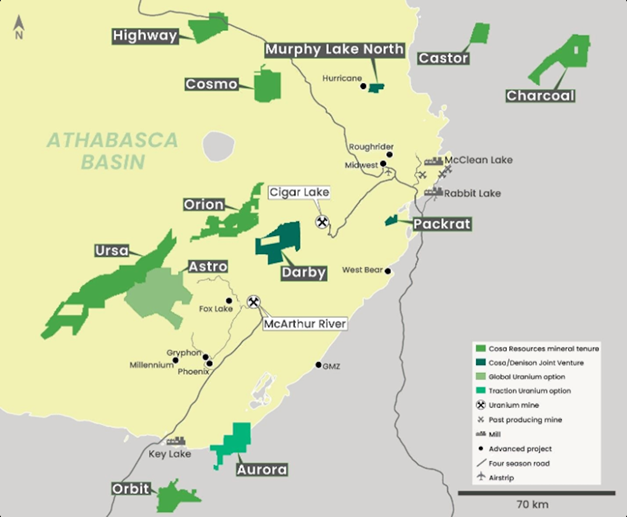
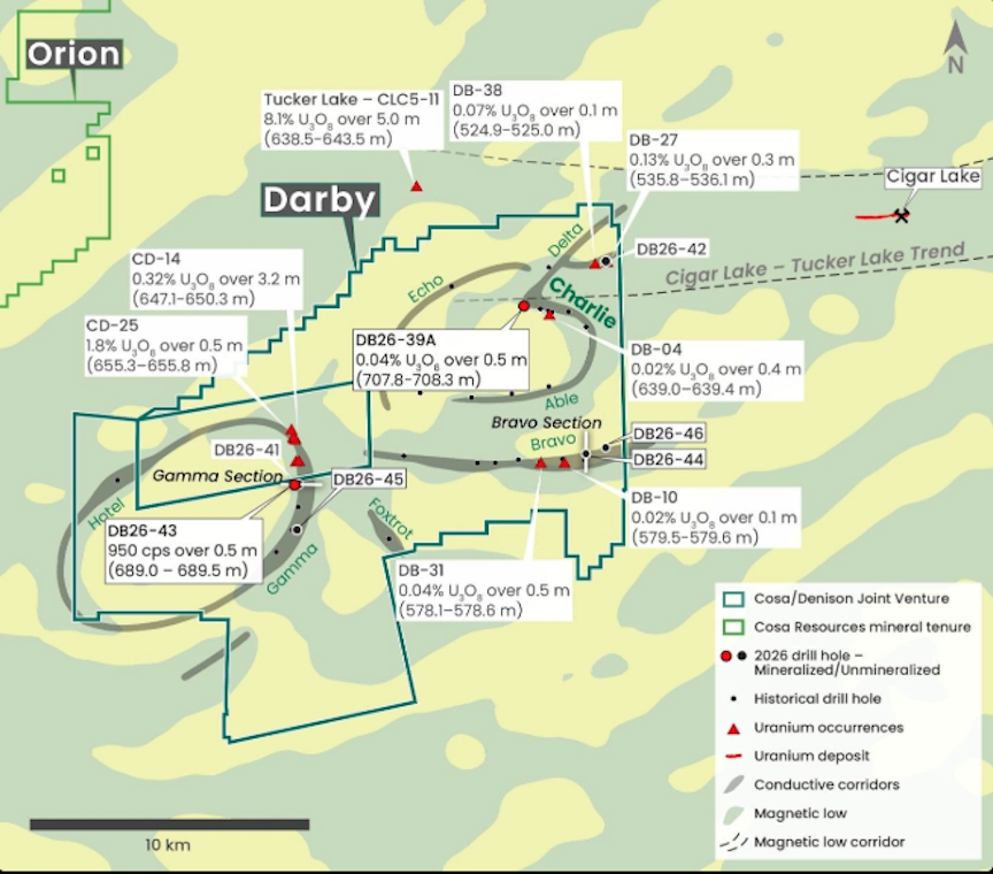
Darby summer drilling
Since acquiring a 70% interest in the Darby Joint Venture from Denison, Cosa’s objective has been to build on historical results to further evaluate and prioritize each of the prospective trends at Darby, four of which host uranium mineralization. Significant results from Cosa’s inaugural drill program at Darby in winter 2026 include prospective geology intersected at the Gamma trend and weak uranium mineralization at the Charlie trend.
The objectives of the four-hole (2,741-meter) summer program were to follow up winter results at Gamma, further evaluate prospective geology on trend with mineralization, and follow up historical mineralization at the Bravo trend which is best accessed via helicopter.
Summer drilling successfully expanded the zones of structure and alteration at both Gamma and Bravo. The company awaits geochemical assays to further vector drilling, notably at the Gamma trend where elevated radioactivity was intersected adjacent to structure and alteration.
Gamma Trend
Two holes were completed at Gamma where previous drilling intersected a broad zone of structure with 35 meters of unconformity offset, alteration, and elevated to strongly anomalous uranium geochemistry on trend with multiple historical intersections of uranium mineralization north of Darby.
Completed on section with previous drilling, DB26-43 intersected multiple zones of moderate to strong faulting and alteration in the lower sandstone (Figure 3) as well as localized faulting in the basement.
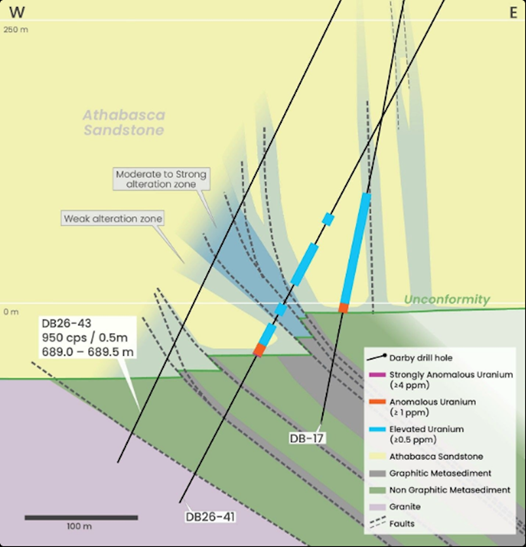
The unconformity was intersected 22 meters lower than Cosa’s winter drill hole DB26-41, increasing total unconformity relief on section to 57 meters. A zone of anomalous radioactivity (950 cps, 689.0-689.5 meters) intersected 33 meters below the unconformity is associated with hematite, limonite and argillization.
DB26-45 was completed 1,600 meters south along strike to follow up historical hole DB-23R which intersected zones of anomalous uranium content in the sandstone. DB26-45 intersected a 37-meter-long interval of faulting in the upper sandstone which may reflect an additional and untested structure.
Together, Cosa interprets that both DB-23R and DB26-45 may be overshots of an untested package of prospective rocks related to sandstone structure, alteration, and anomalous uranium geochemistry. The Gamma trend warrants focused drilling, and follow-up is planned to further evaluate the source of anomalous uranium geochemistry and sandstone structure.
Bravo Trend
Two holes were completed at Bravo to explore prospective geology intersected by historical drilling highlighted by intersections of weak uranium mineralization, broad zones of anomalous uranium, graphitic faulting, and over 25 meters of unconformity offset. Summer drilling targeted 2.2 kilometers of untested strike length on the eastern Bravo trend and intersected zones of faulting and alteration in the sandstone and basement.
DB26-44 followed up DB-12, which Cosa interprets to have undershot the Bravo trend’s faulted graphitic rocks by approximately 175 meters (Figure 4). DB26-44 is considered a near-miss overshot of the ideal target by ~30 meters. The lower sandstone contains faulting and accompanying alteration, and the unconformity was intersected 41 metres lower than in DB-12.
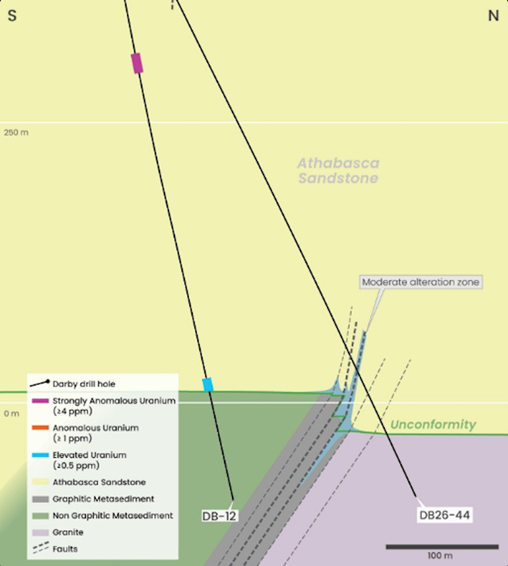
Hole DB-12
DB26-46 targeted graphitic faulting 800 meters east along strike of DB26-44 and intersected weakly bleached lower sandstone above the unconformity at 516.1 meters. Variably graphitic gneiss from 542 to 568 meters is faulted and hosts weak to moderate hydrothermal alteration. DB26-46 is interpreted to have undershot the optimal target by 30 meters.
The presence of sandstone structure, alteration, and unconformity offset defined by DB26-44 combined with basement structure and alteration in DB26-46 suggests that drilling 800 meters apart along strike narrowly bracketed the target graphitic horizon and indicates that Bravo hosts a significant, kilometer-scale hydrothermal system.
Next steps
Drilling at Gamma and Bravo has further demonstrated the prospectivity of both trends. Focused work at Gamma is a priority for 2027 and is expected to include significant drilling supported by geophysical surveys to refine drill targets within the 1,600-meter corridor of structure, alteration, and anomalous uranium that remains open on multiple sections and along strike on this 4-kilometer-long trend. At Bravo, pending geochemical assays are expected to guide follow-up drilling given the proximity of both summer drill holes to the target horizon.
Cosa remains committed to prioritizing areas for further work at Darby. In addition to Gamma and Bravo, multiple mineralized trends at Darby feature kilometers of untested or ineffectively tested strike length. Given the degree of structure and alteration intersected by both drill programs in 2026, Cosa awaits geochemical assays from summer drilling to further prioritize existing targets and follow-up work.
The company is eager to return to Darby, and follow-up drilling for both Darby and Murphy Lake North (MLN) is tentatively scheduled to commence simultaneously in January.
Conclusion
Cosa’s news release shows more signs of life from the Darby Joint Venture. It has all the ingredients you’d want to see in an early-stage uranium play and is similar to MLN. This includes:
- Multiple mineralized holes on trend
- Anomalous radioactivity now drilled by Cosa
- Structure and alteration now drilled over 1.6km of strike and still open
- Potentially identified another parallel trend with impressive structure and alteration high up in the sandstone
The drill program at Murphy Lake North concluded in mid-September. Cosa highlighted multiple zones of structurally controlled alteration and elevated radioactivity remain open along strike for several hundred meters and on multiple sections.
Drilling evaluated multiple structures over 650 meters of strike length, with all 13 drill holes intersecting strong structure and/or alteration.
Summer 2026 drilling prioritized unconformity targets with significant room for basement-hosted mineralization remaining.
Cosa Resources Corp.
TSXV:COSA, OTCQB:COSAF
Cdn$0.28 2026.11.12
Shares Outstanding 136.7 m
Market Cap Cdn$37.5m
COSA website
Richard (Rick) Mills
aheadoftheherd.com

Subscribe to AOTH’s free newsletter
Richard does not own shares of Cosa Resources Corp.
TSXV:COSA. COSA is a paid advertiser on his site aheadoftheherd.com
This article is issued on behalf of COSA
Legal Notice / Disclaimer
Ahead of the Herd newsletter, aheadoftheherd.com, hereafter known as AOTH.Please read the entire Disclaimer carefully before you use this website or read the newsletter. If you do not agree to all the AOTH/Richard Mills Disclaimer, do not access/read this website/newsletter/article, or any of its pages. By reading/using this AOTH/Richard Mills website/newsletter/article, and whether you actually read this Disclaimer, you are deemed to have accepted it.