 RSS Subscribe
Unloved silver the poor mans gold but the devils metal – AOTH

Silver is commonly known by these distinct monikers due to its massive price volatility, lower entry cost relative to gold, and historical tendency to be ignored by mainstream investors until a supply crisis hits. While it has long lived in the shadow of gold, its unique dual identity as both a monetary asset and a critical industrial commodity shapes these three famous reputations.
Silver is nicknamed “the devil’s metal” because of its highly volatile, erratic, and unpredictable price swings. Speculators and traders have historically been driven to madness trying to time the silver market. This chaotic behavior stems from two structural factors:
- The silver market is roughly ten times smaller than the gold market. When institutional capital flows into or out of silver, it causes massive, magnified percentage jumps or crashes.
- Unlike gold (which acts almost purely as a safe-haven asset), silver is heavily exposed to industrial demand. It constantly swings between reacting to macroeconomic updates (inflation, interest rates) and microeconomic manufacturing cycles.
The phrase “poor man’s gold” highlights silver’s significantly lower price per ounce compared to gold, making physical precious metal ownership accessible to everyday retail investors.
- For centuries, societies globally (notably across parts of Asia like India) used silver for everyday transactions, dowries, and celebrations because gold was entirely out of financial reach for the working class.
- Historically, this ratio averages around 68:1 (meaning it takes 68 ounces of silver to buy 1 ounce of gold). Because it is vastly less scarce than gold, it offers a cheap entry point for baseline physical wealth preservation.
Silver is often deemed “unloved” because institutional Wall Street investors frequently ignore it for years during extended economic expansions.
The Changing Narrative
The “poor man’s” narrative has faced a massive structural shift due to the global green energy transition and the rise of artificial intelligence. Because silver is the most electrically conductive and reflective metal on earth, it has become an irreplaceable bottleneck for solar photovoltaics, AI data center switches, and military defense infrastructure.
With the global market logging multi-hundred-million-ounce structural deficits, the “unloved” asset is increasingly viewed by analysts as a strategic industrial asset rather than just gold’s cheaper alternative.
The consecutive annual deficits since 2021 have fundamentally altered silver’s market dynamics, culminating in a cumulative shortfall of 762 million troy ounces. This multi-year run has drawn heavily from above-ground institutional stockpiles, meaning the world has effectively consumed nearly an entire year of global mine output just to fill the supply gaps.
This deficit has added severe fundamental pressure to silver pricing, which is reflected in its highly volatile multi-year performance.
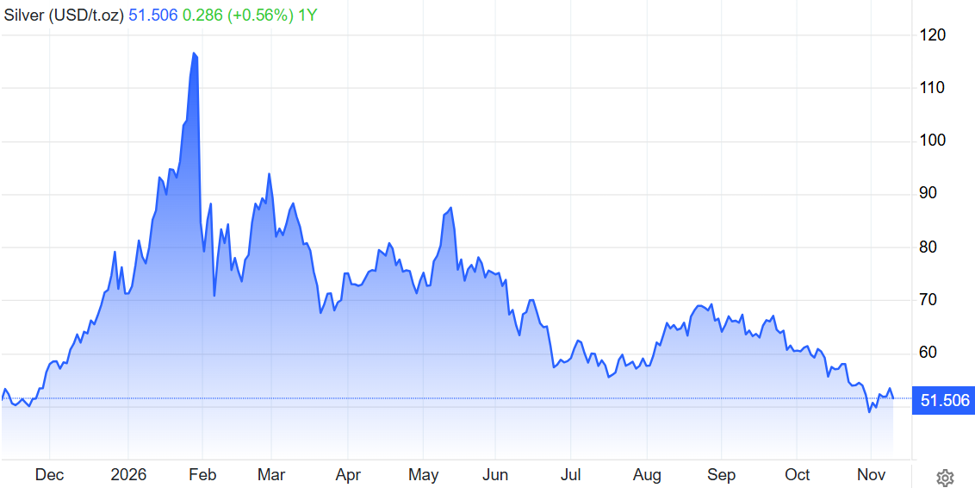
Data tracked by the Silver Institute highlights that this structural deficit is a persistent mismatch where combined mining and recycling operations fail to meet escalating commercial use.
Over 70% of silver is pulled from the ground as a secondary byproduct while mining for primary metals like copper, zinc, lead, and gold. Because miners do not build new facilities based primarily on the price of silver, supply remains rigid and unable to react rapidly to shortages.
Industrial demand now captures roughly 58% of the annual market. While alternative applications have seen optimization, the exponential scaling of solar photovoltaic capacity, AI data centers, and advanced vehicle electronics continues to create a baseline requirement that previous decades never experienced.
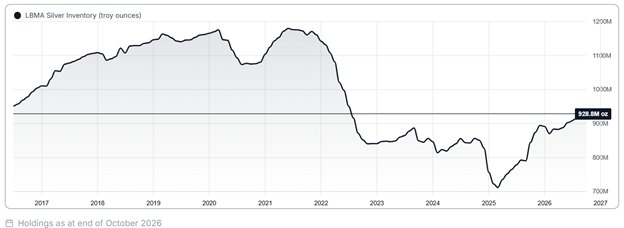
The gap between total supply and demand has been covered by liquidating physical silver from London (LBMA) and New York (COMEX) exchange vaults. This continuous drain means global above-ground liquidity has thinned significantly, elevating the risk of abrupt price spikes if physical demand suddenly surges.
The persistent six-year structural deficit has fundamentally reshaped above-ground silver inventories at major Western exchange vaults. Because newly mined silver cannot fulfill escalating global industrial and retail investment needs, exchange warehouses have served as the vital safety valve bridging the shortfall.
This drawing down of visible stockpiles has triggered sharp regional imbalances and localized physical inventory crunches:
The Total Visible Supply Landscape
Combined inventory tracking across the major global hubs, the London Bullion Market Association (LBMA) and the New York Commodity Exchange (COMEX), highlights that while massive raw metal quantities remain stored, the composition and accessibility of this silver has tightened significantly.
As of late 2026, the aggregate visible silver stored across major western and eastern (SHFE/SGE) exchanges sits at roughly 1.33 billion troy ounces.
Western storage centers hold the overwhelming majority of this footprint. Publicly reported figures outline the distribution between the two core networks:

COMEX Inventories: The Registered vs. Eligible Divergence
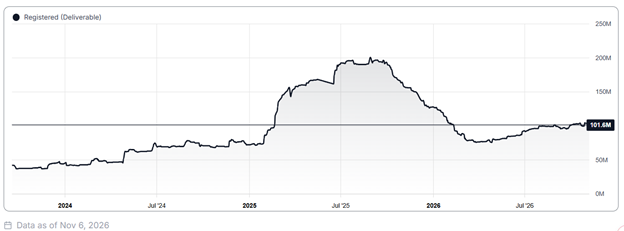
The headline metrics at New York’s COMEX warehouses require a vital distinction to understand the real physical market pressure:
- Eligible Stockpile (~233.6 Million oz): This silver satisfies the precise purity requirements but is strictly held for long-term private wealth storage, corporate operations, or institutional custody. It is not up for sale or delivery to the futures market.
- Registered Stockpile (~100.9 Million oz): This represents the active liquidity pool available for physical delivery against COMEX futures contracts. Earlier in 2026, intense physical delivery demands forced registered stocks beneath the 100-million-ounce threshold, driving a multi-decade drawdown from 2020 highs before stabilizing slightly near late-year.
LBMA & The “Free Float” Squeeze
London remains the undisputed epicentre for physical wholesale trading, yet its 928.8-million-ounce inventory is largely an illusion of liquidity.
- The ETP Lock-Up: The vast majority of the LBMA vault holdings are legally allocated to back physical Silver Exchange-Traded Products (ETPs) like iShares Silver Trust (SLV).
- The “Free Float” Collapse: When factoring out ETP allocations, industrial client reserves, and banking forward contracts, the truly unencumbered, “free-floating” silver available for prompt delivery dropped into an incredibly narrow band. Earlier acute stress indicators saw this unallocated tier drop dangerously low, triggering spikes in physical leasing rates to historical peaks near 39% before stabilizing later in the year as regional flows equalized.
Tariff Arbitrage and Regional Shifts
The vaults are not just quietly draining; silver is actively migrating across the Atlantic. Driven by corporate anxieties regarding sweeping industrial tariff adjustments in the United States, roughly 225 million ounces of silver aggressively migrated from London vaults to CME (COMEX) depositories.
This means that while New York warehouse data looks relatively well-buffered on paper, it has artificially mask-shielded the sharp exhaustion occurring in European and Asian wholesale physical pools—where Shanghai inventory hubs have scraped through deep 10-year lows.
China’s implementation of sweeping silver export licensing rules has triggered a severe structural shock to global precious metal supply chains. By replacing its 25-year-old quota-based system with a strict state-controlled licensing regime, Beijing has essentially placed a government gate over a massive global artery of physical silver.
This trade policy shifts silver from a standard commercial commodity to a nationally protected strategic material, treated with the same regulatory severity as rare earth elements.
The mechanics of this shift directly aggravate the severe inventory drain on Western vaults like the LBMA and COMEX.
Asymmetric Refining Monopolies
While China mines roughly 13% of the world’s raw silver, it has built a near-monopoly on processing, controlling 60% to 70% of the world’s refined silver exports.
The country imports raw ore and base metal concentrates, processes them in its 27 accredited mega-refineries, and ships out pure investment-grade bullion.
Under the strict rules, exporters must prove massive financial baseline qualifications—including minimum annual production thresholds of 80 metric tons and over $30 million in verified credit facilities. This has effectively purged hundreds of independent international suppliers overnight.
Squeezing Western “Safety Valve” Vaults
Because North American and European solar, EV, and AI data infrastructure manufacturers can no longer rely on unhindered, fluid supply chains out of East Asia, they have turned to the next available source: visible exchange vaults.
[Chinese Export Curbs Installed] ➔ [Refined Metal Kept Domestic]
⬇
[Western Exchange Squeeze] ◀─── [Industrial Buyers Drain LBMA/COMEX]
This sudden redirection has accelerated the “free float” inventory erosion in London and New York, causing severe localized physical shortages and expanding physical market premium spreads.
A Multi-Layered Squeeze Strategy
The geopolitical positioning of silver has prompted both the United States and the European Union to officially elevate silver to their nationally designated Critical Minerals Lists. This recognition has intensified as China rolled out subsequent, indirect policy levers to protect its domestic solar and high-tech supply chains.
Following its export clampdown, China logged massive record import volumes for refined silver, aggressively hoarded to feed its domestic tech manufacturing.
Further tightening the macro-market loop, China implemented an export ban on sulfuric acid. Because 70% of global silver is recovered strictly as a secondary byproduct of copper, lead, and zinc extraction, cutting off the foundational chemical feedstocks to major copper producers (like Chile) introduces an indirect bottleneck that naturally slows down global silver mine production.
These restrictions have accelerated a stark divergence between “paper” silver futures and the physical underlying market. While digital exchange-traded contracts react heavily to interest rate narratives and automated liquidations, the physical premium for actual deliverable bars in Asia has frequently surged out of normal alignment with Western paper benchmark spot prices.
With only 44 large state-authorized Chinese entities permitted to export silver globally, the open market is operating under highly calculated supply constraints.
Conclusion
China’s strict export licensing controls on its 60%+ monopoly of refined silver exports will continue to act as a geopolitical buffer.
Western industrial buyers can no longer rely on frictionless, “just-in-time” delivery of silver bullion from East Asia. To secure supply chains, industrial giants will continue to maintain higher private safety reserves.
Localized inventory crunches mean the price of physical deliverable bars—especially in localized Western manufacturing hubs—will likely carry persistently higher premium deviations over the underlying digital “paper” spot benchmark price traded on global exchanges.

Legal Notice / Disclaimer
Ahead of the Herd newsletter, aheadoftheherd.com, hereafter known as AOTH.Please read the entire Disclaimer carefully before you use this website or read the newsletter. If you do not agree to all the AOTH/Richard Mills Disclaimer, do not access/read this website/newsletter/article, or any of its pages. By reading/using this AOTH/Richard Mills website/newsletter/article, and whether you actually read this Disclaimer, you are deemed to have accepted it.