 RSS Subscribe
Russia and China have been sabotaging US war efforts in order to erode American global dominance – Richard Mills
The ongoing conflict between the US, Israel and Iran is at a tense crossroads as fragile diplomacy attempts to prevent a wider escalation.
President Trump stated in a ‘60 Minutes’ interview that he is “not looking” to escalate the war and views full-scale resumption as unlikely if progress is made, while simultaneously asserting that Task Force Iron Gate is active to enforce an expanded naval and overland blockade.
Iran insists on seven conditions to end hostilities — including the lifting of the US naval blockade on its ports, release of seized assets, and removal of sanctions — while Foreign Minister Abbas Araghchi has warned against any renewed US attacks.
Diplomatic efforts continue, with Qatar’s prime minister meeting with US leadership in Washington as regional mediators try to broker a path past the stalemate.
Meanwhile, Russia has been selling gold to help plug budget deficits and fund military spending amid Western sanctions, while cooperating with Iran militarily, where both nations exchange advanced weaponry, tech, and intelligence to support their respective conflicts.
Iran is also continuing to sell oil to China, its primary buyer despite US sanctions and maritime blockades.
Russia-Iran military cooperation
While Iran has famously acted as a key supplier for Russia’s war in Ukraine, recently leaked defense documents and intelligence reports demonstrate that Russia is heavily reciprocating by arming and reinforcing Iran.
Since the 2022 invasion of Ukraine, Iran has supplied thousands of Shahed-136 attack drones, which Russia now manufactures domestically under the name Geran-2 with Iranian technical assistance.
Iran has transferred short-range ballistic missiles, hundreds of thousands of artillery shells, firearms, and tactical gear (like helmets and flak jackets) via secret Caspian Sea shipping routes.
The waterway bordered by Russia, Iran and central Asian states sits outside the reach of NATO or US naval forces, serving as a secure corridor for weapons component shipping, shielding both countries from interception.
In return, a wave of military hardware and technologies have been flowing from Moscow to Tehran. See below for a summary.
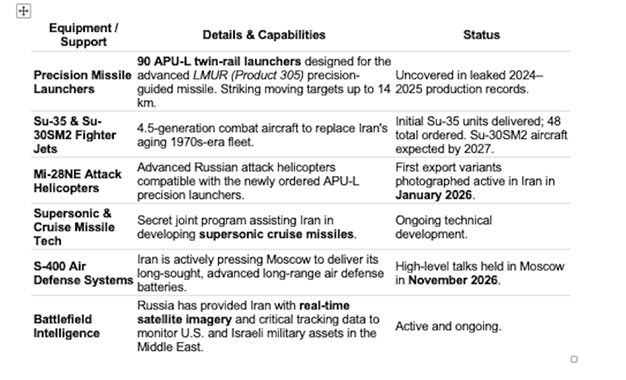
Most recently, Russia had arranged to supply Iran with 90 launchers for advanced guided missiles, the Guardian reported last week.
The documents, obtained by Dallas Analytics, a Ukrainian private intelligence firm, and shared with the Guardian, detail plans to supply Iran with launchers for the LMUR, a guided missile fired from attack helicopters which Russian forces have used extensively against Ukrainian targets since the full-scale invasion in 2022.
A production schedule drawn up in May 2024 by Vympel, a leading Russian designer of missiles and launch systems, lists an order for 90 launchers under an export contract designated “K-10”, with deliveries scheduled between late 2024 and December 2025. Separate internal paperwork explicitly identifies K-10 as Iran.
Aljazeera noted the report came a day after a senior Iranian official visited Moscow to discuss expanding a defence pact signed last year.
Iran is sourcing key precursors and ingredients for solid rocket fuel primarily from China.
Western intelligence reports and tracking data show that state-owned Iranian shipping vessels operated by the Islamic Republic of Iran Shipping Lines, or IRISL repeatedly transport large quantities of sodium perchlorate — a crucial chemical precursor used to manufacture ammonium perchlorate solid rocket propellant — from Chinese ports.
Russia selling gold reserves
The war with Ukraine is straining Russia’s finances. One way President Putin is trying to lessen the budget deficit is by raising taxes, including a windfall profits tax on mining companies.
Another means is by selling Russia’s gold.
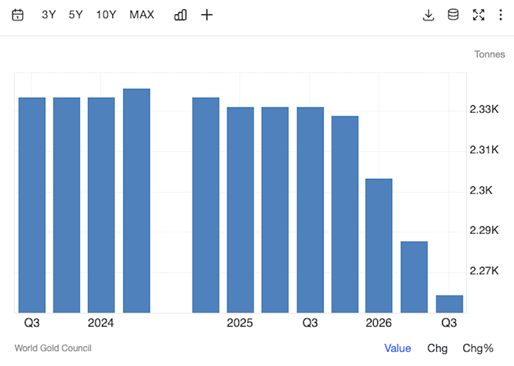
According to the World Gold Council, the Bank of Russia sold 18.66 tons of gold in the third quarter of 2026, making it the world’s biggest seller of central bank gold reserves for the second consecutive quarter.
Gold reserves in Russia averaged 1234.70 tonnes from 2000 until 2026, reaching an all-time high of 2335.85 tonnes in the second quarter of 2024 and a record low of 343.41 tonnes in the second quarter of 2000.
The structural shift marks the first time in 25 years that the Bank of Russia has systematically drawn down its sovereign gold holdings to support public finances.
They fell by about 62 tonnes between December 2025 and late 2026, reaching their lowest level since 2019.
Russia’s projected budget deficit of 7.3 trillion rubles is exacerbated by shrinking oil and gas revenues alongside skyrocketing military spending.
The drawdown in Russia’s National Wealth Fund is even more severe. Reports indicate the Kremlin has liquidated over 71% of the gold assets previously held in the NWF, exhausting its most accessible liquid fallback reserves.
Because Western sanctions froze roughly $300 billion of its foreign currency reserves, and G7 nations and the London Bullion Market Association banned Russian gold imports, Moscow has rerouted its bullion pipeline.
China is the main recipient of Russian gold, with Hong Kong acting as an intermediary. In other words, Hong Kong acts as a duty-free gateway to mainland China, which has not sanctioned Russian bullion.
Russia exported a record 165 tonnes to Hong Kong between January and September 2026 — a 55-fold surge compared to pre-war volumes. Russian gold now makes up roughly 15% of all gold arriving through Hong Kong, or one in seven bars.
To turn gold into war funding, the Russian Ministry of Finance transfers gold assets from its wealth fund to the central bank in exchange for rubles, which are then immediately deployed to cover domestic military procurement, soldier salaries, and industrial war production.
The highest priority for Moscow is acquiring components to bypass Western tech blockades. The proceeds from gold sales are heavily funneled into semiconductors and microchips; chips that can be repurposed for military hardware; and Computer Numerical Control (CNC) machine tools needed for domestic war related goods manufacturing.
But Iran is buying
In Iran, gold is moving into the country instead of out of it.
Iranian citizens have turned heavily to gold bars, coins, fractional coins and jewelry to protect their savings against massive inflation (currently running as high as 88%) and currency devaluation.
According to the World Gold Council, demand for gold bars and coins in Iran reached 19.1 tonnes in the first nine months of 2026, though quarterly demand slowed slightly mid-year as war-related disruptions and living costs forced some selling.
Iran’s central bank has not publicly disclosed any gold purchase figures for the year.
A report by Kharon Research revealed that nearly $200 million in gold flowed into Iran from Türkiye through networks disguised as agricultural (fruit and vegetable) trade to bypass financial isolation.
Iran selling China oil
Gold isn’t the only commodity being gobbled up by China. The country continues to buy more barrels of oil from Iran than any other nation. How does it get away with it?
Leaked confidential documents from November 2026 reveal that Iran has worked to establish a hidden network inside China — acquiring control or stakes in port facilities and oil storage tanks (including locations in the Ningbo-Zhoushan free trade zone and Shandong province like Qingdao and Pant) to let sanctioned shadow-fleet tankers unload crude directly.
The docks are located close to pipelines, allowing crude to be transported to Chinese refineries without being transferred to other vessels, the sources said.
Iran has also purchased seven oil storage tanks in China, according to the report. Four are located at the ports of Dalian and Huizhou and in the coastal cities of Dongying and Weifang. The oil ministry controls three others in the Zhoushan area of the Ningbo-Zhoushan archipelago, including facilities on Aoshan and Shulanghu islands and in the Zengyamuo oil zone.
The facilities are reportedly being used by tankers linked to Hossein Shamkhani, son of Ali Shamkhani, who operates a shadow fleet. Iran International said the arrangement allows these vessels to continue delivering Iranian crude despite sanctions. The US Treasury has sanctioned 51 vessels linked to Hossein Shamkhani.
Much of the oil is purchased by smaller, independent Chinese refiners (“teapot” refineries) who seek out discounted Iranian crude.
The two countries use non-traditional and covert payment mechanisms — channeling oil proceeds through special-purpose vehicles and credits rather than standard international banking — to help Chinese suppliers and entities get paid while shielding them from secondary US sanctions.
Even though China remains Iran’s largest customer, leaked correspondence also indicates that Beijing has faced rising pressure, sometimes demanding steeper discounts or balancing imports with other suppliers like Venezuela.
Conclusion
It’s hard to imagine the United States winning the war in Iran with two major powers, China and Russia, actively working to sabotage them.
Russia and China are using the ongoing US-Iran conflict to erode American global dominance without engaging in direct military confrontation with Washington.
Sustained military operations and missile defense interceptors used to counter Iranian strikes have severely depleted US inventories, leaving Washington with constrained stockpiles needed for other theaters like the Indo-Pacific or Europe.
Deploying multiple US aircraft carriers to the Middle East has thinned naval presences in Asia, giving China more room to act assertively around Taiwan and the region.
U.S. intelligence and defense officials have reported that Russia and China have supplied Iran with intelligence, geospatial data, and high-resolution satellite imagery to help track and target U.S. military and naval assets in the Middle East. Reports also indicate potential Chinese and Russian military or missile technology flows (such as MANPADS) to help Tehran rebuild its short-range air defenses.
China acts as the primary buyer for Iranian crude, frequently routing shipments through intermediaries and “teapot refineries” to bypass Western banking exposure.
Beijing continues to weave Iran into non-dollar economic frameworks, utilizing mechanisms like yuan-denominated trades to chip away at the petrodollar.
Regional disruptions and fluctuations in oil prices benefit Russia’s fiscal and war posture, easing the pressure of Western sanctions and providing a distraction from Ukraine.
Both Beijing and Moscow frame the US-Iran conflict as proof of the decline of the American-led global order, positioning themselves as alternative diplomatic partners or mediators.
Richard (Rick) Mills
aheadoftheherd.com

Legal Notice / Disclaimer
Ahead of the Herd newsletter, aheadoftheherd.com, hereafter known as AOTH.Please read the entire Disclaimer carefully before you use this website or read the newsletter. If you do not agree to all the AOTH/Richard Mills Disclaimer, do not access/read this website/newsletter/article, or any of its pages. By reading/using this AOTH/Richard Mills website/newsletter/article, and whether you actually read this Disclaimer, you are deemed to have accepted it.