 RSS Subscribe
Gold and gridlock – Richard Mills

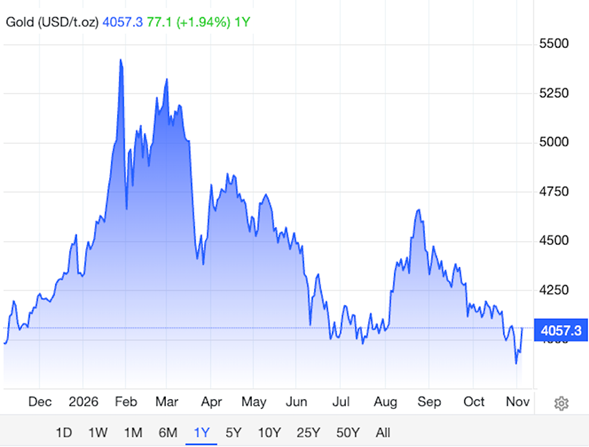
Gold climbed around 2.6% to $4,035 an ounce on Wednesday, putting it on track for its biggest daily gain since mid-August, as the US dollar tumbled following a sweeping Democratic victory in the midterm elections. Investors also looked ahead to this week’s US nonfarm payrolls report for further guidance on the policy outlook, following the Federal Reserve’s decision to leave interest rates unchanged in October.
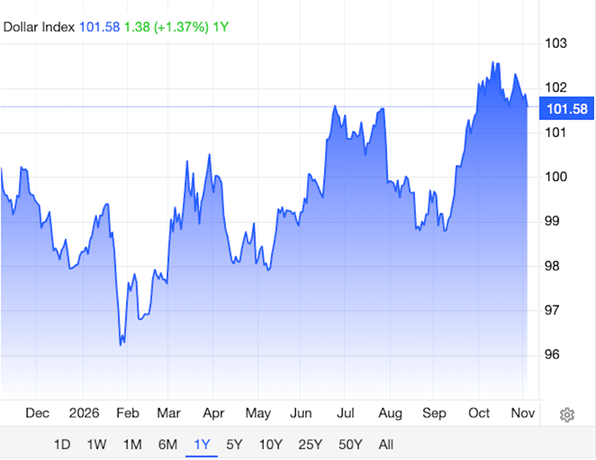
The Democratic victory, which secured control of both chambers of Congress, sent the dollar to a more than one-month low as investors assessed the potential impact of tighter AI regulation on economic growth. Meanwhile, inflationary concerns persisted and oil prices remained elevated as markets awaited Washington’s next move in the US-Israeli war on Iran. Traders currently see a 79% probability of a Federal Reserve rate hike in December, according to the CME FedWatch Tool. Trading Economics
Political gridlock is the most likely outcome of the “Blue Wave” that washed over much of Republican-held America.
This refers to a situation where the executive branch of government (the President) and the legislative branch (Congress) are controlled by opposing political parties, making it difficult to pass new laws or advance major legislation.
Midterm elections occur halfway through a president’s four-year term. Historically, the political party holding the White House frequently loses seats in Congress during these elections. When control of the House of Representatives, the Senate or both flips to the opposing party, it creates a divided government.
According to AdvisorHub, in a piece written before the midterm results were known:
A Democratic sweep of both chambers would mean more aggressive oversight and tougher fights over regulatory policy. In both scenarios, new legislation would likely slow to a crawl, which is the definition of gridlock.
A Democratic win in either chamber also means more funding fights. Divided government has historically made new spending harder to pass, and with a $40 trillion debt burden and large fiscal deficit, we don’t see much appetite for new spending packages regardless of who holds power. That fiscal strain has already been a factor in this year’s bond market selloff, much to Treasury Secretary Bessent’s chagrin. The debt ceiling is the first real checkpoint to watch. Though this has unfortunately become a regular occurrence, our base case is a combative standoff that tips into a government shutdown in early 2027.
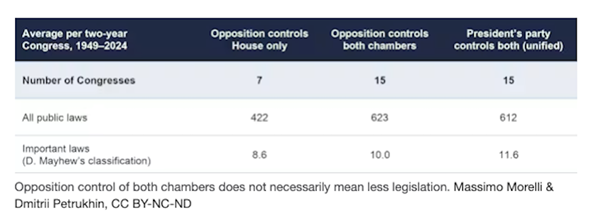
Taking a contrary position, The Conversation says a Democratic Congress could actually mean less gridlock, not more. The reason? Our analysis of past US Congresses suggests that, while losing both chambers means more opposition for the president, it could also reduce partisan friction between the House and Senate.
The proof is in the figure below which shows that opposition control of both chambers need not mean less legislation. Opposition-controlled Congresses have passed roughly as many laws as unified ones, and more “important” laws than those in which the opposition controlled only the House.
However, agreement between the House and the Senate is only half the battle, The Conversation explains. That’s because even if Democrats pass legislation through both chambers, Trump can veto it. Overriding him would require two-thirds in each — beyond the Democrats’ current majorities.
Before the elections, Trump warned he would block all legislation presented to him by a Democratic Congress. On election night he softened his tone, telling journalists, “We’ll work with the Democrats,” while still promising to use his presidential veto for “things that are insane.”
The latter hints at an aspect of gridlock that hasn’t been talked about much. It refers to the Democrats squabbling amongst themselves, specifically, fights between moderate Democrats and the so-called DSA, Democratic Socialists of America.
Founded in 1982 through a merger of the Democratic Socialist Organizing Committee and the New American Movement, the organization was originally led by activist Michael Harrington.
It experienced a massive surge in membership following the 2016 presidential campaign of Senator Bernie Sanders and the election of Donald Trump, growing past 100,000 members with local chapters across all 50 states.
Fox News reports the DSA are poised to claim victory in two-thirds of the Tuesday elections in which it endorsed a candidate, making the radical offshoot an ascending force within the Democratic Party.
From Berkeley, California, to New York City, the hard-left group saw its preferred candidates win, underscoring how it is driving the larger party further toward socialism.
Gridlock could easily occur when the DSA and their progressives demand concessions that the moderate Democrats aren’t willing to give, for example on issues relating to Israel.
Intra-party factionalism within the Democratic Party could also occur in so-called red-state wins, where newly elected moderate and centrist Democrats will heavily influence the party’s direction, likely pushing back against the progressive economic populism championed by the expanded DSA wing. (Aljazeera)
House Democratic Leader Hakeem Jeffries and Senate Leader Chuck Schumer face a delicate balancing act. If leadership tries to appease the DSA left flank, they risk alienating moderate members critical to maintaining their majority. Conversely, if they sideline the socialists, the DSA bloc can withhold their votes on key legislative packages. (The Washington Post)
If Congress ends up gridlocked, what happens to gold and silver?
Total congressional gridlock typically acts as a major catalyst for gold and silver, historically providing a strong tailwind for their prices.
When a divided government or intense political gridlock paralyzes Washington, the impact on precious metals is driven by three main economic mechanisms: increased safe-have appeal, a weakened US dollar, and the divergent impact on silver due to industrial demand.
Gridlock introduces immense legislative uncertainty, particularly around high-stakes issues like debt ceiling deadlines and potential government shutdowns. When investors worry that the government cannot pass basic budget legislation, risk aversion rises. Because gold and silver are globally recognized as “hard assets” with no default risk, money flows out of riskier equities and into precious metals.
Gridlock usually squashes plans for major new legislative agendas, corporate tax changes, or massive domestic stimulus packages. A standard market reaction to a divided government is a drop in the US Dollar Index (DXY) and declining Treasury yields. Because precious metals are priced in US dollars, a weaker greenback makes gold and silver significantly cheaper — and therefore more attractive — to international buyers holding other currencies.
While gold reacts almost purely as a monetary asset and a safe haven, silver faces a dual reality. Silver is heavily utilized in global manufacturing, electronic components, and solar energy technology.
If congressional gridlock delays infrastructure bills or rolls back clean-energy incentives, industrial demand for silver could take a hit.
But historically, when institutional and retail investors flood into silver to hedge against political risk, this investment surge easily overpowers any short-term dips in industrial manufacturing demand.
Like precious metals, the stock market historically tends to view political gridlock and divided government as a positive force, because it eliminates the uncertainty of radical policy or tax overhauls passing through Washington.
When power is split or gridlocked, investors can price in the status quo rather than guessing how major legislative shifts might hit corporate profits.
According to data tracked by AdvisorHub, the S&P 500 has historically posted strong average returns in the 12 months following midterm elections — often exceeding +14% overall and averaging closer to +23% under a split-Congress scenario with a divided government.
Gridlock makes it difficult to enact massive corporate tax hikes, aggressive antitrust breakups, or sweeping regulatory resets.
Much has been written on the Blue Wave’s impact on US President Donald Trump. CBC News, for example, wrote on Wednesday,
The outcome is a powerful repudiation of Trump’s performance in his second term.
Voters clearly sent a message that they are angry about the Republican president’s failure to deliver on his promise of lowering prices, punishing him in particular for pursuing the war in Iran and for launching his tariff regime.
The big question now becomes how Trump reacts to that repudiation. He’s not known for taking criticism with grace or acknowledging he got things wrong.
A lot of observers are bracing for impact, expecting that Trump will want to lash out at the people around him he blames for the midterm drubbing and seek to go even further with the executive powers he’s already used to unprecedented effect.
Trump has plenty of time left in the White House to exercise the power voters gave him last election. He’s already given an early indication of what he intends to do with his executive authority, by posting an image of a red MAGA-style hat emblazoned with the word “VETO.”
Critical to the gold and silver markets is what happens with the war in Iran, which has driven up inflation and interest rates, at the expense of precious metals prices.
Clearly the Democrats cannot unilaterally stop the war with Iran just by winning control of Congress.
Trump retains executive authority as Commander-in-Chief and holds veto power over legislation. Overriding a presidential veto requires a two-thirds supermajority in both the House of Representatives and the Senate, which Democrats do not have.
Although there are 54 Democratic seats to the GOP’s 44 in the Senate, the Dems need 60 to overcome a potential Republican filibuster, which could occur when passing legislative restrictions or anti-war measures.
Moreover, the newly elected Congress is not sworn into office until January 3, 2027, leaving a two-month transition period during which the administration can continue military operations.
Once in office, the Democratic-led Congress can attempt to restrict or cut off funding for military actions in Iran, though doing so still requires enough votes to bypass or override vetoes and filibusters.
Democratic committee chairs can launch investigations, hold hearings on the strategy and costs of the war, and demand executive branch documents.
The Senate can leverage its confirmation powers to stall or block Trump’s cabinet, diplomatic, judiciary and national security nominees.
Conclusion
When Congress is completely gridlocked, it creates a political environment that typically acts as a major catalyst for higher gold and silver prices. Precious metals markets view legislative gridlock not as a pause, but as a direct trigger for economic and financial shifts that weaken the US dollar and depress Treasury yields, pushing investors towards hard assets.
Gridlock stalls the gears of Washington. It oils the wheels for a precious metals rally by lowering real interest rates and forcing investors to seek shelter from political instability.
Richard (Rick) Mills
aheadoftheherd.com

Legal Notice / Disclaimer
Ahead of the Herd newsletter, aheadoftheherd.com, hereafter known as AOTH.Please read the entire Disclaimer carefully before you use this website or read the newsletter. If you do not agree to all the AOTH/Richard Mills Disclaimer, do not access/read this website/newsletter/article, or any of its pages. By reading/using this AOTH/Richard Mills website/newsletter/article, and whether you actually read this Disclaimer, you are deemed to have accepted it.