 RSS Subscribe
Under the Spotlight – Malcolm Dorsey, CEO Torr Metals TSX.V:TMET
Rick Mills, editor AOTH: This morning I’m talking to Malcolm Dorsey, Chief Executive Officer of Torr Metals. Torr is advancing its flagship Kolos Copper Gold Project in the southern Quesnel Trough of British Columbia. The project spans 332 square kilometers, the land package is located near major infrastructure and active mining operations like Highland Valley Copper and New Afton.
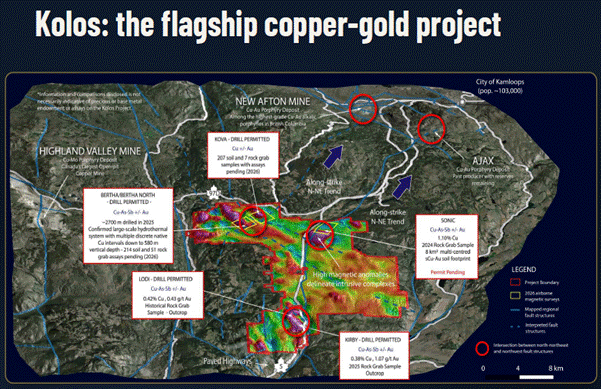
The initial phase one drill program at Kolos in 2025 marked the first ever drill tests on the property. It confirmed a large structurally controlled peripheral hydrothermal system intersecting native copper and deep oxidization/ hematization down to 500 meters vertical depth within a picrite corridor.
In early 2026, surface geochemistry and follow-up work pinpointed the Bertha North target, located over a kilometer northwest of the initial phase one drilling program, as a more proximal vector towards a porphyry feeder core. Torr Metals launched a fully funded phase two 6,000 meter drilling program mid to late 2026 centered on Bertha North.
Drilling has intercepted extensive hydrothermal brecciation, multi-stage veining, and magnetite bearing intrusive dykes within disseminated pyrite and chalcopyrite mineralization. Drilling is actively stepping out towards deeper resistive anomalies, extending past a thousand meters vertically to vector into the main porphyry heat and fluid source.
Is that an acceptable summary of where we stand today, Malcolm?
Malcolm Dorsey, CEO Torr Metals: That is a good summary overview of what we’ve done over the past year.
RM: We’ve got a news release this morning, November 18th, and you’ve got some geological observations from hole 26-KO-07 and 26-KO-08, hole 7 and 8 at the Bertha target. Both holes have intersected copper mineralization associated with intrusive rocks, veins, and altered volcanic hosts, strengthening the company’s interpretation of a large brand new copper gold porphyry system.
The headline was Torr Metals intersects repeated copper mineralization and intrusive phases in holes 7 and 8 at Bertha North. Could you talk about these two holes, 7 and 8, and the multiple intervals of copper sulphide mineralization?
MD: This news release boils down to what we’re looking for at Bertha North, which is the core of a porphyry. That was our thesis, that if we move to the south and we drill holes 7 and 8 where we did, it’s closer to where the deep-reaching resistivity is, it’s where structural convergence occurred, structures that we identified with the first couple of holes and then start following, vectoring.
We were theorizing that that is where we’re going to start seeing primary sulphides, where we’re going to start seeing greater concentrations of intrusive rocks, and that we’re looking for five key factors. We are using New Afton as an exploration model, but with that, what are the five features I think that would really be indicative of a New Afton-style system?
And that’s that there’s favorable intrusive rocks, so there has to be a source to the mineralization, so you have to find some intrusive rocks that are sulphide bearing. You want to find them in structurally complex areas.
New Afton is very structurally complex. There’s multiple structures, at least three that are host to mineralization, so you want a structurally complex area.
You also want potassium alteration starting to show up at depth.
A key feature is reactive volcanic contacts, and that’s because as you go deeper in New Afton, the mineralization is not so much in the intrusions anymore, but within adjacent permeable volcanic rocks, so rocks that allow fluid flow, as well as geochemically reactive rocks such as picrite.
And then the last thing was to identify, is there both supergene and hypogene transitional horizons? You need primary sulphides at depth, that’s chalcopyrite, bornite, and then near to surface you need to see mostly native copper.
All those five features are what we were looking for at Bertha North in order to continue saying that this is a New Afton-style system, or that we can use this as an exploration model, and all five of those features are now what we’ve seen within holes seven and eight.
RM: The vectoring is done, you’ve found the central portion of the system, now it’s just a matter of hitting it with more drilling. You give a geological description of the holes seven and eight in the release, what can you tell us about that?
MD: Let’s go back to what does New Afton actually looks like, it’s lenticular, so you have these lenses essentially, or conical shapes, kind of tapering towards depth, and then you get a paralleling portion of the mineralized system, and that’s what they’re mining at New Afton right now, they’re moving from section to section, right now they’re mining in what they’re calling the K zone.
Those portions of the mineralization at New Afton, if we use that just as a model, this is not to compare or to say that we’ve got exactly a New Afton style system, but you’ve got relatively discrete intervals at New Afton. They can be as narrow, you can see them down to 10 to 20 meters in width of mineralization, you can also see them up to just above 100 meters, they average out to about 90 to 100 meters in width for the majority of the deposit. Is all of that going to be mineralized? No, there’s going to be some sections that are higher grade than others.
What we’re seeing here with holes 7 and 8 are intervals that are in the right scale for what we’re looking for, with that we’re seeing a repetition of the intervals as well. We’ll see with further drilling exactly how these all come together, but it’s showing a concentration of intervals along the whole core length, they’re coming in and out, and within that there’s a lot of what we described when you look at the geological descriptions.
I tried to keep it to just descriptions of where there were visible sulphides. Does that mean that the entire interval contains or doesn’t contain sulphides throughout it? We broke out these intervals based on the alteration, the veining, as well as where we saw these discrete occurrences of visible mineralization.
But these zones are also heavily altered, they’re really obscured by the alteration. A lot of the mineralization that you’re seeing, there’s certainly quite a bit of bornite, it’s dominantly bornite within the cross-cutting veins and veinlets, which are going to be the easiest stuff that you can see, but you’re also getting interstitial bornite, so that is going to be very difficult to make out as it’s bornite in between the grains of these intrusive units, as well as fracture-filling bornite, a lot of the mineralization at New Afton within the volcanics is within fractures, fine fractures, very thin, and as well as similarly in amygdales, you’re getting it within interstitial as well.
A lot of this mineralization is going to be difficult to see, but we broke out the visible intervals based on the alteration, the degree of veining, as well as where we would see mineralization popping up here and there throughout the interval.
Whether or not it all runs is ultimately going to come down to assays, but it’s good to see bornite and dominantly bornite, because bornite with copper by weight is twice that of chalcopyrite, so you don’t need as much bornite to get meaningful grades.
RM: And the bornite was what we were looking for in the hypogene, wasn’t it?
MD: Bornite was what I wanted to see, I wanted to see that vertical transition going from native copper within the upper portions, because that means that we’ve had supergene-style weathering, so we’ve stripped out the copper and those hydrothermal fluids have reprecipitated that copper as native copper, and they’ve reprecipitated in areas where there’s drops in pressure, such as permeable volcanics. A lot of what we’ve seen, we actually have native copper filled amygdales (holes within the volcanic rock that are copper filled), and so that native copper is filling those holes, that permeability.
Then we see that transition to bornite directly underneath, so that’s exactly the transition that I want to see. I want to see that there’s bornite directly underneath as well, because that would indicate that the primary sulphite, bornite with a little bit of chalcopyrite, at one point would have reached closer to surface, but they’ve been exposed to weathering oxidation and now been transformed into native copper. But it shows that the whole system is interconnected, and the fact that we’re getting bornite, it can be used in porphyry systems as a vectoring into the core of a porphyry.
It can also occur within veins just outside of the core of the porphyry, but end of the day, bornite does not travel far. It drops fairly quickly out of the hydrothermal transport. It’s excellent that we’re seeing that, and that we’re seeing dominantly bornite as the principal primary sulphide at depth.
RM: We talked a lot about diorite in one of our talks. Is that still important here now?
MD: Yeah, that’s still important because diorite can be in this region, late Triassic intrusions, which are the age of intrusions that you want for significant porphyry systems, those tend to be diorite. But we do get a mixture of multiple phases of intrusions here, so it’s good to see that as well, because it shows fertility of the system as well as longevity.
We want to see that it’s gone on for a long time, there’s been repeated intrusive events. We’re getting diorite and it seems to be the principal host of mineralization here, including the interstitial bornite that we found in both holes 7 and 8. But we do see some monzonite, some monzodiorite, so some variations in the composition as well, which is good to see.
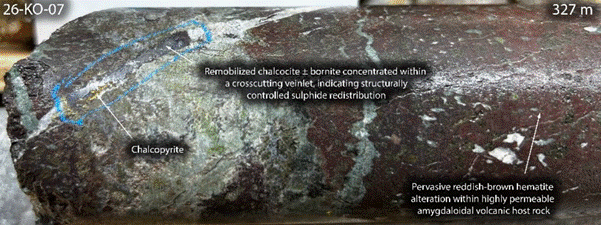
But one of the main features that I really like is the fact that we’re getting multiple mineralizing events, you can see it in the photos. We have that interstitial bornite, we have a pervasive carbonate alteration that also seems to carry copper mineralization with it, so that came at another point. We also get cross-cutting veins, multiple orientations, which means multiple generations of cross-cutting and mineralized veining, and then we end up with copper permeating through the fractures within these rocks as well.
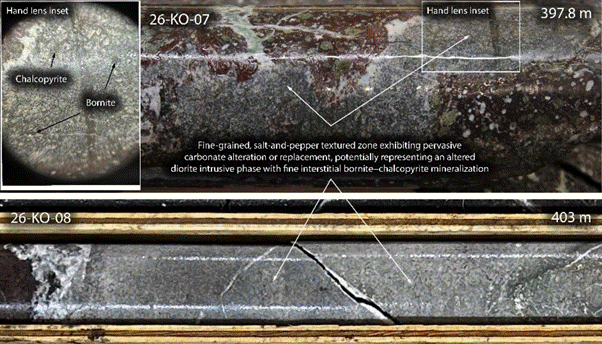
So there’s multiple environments here that we’re getting sulphide, and that’s exactly what I want to see, because if you have overprinting of overprinting of primary sulphides, that’s where you have the potential for higher grades, whereas if it was just a normal intrusive rock with some primary sulphides in it, such as you find typically in a lot of other BC porphyry systems, you’re not going to ever get much higher than your typical BC porphyry grades. Whereas seeing this diversity, this complexity, this overprinting, that is where you can get concentration of copper mineralization. And with that, the intervals are on the scale that we wanted to see if we want to actually have a new Afton-style system.
If they were larger, then I’d say we would have a different style system, and if it was all hosted within just one big intrusive unit, then I’d say it was a different style of system. It’s good that these are the features that we’re seeing, and it continues to fit the model that we’re looking for.
RM: We’re oxidized down to about 500 meters, that would be your supergene, and then we have a transitional zone going into hypogene?
MD: Yes, I’d say we’ve seen a little bit of potassium alteration associated with some generations of veining that’s carrying bornite and chalcopyrite, so that could be indicative that we are entering just into a hypogene zone.
I’d say we’re seeing some chalcocite’s as well, so that could be indicative that we’re somewhere in that realm of the transitional zone, just beneath the supergene, and maybe just tapping into some of the hypogene as well.
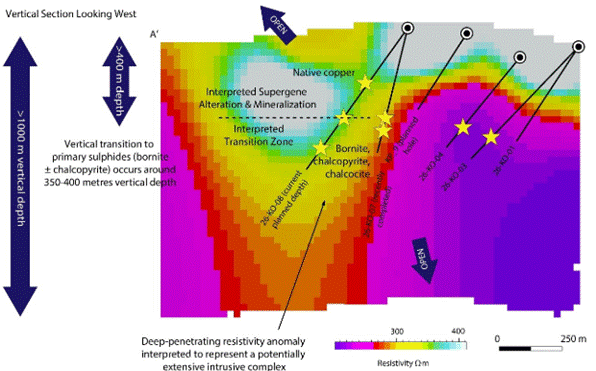
I’m looking at the vertical section looking west, and I see the interpreted supergene alteration and mineralization, and then you have the interpreted transition zone. It looks like with hole 3, 4, and 1, what were we into there?
MD: A different style of intrusive, different phase than what we’ve seen in hole 7 and 8. So, related, but I would say they would be more distal, which would make sense with where we’re drilling now. We’re drilling into the interpreted deeper reaching portion of the system, so if this is closer to the causative intrusion, and I’d say it is based on the fact that we’re getting multiple intercepts of an intrusive unit, so the concentration density of intrusive diking is increasing with hole 7 and 8, so we’re seeing some variations in the sulphides, but you’re right that there was some native copper in the upper portions of hole 4 as well, just as we start to enter the chargeability there. So that could be indicative, again, that we’re getting that transitional, that vertical window of supergene, which does seem to lie above in hole 7 and 8 and hole 4. It starts at, extends to about 400 meters vertical depth.
Of course, that’ll be further constrained with more drilling, but it does show that that level, that horizon extends across a significant potential strike length, as really you’re looking at about 500 meters distance between that intercept in hole 4 and what we’re drilling in hole 7 and 8.
RM: I see between the purple and the yellowish red, we’re almost looking at two different zones of mineralization. I think that’s clear, but there’s that red line. Would that be the picrite boundary?
But when you look in the center, you see more bornite, chalcopyrite, chalcocite, and then you just explained what was on the east side of this picture. Is that boundary now, is that like the volcanics or the Picrite, like the red?
MD: That’s a good question. We’re looking at the resistivity, and so the resistivity, you can see it break through and extend to depth where we’re drilling with hole 7 and 8. What we’re seeing is likely due to that’s where the intrusion continues to depth.
In this zone where you have a convergence of both the northwest, northeast, and north-south structure, so there’s three different structures converging in that area, so you have maximum dilation weakness in the rock, which allows this intrusion to come up in that area, which was part of the interpretation. But yeah, as you continue towards the north there, towards where we did intersect mineralization in holes 3 and 4, I think you get a bit of a mixture there. There is a northeast trending structure, north-northeast structure in that area, and I think the primary orientation of the mineralization is following that, and it’s following this structure.
What we get in holes 4 and 3, this intrusive is obviously, and different phases of the intrusion, is following that structure, bringing mineralization with it, a little more distal from the core portion, but it’s a continuation.
There is some interplay there between picrite boundaries, regular volcanics, and then the intrusive units as well. I’d say the purple tends to be a mixture, it can be picrite or unaltered picrite, but up in that area where holes 3 and 4 were, I’d say it’s conductivity caused by pyrite that’s causing some of that conductivity that you see, which is the purple color.
So, pyrite as well as more unaltered magnetite content. The magnetite and pyrite are going to be more conductive, they cause more of a purple color, as you get over towards where holes 7 and 8 are, there’s more oxidation, more alteration of probably the magnetite that was originally within the volcanic rocks. I think that’s why we see some variation here.
Resistivity is always a great geophysical tool for defining different rock types as well as alteration. Where we want to be is not in the purple, it’s the yellow and the reds. And basically, that is the nuts of the system, because as you said, it goes down to whatever depth.
RM: The yellow surrounded by the red, there’s where we want to be, and then we can kind of see maybe a feeder off to the right there at the top, the yellow and the green. But why would hole 9 be into the purplish instead of down over more where 7 and 8 were?
MD: Hole 9 has been moved over to where holes 7 and 8 were drilled.
That’ll be testing across both the interpreted northeast as well as northwest structural trends that we’re seeing. And it’ll help us better delineate exactly the directions that we want to follow here. There’s going to be multiple orientations of mineralization here, that’s to be expected, especially with what we’ve seen within the core.
But now what we need to do is continue plugging away, put more drill holes into it, better define the strike length, the orientations of these systems. And as we get more drilling and more holes into the system, it will be to demonstrate to us exactly the best possible locations and define the exact areas that we want to focus into. But we’re into it at this point, I’d say we’re into the core of it.
RM: We’re not vectoring anymore. We need to drill more to define and to build. And perhaps down the line, this could be a deposit, we’ve gone past the stage of a discovery.
MD: When I get a whole bunch of bornite occurring in both holes 7 and 8, well over 10 to 30 meter intervals that contained bornite within them, when you get that much bornite showing up within the system, together with the overprinting that we’re seeing, there’s certainly some strong potential here for some meaningful grades. We need to follow up on that, the discovery is made.
Now we need to continue defining it.
RM: You showed segments of core where you could actually see the sulphides. But you also said there was possibly a lot of interstitial bornite in there that you couldn’t see by eye.
MD: We’re still using XRF, we’ve got what’s actually observable together with just extending where we observe visible mineralization and we’re looking at the relationships with the alteration and the veining and the type of host rock as well. That’s where those intervals came from was basing it on all that because not everything in this degree of alteration is going to be observable.
This type of system, you’re just never going to see a nice looking intrusive with very visible sulphides. This system is complex. It’s overprinted over several generations.
Basically, what was there has been blasted apart. And with that, we’re just breaking out the whole interval that this is a prospective zone based on the fact that we have seen some observable sulphides in this area and we’re extending based on alteration and veining associated with those visible sulfides.
That is how we define those and their prospective envelopes at the end of the day.
RM: We need assays to truly indicate exactly what those intervals mean, but they certainly are prospective. So far we’ve been talking about copper mineralization.
Are you seeing any indications of gold or precious metals in the system?
MD: You’re not going to get a visible gold type of sulphides yet. We need more work done, and to determine silver as well. We do know from surface sampling that we do a potential here for gold and silver.
So that’s something that’s going to have to be confirmed with assays, but we certainly are seeing some positive indicators for that with XRF, of course the caveat being that XRF is not reliable for gold or silver but can give an idea of what we’re looking at.
RM: Right. I’m looking at the second picture, the 2026 drill holes that have been in phase two that have been completed.
And I see an additional intrusion with a question mark. What’s that about?
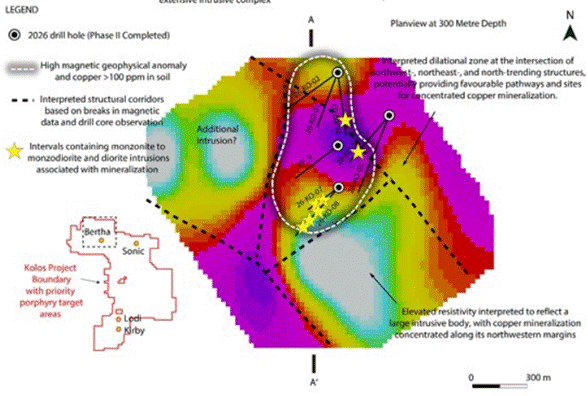
MD: That is at surface, we have been able to find some rock, it seems to also be where you see more of the yellows and everything surrounding those high resistivities, but within the high resistivities, which is the white color that you see in there, we do have at surface some intrusions that we’ve been able to note. Those intrusions seem to carry, well, more a biotite phase type metasomatic alteration.
There’s certainly attractive looking intrusives in that area. So that’s something as well that we have to explore, but it’s also something that maybe has a role to play in this system, especially you can see some of the structural interpretation that’s been put in there. We can see that these intrusives, so these white colors that we see, there’s essentially two intrusive centers to either side of this system, where we get the copper soil anomaly that’s outlined by the white dashed line.
And we see these two potential source intrusions, maybe larger bodies that are part of a northwest trending larger body intrusive complex. And right where we get all this anomalism is right in the jog in that northwest trend. There’s a slight deviation in the trend of that northwest orientation, and that’s where you get the maximum breakage occurring with other fault systems developing, shear systems developing off that northwest trend as it bends.
And it’s interesting that those are basically cushioning either side of this anomalous zone, which also is a concentrated zone of structural complexity.
RM: It’s no coincidence that I see the interpreted structural corridors, the black dotted lines, and the intrusive is right in the middle of the of sort of a V there between two.
MD: No, that’s not a coincidence when you have that kind of feature.
And then you see the purple of the conductivity kind of extending largely towards the northeast. And as we talked about before, that could be a measure of it, could be rock types, it could be alteration. So far, what we’ve found is it does seem to largely be related to pyrite and magnetite.
And the more altered those are, the less purple they are. And we’ve seen some of that within where we drilled within holes three and four. It’s important to note as well that some of the conductive boundaries appear to be pyrite.
There’s a couple different orientations of pyrite in here. And as we’ve talked about before, pyrite is very important, not only in that it helps define these large northwest trending structures. So large regional structures in this area are often defined or marked out by pyrite boundaries.
Some of those conductivity margins that we see going towards the northwest, that’s probably pyrite. And then we see this northeast trending conductivity that’s broken up, especially where holes seven and eight are. So that could show perhaps a more enhanced alteration of this northeast trend.
So that northeast trend could be due to the northeast structures, could be due to alteration changes in some of the mineralization such as magnetite, hydrothermal magnetite or pyrite. But all of it is showing that this area is complex. There’s a structural reason for this all to be here, which was part of the initial regional interpretation as well.
Because it’s important to remember this was an area where there’s almost no surface outcrop and only soil anomaly and some geophysics that were really indicative that something could be there. The fact that we went from large regional ideas and theses, bring it down to the local, looked at the local, identified where we needed to do some drill testing and now we’re getting some significant bornite showing up at depth. That’s not by coincidence.
RM: Is there any other interesting structural traps like this one on the property?
MD: There certainly are others. And with that, this is also a proof of thesis.
If we continue drilling and we define what we are looking for, which is a smaller tonnage potential higher grade style new Afton system, that’s what we’re looking for. And if this is a proof of thesis, then there’s certainly other areas. It’s a large property, it’s 332 square kilometers.
We have plenty more targets. This area has been basically unexplored and now we can showcase that we can basically point out the needle in the haystack, go and drill it and end up with some significant bornite within it. From that, I’d be very curious to extend it to some of the other targets on the property.
RM: The weather’s holding up quite well. I’m a few hundred kilometers north of Kolos and all we’ve had is some frost, maybe down to minus six.
Very, very easy November
MD: It’s been very mild and it’s forecasted to continue to be mild through the winter. We do have another 1500 meters of drilling to do and we’re going to continue that.
It’ll probably take us into December. But of course, with that kind of weather in this area, the potential here for operating year round is certainly there. We don’t have an exploration camp.
The crews stay in Merritt and Kamloops. And with that, we’re able to operate very easily year round. And even in normal years, there’s very limited snowfall in this area as it’s in a bit of a rain shadow.
RM: How many more holes could we expect now that we’ve finished vectoring and we’re trying to define an area of mineralization?
MD: Once you end up in mineralization and when you see the alteration and veining continuing, you got to keep drilling. We could potentially get another three to four holes of drilling out of this with another 1,500 meters. Then we’re going to take a break over the holidays and get some assays back.
RM: And then?
MD: We’ll certainly be looking at continuing to drill the Bertha North target.
RM: Do we have the money or are we going to have to raise?
RM: In terms of funding, we’ve got flow through that we’re using for this drill program.
So that’ll be used up here with the additional 1,500 meters and that should leave us with about roughly $850,000 hard money in the bank as we go into the new year. We’ve got the money that we’ll be able to run in terms of monthly costs. But of course, if we are looking to do another drill program, we will have to go back to the market at some point.
RM: You do not need that much bornite to have very meaningful grades.
This is certainly the style of environment where you could have more enhanced grades.
I know we’ve got a discovery, but an economic discovery, when we look at the grades and hopefully we say, oh yeah those are thought to be economic anywhere, especially here. If we have something like that coming in the new year, this is going to be, you’d have to say it’s, imo, a major catalyst, not just for TMET’s valuation, but I’m thinking about regional mineral exploration in Southern British Columbia.
This is a very under explored pocket here and we’re surrounded by aging multi-billion dollar copper mines. Hitting a potentially economic porphyry core here is going to validate a brand new mineral district right next to all the existing aging or replacement needing mines. We’ve got a lot of the ground between Highland Valley, New Afton and Copper Mountain, all mines, it was always ignored because basically the underlying bedrock was hidden.
It’s potential satellite feed to extend the life of nearby mills without requiring a company to build a brand new processing plant. Now, this might be arm waving, but Boliden and Fortescue have already staked massive grounds to the north to try and secure copper pipelines. You’ve got all these major mines and major mining companies staking or holding ground.
Coeur bought New Afton and it’s got what, five or six years life of mine or something like that?
MD: Yes, they’ve extended it, it was originally 2031, now ‘32. It’s important to remember that New Afton’s only 150 million tons, but historically has had quite high grades, more around a percent copper and a gram per tonne gold.
Of course, that’s decreased a bit here. I think it’s now more 0.5 to 0.7 percent copper, but still staying up there in terms of gold as well. But that was why we identified that as this is what we want to go out and find.
We want to find something that’s relatively small, that a junior can actually go and explore and look for. That’s a concentrated, highly structurally controlled porphyry system, but also that carries much higher grade than is typical in British Columbia. We’re looking for something that could have the capacity to have grades that are two to three times higher than your typical average economic cut-off in BC.
All that is to look for something that a junior can actually explore without heavy dilution, something that’s concentrated, that can produce grades that certainly are going to be prospective, especially in an area such as this, where cost of operation is quite low. You can operate year-round. It’s already an established mining district.
There’s three nearby mills that all are going to require feed in the near future. It’s strategically, as well as in terms of what type of system we’re looking for, is all fitted together to try and meet the actual needs in this area.
RM: You’ve got a confirmed porphyry discovery, in porphyry exploration, grade, of course, is important, but so is thickness. I mean, absolute tonnage in these porphyries is what is most important.
When you look at companies using as low as a 0.2% economic cutoff it’s tonnage, scalability, that makes those deposits. But this one is grade, maybe not as much tonnage importance. It’s a bit of a switcheroo, you could say, in that when you’re doing 0.2% you’ve got to have that massive tonnage to do economies of scale.
But when it becomes a New Afton target or model, you’re looking more for grade than tonnage, correct?
MD: Grade is key, when you look at the scale of the system, even with figures in the news release, you can see that we’re looking at maybe a strike length of around 600 meters, so far, from near surface. And then width-wise, like we’re looking at something in terms of the soil anomaly, it’s about 300 meters.
We’ll have to see with more drilling exactly what the depth/ width could be once we’re into the subsurface. But these types of dimensions, this is on par with what New Afton was even back in 2016. Or earlier than that, they had a strike length of about 520 meters.
The deposit itself was only about, on average, 90 meters in width, but certainly has areas where that width is much narrower, even in the realm of 20 meters. This is fitting the right scale for that type of system that we’re looking for.
RM: We seem to be down a penny on very low volume on this news. TMET’s market cap is now below $8 million with 84 million shares outstanding. What are investors missing here?
MD: I think people want assays, I know I do, we’re still somehow waiting.
The first assays that come out will be for holes one and two.
Those, I think, are important builders, especially hole two, you’ll see it is following the same azimuth as what we drilled in hole eight. But it’s encountering the system a little further at depth. I think hole two especially could start to find what we’re looking at here in terms of mineralization.
Thankfully things are speeding up at the lab, perhaps we could get hole seven and eight by early in the new year is what I would be anticipating. But I think, yeah, the market is missing that, they’re waiting for assays.
How does the New Afton-style system encountered with holes seven and eight continue to fit that model, which they do? We’re going to be continuing to get that story out into the market and demonstrating the potential that we have here.
RM: Well, I see opportunity, if we do come up with what appear as economic assays, it’s a fact that major producers in the area, they’re going to pay steep premiums over market averages when an asset like Torr solves a specific operational problem.
And they’ve got the worst one, the worst operational problem you can have. Their reserves are declining and there are several mills in the area that absolutely need to buy resources from a junior and turn them into reserves.
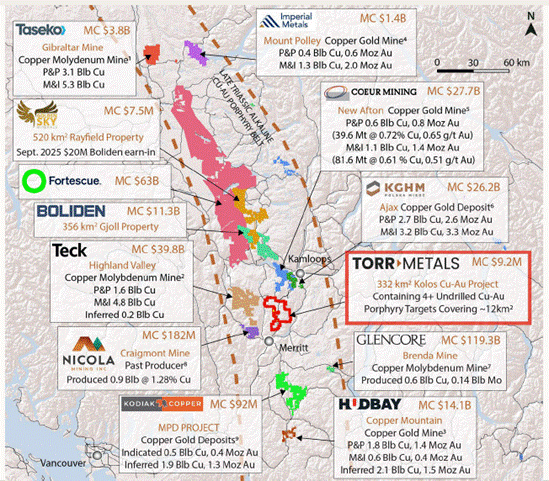
MD: And that is why we decided to set up here was because we can answer a specific problem, we’re in exactly the right position that you want to be. Now we’re proving a brand new discovery, what we see so far, and it continues to check the boxes for our exploration analog using New Afton as a comparison and a model, an exploration model.
I’m excited to see what starts to come out of hole nine as well.
RM: Where are we now? We’ve done seven and eight and you’re going stay on the same pad and start nine and then go into 10, 11, 12 potentially?
MD: Yes, we’ve just started hole nine as of today (2026.11.18).
RM: Okay. Is there anything else you want to add here, Malcolm?
MD: Yeah, I think the only thing to add would be essentially we set out, bring it back around to the beginning, we set out looking for features for this New Afton style system. So those features we’ve now identified all five within hole seven and eight, they are found there, it’s highly encouraging seeing supergene style horizon of native copper directly overlying quite a bit of bornite. We’ve identified already where the underlying transitional or hypogene zone could be.
Now it’s just a matter of putting more drill holes in there. It’s no longer vectoring, we’re into the core of the system and we’re going to continue drilling it here through into December.
I think there’ll be more exciting updates that we’ll be sharing with the markets and more that we can look forward to.
RM: Perfect thank you.
MD: We’re into it. And that’s why I’m excited to see with hole nine here now drilling more towards the west. There’s bornite at depth. We’re going to keep trying. That’s all I need to say.
Thank you, Rick
Richard (Rick) Mills
aheadoftheherd.com

Subscribe to AOTH’s free newsletter
Richard owns shares of Torr Metals (TSX.V:TMET).
TMET is a paid advertiser on his site aheadoftheherd.com
This article is issued on behalf of TMET
Legal Notice / Disclaimer
Ahead of the Herd newsletter, aheadoftheherd.com, hereafter known as AOTH.Please read the entire Disclaimer carefully before you use this website or read the newsletter. If you do not agree to all the AOTH/Richard Mills Disclaimer, do not access/read this website/newsletter/article, or any of its pages. By reading/using this AOTH/Richard Mills website/newsletter/article, and whether you actually read this Disclaimer, you are deemed to have accepted it.