 RSS Subscribe
Under the Spotlight – Justin Rodko, VP Corporate Development Cosa Resource Corp. TSXV: COSA

2026.09.19
Cosa Resources Corp. (TSXV: COSA) is a Canadian uranium exploration company focused on properties in northern Saskatchewan’s Athabasca Basin.
Management
- Headed by President and CEO Keith Bodnarchuk.
- The award-winning team received the AME Colin Spence Award in 2022 for discovering the Hurricane uranium deposit. Members also played key roles in discovering Denison’s Gryphon deposit and founding NexGen and IsoEnergy.
Projects and Portfolio
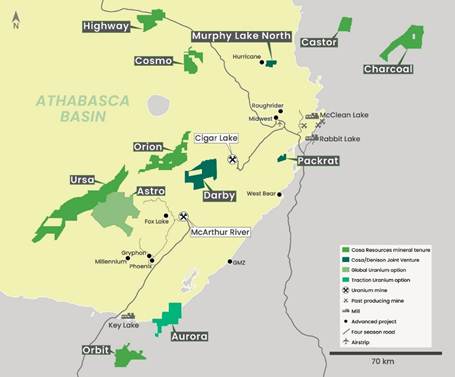
- Holds roughly 237,000 hectares across multiple 100%-owned and operated joint-venture projects in established uranium corridors.
- Denison joint ventures Murphy Lake North (MLN) and Darby. Partner-funded earn-ins at Astro and Aurora. 100% owned projects include Ursa, Orion, Orbit, Cosmo, and Highway. Cosa acts as the operator on every project.
2025 and 2026 efforts
- 2025: Entered a transformative strategic collaboration with Denison Mines covering eastern Athabasca projects and advanced exploration across its portfolio.
- 2026: Executed winter and summer drilling campaigns at Murphy Lake North (intersecting broad alteration and radioactivity along the Cyclone trend) and initiated drilling at the Darby project. It also optioned the Aurora project to Traction Uranium in early 2026.
Joint venture partners and future plans
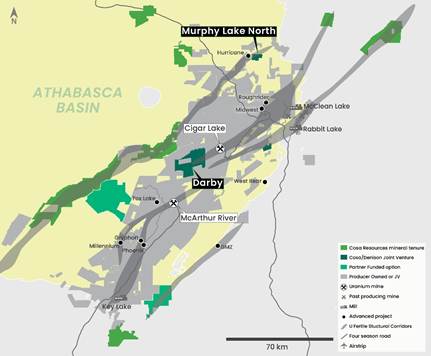
- Denison Mines TSX:DML: Cosa’s largest shareholder and primary JV partner. Cosa holds a 70% interest and serves as operator, while Denison holds 30% in core joint ventures like Murphy Lake North and Darby.
- Traction Uranium: Partner on the Aurora project, where a partner-funded drill program is set to commence.
- Drilling Plans: Ongoing work at Darby and partner-funded drilling at Aurora, with plans for a significant return to Murphy Lake North in early 2027.
Keith Bodnarchuk, President and CEO, commented: “Having recently completed an encouraging and productive drilling program at Murphy Lake North, we are excited to be back drilling at the Darby Joint Venture with our partner and largest shareholder, Denison Mines. Viewed by Cosa as a discovery-ready Project, Darby boasts an exceptional pipeline of high-upside drill targets in proximity to structure, alteration, and historical uranium mineralization. With $16 million in the treasury, we are fully funded for the summer program and follow-up in 2027. While our core focus remains on advancing the Murphy Lake North and Darby joint ventures with Denison, we are finalizing plans for a 100% partner funded drilling program expected to commence at our Aurora project in the coming days.”
Andy Carmichael, VP Exploration, commented: “In addition to intersecting basement-hosted uranium mineralization, winter drilling and reinterpretation of historical results at Darby further upgraded multiple trends, notably at Gamma and Bravo. The exceptional geochemical anomalism, numerous intersections of graphitic structure, and significant untested strike length across virtually all major trends at Darby continues to make for an exciting drill season. At Gamma, drilling will further test a broad zone of structure and alteration defined during the winter program that is also on trend with multiple occurrences of historical mineralization. At Bravo, drilling will follow up prospective geology and uranium mineralization intersected by multiple historical drill holes that lie within a magnetic low trend interpreted to extend to the Cigar Lake uranium Mine area.”
Murphy Lake North (MLN) Project
Cosa Resources released the highly anticipated results from its massive 2026 summer drilling campaign at the Murphy Lake North (MLN) Project. The program significantly built upon the core uranium discoveries found during the previous winter drilling phase.
The primary breakdown of the specific drill results on the Cyclone trend includes:
The winter 2026 core discovery
-The summer campaign was designed to expand on a standout discovery hole from the winter 2026 program:
-Drill Hole MLN26-013: Intersected 5.0 metres averaging 0.55% U₃O₈ (from 308.5 to 313.5 metres depth).
-High-Grade Subinterval: This included a rich pocket of 0.5 metres averaging 1.70% U₃O₈.
Summer 2026 drilling highlights
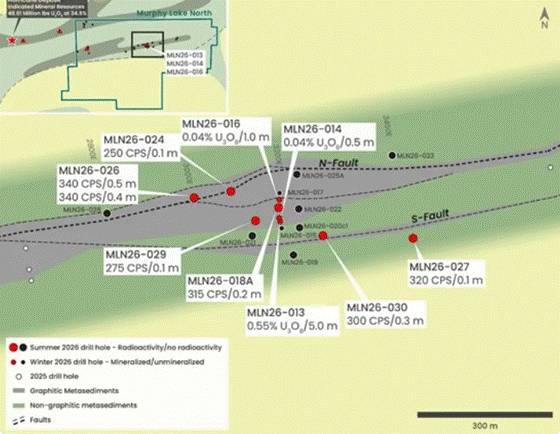
Cosa drilled 13 holes totaling 6,752 metres during the summer, testing the Cyclone trend over a wide 650-metre strike length (stretching 400m west and 250m east of the original MLN26-013 hole):
- 100% Structural Hit Rate: All 13 summer drill holes successfully intersected moderate to strong alteration and faulting. This confirms a massive, continuous system of moving hydrothermal fluids required to form large uranium deposits.
- Radioactivity Pockets: Seven of the summer holes hit narrow intervals of elevated radioactivity ranging from 0.1 to 0.5 metres long. In all cases, radioactivity is associated with alteration.
- Two Major Structural Faults Defined: The team mapped out two prominent parallel boundaries along the edges of the Cyclone graphitic unit:
- The N-Fault (North Boundary): The most prominent structure on the project, hosting intense basement alteration. Five holes targeted this area at the sandstone/basement unconformity, hitting heavy hydrothermal hematite.
- The S-Fault (South Boundary): Two holes targeted this fault at the unconformity but undershot, hitting the structure deeper in the basement rocks.
- Pathfinder Growth: Drill hole MLN26-020C1 extended a basement alteration zone 36 metres to the east. It hit enrichment of uranium pathfinder elements, proving the mineralized system remains open.
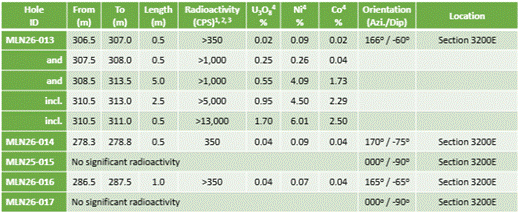
Current assessment
Geologists note that the physical footprints—such as the 100-metre wide structural corridor and the style of sand alteration—look incredibly similar to the early-stage indicator holes that led to the nearby world-class Hurricane Deposit discovery.
Cosa has sent out these summer core samples for laboratory evaluation. The pending chemical assay results should help vector where follow up drilling should focus.
Crescat Capital
Cosa Resource reports results from its summer drill program at the Murphy Lake North Uranium Project in Saskatchewan:
– The 13-hole program totaled 6,752 m and tested the Cyclone trend over 650 m of strike.
– All 13 holes intersected moderate to strong alteration and/or structure, with several holes encountering elevated radioactivity.
– MLN26-020C1 extended a uranium pathfinder-enriched basement alteration zone 36 m east, where it remains open down dip and down plunge.
– Cosa is planning a significant winter follow-up program at Murphy Lake North, with C$16M in treasury.
The image below highlights the summer drilling and target areas along the Cyclone trend at Murphy Lake North.
Because Cosa’s management team actually discovered and mapped out the Hurricane deposit themselves while working at IsoEnergy, they are using the exact same geological playbook to explore MLN.
The core geological elements shared between Murphy Lake North and the world-class Hurricane deposit include:
The same regional exploration corridor
Both properties sit directly within the highly active Larocque Lake trend. This established exploration corridor in the eastern Athabasca Basin is famous for hosting massive, high-grade uranium zones.
MLN contains the along-strike continuation of the exact same basement geology that sits underneath the Hurricane deposit. The core structures from Hurricane flow right into MLN’s western boundary.
Matching target depths and unconformities
High-grade uranium deposits in the Athabasca Basin are typically found at the “unconformity”—the boundary where the younger sandstone layer meets the ancient basement rock.
At Hurricane, this target horizon is roughly 330 metres from surface. At Murphy Lake North, it’s even shallower at a depth of roughly 250 to 270 metres below the surface. This makes drilling faster, cheaper, and highly comparable block-for-block.
Identical faulting and core structural settings
At the Hurricane deposit, the uranium is controlled by massive geological faults located precisely at the physical contact where graphitic basement rocks meet non-graphitic rocks.
Drilling at MLN has hit this exact structural marker—intersecting heavily fractured, strongly graphitic and pyritic basement rocks hosting major fault zones right at the geological transition zone.
Parallel conductive footprints
Uranium exploration heavily relies on finding underground electrical conductors (often caused by graphite, which has long been thought to be a primary component in precipitating a uranium deposit).
Just south of the main Hurricane trend line, MLN hosts the Cyclone trend—a parallel conductive corridor over 100 metres wide that mimics the footprint of the structures holding the Hurricane deposit.
Polymetallic “pathfinder” fingerprints
Geologists don’t just look for uranium; they look for the specific cocktail of elements that travel with it. Like the Cigar Lake and Key Lake uranium mines, the Hurricane deposit is famous for being polymetallic, meaning the uranium is closely bound to high amounts of nickel, copper, and cobalt to name a few.
Laboratory assays from MLN’s discovery hole (MLN26-013) confirmed that its uranium mineralization is also highly polymetallic, carrying the exact same pathfinder fingerprint seen at Hurricane.
Hydrothermal alteration halos
Before a drill hits actual uranium, it usually passes through a massive “halo” of rock, bleached and broken sandstone. that was cooked and altered by hot, mineral-rich fluids millions of years ago.
The lower sandstone blocks at MLN feature heavy fracturing, core loss, and severe “desilicification” (where the quartz has been dissolved away), along with patches of hydrothermal hematite. This style and intensity of alteration match the early indicator holes that originally led the team to the center of the Hurricane deposit.
***
RM: I’m here this morning with Justin Rodko, Vice President of Corporate Development for Cosa Resource Corp, TSX:COSA. The first thing that we want to talk about, Justin, is Murphy Lake.
JR: Thanks Rick, it’s great to be here. Happy to jump into Murphy Lake North. We are very encouraged by the drilling that we’re doing. Everything we’re seeing is telling us that we need to keep going.
There is a precedent in the Athabasca that these deposits are well known for being elusive. Especially ones that might happen to be in the basement.
If you look at the history of a lot of these discoveries, you’ll see very clearly that many of them have been missed by at least one operator, sometimes two or more operators. People go in there and they drill mineralization and they drill alteration but then they get discouraged and give up.
And then it’s the next junior company that that comes along and drills that discovery hole. And maybe the first guys were just 50 meters away.
I think that that’s exactly where we’re at with Murphy. We followed up that mineralization of five meters of 0.5%, did not hit.
We have an equal opportunity to do that in this upcoming winter program. Like I said, we all remain very excited. The amount of structure and alteration that we’re seeing in the area tells us that we just need to keep drilling.
We’ve got those major structures, very typical graphitic faults that bound our graphitic package, it’s a very common eastern Athabasca Basin setup. We’ve got alteration that goes along the unconformity as well.
We have that basement alteration that’s still open and some of the early geo-chem results that we’ve gotten back have shown us we are seeing those uranium pathfinders light up through that alteration. And that’s exactly what you want to see.
As long as you’re still seeing sign like that, then that’s enough to tell you that you need to keep going.
RM: Murphy Lake North is basically a mirror image of what you discovered with ISO.
JR: Absolutely, everybody recognizes Hurricane for the for the incredible deposit that it is. But not that many people know the history of that discovery.
The previous operator put seven drill holes within about 300 metres of that deposit. And a number of those have weak uranium mineralization in them, typically shorter intersections of weaker uranium mineralization. All of those holes hit structure and alteration.
Two of those holes were within 40 metres of that deposit. When we made that discovery, we just drilled 40 metres underneath one of the previous operators drill holes.
We parked our helicopter on their drill pad and then paced off where we were going to put our drill hole.
We’ve proven that Murphy Lake North hosts uranium mineralization and we’ve defined our structures that are driving alteration. There are uranium bearing fluids that are traveling through there, so we’re pretty focused on getting back in there and doing more drilling.
RM: You originally did the joint venture with Denison because of Darby
JR: That’s right. Darby was a very big part of that deal with Denison and it was a project that we fought very hard to get. You know, we refer to it as a mature discovery ready project for very good reason. I view it as quite analogous to the Larocque East project where we made the hurricane discovery in 2018.
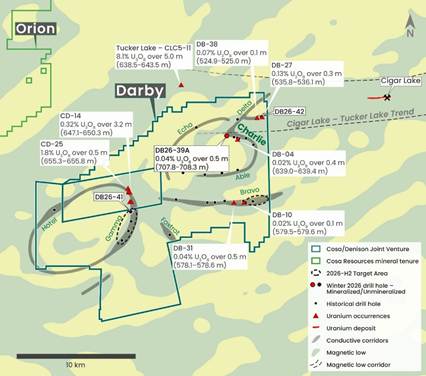
Initially you look at a map and it looks like there’s a fair bit of drilling on the project and there is. But when you look at that drilling closely you know that a lot of it’s got all of the ingredients that you want to see. We’re seeing structure, the exact genuine graphitic structures that you want to see.
We’re seeing lots of alteration on the flanks of those structures. And we’re seeing an incredible amount of geochemistry in the sandstone. I would say that some of the strongest uranium anomalies in sandstone I’ve ever seen are on the Darby project.
The last time Darby was drilled was before Denison acquired it in 2009. And it was a couple of Cosa guys that were involved with the project. But they’ll readily admit they weren’t totally sure what they were doing with the project at the time.
It was kind of everybody’s introduction to the Athabasca Basin. It wasn’t until we acquired the project that we got to apply our 15 years or so of experience and multiple discoveries and really take a good hard look at the project and bring everything together. A lot of that drilling was done kind of piecemeal, smaller budgets with different geologists.
And having the benefit of being able to look at everything at once and see how much structure alteration and geochemistry there is huge. There’s five or six intersections of uranium mineralization on the project. You’re just 10 kilometers west of Cigar Lake.
We go through that mine site to get into that project. It’s got everything that you’d want to see.
It was absolutely a had to have project for us. Of course, exploration success is never guaranteed, but I believe that between Murphy and Darby, we’ve got a real shot at more than one discovery.
RM: You’ve got cheap diesel stored at Darby.
JR: Yeah, absolutely. You know, it’s a funny one, and it seems in the Athabasca Basin that, share prices and company valuations have largely stayed the same for many years, but exploration costs continue to go up. Having Denison there to fund 30% obviously is great, and then any other edge that you can give yourself to save money to get more drilling done might make the difference.
And our edge there is our VP of Exploration, Andy Carmichael, and the rest of our technical team, Keane Baseden, Hayley Kitt, and Michael LeBlanc. I worked for Andy as a geologist with IsoEnergy for many years, and he is a meticulous planner, much to our benefit.
We were able to stage all the supplies that we need at Darby for a foreseeable amount of drilling, and part of that was a diesel fuel cache, which was done when the price of fuel was much cheaper.
The cost of fuel, whether that’s for a helicopter, for heating your camp, or running the drills, that does make a difference on the bottom line.
RM: Traction Uranium, your partner on the Aurora project is funding a drill program on Aurora, you’ve had some interesting news recently off that.
JR: That’s right, it’s just 16, 17 kilometers east of Key Lake. It hasn’t been drilled in roughly 40 years.
We did a few rounds of airborne geophysics, we did some VTEM work and we’ve done some gravity work. Traction funded some radiometric work and stacked up some anomalies.
So that extra 40 years of advancements in geophysical techniques and understanding of various deposit models, especially after the GMZ discovery by 92 Energy (later acquired by Atha). There are several analogues to the Key Lake structural setup just to the west, as well as the GMZ structural setup to the northeast. So that’s one that we’re very excited to go in there and drill.
And our partners are very excited about it, too. Having them fund that work as part of their multiyear earn-in is great for us. It offers Cosa exposure to discovery success without having to fund that work ourselves. It’s a great deal for us, especially because we’re so focused on developing drill targets and working towards discovery at Murphy and Darby with Denison.
RM: Why Murphy Lake before Darby?
JR: It’s a fair question. There was several reasons even though the prospectivity of the projects is very similar.
They both have exceptional geology, Murphy is just a bit shallower than Darby. The unconformity at Murphy is roughly 260 meters deep, which is 20 to 30 percent shallower than Hurricane, and it’s just a few kilometers east of Hurricane. We know that geology very well so we all jumped at the opportunity to be back drilling just next to Hurricane.
I was the Senior Geologist for IsoEnergy when we drilled off that deposit, so Andy and I know that geology exceptionally well and we were just drawn to it because we’d spent so much time in that area. Like you said, Darby is worthy of an equivalent amount of work, and that’s why we’ve continued to advance both projects.
From the start, when we formed Cosa, we decided that we would retain the drill it and kill it strategy that worked so well at Iso. With that success that we had at Hurricane, that didn’t happen overnight.
We drilled several projects before we ultimately discovered Hurricane, and that’s what we’ll do with Cosa. We’ll keep going, we’ll keep moving through our projects, and a big part of that strategy is to be advancing both Murphy and Darby. That way, if at one of those projects we’re seeing stronger results that tell us that we need to look more closely, then we’ll put a bit more of a budget towards that project. Conversely, if we drill one of these projects for a few seasons and we’re not seeing the results that we want to see, then we’ll shift our focus elsewhere.
And we’ll keep doing that until we have the success that we want.
RM: You are going back to Murphy Lake this winter, and you’re going to be drilling from the lake, which is a huge advantage.
JR: Yes, that’s right. Our logistical access was a bit tougher than we had expected after we revised our model. These deposits are structurally complex and after we got a better handle of things we ended up having to drill some longer, flatter holes just to access those targets. This winter we’re not expecting to have those issues.
This is not a major lake that we’re dealing with either, it’s relatively shallow, only a few feet deep. Last winter it froze solid, so we should have no issues getting in there. We absolutely plan to be at Murphy as early as possible in January.
There’s a shared road that is also used by ISO and Cameco while they’re doing their drilling in the area. We’re expecting to have good logistical access at the Murphy early on this winter.
It should be a similarly sized program to what we just finished up. We’ve still got to discuss our plans and formalize our budgets with Denison. But as of right now, the plan is for a significant program at Murphy as early as possible in January.
We also will have a budget for more work at Darby.
RM: What is your cash position right now?
JR: We have roughly $16 million in the Treasury and it’s worth noting most of that is going to go to drilling. We’re going to put together solid drill programs for Murphy and Darby. We’re going to drill the targets that need to be drilled from a technical perspective.
RM: Tell us about your partnership with Denison. It’s extremely important to have a partnership with a major in the Eastern Athabasca Basin.
JR: It’s been an incredible deal for us. Denison’s management stay involved with the company. They’re there for anything that we need from them, it’s been great.
They’ve participated in every financing that we’ve done since we did this deal with them. They continue to fund 30% of their share of the joint ventures and all of that makes a big difference to us having a partner like that.
The cost of exploration in the Athabasca continues to rise so having somebody that’s committed to funding 30% of that work makes a big difference. Our cost to drill at Murphy Lake North, after accounting for Denison’s 30% share, is some of the cheapest drilling that I’ve ever done. I don’t think I’ve drilled a project that cheap probably since 2018 or 2019 pre-COVID.
It’s a huge advantage for us, not just financially, but also they have very bright minds technically. Chad Sorba, he also came on as a technical advisor as part of the deal with Denison. He’s had an incredible amount of success in the Athabasca as well.
He was around for both of Denison’s Phoenix and Gryphon discoveries. And he often has a lot of really valuable insight as well.
RM: Would you describe Denison as a strategic partner in the basin?
JR: Yeah, you can tell that Denison is clearly trying to expand their scope. They’ve done this deal with us. They have some other similar deals as well.
I think it’s very obvious that they’re partnering with junior companies that know what they’re doing because they want to send us out into the basin with great projects and see us realize some exploration success. Hopefully, that success ends up as part of Denison’s future development portfolio.
It’s a brilliant move by them, especially in the current uranium climate that we’re in. We need discoveries now and we really needed them five, ten years ago.
RM: Tell us a little bit about the supply and demand dynamics of the uranium market right now and a brief explanation of why uranium, right now, is something that investors should have on their radar screens.
JR: I would say the fundamentals are the strongest they’ve ever been.
You know, the supply deficit that is looming is quite incredible. There’s a lot of chatter coming out of the WNA symposium that just happened in London.
To summarize, there’s a major tonal shift from utilities and consumers of uranium where, just within the last year, that tone has changed from nickel and diming producers and arguing over price and complicated contracts, to doing business with anybody at almost any price. As long as they can guarantee that the supply is going to be there.
That’s showing where the market is headed. You’re seeing countries come to market that are doing their nuclear build out. India seems to be contracting an incredible amount of uranium.
Most people haven’t really woken up to it yet.
RM: Are power utilities under stress to make contracts right now?
JR: Absolutely, and not just domestically in the U.S., but globally you’re also seeing that happen.
You’re seeing the market continue to bifurcate. Look at Kazatomprom, the largest producer in the world. More and more of their uranium looks like it’s going to stay in the east. And that’s left a lot of the Western consumers, the U.S. in particular, scrambling to secure future fuel.
And that’s where a lot of these strategic funding initiatives are stemming from.
RM: Your market cap is $65 million. I think it’s a very reasonable market cap because of management’s discovery history, what you’ve done at Murphy Lake and the fact you’re going back. Darby is an equivalent quality project of Murphy Lake and you’ve got a paid for drill program at Aurora.
You’ve got a strategic partner in Denison and you’ve got $16 million cash going mostly to drilling.
For all those reasons I think that your market cap is reasonable for where we are right now. I’m not going to say you’re poised for discovery, but you’re sure working hard for one.
JR: That’s the crux of it, but it’s in two parts.
One, we have put in a ton of time and money and effort into getting the company where we’re at now. Discoveries are made with the drill bit and most are made by following up an interesting drill hole.
We’ve now advanced Darby and Murphy Lake North to the point where we’re doing follow up drilling. We know there’s uranium.
We know there’s structure and alteration. All the signs that you want to see to tell you that you’re in the neighborhood are there. And at that point it could be that next drill hole that’s going to make the major discovery intersection for you.
Again, there are no guarantees but drilling’s the core focus for us and we’re going to keep doing that.
RM: Discovery is only made when you’re drilling. Period. And we all want a discovery.
JR: Our projects are at the stage where we could just be one or two drill holes away.
People should be aware of how incredibly valuable these deposits can be when you are successful. It seems the only thing that rivals the difficulty of discovery is how valuable these deposits are when you discover them.
Look at NextGen and their $10-plus billion valuation that’s largely underpinned just by their uranium discovery and the development stage that it’s at.
We took IsoEnergy from roughly $0.30 stock to nearly $7 on hurricane. It was pre-consolidation but done over only 18 months.
And even more impressively, in my opinion, is that it was almost a year before we even released an initial resource. And so that all happened very quickly on the back of those drill results. Those drill results can come at any time with the projects and the drill targets that we have.
And we have the money to keep drilling. We’ll fully funded for the rest of this year and winter 2027.
RM: That’s the crazy grades you get in the Athabasca Basin.
JR: It’s quite extraordinary. Hurricane’s average grade is 34.5%, but over 90% of that resource actually averages over 52%.
RM: Nowhere else in the world does it seem to get over 1%.
JR: At those grades it is the most valuable rock on Earth.
RM: I think we’ve covered everything. Is there anything else you want to add?
JR: Yes, I certainly appreciate you taking the time and sharing the story.
I think we check all the boxes for a pre-discovery junior. We continue to put our own money into this thing because we want to replicate the success that we had at IsoEnergy.
Ultimately, we’re going to keep moving and keep advancing projects until we have that success.
RM: Okay, thank you. And we’ll talk again soon.
JR: All right, cheers, Rick.
Richard (Rick) Mills
aheadoftheherd.com

Subscribe to AOTH’s free newsletter
Richard owns shares of Cosa Resource Corp. (TSXV:COSA). Cosa is a paid advertiser on his site aheadoftheherd.com
This article is issued on behalf of Cosa.
Legal Notice / Disclaimer
Ahead of the Herd newsletter, aheadoftheherd.com, hereafter known as AOTH.Please read the entire Disclaimer carefully before you use this website or read the newsletter. If you do not agree to all the AOTH/Richard Mills Disclaimer, do not access/read this website/newsletter/article, or any of its pages. By reading/using this AOTH/Richard Mills website/newsletter/article, and whether you actually read this Disclaimer, you are deemed to have accepted it.