 RSS Subscribe
Under the Spotlight – Malcolm Dorsey CEO, Torr Metals TSXV:TMET
2026.08.22
Richard Mills, Editor Ahead of the Herd: This afternoon I’m talking with Malcolm Dorsey.
Malcolm is the CEO of Torr Metals, and he’s working the Kolos Copper-Gold Project in the Southern Quesnel Trough.
Today we’re discussing what Torr’s CEO sees, which is multiple repeating pulses of magmatic hydrothermal activity, the basics of how these copper-gold porphyries in BC form.
Over time in the Southern Quesnel Trough these deposits were created by a number of these pulses. At Ajax, in the Cherry Creek intrusion on the Iron Mask Batholith, just outside Kamloops, there were five, three of which were mineralized, and two that weren’t. This is the classic pattern from which these complex porphyry systems are born.
“The multi-pulse intrusive and hydrothermal model for alkalic copper-gold porphyry systems, such as the Ajax Project near Kamloops, B.C., involves early barren fracturing events that create permeability, followed by successive fluid and magmatic injections where later, highly evolved pulses—frequently associated with albitization and specific dioritic phases—deliver the primary economic chalcopyrite and gold mineralization.
The Ajax and Afton deposits are part of the same alkalic porphyry copper-gold system. They share identical multi-pulse magmatic mechanics because they are hosted within the same geological structure.”
Malcolm, can you talk about these pulses?
Malcolm Dorsey CEO, Torr Metals: Sure, you need structural controls on these systems, an area where you get that dilation that allows for these pulses of magmatic. Let me say here my background, my training and my work is structural controls. Something that you want to look for is where structures are intersecting and where there’s cross-cutting transfer structures as well.
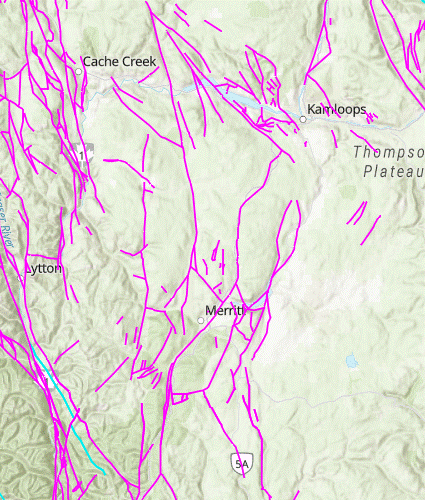
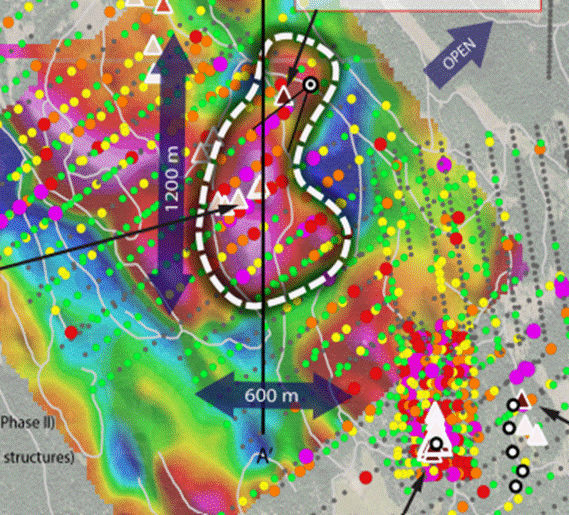
These faults and cross faults allow for the movement of the rock, the weakness needed to allow for the magmas to come up. This is what you want to see, evidence for multiple pulses coming up.
Of course they leave a fingerprint, and that fingerprint maybe it’s mineralization maybe not but it’s always alteration.
We can see evidence for multiple pulses in the Bertha North area.
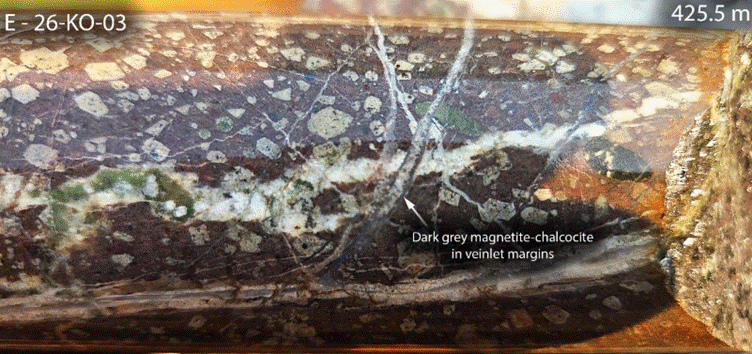
This evidence is shown by multiple vein styles and multiple vein orientations. some are straight, some are irregular but we hit all the different styles of veins you could think of.
Then because of the pulses. the brecciation and the alteration overprint each other, breaking the rock up, a second time, a third, a fourth and a fifth time at Ajax.
What you really want to see is a very dynamic environment, long-lived structures, lots of evidence for multiple pulses of magmatic activity concentrated in the dilational zone. And in those multiple pulses you want to find some evidence of mineralization.
All of this is what we see at Bertha North.
RM: What this does, with the understanding there are unmineralized sections in there, like when you look at Ajax or Afton forming, what this does over time is that you’ll see high-grade, medium-grade, low-grade all interspersed with no-grade core. And this is going to be true for much of the drill cores that we look at.
Is that something that’s correct to say?
MD: Oh, definitely. You’re looking for pulses. Some, as you said will not be mineralized. Some will be. People have a vision that you drill into a porphyry and it’s just a big blob. It’s not that, it’s highly structurally controlled and they are highly complex.
On top of all that, on top of all these pulses and waves coming up through the rocks, they are at different time periods. What happens is the first one opens up, finds the pathways and it might not even be mineralized, but the second or the third etc. well, they could be. And each pulse fractures and shatters more rock for more pathways.
That’s magma coming up, it’s boiling high-pressure fluids. And they are forcing their way up into the same space time after time.
The host rock is so cracked and fractured because it’s been heated with the minerals and shattered time after time. It’s like hydraulic fracturing from inside the rock.
All that superheated gas and water coming up is now under a solid cap of older, cooler rock. When that fluid pressure blows up, by exceeding the weight of the rock above it, everything explodes.
There’s your hydraulic fracturing. And what happens is you get stockwork veins, and this is what we want to see.
RM: Explain more about the stockwork.
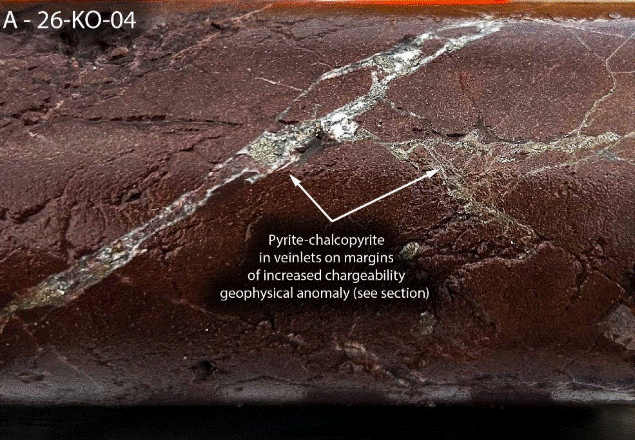
MD: You want to see it forms a pattern of veining, but also there’s a concentration of it. It just indicates the area in the system where you have the most activity, the most hydraulic pressure.
Those pulses directly speak to the fertility of the system. If you find only a single pulse that carried some mineralization, that’s some of the lower-grade-style systems. But what you want to see is evidence for multiple pulses, because every time there’s a new pulse, new fracturing, new brecciation, new stockwork veining, breaking up the old, then that’s where you create more fluid pathways, more opportunities for potential concentration and deposition of the mineralization that may be carried by that magmatic pulse.
RM: What exactly are they doing when they’re compositing the core?.
MD: It’s a tool that ultimately is used more towards resource estimation when you work in that side of things. Because of the pulses that we were talking about, you’re not going to always consistent ore veins that are coming through it, there’s going to be lightly and totally barren rock.
There’s also going to be mineralized rock. When you’re working through the core, you need to have an idea as well of how much drill core within your sampling intervals is mineralized and how do you break up the mineralized sections? Do you break it up based on alteration? Do you break it up based on veining?
You want the mineralization, the grade, to be as accurate as possible so that eventually, if you do have a system that might become a deposit suddenly you’re working towards a resource estimation, you need to come up with a good idea of how that drill core can be composited, the answer is interval logging.
The geologists split the core and sample it in equal intervals. That can be one to two meters, but it does depend on what you’re sampling.
Then assays are based on those intervals as well that are measured out on the core by the geotext and the geologist.
You’ve got to build a realistic picture of the deposit. And they do smooth out the high peaks and the zero grade across the whole core.
RM: You’re a structural expert and an exploration geologist, you have a process of reading the clues left in the rock to point you towards the richest high-grade core of the whole system, and that is called vectoring.
Can you explain that to us?
MD: Yes, it’s looking at the sulfides that you see in the rock, the vein densification, metal ratios, that’s in soils or rock samples.
All that is going to be fed into coming up with a vector, a path, the direction towards the next zone of the porphyry, and hopefully, eventually the core.
We can, with great accuracy, say with the proper evidence where we’re looking at within the system. So that’s the idea of what vectoring or using pathfinders is, is to find where you are within the system.
These porphyries are very large, in some cases they can be multi-kilometer in size and it starts with the outermost section, which is propylitic.
You’ll see a lot of greenish-looking rock. It’s got epidote, chloride and calcite. And it’s the start where you can understand that you’re somewhere in a zone way out on the outer fringe of the system.
Then you work your way in. The next zone you typically find is phyllic. This is definitely closer to the action.
Here the fluids are more acidic destroying the original rock matrix, and they bleach it, you’ll see a lot of bleached-looking rock.
You’ll often hear about pyrite halos and a lot of where we see our propylitic halo appears to have been hematized.
You end up with oxidation of that pyrite, which can be a common thing in supergene weathering environments like we have. And then out of that, you’re looking towards the potassium zone.
What does the center of the porphyry look like? This is where the highest temperature portion of the core is.
It’s where the highest acidity is in terms of the hydrothermal fluids. It’s typically where you get more enhanced copper-gold-molybdenum values. And you’ll see more of a potassic alteration.
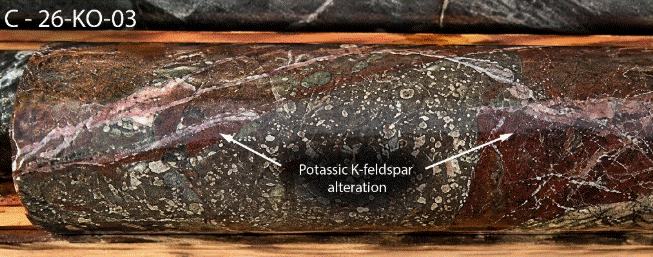
Within that potassic alteration you’ll typically find K feldspar as well as biotite potassic alteration.
Biotite will be a shiny black mineral that you’ll see within the core. So, we’ve seen evidence for both of those within drilling at Bertha North which tells us that we are, based on the vectors, looking at the potential core. We’re into the central portion of the system.
Now with further drilling, of course, we’re going to have to better define where the biotitic zones are as opposed to the potassium feldspar. But this is all part of the vectoring, part of the geology, the fact-finding mission. This is what you follow to work your way inwards.
RM: What zone did we hit last year, you just described three zones. The outer rim, the propylitic zone, the middle ring, which is the phyllic zone, and then, of course, the bullseye, the potassic zone.
DM: I’d say we ended up within the outer propylitic. However, with some of our later drilling in phase one, what was starting to pop up as we were getting closer to this large northwest structure, within some veining was some discrete sterocytic pyrite. So essentially structurally controlled.
That’s what led us to follow that northwest structure, the same structure that also defines a major lithological boundary which is followed by a pyrite unit. In this region, you find essentially pyrite, which is ultramafic. It occurs only along large structures, along lit structures.
All of these clues led to Bertha North. With this first drilling, these first four drill holes, we’ve now, I think, been able to confirm the source of some of that sterocytic fluid. With that, we’re getting larger intervals up to 142 meters.
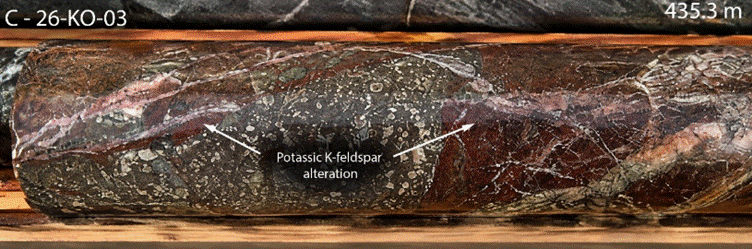
So no longer just discrete, we’re seeing osteocyte, pyrite and quartz veining, what looks to be more like a phyllic zone related to directly to proximal porphyry. Now in the last drill hole, hole number three here, we found some potassium, significant potassium alteration across 25 meters within a phyllic zone.
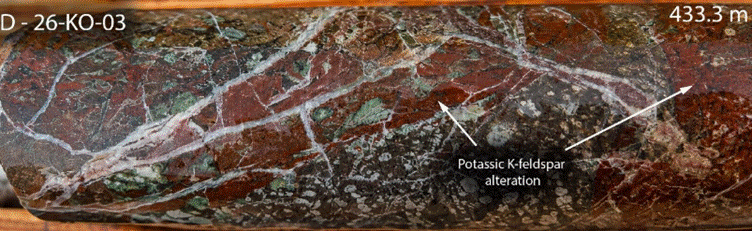
RM: We know that because you hit the potassium feldspar, the K feldspar, and you’ve seen secondary biotite, mica. We’ve seen both of those. The biotite was not as impressive in photos, you might just see these little shiny black flecks within it.
MD: Right now, we’re getting mostly potassium K feldspar dominant alteration, but outside of that we’re starting to see some element of biotite within the adjacent volcanics.
That’s the area that we’re most interested in. We’re using New Afton as an exploration analog, typically that’s where you get the concentration of more enhanced grades within that biotite phase potassium alteration that lies adjacent to those monocytic potassium feldspar altered intrusions. That’s because, like we talked about, those intrusions, they’re part of that pulse, and they create radiation along their margins, which is a great place for the mineralization to get concentrated.
RM: There is also what’s known as the chloride trap, and the transformation is called a retrograde alteration.
But you can get this with all the other types of alteration as well, where you can retrograde into previous alteration phases. A lot of the mafic minerals can retrograde back into biotite during those hydrothermal processes.
What do you absolutely have to have to crack, no pun intended, these massive systems wide open?
MD: You need to have a large-scale conceptual model of looking at regional structures and identify where within those regional structures do you have the highest probability of getting the sort of concentration of an intrusive complex, because that’s what you want to look for. You want to find somewhere where these intrusions get concentrated.
You do that using the structure, regional structures, and remember everything at large scale is always repeated on a smaller scale as well. That’s what I’ve done in this region. I’ve spent 10 years developing a model of this region that I based consolidating Kolos on and specifically developed to use here.
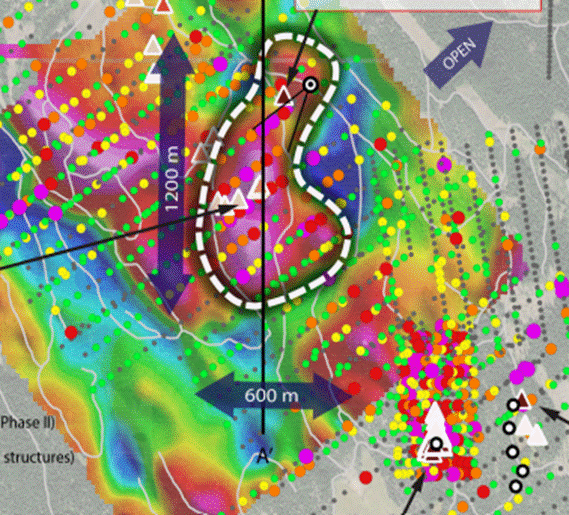
It zeroed in and showcased that the Bertha-Bertha North area was worth looking into. And so that’s what we’ve been doing over the last couple of years.
RM: It’s interesting to go back to what you just said, the area where we drilled last year and got the vector to where we’re drilling this year.
That’s at least a kilometer apart demonstrating the sheer size and scale of these porphyries. We’re literally searching for a needle in a haystack, because you’ve got a kilometer probably on the other side.
These auras go around it, and they spread out so far that you’re literally picking clues and trying to put it all together into a vector. We’re not talking over 100 yards, we’re talking over thousands of meters trying to pinpoint the core.
It is a very scientific step by step process.
MD: Ultimately that potassium core is not that big, you’re looking for a relatively small potassium core compared to the envelope of alteration and mineralization veining that you might see. When we’re looking for something that is along the lines of a New Afton-style system, you have to remember the actual ore body at New Afton is only about 100 meters average across in width, with roughly 1,200 meters of depth, so far.
Back in 2015-2016, the known deposit would have been about 650 meters in strike length. Now that strike length has roughly doubled, but the average width is still about the same. You’re looking for something that’s relatively small.
RM: The fact that we’re seeing this potassium alteration showing up is showcasing that we are looking at what could be the central portion of the porphyry here. It’s amazing to think that Teck mined out Afton and then somebody else with a theory and a model comes along and slams into a New Afton. Research, theories and models.
Here is something to think about. The hypo gene comes up from the bottom, magma super heated fluids pushed up because of the way the rock fractured and shattered by the repeated pulses, more up than out. Underneath Afton was New Afton.
They’re working at a 1200 meter depth, and now they’re going to move over to what they call the K-zone, which is a parallel structure up/ down structure. And they think that that’s going to double the strike length.
There is a moderately steep plunge to the system, so block and cave mining.
Let’s talk about K-Feldspar, potassium feldspar.
MD: Well, it definitely showcases that you are into the system. And what was interesting, with what we saw in hole number three, the K-Feldspar seems to be overprinted by the sericitic envelope, and we saw 104 meters of that sericitic envelope in hole 3.
So even there, it’s speaking to there’s some relic K-Feldspar alteration, there’s potassium alteration within, and all that’s being overprinted by sericite typical of a “phyllic-style envelope”. And that speaks to what we were talking about earlier, these multiple pulses. You get multiple overlapping alteration events as well as mineralization and veining that may or may not come along with that alteration.
RM: You can’t find K-Feldspar too far away from the source. It only forms when fluids are incredibly hot, anywhere from 400 Celsius to 650 Celsius.
Those superheated fluids really lose temperature rapidly as they travel away from that source, so K-Feldspar can’t travel far. Finding it generally means you’re standing right in, or extremely close to, the core of the system, the magmatic engine room that pushed the metals upward.
MD: Your K-Feldspar directly correlates with high-grade copper sulfites like chalcopyrite and bornite and we all covet bornite as it is 63% copper by weight.
RM: There’s a gold correlation too.
MD: If we’re looking at a new Afton-style model there’s some lower grades associated with the K-Feldspar, but the phase potassium alteration is where some of the more enhanced grades occurs. So, it’s a great vector, again, a great tool to get into the center of the system. Of course, I am not saying Bertha North will display the same attributes but it is the exploration model we are using.
If you’re getting K-Feldspar, it means you’re in the right zone for hot hydrothermal fluids that have the capacity to carry mineralization. And really what can happen is that those monzonitic intrusions potentially expelled most of their copper content into the adjacent volcanic rock, if they are the potential source.
If those volcanics have some of that biotype phase potassium alteration, there’s typically a good correlation at New Afton between grade and that biotype phase potassium alteration.
RM: We have hematite alteration, which is often a reddening of the rock. And you said it was persuasive. That means that an entire body of rock basically is a stained vibrant brick red or like a salmon orange color.
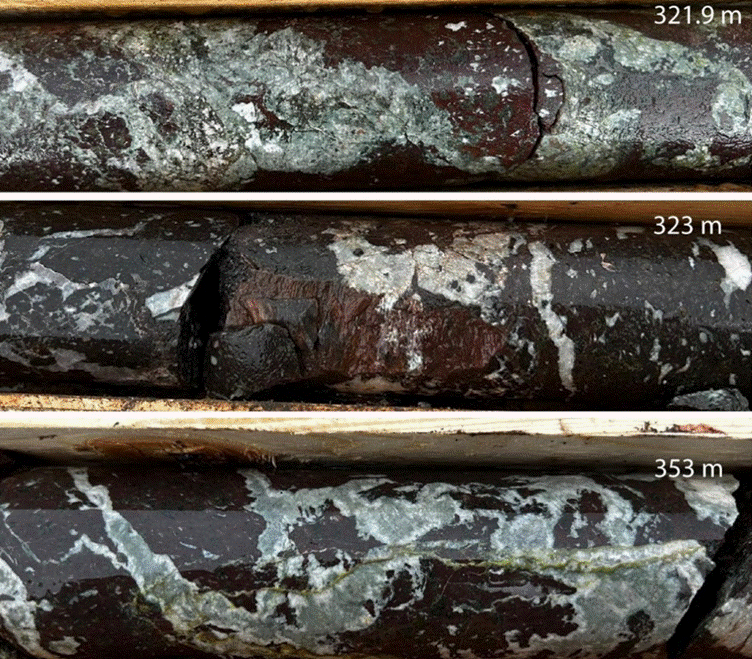
What depth does a nail stop rusting? Hematite shows the level of oxidation. It’s the same thing. The rock at Bertha North is rich in iron content and there is a a lot of disseminated magnetite, the hematite is of course oxidized magnetite.
There’s going to be a lot of disseminated pyrite, pyrites and iron sulfide. That iron starts to oxidize. But for that intense oxidation to occur, it’s got to have been exposed.
MD: We’re seeing really deep reaching oxidation down to, well, we are still in it with a lot of our holes, we’re seeing it multiple hundreds of meters vertical depth, it’s highly unusual to have that kind of permeation of oxidation that deep and it really speaks to it being a really long life structural environment.
These structures are moving rocks around for a really long period of time. They’re allowing rainwater to percolate down into the structures and permeate into the adjacent wall rock and alter and rust out all the iron content, we are seeing a lot of that here to an extraordinary depth.
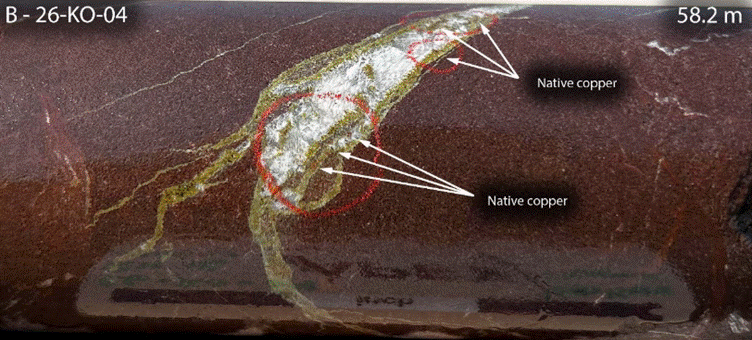
It speaks to, together with the native copper that we’ve encountered with the beginning of hole four, that together with the calcite copper sulfides that we’re seeing, speaks to this being a supergene style environment and is what we’re mostly drilling within.
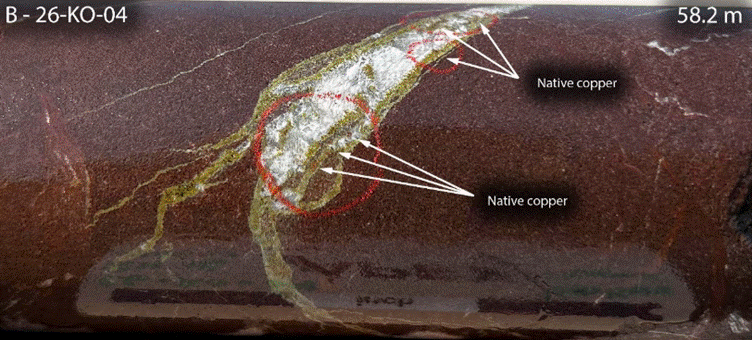
Supergene means weathering. Oxidation over such a long-lived event means there were many opportunities over an incredibly long period of time for rainwater to percolate down, alter the wall rock, rust out that iron content, but also strip out copper from primary copper sulfides such as chalcopyrite or bornite and redistribute that copper through hydrothermal fluids.
With that redistribution, where does the copper end up? It gets concentrated within lithological branches and within hydrothermal branch systems. But here we also have a lot of amygdaloidal basalts as well, which just means you have a whole bunch of vesicles (holes) within the rock that allow for concentration of fluids as well as minerals.
RM: Back to Afton, then New Afton, it was all hypogene mineralization that came up from the magma with the superheating fluids. And it came all the way to the surface.
As it weathered over millions of years, it turned into supergene. Now you’ve got the supergene that goes down, and turns into the hypogene. That’s the way Afton/ New Afton formed. You’ve got the weathering oxidation on top of the many times pulsed up hypogene.
The supergene mineralization at Afton one time was hypogene, but it was weathered into supergene.
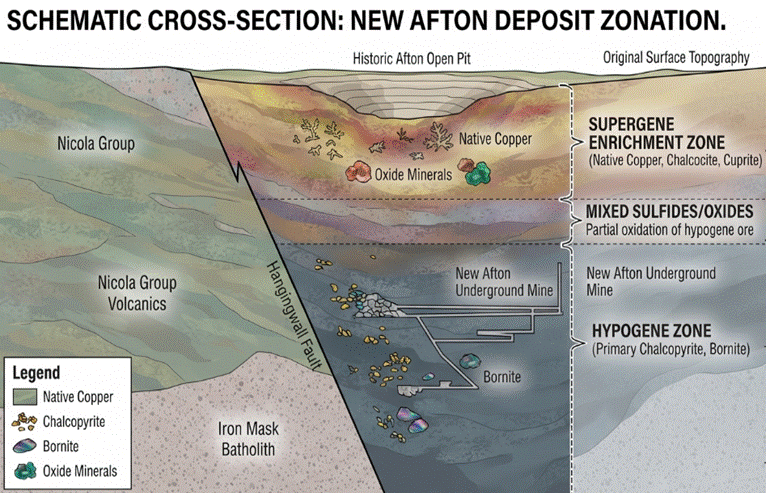
MD: That’s a perfect description, you would have had those primary sulfides going to wherever the exposure level was.
The remarkable thing about the New Afton hypo gene underneath that Afton mined out supergene is the grades. They’re consistent right from the bottom of the transition zone, right down to the 1200-meter mark.
And then over into the K zone, they seem to be about the same grade. And it all works out to about 0.7g/t Gold, 0.7% Copper. And that’s all the way down.
It’s also over the LOM, that’s over the life of the mine, so far. That’s a remarkably consistent grade. Something like that in your mining, when you can count on such consistent grade is huge.
RM: Let’s touch some compliance issues. You can study the core, you can analyze it, you can look at it. But if you haven’t released information on that hole to the market, you can’t speak about it. Period, full stop,
MD: That’s right, and that’s something that I right on course with.
RM: You can use XRF and it’s a great tool, especially on Copper. And it does show you anomalous Gold, but it is not really reliable for grade.
You’re also not able to say much about the XRF, very basic info, like, yeah we’re using one.
MD: Right, it’s another tool and its a very good tool for vectoring. It’s a preliminary show of single points across the core. What it is really good at is showcasing where your anomalous zones are. Because if they’re highly anomalous, then you’re certainly going to see that pattern emerge within the XRF results.
In terms of gold, in terms of the grades that XRF can report it can be highly erratic. But it can showcase whether or not you’ve got some positive potential here for gold.
It can also be a useful tool to call attention to a certain zone, to look at it again, to really further investigate areas that perhaps you wouldn’t have caught just by using the naked eye. And that is something that we’ve seen as well here with the drilling that we’re doing, as we’re seeing sometimes within this strong, clay-like hematitic alteration.
That’s something that we keep running into with the drilling. In terms of drilling, it’s been a little bit slower than normal. But that’s due to the degree of alteration that we’re running into, the degree of fracturing, faulting.
This rock has been broken up so many times over many millions of years. That all adds to slower drilling. The hematitic clay is so strong that sometimes we’ve got to pull out and ream the hole, just to keep the hole open.
Those are all good problems to have. But just to go back to that hematitic clay, there’s been some zones where we’ve noted it’s got a coppery sheen to it. Our attention attention was drawn to that by the XRF, because you do have areas where you get this finely disseminated copper within it.
RM: I took a look look at some of the cutoff grades of the massive copper mines in BC. We have the biggest and the second biggest open pit copper gold mines in Canada here and they are our neighbours.
Highland Valley is Canada’s largest open pit copper mine. And the reason they run at such a low cutoff is because they’ve got economies of scale. And scale is very important to these guys. At Highland Valley, the internal economic cutoff floats between .10% to .12% copper.
Copper Mountain is a conventional open pit and has 0.10% for certain pits and 0.13% for its main body in the north pit.
Gibraltar, which is the second largest open pit mine in Canada operates roughly a head grade of 0.25% copper.
At New Afton’s underground block caving, they use an NSR cutoff, it’s historically right around $20 to $24 per ton Canadian.
Mount Milligan is using an NSR calculation as well, they’re around $7, $8 per ton for mill feed.
The proposed Ajax copper project near Kamloops is using a net smelter return, an NSR of US $7.10.
This project could be BC’s next major mine – the economic copper cut-off grade for Trekor Metals (formerly Taseko Mines) Yellowhead Copper Project mineral reserves is 0.17% copper.
Here are earlier stage Southern Quesnel Trough projects that have a mineral resource and have done cutoffs:
Kodiak Copper (TSXV:KDK) just released its maiden mineral resource estimate for their MPD copper/ gold project. And they have a 0.2% copper equivalent.
North Island open pit is a 0.15% copper equivalent (CuEq).
The Berg open pit uses a dynamic NSR, which means a floating NSR.
Treaty Creek, a northern porphyry, is up in the Golden Triangle and has a US $50 a ton NSR.
(Some heavy regional infrastructure investments- including the paved Stewart-Cassier Highway (Hwy 37), the Northwest Transmission Line, and deep-water port facilities in Stewart – are steadily improving commercial access to the area – Rick)
You’ve got southern porphyries vs. northern mountain porphyries. Torr Metals (TSXV:TMET) Kolos Project is located in southern BC, where you have paved roads, power line, rail lines, and don’t need camps. Even the weather is on your side. Kolos is directly intersected, and serviced, by Highway 5 and Highway 97D. You’ve got a mining history.
The northern projects get an infrastructure penalty and a lot of metal is stranded until they get better access out, like a railway. That’s just the way it is. You have higher value-based NSR cutoffs to clear the economic hurdle of building access roads, long-distance power connections, and camp operations, flying in diesel and stuff like that.
Where Kolos is, why don’t you just touch on the infrastructure and the workforce in the area?
MD: All of that was part of the process I had used when I was staking Kolos. Something I always liked was the infrastructure access.
The fact that you already have roads, you already have operating copper mines. You have the greatest concentration of mines in British Columbia. You’ve got direct highway access, no helicopters. Stay in a motel half an hour away.
I can drive to any of the target areas. Major regional power lines, there’s one that just runs literally less than 100 metres away from where we’re drilling at Bertha North.
The accessibility is there, together with the skilled workforce that already exists, existing mining infrastructure where majors are putting billions of dollars into mining infrastructure expansion. That’s happening over at Highland Valley, just 30 kilometres to our west. This is where the effort is going into because this is, like you said, is where the infrastructure already exists.
And with that, there’s the advantage here that with the potential and the fact that it’s been hugely underexplored as Golden Triangle and other areas up in the north kind of stole the show when the glaciers started to recede and expose these big mountains of gossan that all are helicopter accessible for the most part. That kind of stole the show. People moved away from the southern Quesnel Trough.
That’s given us the opportunity here that it’s hugely underexplored. We’ve been able to point to essentially what was virgin ground right off a highway and say we’re going to find a new porphyry system here. We see the potential for this.
We’ve spent very little time, very little exploration dollars, to be able to define a brand new porphyry system that now we’re drilling into. It’s in a district that has a need for near-term feed. Rick, there are nine major miners around us, some with only property, some with mines and mills.
RM: Existing infrastructure lowers the bar for successful economics when talking about ore to be shipped to Vancouver or a stand-alone project. The bar is lowered again when ore becomes feed for an existing mill.
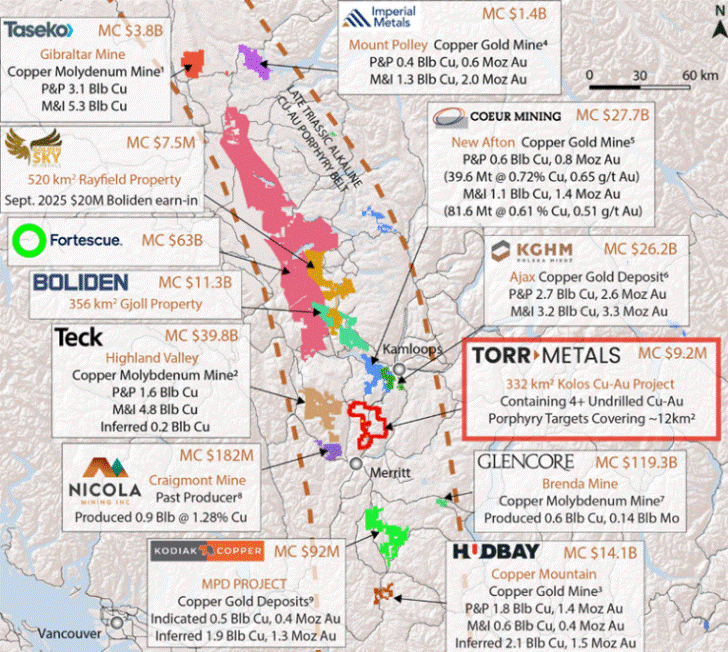
I’m looking at a map of the Kolos area.
Basically within 100 kilometers, maybe less, you’ve got Taseko, you’ve got Fortescue, you’ve got Boliden, you’ve got Teck, you’ve got Imperial Metals, you’ve got Coeur Mining, you’ve got KGHM, you’ve got Glencore, and you’ve got Hud Bay. That is is a huge concentration of majors.
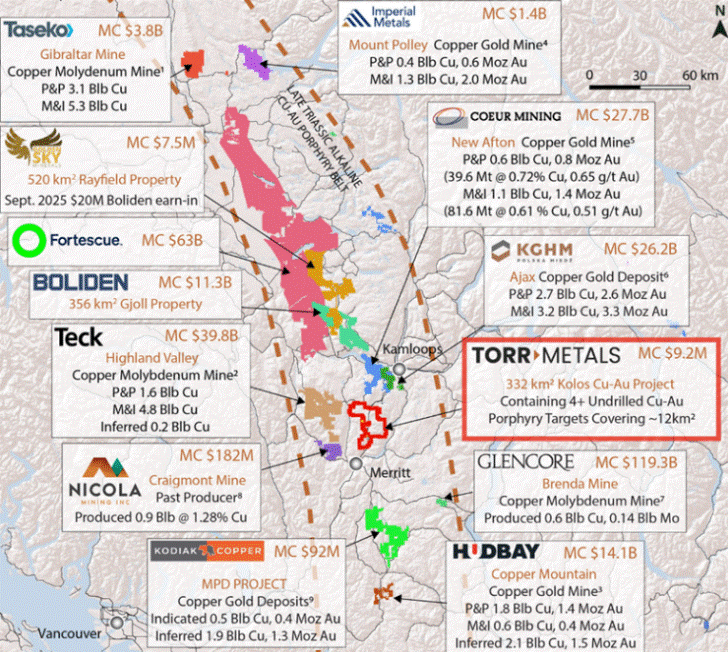
It might be the biggest concentration of majors in Canada. Why the hell are they here, you’ve got to ask that question, right?
MD: Oh, exactly. Number one for them, right at the top of their list is infrastructure access, reason two is the prospectivity of the geology, and three the potential for new discoveries. The same stuff that led me here 10-years ago to begin my process of building Kolos. And, yeah, they also recognize now the low degree of maturity and exploration in this area.
The fact that there are underexplored areas, even though we’re pretty much right next door to operating mines. That is where opportunity lies, to go to low-maturity exploration areas and to get that coupled together with a region that has this many operating mines and majors is pretty rare.
RM: More than a few eyebrows were arched when you started to raise money last year.
I know it was years in the making, but a lot of people were first exposed to you and your model last year. And one of them was a very well-known broker, massive book.
He called me, “Rick, you’ve been in BC for a while. You know some porphyry stuff. Can you check out this guy’s project and get back to me?”
It was thumbs-up. I asked him to set up a meeting between me and you, and we spent quite a bit of time on the phone.
It was an area that was never been worked before, which was intriguing, I studied your past, your history, you are a structural expert. That’s where your expertise lies.
And here we are a year later and all I want to say is awesome, drill the crap out of this thing.
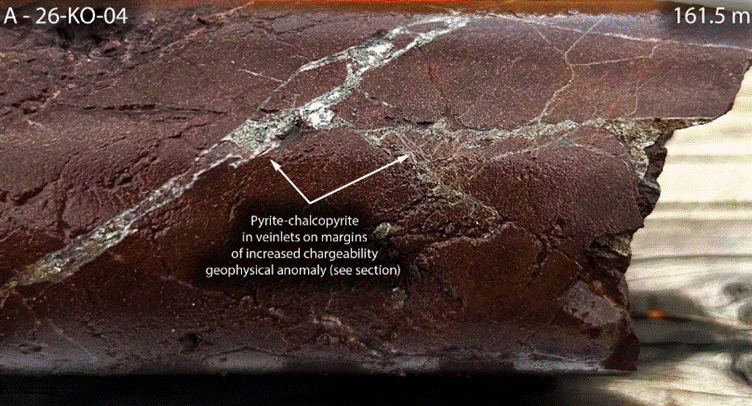
MD: We found some evidence of intrusive activity associated with hot hydrothermal fluids as evidenced by potassic K-feldspar alteration. With this evidence in hand, we need to continue drilling to see if the alteration and stock work veining gets stronger and whether copper sulphides content increases, and if so, more drilling will better delineate those zones.
With every hole we are putting together more of that model, and with that in mind we have to stick with it here.
That’s what we’re seeing now in the first four drill holes, we have to stick with it here.
RM: You were planning on maybe drilling a second target later this year, after the drill program at Bertha North.
I’m guessing you’re not leaving Bertha North.
MD: When we come across this kind of evidence, I have to spend more time on it. We need to put more holes into Bertha North.
What we’ve seen so far certainly requires follow-up and we’ve got the treasury to stick with this and keep drilling it and really get it quite advanced this year.
I think what’s really exciting is the progression. We found the plumbing right away with 2026’s holes one and two.
We saw that activity over 100’s of meters. We saw copper sulfides. Now we’re seeing an intrusive affected by hotter, more potassium-style alteration, more copper mineralization.
We’re drilling towards those geophysical targets. They appear to be getting stronger and broader at depth. So really, this is just the beginning.
RM: I think we’ve covered everything. But would you like to do a quick wrap-up and then we can end this?
MD: I would bring it back to where we started a year ago. What I had when we first talked was just a geological, geophysical idea on virgin ground. Nobody had ever drilled it. And today we put four, only four holes into that system.
We’ve already confirmed a large multiphase, porphyry-style hydrothermal system exists here. That that’s really exciting. I think we’re seeing all those elements come together and we’re only just beginning to define what the scale and continuity of this system could be.
Yes, the assays are very important, those are coming down the line. But there’s still plenty to continue working on here, refining the model.
Every drill hole is getting smarter with what we’re targeting. This is what systematic exploration is supposed to do. It’s supposed to find a target such as this.
We are supposed to continue expanding on it, really testing the different theories, the different targets within it. And with a fully funded program, the infrastructure access we have—and not to mention, there are, as you mentioned, four other compelling copper-gold porphyry targets on the project that have never been drilled. We’re in a very interesting position right now.
RM: What’s the endgame target for you?
MD: The endgame is, with the setup of our land position, our strategic positioning, the endgame is always with a thought towards transaction potential. And we’re just leveraging everything that we can with that by looking for not just copper-gold porphyry in British Columbia but looking for the right style of system that I think suits what major miners could be looking for in the province.
I think smaller tonnage, so New Afton-style systems that are only 100 million tons but pack a punch with 2 billion pounds of copper, 2 million ounces of gold potential, in an infrastructure-rich district is something that can hardly be ignored. And which, yeah, I think it would be very attractive with what majors are looking for.
New Afton, a system such as that, smaller tonnage but high-grade, next to operating mills and mines, offers a real competitive advantage.
RM: And there’s a sweetener to the deal. That’s our other targets.
MD: We had three other targets till recently, but now with the new Kova target, four copper-gold porphyry targets across the largest land package held by any junior this close to New Afton and Highland Valley, and there is a possibility of finding more targets, we are not done with exploration on Kolos. Both those mines are only about 30 kilometers away. And just having those additional targets just adds that incentive value of, this is a project that could offer many years of exploration for the potential partner takeover.
RM: Exactly. Thank you, Malcolm. I really appreciate you taking the time to do this for your shareholders.
As usual, very informative.
MD: Thank you Rick.
Richard (Rick) Mills
aheadoftheherd.com

Legal Notice / Disclaimer
Ahead of the Herd newsletter, aheadoftheherd.com, hereafter known as AOTH.Please read the entire Disclaimer carefully before you use this website or read the newsletter. If you do not agree to all the AOTH/Richard Mills Disclaimer, do not access/read this website/newsletter/article, or any of its pages. By reading/using this AOTH/Richard Mills website/newsletter/article, and whether you actually read this Disclaimer, you are deemed to have accepted it.