 RSS Subscribe
Under the Spotlight – Marc Blythe, CEO Au Gold (TSXV:AUGC)
2026.06.04
Rick Mills, Editor/ Publisher, Ahead of the Herd:
Marc, back in March, you filed a technical report on the acquisition
of the Havelock Gold-Antimony Project. Was there anything in that technical report that should have stood out for readers? What was the important takeaway or takeaways?
Marc Blythe, President and CEO, Au Gold Corp:
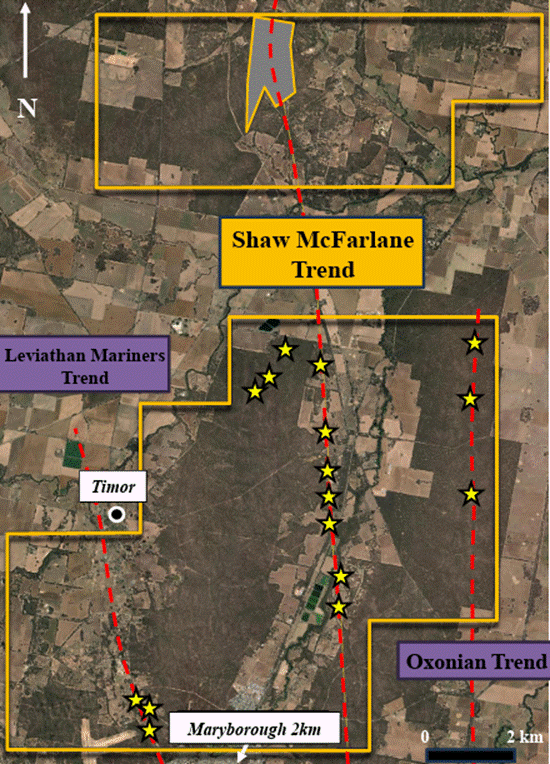
I think the central thesis was that the Shaw-McFarlane Trend, which is about a 9-km trend that goes almost north-south through the property, has really had almost no exploration, despite having a history of high-grade gold production on a small scale back in the 1800s, and also some sniffs of antimony in the records as well.
RM: And that’s gold and antimony in a type of deposit that can produce really high grades.
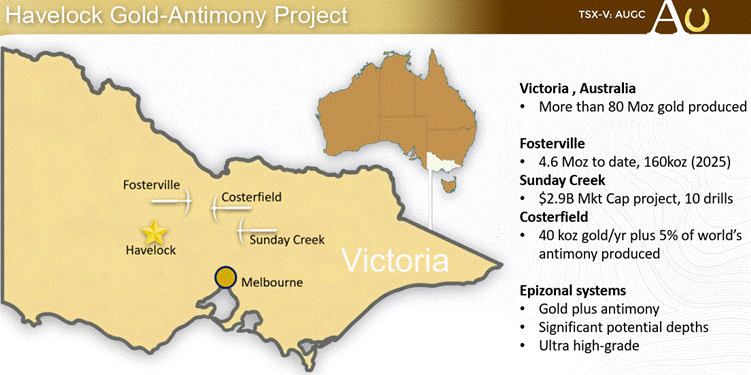
MB: That’s correct. That’s why we initially got really interested in this area. High-grade gold with antimony is potentially an indicator of an epizonal gold system. And those types of gold systems are a subset of orogenic gold deposits.
We were very interested to look at them because it puts it in the same category as potentially Costerfield, Fosterville, and Southern Cross Gold’s Sunday Creek Project, all of which are epizonal systems.
RM: When you put out your news release on April 8, you titled it, ‘Au Gold Corp Identifies High-Grade Gold Target at its Havelock Project’. We’re following up on the technical report here with evidence from your own investigation.
MB: Yes. We’ve obviously been doing some orientation sampling, figuring things out, it’s a big property, Rick. It’s easily accessible, but there’s a lot of ground to cover here.
Obviously, ground zero is that Shaw-McFarlane Trend, but being 9 kilometers long, being in the right spot on it is important. We want to make sure when we go drilling that we pick the best possible spot to give us the greatest chance of success early on in the program.
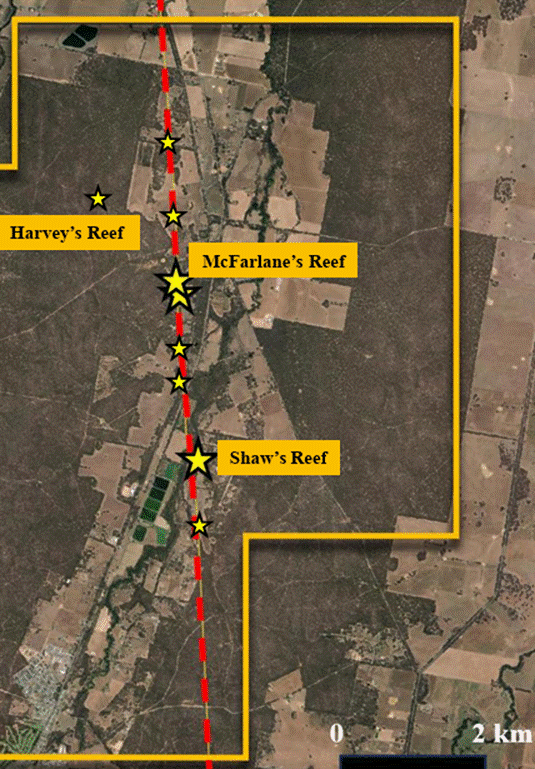
RM: Right. You talk about the Harvey’s Reef target on the Shaw-McFarlane Trend in this news release. Can you talk a little bit more about that?
MB: Yes. Harvey’s Reef, it’s an interesting setup because there’s a dike there recorded in the historical records. The gold is adjacent to the dike and the hanging wall or the footwall of the dike, which basically means it occurs alongside the dike. That tweaked our attention because at Sunday Creek, Southern Cross’s project, most of the gold that they find is in association with a big dike. So, when we saw that association, we thought this is interesting. We’d better tune in here and see what’s going on. But what really led us there was when we were doing our diligence, the Qualified Person collected a sample there that ran just over 12 grams gold and had 0.18% antimony with it as well. So that made us go back there.
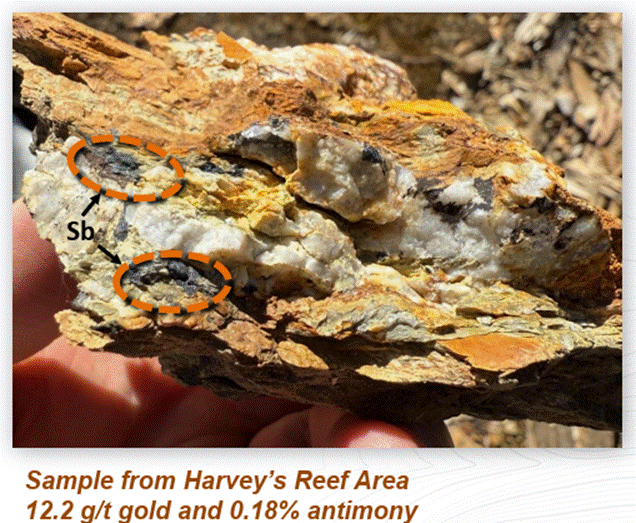
As we’ve worked through all the historical data and tried to assimilate that into our planning, we located records of an old hole that had intersected 1.5m of 9.24 g/t gold. There was no assaying for antimony in that drill program. And that was a very shallow intercept.
It was only 30 meters below surface. At the time that hole was drilled, it wasn’t particularly interesting to the company that drilled it because of the gold price. But these days, those kinds of grades are pretty interesting.
For us it’s a thread that we need to pull on and see what’s this all about. It’s right near surface. We’ve got a sample on surface that ran. We’ve got this historic drill hole that was very shallow. And then there’s these mining records from this Harvey Zone, which is right there where they were mining hard rock near surface, very shallow workings and recovering material that ran an ounce per tonne.
RM: And the limited exploration was only to shallow depths, 18m at its deepest.
MB: You’ve always got to think about the technology of the day and what sort of grades were interesting to the old timers. They probably needed one ounce material to get interested because they were mining it with manual methods. Then you’ve got to transport that rock somewhere to get it crushed and run through the gravity separation circuit. So, yes, they were looking for higher grades than what might be of interest to us.
RM: I thought it was interesting that gold grades of one ounce per tonne were reported from the hanging wall, while greater than one ounce per tonne was reported from the footwall. Does it mean anything?
MB: We’re working on a bit of a theory that, I don’t want to get too technical here for you, but this is about rheology, which is the contrast of the hardness of the host rocks is perhaps causing a site where the gold is precipitating out.
You have these gold-bearing fluids and what we’re looking for is an accumulation. So, obviously we’re looking for the gold-bearing fluids, but some of the accumulation metric is going to be around width as well, and whether the widths and the grades combined are interesting to us going forward. So, anytime we can identify things like this where there seems to be a mechanism, that’s really helpful for our understanding of what’s going on here and how to target things better going forward.
RM: It was described by Howitt in 1913, the Harvey’s Reef as occurring directly on the wall of a large lamprophyre dike up to five meters thick.
MB: Correct. That lamprophyre dike will have different rock properties to the sediments, the Ordovician-aged sediments that are the predominant rock unit that we’re dealing with. That could lead to that dike being an ideal precipitation site for the gold mineralization, in the way that it happens at Southern Cross Gold potentially. That’s our line of thinking anyway. It’s pretty early days and we’re still working through what we know and what we don’t know.
RM: Your next news release was on the 22nd of April. You talked about hiring Clive Willman and Associates to research and reconnect, reconstruct historic mining activity on the Shaw-Macfarlane.
We’ve seen some results from that, such as the diagram of the mine. They’re studying the late 1800s and moving forward. How’s that going?
MB: I’m absolutely blown away by what Clive has been able to achieve. I’m heading to the property tonight, and I’ve got a pile of his reports and maps lined up to read on the plane on the way there.
He’s very thorough, very detailed, and he’s worked through this in a very methodical way. These mines, when they were originally being mined, they would have had plans and sections describing the works. But obviously with the process of time, all that data has been lost.
He’s been able to reconstruct from written records what these mines look like in three dimensions. That’s extremely useful for us in terms of understanding where the potentially interesting spots of these old workings are, so that we can figure out where we want to drill underneath. These workings are all quite shallow. The deepest is about 510 feet. We’re less than 200 meters deep. If we can from his work establish where the best thicknesses and grades are, then we’re off to the races with drill targeting.
We’re in the process of working through the data that he’s collected for us and assembled. I’d like to make some of it public but it’s extremely detailed and we need to simplify it for public consumption. But he’s managed to create long sections and cross sections for a number of these old mines. It might even be eight or nine different shafts.
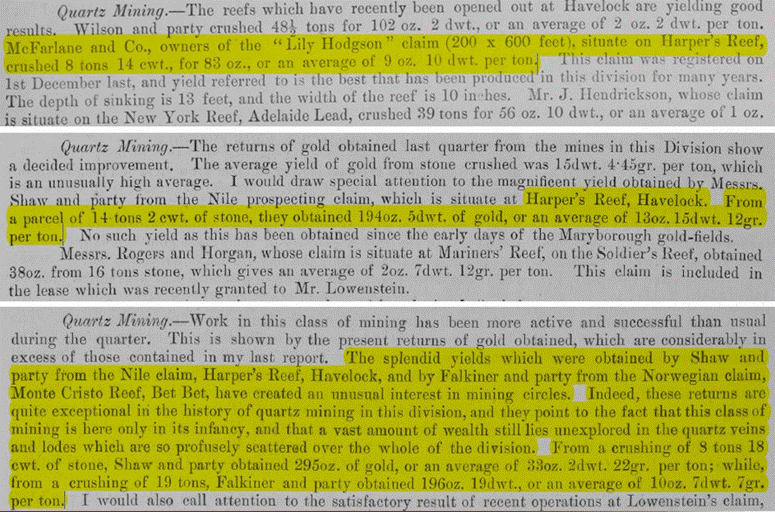
I can’t remember the exact number, but it’s fascinating to look at. It’s a ton of work. It’s very painstaking work that he’s done. And there are records of antimony being encountered underground in the McFarlane shaft workings. So, that’s really encouraging for us that that’s specifically called out in the workings and know whereabouts it is that they encountered that material.
So, from a drilling perspective we have our eye on the ball.
RM: How does it jibe with your own work that you’ve been doing?
MB: Well, the Shaw-McFarlane Trend itself, much of the interesting part of the trend is on private land. And that private land, a lot of it has been turned into farmland.
So, a lot of the clues that we would typically go and look for and we’re out prospecting are gone because the land was leveled to allow grazing. Having the ability to look at these historical records is almost as good. That’s the way I’d characterize that.
In the more recent press release that we put out, we talked about the southern extension of the Shaw-McFarlane Trend, which goes back out into Crown land forest areas. So, I’m pretty excited to go and look at that when we get down there as well.
RM: In the May 21st news release, you talk about additional gold targets, the exploration results.
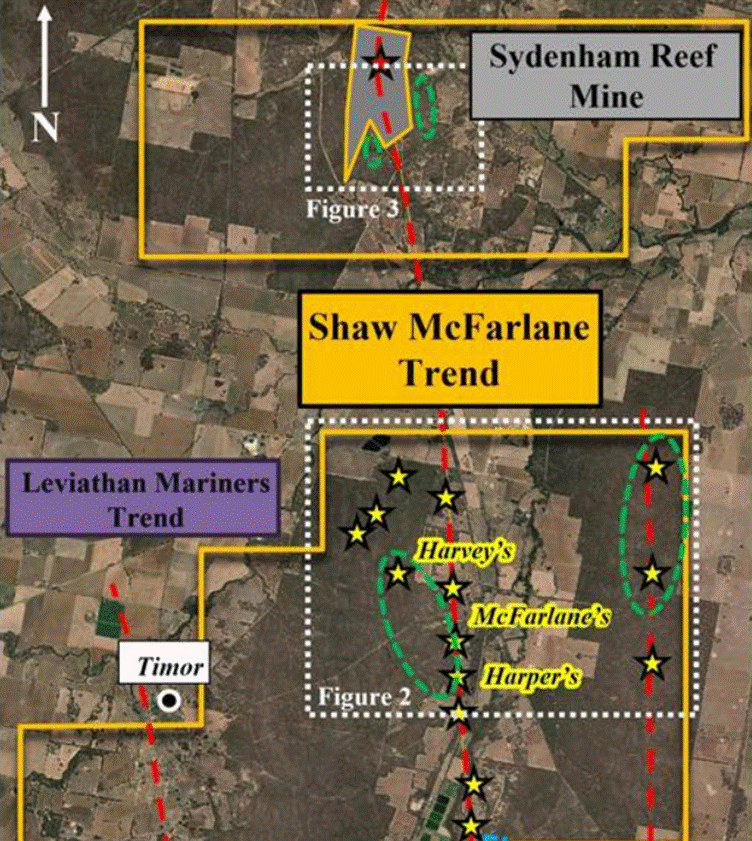
MB: And then on that northern claim block as well, we’ve established from the data two trends that look like they have some in-situ and some float samples that run multi-gram assays at surface. So, that’s obviously worth following up as well.
RM: How successful was the work up on the Oxonian Trend.
MB: We certainly don’t think we’ve done that to death, but we didn’t necessarily get what we had hoped for from the prospecting samples.
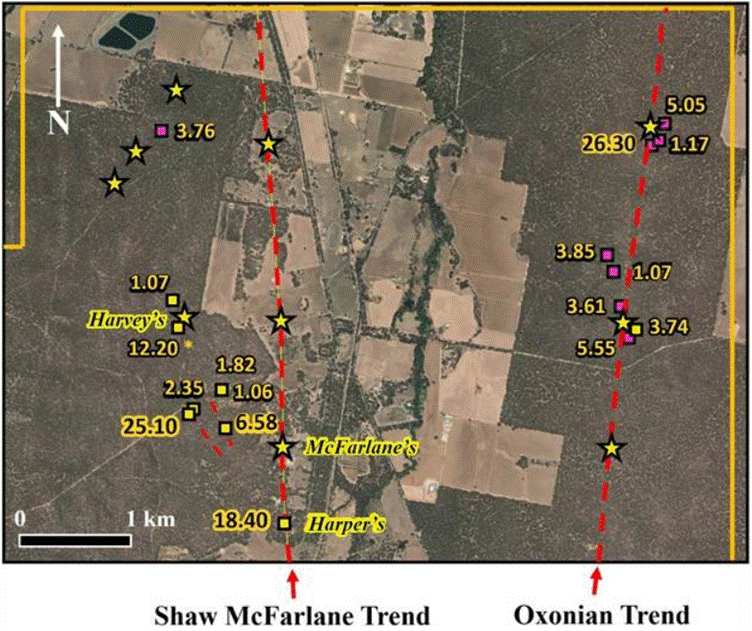
We prospected very generally across the broad area there. So, we’re just getting tuned in and that’s why we characterize it as orientation sampling. There’s some historical workings there.
The thing that really intrigued me about that Oxonian Trend is the alluvial workings are quite substantial, but the hard rock workings are not. In my mind, there’s only a couple of explanations for that. One is that the old timers never really got onto where that gold came from. The other possibility is that maybe the hard rock material was below their expectations, grade-wise or thickness-wise.
Now you don’t necessarily need a high-grade hard rock deposit to create a high-grade alluvial system. The alluvial systems are very efficient ways of concentrating gold in drainages.
You could potentially have a low-grade vein that erodes away over time, but all the gold is very efficiently concentrated in the creeks. So, that’s a possibility as well. We haven’t written it off, we have more work planned there — we talked about that in the last press release — more soil samples being collected and probably some follow-up prospecting there as well.
RM: And Harper’s Reef?
MB: Harper’s Reef is on that Shaw-McFarlane Trend. We were able to get permission off one of the landowners to go and inspect the workings there and see what the host rocks were. There were some quartz fragments on the top of the waste dump.
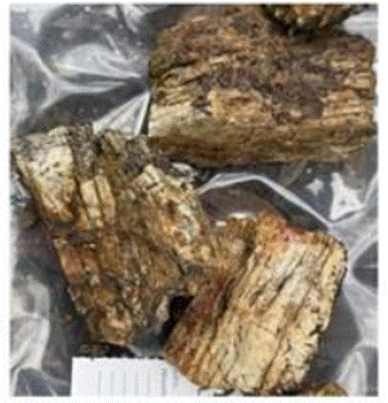
I think because the quartz was so high-grade when they mined there, they took it all. We managed to collect enough samples to establish that that material ran, I think it was about 18 grams. So, definitely in the right spot on that Shaw-McFarlane Trend. It’s potentially a drill target, that area.
RM: Your Havelock dataset review is already paying results. It identified two well-defined northerly trends of gold-bearing float in the northern Havelock claim block.
MB: That’s right. We haven’t spent any time there, really.
That was on the diligence visit. We’ve really just been totally focused on the southern block and the Shaw-McFarlane Trend. But those rock samples at surface, some of those grades that were reported in that last press release were in-situ samples.
So, that bodes well for finding and figuring out what’s occurring there.
RM: You’ve got the Sydenham Reef Mine. It’s owned by a third party and it’s believed to be inactive, but that’s a good sign having a mine there already.
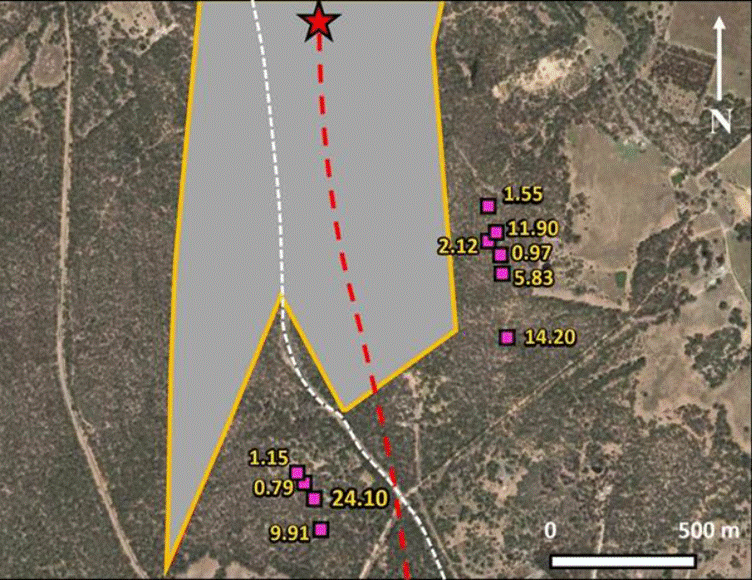
MB: For sure. We know the people that own that mine and I’ll be connecting with them. There’s a conference in a couple of weeks in Ballarat, which is about an hour’s drive from the property.
The guy that runs the company that owns that mine is going to be there, we’ve arranged to catch up. I’d be interested to learn a little bit more about what that project is and what their plans are for it.
RM: You’ve got two trends, the Sydenham Central and the Sydenham East Trend.
MB: Correct.
At Sydenham Mine in the historical records, there was antimony recovered there as well.
RM: You’ve started your phase 2 work program at Havelock.
MB: We’ve got a guy out there collecting soils for us right now. We’ll be joining him on the ground, myself and our exploration manager and doing more follow-up on the data that we’ve managed to wring out of the data set that we’ve constructed.
So, lots of follow-up, probably some long days in the field and collecting some more samples and getting them in the lab and fine-tuning our ideas about whereabouts we want to go and drill.
And then on the community side, connecting with some of those landowners and people in the community to make sure that we’ve got that social license to operate, which is very important.
RM: You’re going to have a drill program this year. Tell us a little bit about when that will start, how.
MB: We’re still working through what we have to do as far as fine-tuning where we want to drill and we’re talking about drilling roughly 2,000 meters. We’d like to be drilling in Q3 this year.
We’re being very particular about figuring out which parts of the system we want to target first. There’s a whole ranking exercise of picking the targets and then figuring out which ones have the best chance for our shareholders to benefit from a discovery.
RM: Talking about the treasury, how are we doing?
MB: We’re still in pretty decent shape. We’re relatively frugal with our spending. We don’t have a lot of staff. We use contractors where we need to.
We still have most of the money that we raised, the $2m placement. I think we’ve eaten a little bit of that, but we’re still in good shape. We’ve had some discussions with drilling companies and our sense is that drilling prices are relatively reasonable by comparison with North America.
RM: The Australian dollar goes further for some drilling?
MB: It seems to, although Australia being an island, they’ve certainly felt this Iran war and shortage of oil and so on. That’s definitely a factor that we’ll have to keep in mind is availability and pricing of diesel.
RM: That’s not unique to Australia or Au Gold. We’ve been telling guys for a while that you’ve booked so much money, so much drilling, but you’re going to have to redo your plans because you’re not going to get that budgeted cost anymore.
MB: Luckily, we don’t need any helicopters or anything like that. It’s super easy to get to our project. We’ve got roads and trails.
RM: That makes a big difference if you’re not using helicopters and flying in and setting up a camp. You tell somebody you’re going to drill 4,000 meters at Christmas this year for whatever your budget was. Now, you’ve either got to increase your budget or knock back your drilling meterage.
RM: What else if going on?
Well, we’re meeting with drilling companies already, we’re doing all the prep things.
One other thing we’ve been doing is there’s a local film maker in the town near where we’ve been working, so we’ve been taking video clips when we’ve been doing field work down there and posting them to our website. She’s working on some additional film clips at the moment, so we’re going to keep trickling those out as they get delivered, and people will be able to have a look at the videos and get a pretty good sense of what the terrain is like and a little bit more of me talking and Bill talking and telling people what we’re looking for and that kind of thing.
RM: Mark, why would somebody consider an investment in Au Gold at this time?
MB: If you have a look at these epizonal gold systems, the ones that are known about, Fosterville, Costerfield, Southern Cross, they’re highly desirable. Southern Cross, for example, they’ve got I think 11 drill rigs and a $2.5 billion market cap, but they haven’t established a mineral resource yet, so the cap is just on the basis of the high-grade drill results. Our market cap is about $12 million, with some success it’d be nice if people think we’re similar to those companies.
RM: Okay, let’s go drilling, what kind of an assay result would you have to see?
MB: That’s a good question. You put me on the spot with that one, Rick.
I think if we can see gold grades that are in the tens of grams range, that would probably tell us we’ve been successful. And if there’s antimony in any of the drilling with gold, that’s definitely another tick as well for that epizonal model.
RM: When we were talking before, the OG’s, the old guys, had a very rudimentary way of sucking up the water and getting it out of there. Back then they were limited severely by pumping capacity. We have some prospectivity, as you were saying earlier, at depth. Because as you said, if we can prove we have an epizonal, these things go down a long way, don’t they?
MB: Definitely. For Costerfield, Southern Cross, they’re all finding gold at depths of more than a kilometer in these system. That’s why these are so exciting. If we happen to get into one, the depth potential is pretty significant.
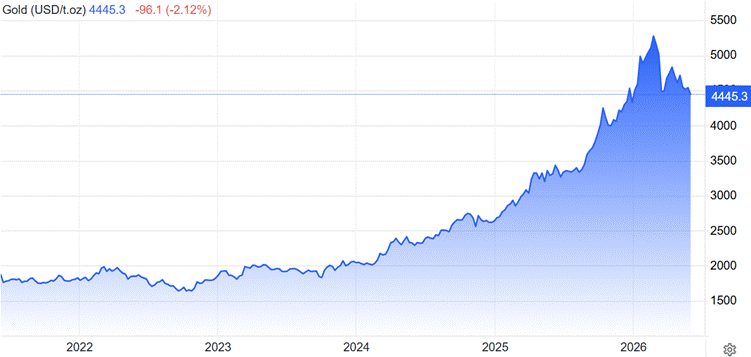
The old timers might have needed, say, half an ounce per tonne to be making money on the material. But if you have a look at Australian gold producers now, the gold price has really pushed the cutoff grades being used down and down. A lot of these Aussie gold producers are producing material that is only a couple of grams a tonne, 2 point something g/t, and making money on it. It’s wild.
RM: $5,500 gold was fantastic for miners, but still at $4,500 gold, that’s a hell of a margin. I don’t care where you are or what method you’re using.
MB: We’re obviously not trying to find something that is 2 grams per tonne, I think Costerfield is a good model. They have narrow veins at a high grade and they take a moderate amount of dilution when they mine them. And their average mine grade is about 12 grams a tonne.
RM: Thanks for taking the time to speak with us today, Marc.
MB: Thank you, Rick.
Richard (Rick) Mills
aheadoftheherd.com
Subscribe to AOTH’s free newsletter
Richard owns shares of Au Gold (TSXV:AUGC).
AUGC is a paid advertiser on his site aheadoftheherd.com
This article is issued on behalf of AUGC
Legal Notice / Disclaimer
Ahead of the Herd newsletter, aheadoftheherd.com, hereafter known as AOTH.Please read the entire Disclaimer carefully before you use this website or read the newsletter. If you do not agree to all the AOTH/Richard Mills Disclaimer, do not access/read this website/newsletter/article, or any of its pages. By reading/using this AOTH/Richard Mills website/newsletter/article, and whether you actually read this Disclaimer, you are deemed to have accepted it.