 RSS Subscribe
Under the Spotlight – Bruce Counts, CEO Storm Exploration TSXV:STRM
2026.08.30
Richard Mills, Editor Ahead of the Herd: This morning I’m talking to Bruce Counts. Bruce is the CEO of Storm Exploration.
Storm Exploration is preparing to drill a large 5-kilometer long Volcanogenic Massive Sulphide (VMS) target at its 100% owned Gold Standard project in northwestern Ontario. Gold Standard is 60 kilometers north of Fort Frances, Ontario, with year-round access via a network of forestry roads. Airborne and ground electromagnetic VLF-EM surveys have outlined a conductivity anomaly that is continuous over 5 kilometers.
The anomaly is 50 to 100 meters wide and indicates strong potential for subsurface sulfide mineralization. We know this because INCO drilled four shallow holes on the property back in 1969 and 1970. Every hole intersected sulfide mineralization, including copper and zinc sulfides. Two holes intersected semi-continuous sulphides over 20 meters.
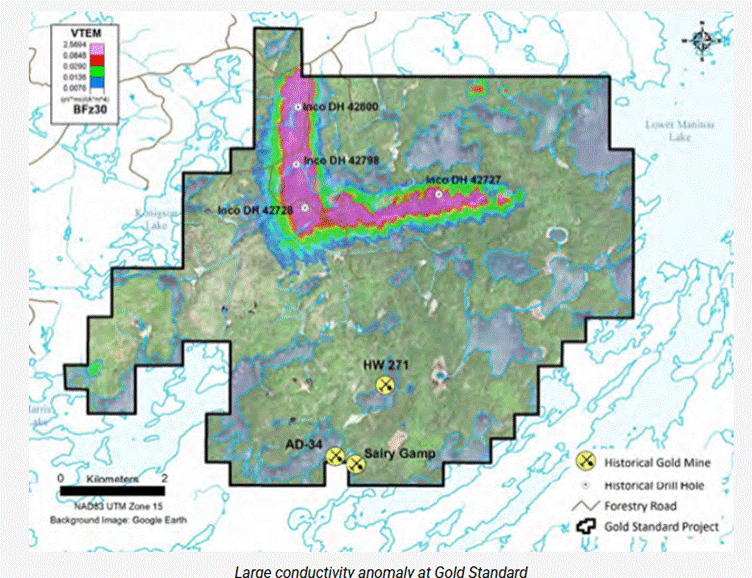
However, INCO never assayed the core because their focus was strictly on nickel.
On the southern end of the property sits the historical Gold Standard Mine. Recent surface grab samples near early 1900 workings have returned impressive high-grade gold values, such as up to 166 grams a ton, and 88.6 grams a ton, and 83.4 grams a ton.
So, Bruce, does that pretty much bring us up to where we are right now?
Bruce Counts, Storm CEO: Yes, it does, Rick. We have a three-year multi-hole drill permit covering the entire 5-kilometer trend. It gives us the flexibility to drill from several different locations along that 5-kilometer EM anomaly.
RM: The company plans to do an initial diamond drill core drilling program of 2,000 to 3,000 meters, roughly 10 to 15 holes.
BC: We’re targeting the drill to test a conductor that’s 100 to 150 meters below surface, that that was identified in that airborne EM anomaly.
RM: I like to see 2,000 to 4,000 meters drilled in a first-pass drill program because that number of meters can give you a good understanding of what your drilling.
BC: I think it’s important to outline what are our goals with this program. We now have a lot of information, based on both the airborne conductor that we’ve now followed up with ground geophysics, as well as the geology that we see on surface. All of this is very consistent with what you would expect in a typical VMS situation.
It is five kilometers long so there’s a lot of system here to explore, but we think we’ve vectored into some good places to start.
You’ve got those four Inco drill holes from 1969 and 1970. They give us a limited view of what’s going on at depth. All four hit sulphides including copper and zinc sulfides and two holes hit semi-massive sulfides over a length 20 meters. There is a lot to indicate that there is a VMS system at Gold Standard but we need to verify that with drilling.
The geophysics tell us that there is a strong conductor 100 to 150 meters down below surface. That’s what we’re targeting with the drill.
We’re using the surface geochemistry to determine where along the 5 kilometre conductivity anomaly we most are likely to confirm that this is a VMS system and get good assay results.
RM: You’ll drill right through the conductor, are you currently thinking of stacked conductors?
BC: The VTEM shows it’s very likely that there is going to be more than one conductive horizon. You could say stacked, you have a conductive horizon and less conductive, and then more conductive.
It’s stacked in places along that five kilometers. That has been verified with the ground geophysics that we’ve done, the ground geophysics provided much better resolution of the conductor.
RM: You’ve got high-resolution ground geophysics, and you’re layering that with deep penetrating airborne surveys but let’s start with the airborne VTEM survey.
Your baseline data came from a versatile time-domain electromagnetic survey. That’s your VTEM survey, you utilized a large airborne transmitter loop to send electromagnetic pulses deep into the ground.
BC: Yes, the VTEM is a system that you drape underneath the helicopter, and then you fly lines. We flew the entire property using a close line spacing of 75 meters.
And the result of that survey was to identify this five-kilometer-long electromagnetic anomaly. So really, what does electromagnetic mean? It means it’s conductive, it’s an indication that you’ve got metalliferous minerals in the rocks.
What we see is that that five-kilometer conductor actually follows a fold in the rocks, it looks a little bit like an L. There’s a north-south arm, then there’s a hinge, and then it turns to the east.
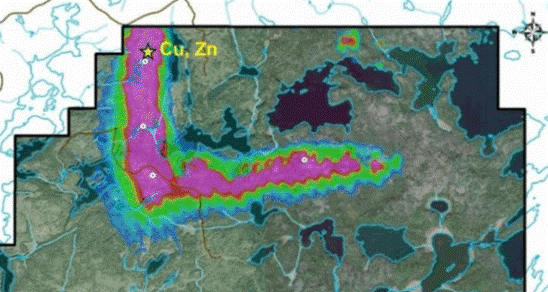
Each of the arms are about two and a half kilometers long. When we analyze that airborne system what we see is 50 to 100-meter-width zone of conductivity that is continuous along that five kilometers.
RM: Can the strength of the conductivity indicate VMS sulfide?
BC: There are a few minerals out there that can create conductivity anomalies. One of them is graphite. But the anomaly we see in the VTEM is strong enough that we don’t believe it’s graphite, at the same time we do not believe it’s strong enough to be nickel sulphide, that’s also based on the surface evidence and Inco’s drilling.
If it’s too strong to be graphite, but not strong enough to be nickel sulfide, which we haven’t seen, than we’re confident it’s due to VMS sulfides.
And you’d have to have a lot of sulphides to ring that bell so loudly, so massive sulfides. That intensity of that conductivity, not too strong, not too weak, just right, really is key to understanding that, yes, this looks like it’s VMS.
RM: And then you couple that… We’re going to get into that right now.
You took the VTEM and basically you refine that survey using a VLF-EM, which is a Very Low Frequency Electromagnetic Survey.
BC: A few things I think are important. There are a number of these electromagnetic survey techniques. And depending on what you’re trying to do, that would define what system you use.
First off VLF-EM is a very lightweight instrument, it’s carried by one person and you can move very quickly, but it doesn’t see as deep. You’re only seeing 100 to 125 meters deep. You might be stretching it to see 125 meters down.
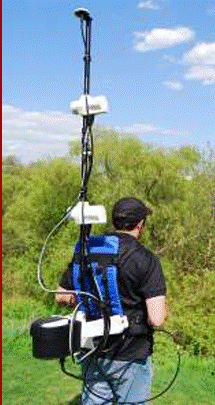
What we were looking to do is confirm that the electromagnetic anomaly that we see in the airborne is strong and it begins around 100 meters down.
RM: The VLF data confirmed that you have a strongly, highly defined conductor sitting just 100 meters below the surface, which perfectly matches the footprint of the airborne VTEM data. And crucially you made the discovery that the VLF data indicates that the conductive zones are strengthening and widening the deeper they go, which all gives you extremely important drill targeting information.
BC: Yes, we’ve got good targeting for these early days of drilling.
And as we understand where we are in the system, we may later bring in a different kind of EM system that looks even deeper. This conductor is starting at 100, what’s going on at 400 meters might be equally as important.
RM: You further refined the information with a a TMI a total magnetic intensity survey. This is where you utilize magnetic data to analyze the structural landscape.
BC: When they hang the VTEM underneath the helicopter they also put on a magnetic sensor. You’re getting two different kinds of data during that fly over.
Certain kinds of rocks in the system have more magnetic minerals than others. And it helps us to identify what the layers are doing in the rocks, and where they’re broken as well, because that shows you structure.
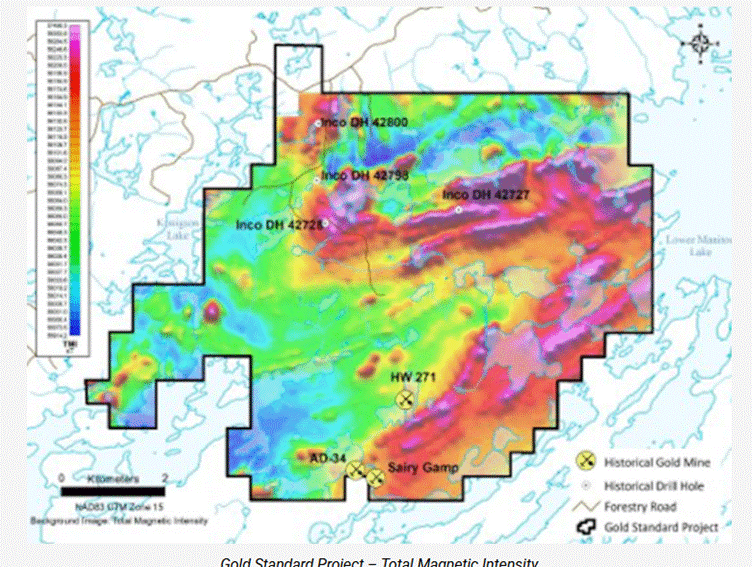
So that’s the magnetic component, where you can really see that the rocks are folded, and that this conductivity anomaly follows that fold and falls between a not conductive magnetic rock and a less magnetic rock. And that’s borne out on the ground when you look at the geology.
RM: The difference between a magnetic volcanic layer and less magnetic layer creates gaps and fault pathways where massive sulfides can accumulate?
BC: If you look at a VMS system, it’s a volcanic vent on the ocean floor, the mafic volcanics represent the ocean floor.
And then on the other side of the conductivity anomaly, we have felsic volcanics, which are lighter in color, they’re lighter in weight, they have a bit different of a composition. So that’s exactly where you would expect to find VMS deposits between those two different rock types.
They’re more magnetic, and then the felsic rocks, less magnetic. It’s consistent with what we’re seeing geo-physically, with what we’re seeing on the rocks with the geology.
RM: The final layer is the surface geochemistry. Geophysics is great, but it only proves that something conductive is under the ground.
Storm did an awful lot of surface sampling and you discovered exposed surface sulfide mineralization, including chalcopyrite. And that was at least three separate locations directly on top of the geophysical conductor.
BC: We’re definitely seeing copper and zinc sulfides in surface. It’s not like we have a continuous trail of sulfides at surface, but we are seeing them over the length of that five kilometers.
And that, again, reinforces what Inco drilled in 1969 and 1970. So yes, I think that the chances that there’s no copper or zinc in the sulfides that we believe are below the surface, it’s pretty low. But until we drill it, we can’t be certain.
And we’re certainly looking at that. We’re taking a lot of things into account when we’re choosing where we’re going to drill. We’re looking at structure very carefully, because structure is really important in understanding where you are in a VMS system.
We’re looking at the kinds of sulfides that we’re seeing at surface as well. We know there’s zinc sulfides, but there’s a couple of different kinds of copper sulfides we’re seeing. We’re seeing chalcopyrite as well as bornite.
And then we’re looking at the geology as well, because the geology can give you clues to where you are in the system. And then we’re targeting the conductor that is 100 meters below the most favorable conditions that we see at surface. I don’t want to say that chemistry isn’t important, but there’s a lot more than just zinc and the sulfides that we see at surface.
RM: What we are saying is that we have legitimate drill targets, worked up by about as much testing as we can do. And what we’re going to do is a drill program
BC: No question. Everything that we are doing, you know, as an explorer, particularly with these sort of discoveries, like we’re talking about here, and it’s not truly a virgin discovery. We’re standing a little bit on the shoulders of Inco from 1969 and 1970, and the reason we staked the ground is because they had drilled those holes.
But, as an explorer, you’re always trying to find, the fatal flaw. I’m a believer that this could be a very large VMS system. Everything that we see when we acquired it pointed in that direction and we have not yet found a fatal flaw.
So, as an explorer, I’m looking as if this has this potential, but can I find the thing that says it does not? And so far, we haven’t found anything that says it doesn’t. In fact, we’re finding things that says it probably is.
RM: Tell us how a phone call between you and Eric Sprott came about?
BC: There is a gentleman I met with briefly in Toronto. He had taken it upon himself to contact a few people in the financial world, including Mr. Sprott. I guess he pitched the story to Mr. Sprott, and Mr. Sprott was intrigued enough that he said, yeah, I’d like to talk to the CEO.
And so that’s, that’s how that happened. It was an unexpected introduction, but certainly a very welcome one. Eric strengthens the registry, he brings a lot of gravitas to the company with the name, and he is now our largest shareholder.
RM: Our largest shareholder for $2 million dollars of $0.40 shares tells me we have almost no outstanding shares and a tiny market cap. It’s also third party validation, and a damn good one at that. Eric Sprott gave you $2 million on a phone call because he liked what you were doing.
I just want to do a little bit on VMS deposits.
Volcanic massive sulfide deposits formed via ancient underwater volcanic hot springs. They’re commonly referred to as black smokers, and they’re on the ocean floor. These deposits are premier global sources of copper, zinc, lead, gold and silver.
Basically, the formation process relies on a continuous multi-stage hydrothermal circulation system. And this is really interesting because you’ve got a heat engine, a body of magma deep beneath the ocean, the oceanic crust heats the surrounding rock. Cold seawater seeps deep into the seafloor through geological faults and fractures.
Now as this trapped seawater approaches a magma chamber, it heats up to extreme temperatures between 350 and 400 degrees Celsius. The water becomes highly acidic and very chemically aggressive. As it circulates back upward to the ocean floor, it strips, basically leaches, sulfur, copper, zinc, iron, gold and silver out of the surrounding volcanic rocks.
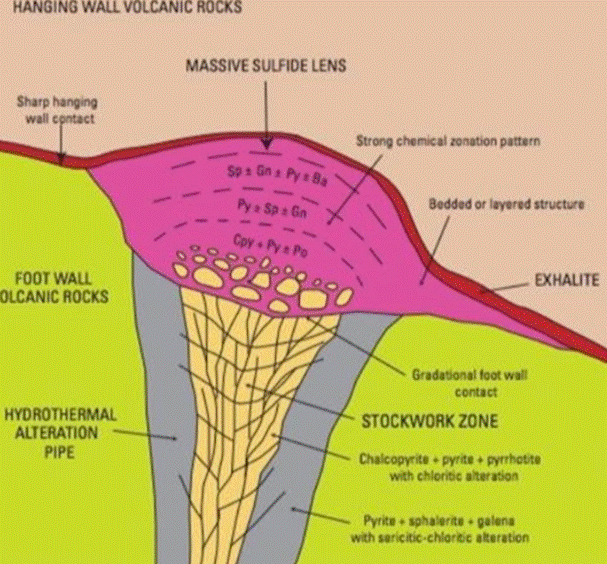
The superheated metal rich fluid rises rapidly towards the seafloor because it’s less dense than the cold ocean water above it. It erupts back into the ocean through localized vents. These vents are the hydrothermal chimneys.
When the 400 degree fluid hits the near freezing 2 degrees Celsius bottom dwelling ocean water, it experiences an immediate thermal shock. The dissolved metals instantly precipitate out of the liquid as solid sulfide minerals. These heavy minerals fall back down around the vent, accumulating over thousands of years into a thick lens-shaped mound.
When modern exploration companies like Storm come across a potential VMS deposit, you’re looking for two distinct zones created by this process.
The first would be the massive sulfide lens, and the second would be the stringer feeder zones. Over hundreds of millions of years, the tectonic plate movements fold and tilt these seabed deposits, kind of leaving them preserved within volcanic mountain belts like those in northwestern Ontario.
You would expect to hit three primary classes of minerals at the Gold Standard project. Base metal sulfides, iron sulfides, and potentially precious metals.
Do you want to talk a little bit about the precious metals component that might or might not be there with the VMS, and maybe a relationship, or not, between the VMS and the Gold Standard Mine?
BC: Okay, but it’s speculative at this point to think that we’re going to have the precious metals in the VMS system where the Inco holes were.
On the other hand, there’s no reason to believe there won’t be, we just don’t have any evidence either way. The compelling part is that four kilometers away, there is the Gold Standard Mine, and then a few kilometers away from that mine, there are two other mines.
All three of these mines were operated between 1901 and 1903, and they mined quartz lenses with high-grade sulfides . We collected rocks around the Gold Standard, which is about four kilometers away from this big conductor that we’re exploring as a VMS target.
What’s interesting is that when we collected rocks and ran the sulfides, we got incredibly high-grade gold, 166 grams per ton gold, and 197 grams per ton silver, so great precious metal content, but interestingly, 1.47% copper as well.
The sulfides that were mined early in the 1900s ran a very high-grade gold, very high-grade silver, and had copper in them. And then four kilometers away, you’ve got this big conductor where you see copper and zinc sulfides at surface and historically in the core that was drilled by Inco. Now, are those two systems related? Maybe, maybe not.
We don’t have any direct evidence that they are, but I do find it very interesting that you get these high-grade sulfides just four kilometers away. On a system that’s five kilometers long, the distances aren’t so unimaginable that they couldn’t have been mineralized at the same time.
I think we need to consider the potential there’s precious metal content in this VMS system.
RM: Have you found any native gold down around the old workings?
BC: Yes, there is visible gold in those rocks that are down around the gold standard showing. And we will follow up on all three of the mines.
They’re actually located on a very large regional structure called the Manitou Shear, and that these are sort of look-a-like smaller discontinuous lenses of quartz that have these high-grade sulfides in them.
We were looking for more of those when we found the big conductor that lined up with the Inco holes from 1969-1970. We do believe that there is potential for more of these high-grade gold pods or lenses down in the southern part of the property.
RM: Our focus is on the VMS target.
BC: We’re excited about the drill program and what it’s going to tell us. First the biggest thing to do is for us to verify that this is VMS. And then can we vector in quickly to the best grades that this VMS system has to offer?
RM: The goal is to find that ancient volcano vent that cooked up the deposit, zoom in on that. If you hit some silicate minerals, like chloride or sericite and maybe some heavy quartz calcite veining these can tell you’re getting close?
BC: Exactly. There’s a few things that we can use to help us vector into where the vent is.
You get your biggest pile of massive sulfides right next to that volcanic vent, so if you have a big thick sequence of, of massive sulfides, you’re going to have a big thick conductor.
We were looking for the thickest part of the conductor when we did that VLF-EM survey along the ground. The other thing is, is it’s a vent.
When a black smoker expels hot, mineral-rich fluids, it doesn’t actually release volcanic rocks or lava like an erupting volcano. Instead, it spews out what looks like smoke but is actually a rush of superheated water packed with dissolved metals and sulfur.
When that hot fluid hits the freezing ocean water, those metals instantly crystallize into microscopic mineral particles. These tiny “bomb” fragments and pieces are called precipitates.
As you get closer to the vent the precipitates are getting ejected from the vent are larger. They get a rounded glassy skin on them, some call it pillow lava.
RM: Are we now a drill play?
BC: We are definitely ready to drill. I think we’re looking at a VMS system and that it has copper and zinc sulfides, it’s time to verify that, or not.
RM: How is it progressing, getting the drills, the crews, accommodations, are we all set?
BC: We are close to announcing to the market that the drilling has commenced, it looks like we’ll be doing so in about a week’s time.
RM: Bruce, why would somebody invest in Storm right now?
BC: You have to recognize we’re early stage exploration, that’s obviously the most speculative end of the business. You invest in these stage juniors because you’re hoping for discovery, you’re hoping for a big return.
I think we could have a virgin discovery. In terms of speculation, you could have a huge win if what we believe we have actually is there.
We offer what I believe is an asymmetric bet, which is skewed dramatically to the upside. There’s always downside in any exploration company, but ours is limited. We’ve got a very strong treasury, we’ve got great shareholders, and we’ve got two other great projects that we own 100%.
The upside of a discovery on our Gold Standard Project discovery could be staggering. I think if you’re looking for a speculative play Storm brings a lot to the table.
RM: We need to consider our relationship with our First Nations partners on whose territory we are operating in.
You have been building a relationship with them for a while, and you’ve talked to them recently.
BC: We understand that we are in their territory. We treat the land with respect. We treat the First Nations with respect. They’re very supportive of everything that we’re doing because we are operating in a very professional way, we’re being inclusive as well as communicative with the First Nations.
You cannot understate the importance of social license. If you don’t have that, it doesn’t matter how good your project is, or how strong your treasury is, or who your shareholders are. You need to have the support of the people in whose territory you are working. They did not stand in the way of us getting a three-year drill permit.
RM: Thank you for doing this Bruce.
BC: Thank you, anytime Rick.
Richard (Rick) Mills
aheadoftheherd.com

Subscribe to AOTH’s free newsletter
Richard does not own shares of Storm Exploration (TSXV:STRM). STRM is a paid advertiser on his site aheadoftheherd.com
This article is issued on behalf of STRM
Legal Notice / Disclaimer
Ahead of the Herd newsletter, aheadoftheherd.com, hereafter known as AOTH.Please read the entire Disclaimer carefully before you use this website or read the newsletter. If you do not agree to all the AOTH/Richard Mills Disclaimer, do not access/read this website/newsletter/article, or any of its pages. By reading/using this AOTH/Richard Mills website/newsletter/article, and whether you actually read this Disclaimer, you are deemed to have accepted it.