 RSS Subscribe
Orestone sampling confirms oxide gold stockwork zone and two new exploration targets at Francisca Gold-Silver Project, Argentina – Richard Mills

2026.06.28
Orestone Mining (TSXV:ORS, OTC Pink:ORESF, FSE:O2R2) on Friday published results of the Phase 1 sampling program at its Francisca Gold-Silver Project in Salta province, Argentina.
A total of 13 trenches were sampled in the South Gold Zone and five trenches in the North Gold Zone. Also, reconnaissance mapping and sampling carried out along the Francisca Trend has identified two new prominent gold-mineralized systems.
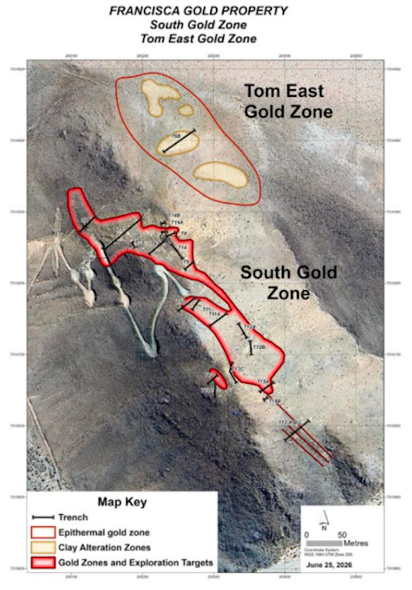
The Tom East Gold Zone where Trench 6B returned 21 meters of 4.45 g/t gold in colluvium — a loose, unsorted mixture of soil and rock debris deposited at the base of a hillslope — is 120 meters east of the South Gold Zone and the Kelly Gold Zone, featuring broad zones of gold mineralized stockwork with grades of 0.24 to 0.41 g/t gold. Both zones are open in three directions. The Kelly Gold Zone is 250 meters along strike of the South Gold Zone and is thought to be an extension of it.
Up to 10 meters of a shallow, 80-meter historical drill hole intersected base metals and precious metals mineralization in porphyry-textured rock. Historical drill results are not NI 43-101-compliant and are not to be used for investment decisions.
What that says to Orestone’s management is that there is a potential porphyry intrusion, a heat engine, underneath the surface expressions of gold and silver.
After all Phase I assays results are received and analyzed, Orestone plans to drill-test the gold/ silver oxide zones and the porphyry target during a Phase 2 drill program that is slated to begin shortly.
The first round of drilling will be around 1,300 meters and is expected to cost approximately CAD$700,000.
Oxide gold stockwork mineralized trend
The Francisca Gold Trend now covers a northwest strike length of 1,500 meters, where an oxide gold-silver system can be observed at surface outcropping in numerous areas: North Gold Zone, South Gold Zone, Kelly Gold Zone and the Tom East Gold Zone (stockwork, vein, breccia and epithermal vein systems).
The outcropping zones are within a 500- to 1,000-meter-wide zone of strongly hornfels-altered sediments and further defined by a 1,700-meter-long by 500- to 700-meter-wide IP chargeability anomaly of 7.9 mV/V that appears to be related to gold-silver mineralization.
Several large, strong IP chargeability anomalies measuring up to 20 mV/V indicate the potential for a larger, buried, sulfide-mineralized gold porphyry.
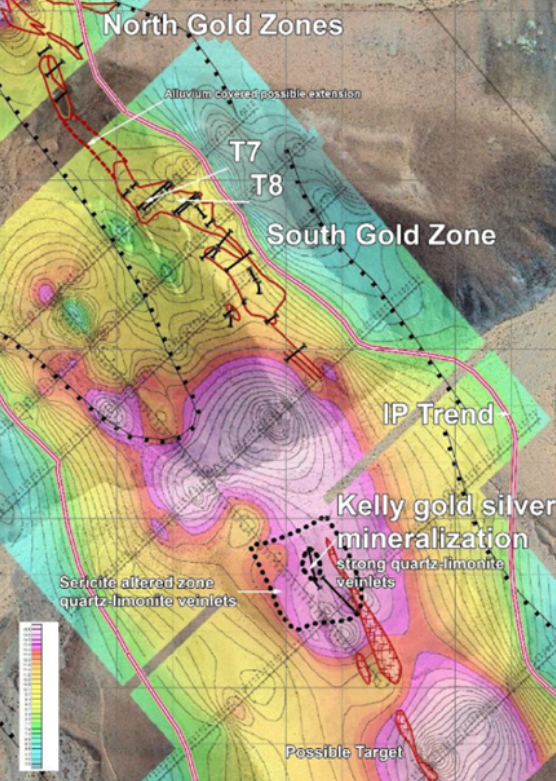
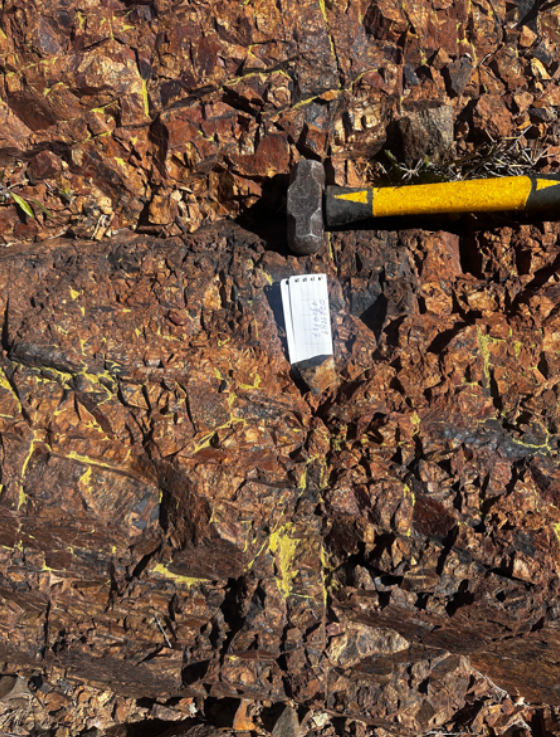
The oxide gold quartz limonite stockwork trend is associated with quartz feldspar porphyry intrusive dikes and intense sericite clay alteration along a NW-trending fault system.
What does all that mean in layman-speak? Read our last ORS article:
Orestone to drill Francisca Gold-Silver Project, Argentina —
Richard Mills
“At the Francisca gold-silver project exploration continues to define new gold-silver targets that provide additional scale along the 1.5 km trend,” Chairman and CEO David Hottman said in the June 26 news release. “Orestone employs advanced geological and geophysical techniques in exploration to cost effectively define targets with high potential that can be systematically drill-tested. The Company’s projects have a relatively low-cost profile to hold and explore and are suitable for exploration year-round.”
Francisca North and South Gold Zone sampling
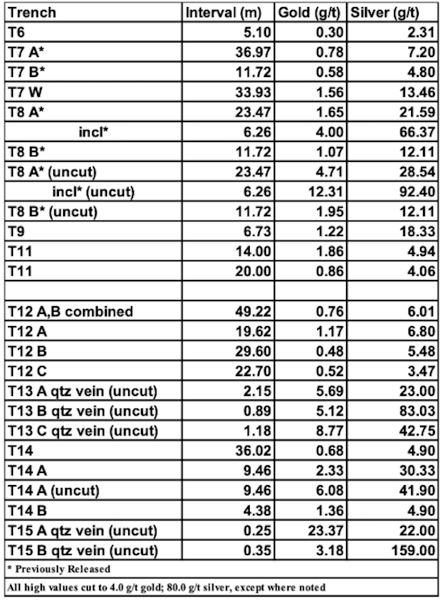
Mapping and a 675-rock-chip sampling program on the Francisca property in March-April has defined a strongly gold-silver mineralized quartz-limonite stockwork system comprising the South Gold Zone. The stockwork system has been defined over a strike length of 400 meters and a width of 30 to 75m averaging 50m. Host rocks in the zone are strongly sericite-limonite-clay-altered hornfels and porphyry dikes. The average grade of 1.04 g/t gold and 7.80 g/t silver is from 332 samples taken from 13 trenches but excludes five high-grade vein intervals.
The South Gold Zone narrows on the southern end into three high-grade veins from 0.89m to 2.15m wide grading 5.12 to 8.77 g/t gold and 23 to 83 g/t silver; these veins extend under an alluvium-covered arroyo (dry riverbed) leading toward the Kelly Gold Zone 250m to the southeast. Sampling in the North Gold Zone did not return intervals of economic interest, although the zone still remains prospective.
South Gold Zone trench samples:
Kelly Gold Zone
Reconnaissance geological mapping and wide-spaced rock chip sampling on the eastern side of the Kelly Gold system has defined three east-west oriented, mineralized panels of vein stockwork with average grades of 0.24 g/t gold from seven samples over 20 meters; 0.41 g/t gold over 40m from 17 samples; and 0.39 g/t gold over 20m from seven samples.
To the east of these zones is a 10- to 20-meter-wide, highly silicified and limonite-altered porphyry dike. All three mineralized panels are open to the north, south and west. The mineralized zone is underlain by a large, 600-meter-wide IP chargeability anomaly of greater than 7.9 mV/V which extends to the north and underlies the Francisca Gold Zone.
Tom East Gold Zone
Prospect sampling early in the Francisca trenching program discovered high-grade gold in a sample of chalcedonic quartz grading 10.33 g/t gold within a large clay calcite-altered zone approximately 120 meters northeast of the South Gold Zone. Follow-up hand trench sampling to a depth of 1.3 meters in Trench 6B in the soft clay-altered colluvium yielded 4.45 g/t gold over 21 meters. The trench material consists of clay-altered colluvium mixed with chalcedonic quartz fragments.
The Google image of this area shows a northwest-striking white clay-altered zone over an area 10m X 200m in a flat, colluvium-covered shallow basin approximately 100-150m east of the South Gold Zone. It is thought that the Tom East Gold Zone is a potential epithermal vein system flanking the Francisca porphyry localized along a parallel NW-trending structure lying just east of the Francisca IP chargeability high.
Conclusion
Orestone has accomplished a great deal over the past year, from raising money to target an oxide gold deposit mineable by open-pit methods and amenable to heap leach gold recovery, to an initial expansion of their Francisca Gold-Silver Project, the completion of a Phase I chip sampling and trenching program, the acquisition of the Francisca II concession, and the purchase of historical geophysical survey data over current and new land positions.
An amazing amount of work and success, done while conserving the treasury and avoiding unnecessary shareholder dilution. After raising $2.5 million last year, the company still has $1.4 million in its coffers. Enough to do at least the first round of planned drilling.
The Francisca Gold Trend now covers a northwest strike length of 1,500 meters, or 1.5 km, where an oxide gold-silver system can be observed at surface outcropping in numerous areas: North Gold Zone, South Gold Zone, Kelly Gold Zone and the Tom East Gold Zone (stockwork, vein, breccia and epithermal vein systems).
Reconnaissance mapping and sampling has identified two new targets: the Kelly Gold Zone and the Tom East Gold Zone.
The Kelly gold system has defined three east-west oriented, mineralized panels of vein stockwork with average grades of 0.24 g/t gold from seven samples over 20 meters; 0.41 g/t gold over 40m from 17 samples; and 0.39 g/t gold over 20m from seven samples.
It is thought that the Tom East Gold Zone is a potential epithermal vein system flanking the Francisca porphyry localized along a parallel NW-trending structure lying just east of the Francisca IP chargeability high.
Hottman says, “new gold-silver targets provide additional scale along the 1.5 km trend.”
When I talked to him on June 5, he said Orestone is looking at a 1,500-meter-long stretch of outcrops — stockworks, veins and gold-mineralized material that pokes up at surface — with large IP anomalies in a trend that covers 1,700 meters.
“We’ve got a tiger by the tail, Francisca represents a multi-million-ounce opportunity for an open-pit gold project.” But he also added they have porphyry dikes that are exposed to surface and there is a big IP anomaly that indicates a larger porphyry target deeper.
Here’s an excerpt from an earlier interview I did with Hottman:
Under the Spotlight — David Hottman, CEO, Orestone Mining
RM: The way you’re talking, it sounds like, if the project has the legs to run down the development path to being a mine, you and the team would not be adverse to going mining.
DH: We’re not afraid of that, we’d like to do it. We’ve all been down that road numerous times in our careers.
RM: I wrote something the other day in prep for this talk, “this is a program from experienced, knowledgeable veterans in the industry who have discovered and built heap leach mines. Bottom line, they know what they’re doing.”
DH: Well, there is one caveat to my answer Rick, and that is, if it turns out to be a 5 or 10-million ounce porphyry, and the mine is going to take five or 10 years to do all of the engineering and the financing, and it’s going to be a half-million-ounce-a-year producer at a cost of $1 billion, I don’t think we’re necessarily up for that. That takes a toll on one’s life.
It’s like if you were asked to commit to building a media empire, at your age, it doesn’t mean that you can’t do it. The question is, do you want to?
RM: No, but if it was a much smaller scale it would be a lot easier to consider doing.
DH: Yeah exactly, and I’d say up to a couple million ounces we’d look at a 10-year mine life because the market doesn’t give any value after 10 years. A lot of times, depending on the size of the deposit, you might make it an eight-year life. You usually find more ounces here and there, satellite deposits, going a little bit deeper once everything’s paid for.
It just depends on size.
Orestone is scaling up the Francisca Gold-Silver Project through mapping and sampling. I’m looking forward to seeing what happens when they drill it.
Orestone Mining Corp.
TSXV:ORS, OTC Pink:ORESF, FSE:O2R2
2026.06.26 Share Price: Cdn$0.085
Shares Outstanding: 107.3m
Market Cap: Cdn$9.1m
ORS website
Richard (Rick) Mills
aheadoftheherd.com

Subscribe to AOTH’s free newsletter
Richard does not own shares of Orestone Mining Corp. (TSXV:ORS, OTC).
ORS is a paid advertiser on his site aheadoftheherd.com
This article is issued on behalf of ORS
Legal Notice / Disclaimer
Ahead of the Herd newsletter, aheadoftheherd.com, hereafter known as AOTH.Please read the entire Disclaimer carefully before you use this website or read the newsletter. If you do not agree to all the AOTH/Richard Mills Disclaimer, do not access/read this website/newsletter/article, or any of its pages. By reading/using this AOTH/Richard Mills website/newsletter/article, and whether you actually read this Disclaimer, you are deemed to have accepted it.