 RSS Subscribe
Under the Spotlight – Malcolm Dorsey, CEO Torr Metals TSXV:TMET
Richard Mills, editor Ahead of the Herd (AOTH): At the Bertha North target Torr Metals’ has confirmed a large copper-gold porphyry system, with recent holes intersecting copper sulphides and vectoring toward a core intrusive source. Torr has mapped out a classic geophysical “bullseye” signature that mirrors the textbook definition of an alkalic copper-gold porphyry system.
By layering Induced Polarization (IP) surveys and Magnetics, their geophysical model provides the core evidence that they are drilling into a major, deep-seated system.
Broad hydrothermal corridors with intense fracturing, brecciation, and quartz-carbonate/quartz-magnetite veining were intersected.
Hole 26-KO-04 hit a pyrite-chalcopyrite-bearing intrusive phase, moving out of lower-temperature alteration.
Hole 26-KO-03 entered a potassic alteration, potassium-feldspar-dominant intrusive unit.
The presence of chalcopyrite and chalcocite in cross-cutting veinlets is evident and native copper has been identified.
Chalcopyrite and potassic alteration indicates drilling is vectoring inward toward a hotter, deeper porphyry core.
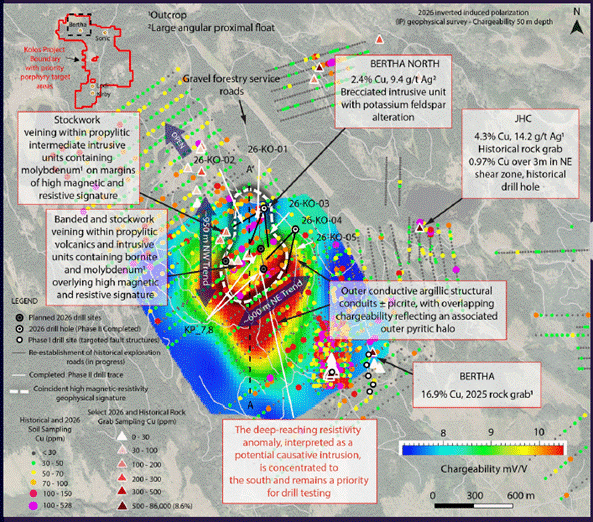
There is a high-priority target immediately south of current holes, with a resistivity feature past 1,000m depth.
Malcolm is this a fair summation of where Torr is with Bertha North?
Malcolm Dorsey CEO Torr Metals: I do think it’s accurate. We’re the first ones to identify the target and drill it, and I think the big takeaway so far is that we are into a large mineralized hydrothermal porphyry system. We’ve been able to put those pieces together as we drill and get a better insight into the underground here.
What we’ve encountered so far is extensive multiple phases of alteration in copper bearing structures and intrusive rocks. We’re really beginning to understand the plumbing of the system, the structures and the broken rock that allowed the hydrothermal fluids carrying the copper to move through it.
We’re not asking, ‘is there a large hydrothermal porphyry system here?’ We know that there is based on what we’ve seen in the drilling.
So now the question is, with the next set of drilling, we’re just a little over halfway and looking to do another 2,500 meters of drilling, but the questions will be, where did those fluids come from? Can we follow these pathways that we’ve defined in the first couple of holes towards that intrusive center, that causative intrusion that’s pumping the copper into these hydrothermal conduits?
That’s really what the next phase of drilling is going to be about. And in the latest release, we really talked about how we’ve pinned down some of the structural controls on this mineralization.
We now know the north and northeast trends are important. They seem to be concentrating the primary copper mineralization within them. We’re seeing evidence, positive evidence for gold as well with our XRF measurements.
We’re looking at the plumbing of the system and now we’re moving towards where we see that engine or the boiler room that all the pipes are leading from.
RM: When I was doing my intro, I talked about a plus 1,000 meter deep resistivity feature.
As the IP survey models move deeper beneath the surface, chargeability and conductivity both significantly strengthen and broaden, there seems to be a major high priority resistivity feature mapped out past a thousand meters vertical depth.
Now, this has got to be one of the most crucial vectors for the company. I mean, while the surface shows oxidized weather rocks down to, was it 550 meters at least, the increasing chargeability at depth, does that not mark the transition into unweathered primary hypogene sulfide?
MD: It potentially does and that’s the interpretation that the company has right now.
Within our region of the Southern Quesnel Trough there’s not too much for regional analogs and that’s why we’ve been using New Afton, as it is the closest to where we’re located. And so far, the boxes we’ve been checking off continue to demonstrate some very strong similarities, including that we’ve encountered extensive native copper within portions of this hydrothermal system in phase one. We’ve also encountered picrite corridors, which is a very important geochemical reactive unit that is key to the mineralization at New Afton.
One of the other things when looking at it from a geophysical perspective is the hypogene section of New Afton has a really strong resistivity signature to it. Resistivity is a very key vector for identifying the hypogene zone, which is the deep reaching portion of the New Afton system. It’s interesting we’re seeing that as we’re following towards the south.
We’re following those pipes showing us increasing alteration, increasing intrusive activity, exactly the type of geochemical elements that we’re looking for as we get more towards the potential source.
All those are increasing as we go towards the south, which is also where we see this deeper reaching portion of the resistivity develop, it’s very important to see that association.
That’s where hole number four really fits into the story, because it represents all the drilling we’ve done, it’s taking that extra step inward to the system.
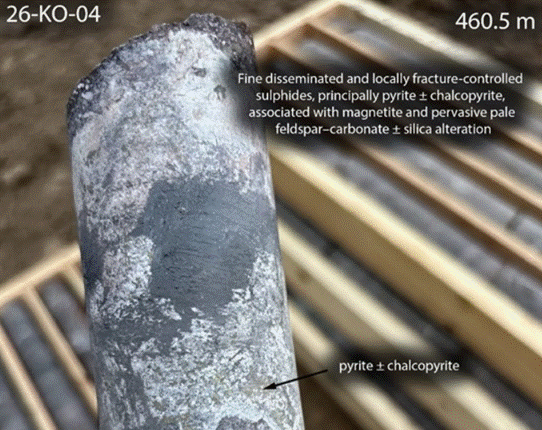
Within the last news release, we were talking about a 40 meter interval of brecciated, hematized and mineralized rock. Within that was a discrete magnetite bearing intrusive dike that contained disseminated pyrite and chalcopyrite. Why does that matter? We found an intrusive, it’s carrying copper sulfides, and it’s seen within a much larger zone of broken, altered and mineralized adjacent volcanic rock.
There’s two reasons that’s important, the brecciation tells us that as we’re going towards the south, this deep reaching resistivity, it’s becoming an increasingly active hydrothermal environment, rocks have been broken apart, repeatedly altered, providing lots of permeability for those mineralizing fluids to come through. And then second, we’re seeing copper mineralization directly associated with the intrusive phase.
We’re seeing this intrusion is carrying copper. Is this intrusion indicative of the potential source, the main body intrusion, which we believe has a potential to correspond to that resistivity feature?
We’re not necessarily going to drill deeper as we’re chasing the chargeability to the surface. Over the next couple of holes, we’re expecting to encounter potentially similar zones, but more within the central portion of a porphyry and at shallower depths. These next couple holes, holes #7 & #8 will certainly be important for validating this next step in the model.
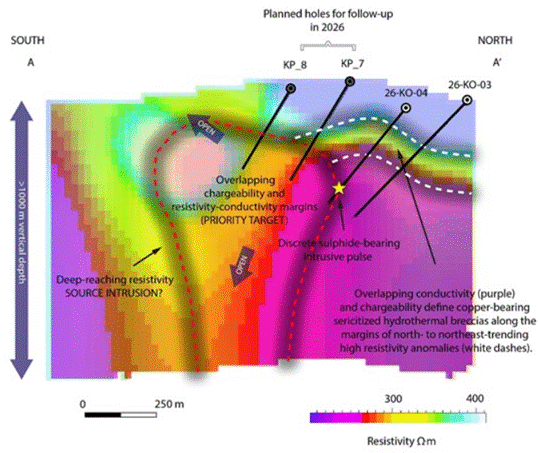
RM: You believe that you’ve locked into a more proximal/higher-temperature part of the system, which is of course, the prize here. It’s the hottest, the central zone. It’s dominated by potassium feldspar and biotite, and this is where the highest concentrations of copper, chalcopyrite, and gold should be found.
Is this the zone that you reported intersecting in hole 26-K0-03?
MD: Yes, when we look at it with the XRF unit we can get a geochemical map of the subsurface. What we’re doing with that data is developing a 3D subsurface model of the geochemistry.
And that’s where we saw, not just within the core, where you could see the potassic altered intrusive units within hole number three. We were seeing those and now they’ve also been validated by the geochemistry that we see in the XRF.
We’re seeing increased potassium within the elemental readings of the XRF.
So that’s telling us we’re getting large bodies of potassic altered intrusive units that are following the trend North and Northeast. And what’s interesting, and where hole four comes into it again, is that we’re starting to see a transition, we’re moving from more feldspar potassium dominate to biotite phase potassic style alteration. That’s indicated within the core and these elemental readings from the XRF.
RM: Hole number four is the closest to have tested where that resistivity geophysical signature starts.
MD: That’s important because if we’re using that as a model generally, as you’re following where the potential increase of mineralization could occur in this region, there is a very positive association between biotite phase potassic and copper mineralization, and we’re seeing some relationships there as well. We find it very encouraging that that’s happening as we move closer towards the South.
Hole seven will essentially start where hole number four ended. We’re going to start at this point where we were seeing some very strong indicators of magmatic influenced biotite phase potassic alteration.
RM: The magnetics, the highs and lows, are very important right now, because when you get into the potassic core, that’s the hottest, it often forms high concentrations of the magnetite, and it shows up as a distinct magnetic high.
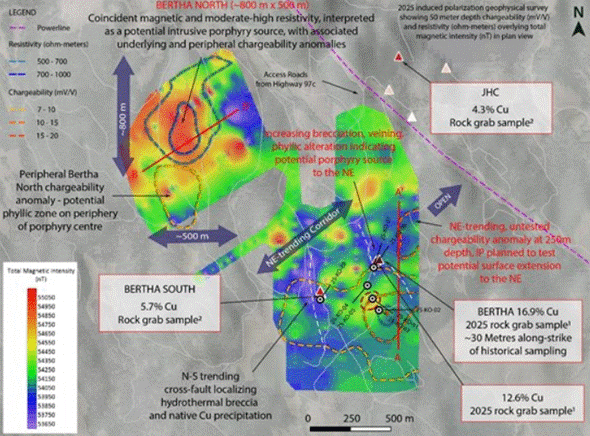
But conversely, the surrounding acidic phyllic zone destroys magnetite, and that creates a contrasting magnetic low. Your know your moving further into the high with this direction.
MD: We are moving progressively further into the magnetic high, and holes one, two, three, four, they all tested different portions of the magnetic high with its relationship with resistivity and chargeability as well.
RM: Another reason why you point to New Afton as an analogue, is that your getting very strong oxidation alteration.
MD: These rocks are rusty and they’ve been oxidized to very deep levels, we’re again seeing it extend beyond 400 meters vertical depth.
This is very deep, it’s unusual to have oxidation to that depth, and it speaks to really long-lived structural systems, lots of fluid pulses, lots of alteration and weathering going on. We are seeing in hole number four that the XRF is giving us a map to a lot of magnetite.
It’s there, but it’s been altered, it’s been oxidized, so rusted, and it loses some of that magnetic quality as it gets altered. But we can see a significant jump in the iron content, especially in hole four there, where we’re starting to see that brecciated interval with the dike intrusive that was within there. So, we’re moving more into the iron-rich portion, into the magnetite-rich portion, and with that we’re seeing correlation as well with copper mineralization with that relationship.
RM: Porphyries rarely occur in isolation. I know that to be true, you know that to be true, but what does it mean for Kolos?
MD: You can get these clustered porphyry systems, that means there’s multiple centers all concentrated in a single area, and that’s because that’s where you’ve often got your large-scale structures intersecting, creating these points of weakness and dilation in the rock that just makes it easier for these intrusive complexes to come up.
And then you get the different pulses that can be mineralized, not mineralized, they can form different porphyry centers. These can turn into some very attractive looking porphyry systems within British Columbia. An example would be Galore Creek which is a very large cluster porphyry system.
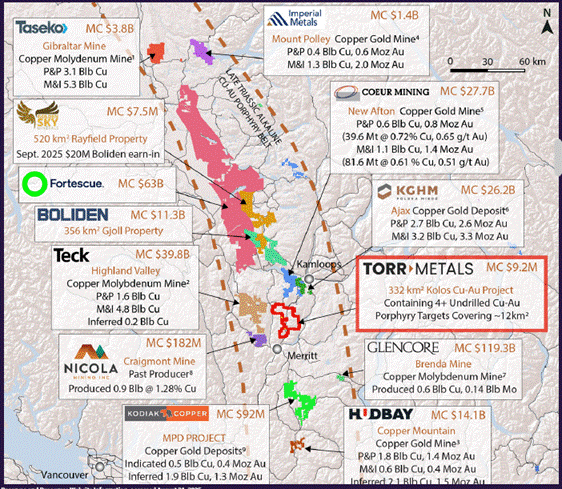
But what does that mean for the Kolos project as a whole? We’ve got a very large district-scale package of 332 square kilometers. Where we’ve identified four brand new areas that we think host a concentration of porphyry centers.
What we have is the largest district-scale package held by any junior this close to Coeur Mining’s New Afton land package, as well as soon to be Anglo Teck’s Highland Valley mine. They’re both about 30 kilometers to our north and our west, respectively. We’ve got a lot of land, a lot of exploration, and a lot of potential as this area has been underexplored and certainly overlooked, even though it has direct highway access and two transmission lines going through it.
RM: Well, porphyry deposits are formed by massive magmatic plumbing networks underneath ancient volcanoes, so the theory that they rarely occur in isolation is true. When you find a porphyry system existing in an underexplored area, that might imply the presence of a pretty fertile magmatic belt. I don’t think we’ll have any disagreement there, do we?
MD: No, and the principal tool used as a first pass exploration is often a gravity survey, because these intrusive complexes are very dense, and with that density, they can really show up in gravity measurements.
So that’s used, and that was used when I was staking the Kolos project. I was using that as a first pass tool, as any of the majors to our north use, such as Fortescue and Bulletin. Both used gravity for staking their large projects, where they believe that they’re following the same porphyry trend.
And with that, it shows you the density, the concentration of these areas of high magmatic activity, and that was used and is still being used as a first pass factor here on the Kolos project. It showcases that we do have, I think, an underexplored porphyry belt here.
RM: A single discovery is often a blueprint to unlock multiple targets, satellite target zones, or even distinct porphyry centers.
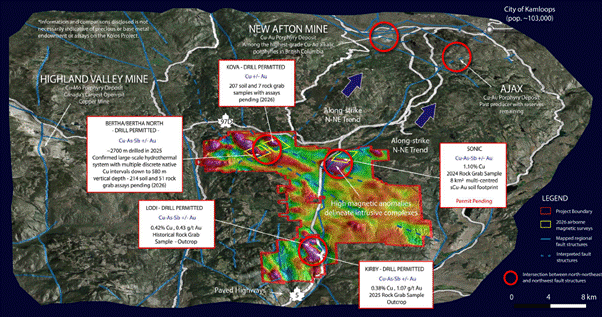
And you see that in Kolos, because we have discovered a porphyry system, we’re waiting for assays, but we do have a new discovery. I would say that’s a trend that’s already been observed at Kolos, we have the other quality targets.
The potential is here for multiple discoveries.
I think that the greatest share price spike, the greatest upside that exists, is the transition from speculative concept to confirmed discovery, the Lassonde Curve highlights this.
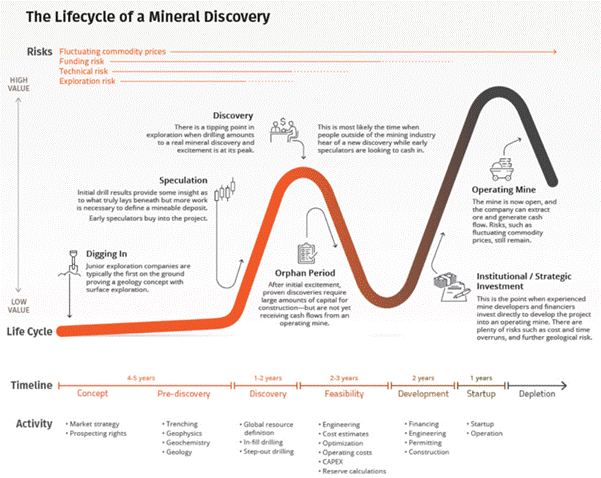
MD: We have the blueprint for what these porphyries look like in this area. Because every porphyry, although we can broadly call them alkaline porphyry systems, there’s features there that are always seen within that context. But in every area, the porphyries are a little bit different.
You always have to tap into exactly what signatures, what geophysics, what geochemistry is unique to that porphyry system, or defines it a little bit better, and just figuring out how to tweak that. And then once you have that blueprint, now you can take that and you can use it across the entire district-scale land package. And I think you’re going to have a strong potential to find additional systems that match that blueprint.
RM: Assays are….?
MD: I’m expecting we should have assays here in the very near term. And then we’ll be going out to the market as quick as we can.
RM: What reasons can you give to invest in Tor Metals?
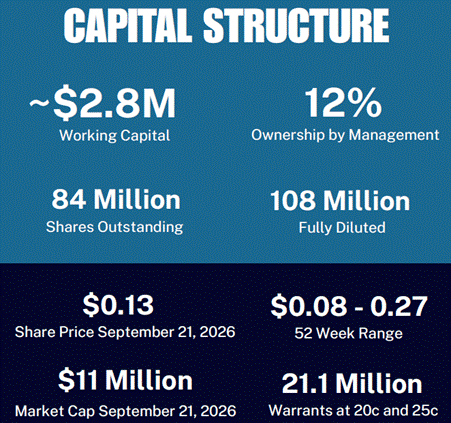
MD: If you look at our current share price we’re still at the pre-discovery valuation with a market cap around $11 million, from a price perspective it’s certainly a good entry point. We’ve already demonstrated we’re into the hydrothermal porphyry system and we’ve already identified mineralization.
Right now, we’re following those pipes into where we see the engine, the boiler room.
We’re looking to define a brand new significant porphyry system. We’ve found a brand new discovery here and we’re going to stick with it.
So, exciting times ahead for Torr and the Kolos project.
RM: And when do you anticipate starting to drill holes #7 and than #8?
MD: We’ll be moving the drills in as soon as we can finish clearing right of way and establishing pads.
RM: Thank you, Malcolm.
MD: Thank you, talk again soon.
Richard (Rick) Mills
aheadoftheherd.com

Subscribe to AOTH’s free newsletter
Richard owns shares of Torr Metals TSXV:TMET.
TMET is a paid advertiser on his site aheadoftheherd.com
This article is issued on behalf of TMET.
Legal Notice / Disclaimer
Ahead of the Herd newsletter, aheadoftheherd.com, hereafter known as AOTH.Please read the entire Disclaimer carefully before you use this website or read the newsletter. If you do not agree to all the AOTH/Richard Mills Disclaimer, do not access/read this website/newsletter/article, or any of its pages. By reading/using this AOTH/Richard Mills website/newsletter/article, and whether you actually read this Disclaimer, you are deemed to have accepted it.