 RSS Subscribe
Under the Spotlight – Malcolm Dorsey, CEO Torr Metals (TSXV:TMET)
2026.07.23
Rick Mills, Editor/ Publisher, Ahead of the Herd:
Last year you said results should get Torr at least a vector into a porphyry, in a worst-case scenario. And what happened? You did. There was a vector for 2026.
Now correct me if I’m wrong. We’re still in the same feeder zone we hit last year, but looking at the difference in mineralization we should be closer to our target.
Malcolm Dorsey, CEO, Torr Metals (TSXV:TMET):
Yes, the key here was building off of phase 1. What I talked about the most was we needed quartz carbonate veining, lots of generations of veining, more intense brecciation, more alteration.
We had seen a little bit of sericitic alteration which means you’re getting close, but I wanted to see intense brecciation. And that’s what we’re seeing in this first drill hole of 2026, over a 140 meters.
RM: What’s the importance of the magnetite and the hematite being so heavily stained red and persuasive? Could you explain why that would be present where we are now, and how come it wasn’t in the last phase of exploration?

MD: We can start with the hematite and why that’s important because basically it’s rust. It’s oxidation of the iron content within the rock. What’s interesting about this is that just like phase 1 we have deep-reaching hematite. So deep-reaching oxidation. This is oxygen getting down into those deeper levels, reacting with the iron and potential sulphides and causing it to rust or get coated by rust.
Now that should not be happening down to 400 meters vertical depth, like we’re seeing, and we saw it down to 600 meters in phase 1. That means what we’re following here is a very large and very long-lived fault structure that’s concentrating this. It’s good to see that because to find potentially significant deposits, you need to be among significant and long-lived structures. So that’s confirmed it for us, there’s lots of iron in the system, lots of geochemical reactions taking place.
But what’s so important, what’s very different with this phase 2, is that we’re now seeing magnetite veining.
We wanted to see this veining because being so dense magnetite does not travel far from the potential core of a porphyry system and settles out of solution fairly quickly.
That iron, that magnetite has to be coming from a magmatic source and we are seeing it associated with pyrite mineralization, as well as chalcopyrite. And then as we get further towards the surface, we’re seeing chalcocite, which is replacing the chalcopyrite.
But all of this is masked by the pervasive hematite, it is very intensive and overprinted and colored the original sulfide minerals. When you look at those core photos you’re not seeing any of those shiny sulfide copper minerals that people are used to seeing because they are coated by hematite.
RM: The red staining is not a bad thing.
MD: If you were to take that to the surface you’re looking at a very large gossan. A big pile of rusty iron saturated rock.
I think a good analogy could be thinking of porphyries like a volcano’s plumbing system. A volcano has pipes that can also be referred to as feeder conduits or corridors. Those pipes lead from the magma chamber to the surface.
We think what we’ve hit with this drilling is one of those major pipes, those feeder corridors. With the magnetite content, the mineralization that we’re seeing confirmed by the XRF as well is all pointing to the fact that we are in a potential porphyry system.
We’re just at this point drilling towards different targets that we’ve defined, which we believe could be the potential core of the porphyry itself.
RM: There’s two things that stand out. Last year we didn’t get any pics. Now we’ve got pics. And you said this year that the holes were planned to be 250 meters.. For you to put out pics and go from 250 to 560m, what do readers take away from that?
MD: The first two drill holes were designed to test new geophysical signatures that we didn’t test in phase 1. One of the things that attracted us to the Bertha North target was that we saw a very large resistivity and we interpreted that to be an oxidized, silicified cap.

And that’s what it’s turned out to be. Just underneath that cap we started into this zone of intense sericite alteration, brecciation, veining. That’s the zone we’re most interested in and it’s lining up with the model that we developed. The follow-up holes will be vectoring in directly on where we see the highest-priority zones being.
We were seeing evidence that we had to chase to depth, so we ended up going beyond, into the 300’s. We hit that zone right about where we predicted. And then it continued for another 140 meters.
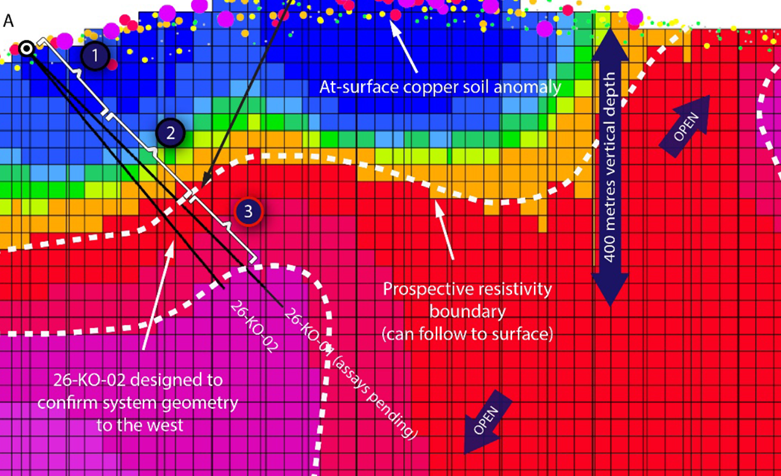
And then of course we wanted to test the decent-sized shoulder you can really see in Hole 26-KO-01 (above), to really add to the model with the geophysical signatures we were seeing.
The second hole is designed to confirm the geometry that we’re looking at, and then the follow-up holes will be testing the chargeability anomaly that is adjacent closer to surface. Those ones will start to test that anomaly and the margins of that anomaly where we expect this feeder zone to continue and potentially come to surface.
RM: When you’re testing this core and you see all that magnetite, do you ever bring a magnet close to it?
MD: It’s not as magnetic where you’ve got this intense oxidation. I did a video showcasing some relatively unaltered magnetite veining that was infilling some of the lithological breccia unit that we see here, which is very good to see.
You could throw a magnet on that and it’ll be magnetic. But as it gets altered and weathered it becomes less magnetic.
RM: You’ve previously mentioned malachite on the surface of Bertha North right where we drilled this first hole. Did it come into play?
MD: Malachite is an oxidation of the copper sulfides. So, it speaks to the fertility of the zone and seeing that malachite alteration of course is your first indicator that there’s copper sulfides in this area.
It was good to see that and good to see corroboration from the soils as well as what has been observed in the core and XRF.
RM: Are the core boxes heavier this year than they were last year?
MD: With the density of the veining, they’re certainly heavier. The sulfide content, of course with porphyry systems it’s a bit different from orogenic gold. Orogenic gold you can certainly tell when there’s dense gold within the core, much heavier boxes, but porphyry, it’s more disseminated sulfides within. But given the density of the magnetite and the veining, you can certainly feel the weight difference.
RM: Last year we talked a lot about supergene — what it was — and native copper. I didn’t see any talk about supergene this news release, and I didn’t see anything about native copper.
MD: In terms of the supergene weathering process, we’re seeing chalcopyrite being replaced by chalcocite, which is part of that process but we’re not expecting native copper with these first two drill holes.
I wouldn’t expect native copper to really start showing up until we start hitting that picrite contact again. That could show up in hole 3 and any successive holes on top of that will potentially be more directly angling towards that picrite contact.
RM: Earlier you mentioned XRF you don’t talk much about using an XRF. I know you have one, is there anything more you can say about what you’ve been seeing?
(Portable X-ray fluorescence (pXRF) results are used solely as an exploration tool to assist geological logging and vectoring and are preliminary in nature. pXRF measurements are not a substitute for accredited laboratory assays and should not be relied upon as representative of final metal grades.)
MD: We’ve been able to utilize the XRF to better understand the systems that we’re drilling through. So not only are we able to, in real time, track some of the pathfinder elements that we’re looking for, but we’re also able to see exactly where there could be anomalous zones for copper as well as gold. The caveat being that XRF is not highly reliable for grade when it comes to gold, but it is quite good at defining where your potential exists for anomalous zones.
And you can extrapolate anomalism based on the degree of multiples between what the XRF is registering. So that gives us a good handle on what we’re looking at, what the relationships are. And something what we’re keeping an eye out for is that correlation between copper and gold, as well as potential divergences that could be indicative of different generations of hydrothermal pulses.
We are using this model in the upper portions where you often have a divergence of copper and gold. Where the gold is enhanced you tend to get lower copper probabilities. Where the copper is enhanced you can get lower gold. This is a typical feature of alkalic porphyries which can also change as you go deeper.
RM: Are you pleasantly surprised by the gold? From what we saw last year there should be elevated gold here, it seemed to be increasing as we moved the drill north.
MD: I’m highly encouraged by what we’re seeing with the XRF, granted this is exploratory and preliminary in nature without assays, but we want to see more enhanced gold values because together with the magnetite, those two would provide a good indication that you’re potentially very close to the core of the porphyry system.
RM: What would be the difference between the feeder mineralization where we are, and moving over a couple of hundred meters and hitting this chargeability?
MD: That’s a good question. This is really looking at exploring the full geophysical mode, as you want to make sure that you fully test all the different signatures that you see in the geophysics.
It’s been good to see that our predictive model has been correct so far with the feeder structure. It could be that this feeder structure overlies the intrusive and that this feeder structure is itself exactly what we’re looking for. It could also be that it is adjacent and part of a bounding structure on the main zone.
So, there’s potential there with the chargeability, that the chargeability could be something different. We’d have to see if perhaps it is indicative of more hypogene-style mineralization or not, or a continuation of similar mineralization that we’re seeing right now. That’ll have to come with follow-up drilling.
RM: Last year I wouldn’t classify as a discovery, but this year we have a discovery. Do you agree?
MD: In terms of the alteration styles of mineralization, it’s certainly going to be attractive in that it is brand new. I would classify this as a significant new discovery in the context of this system never having been defined before. Now what we need are assays to confirm exactly what we’re seeing within the core and then we’ll be building off of that.
(The geological observations and interpretations discussed in this interview are preliminary and based on drilling completed to date. Laboratory assay results remain pending and may differ from field observations. References to alteration, veining, mineralization, geophysical signatures, and potential porphyry relationships reflect geological interpretations only and should not be interpreted as confirmation of the presence, grade, continuity, size, or economic viability of a mineral system or deposit.)
RM: I want to go back to the resistivity chart and the chargeability chart. When I look at the chargeability colors, when I look at the resistivity colors they’re the same. When I look at the first hole we drilled and then down into the shoulder, I see two red colors there, 223 to 240 and 240 to 278 on the resistivity.
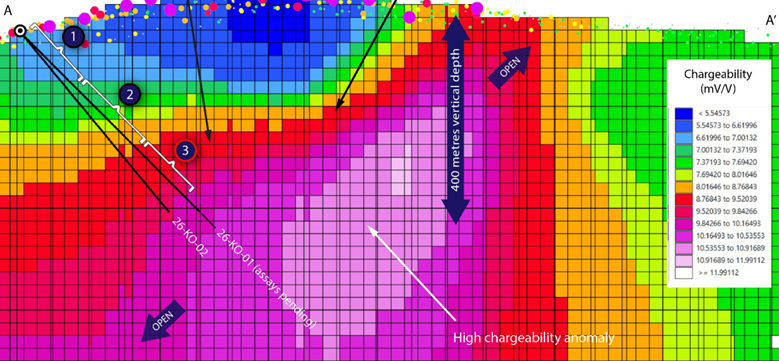
I go down to the chargeability and I look at that first hole and I see red and I see another color red, which is 8.7 and 9.5. Now when I look at the resistivity I see the same colors as in the chargeability anomaly.
What I want to know is you’ve got the colors, you’ve got mineralization in the first hole, they’re matched by what is in the chargeability underneath the colors. Are these numbers that you hit this mineralization on, the two red colors in both, are they Bertha North’s sweet spot for chargeability and resistivity targeting?
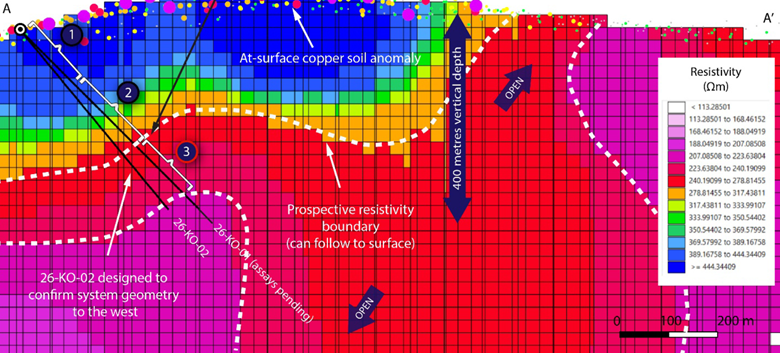
MD: That’s a good point made and that’s essentially what we’re looking at and why it’s important to test all the interfaces between all these different signatures to get a good idea, a confirmation of exactly what’s the interplay that you’re looking for.
So that’s what we’re looking at. That level of resistivity combined with that level of chargeability, currently we’re seeing it as the margins of the higher chargeability where we get that interface between the resistivity interplay with the chargeability. That’s where we’re getting this feeder zone and so one of the last features that we need to test out is what happens when we have that same resistivity but with a bit of a higher chargeability as you pointed out there.
That’s where some of the success of drilling will test out that last combination, but certainly if we’re just looking at what we have so far, it speaks to a large degree of openness to the system, that there’s still a lot to drill and you can see that it’s certainly got size potential.
RM: At AOTH we believe Bertha North is a new discovery, in an unexplored area, and your work here is an excellent example of the process of discovery and exploration and interpretation.
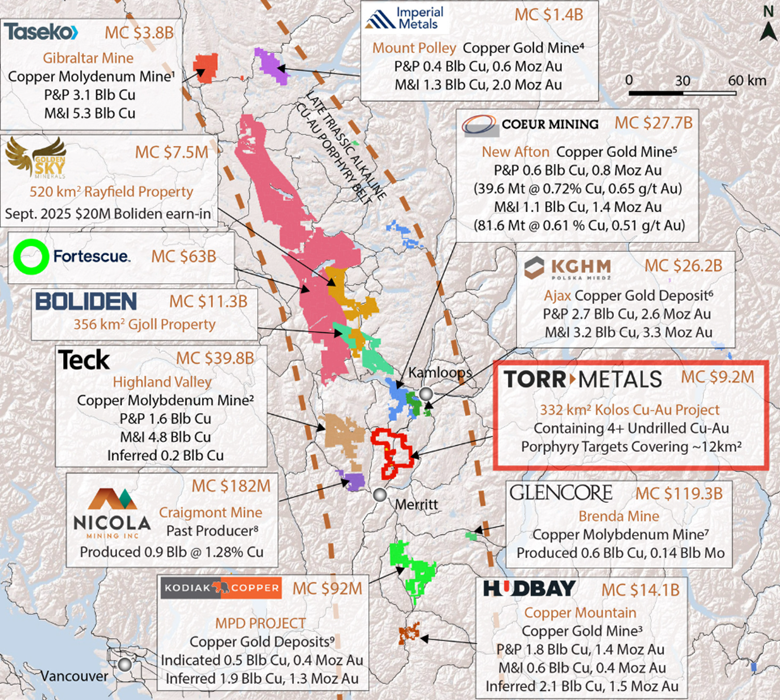
MD: It’s a brand-new area, it’s drilling a brand-new target that outside of the soil anomaly largely does not have an extensive surface exposure. Gaining an understanding from phase 1 allowed us to look at the geophysics and identify what we thought to be prospective and now we’ve been able to confirm that with the drilling. So even just having that, being able to build off of it, say, hey here’s the exploration model and we think that this is going to be the zone that we need to hit, and then we drill into it and we see exactly what I’ve been talking about for the last couple of months of seeing this increased veining, alteration, brecciation.
It’s certainly a great vindication of what we’re doing and it makes me excited for the follow-up drilling as well, as we start to build out this model and start to explore a little bit further into these geophysical signatures.
RM: You’ve talked many times about multiple phases. What you’re talking about is something that we need to explain a little bit because it’s so darn important, it’s sometimes I believe used to maybe mislead? It’s about multiple waves of mineralization coming up, overlapping, overprinting.
MD: It’s important to understand the alteration. When I was doing project review and assessments for major miners it something that was continuously brought up. We’d hear, “We have potassic alteration.” And it would be, that is great but is that potassic alteration associated with a mineralizing event? Over time there could be several potassic pulses but all that means is that you have hot fluids coming up from the intrusive source. Those fluids, because they’re hot they have certain alteration elements associated with them.
You’re going to get overprinting patterns, multiple pulses overprinting each other, so different phases might be sericitic overprinting and retrograding, potassic alteration and so these are very complex systems and basically overprinting footprints of alteration and so it’s understanding ultimately what do you want to see? You want to see epidote, you want to see potassic alteration, it’s great to see sericite because sericite usually occurs within a phyllic zone adjacent to or very close to the core of the porphyry.
In terms of our sericitic alteration, it appears to be largely structurally concentrated though I wouldn’t say it’s a classic alteration envelope around an intrusive unit but it’s certainly similar in many aspects so it also speaks to proximity to a potential core.
(This interview contains forward-looking statements regarding exploration activities and potential outcomes that are subject to risks and uncertainties. Readers are cautioned not to place undue reliance on such statements.)
So those are patterns you want to see, they point towards where your hottest fluids, most acidic fluids are going to be and that just means fluids that are the most capable of carrying mineralization, but do they carry? That’s what you want to look for as these fertile systems, multi-generations of veining, multi-generation of pulses of alteration and within that you want to see the mineralization associated with it.
That’s why it’s very good to see within this zone veins that have broken up, other veins and veins that have broken up the rock all means that you’ve got many generations in a very long-lived system and it just speaks to the fertility of this zone especially with the alteration associated with it.
Alteration tells us these were very hot fluids that formed the veins and within that we see mineralization so with that these are hot, mineralized fluids that have been active for a very long time and come up multiple times within this zone which could speak to the potential fertility of this area.
RM: Malcolm, anything you want to say in terms of closing?
MD: What we’ve done here, we’ve identified one of those significant feeder corridors, so it’s a structurally focused hydrothermal feeder. We’re interpreting that it’s directly connected to an intrusive source, so that’s what we continue to drill towards, to locate where that source is and with that we’re continuing to drill. There’s lots to look forward to, lots of news catalysts coming along the way and we look forward to keeping shareholders and investors up to date.
RM: Awesome. Thanks for doing this, Malcolm.
MD: Thanks Rick.
Richard (Rick) Mills
aheadoftheherd.com

Subscribe to AOTH’s free newsletter
Richard does not own shares of Torr Metals (TSXV:TMET). TMET is a paid advertiser on his site aheadoftheherd.com
This article is issued on behalf of TMET
Legal Notice / Disclaimer
Ahead of the Herd newsletter, aheadoftheherd.com, hereafter known as AOTH.Please read the entire Disclaimer carefully before you use this website or read the newsletter. If you do not agree to all the AOTH/Richard Mills Disclaimer, do not access/read this website/newsletter/article, or any of its pages. By reading/using this AOTH/Richard Mills website/newsletter/article, and whether you actually read this Disclaimer, you are deemed to have accepted it.