 RSS Subscribe
Torr Metals: Drilling advances within Bertha North Cu-Au porphyry system toward interpreted source intrusion – Richard Mills

Torr Metals (TSXV:TMET) in June 2026 embarked on a 6,000-meter Phase II drill program at the Bertha North target, part of the 332 km² Kolos Copper-Gold Project in southern British Columbia.
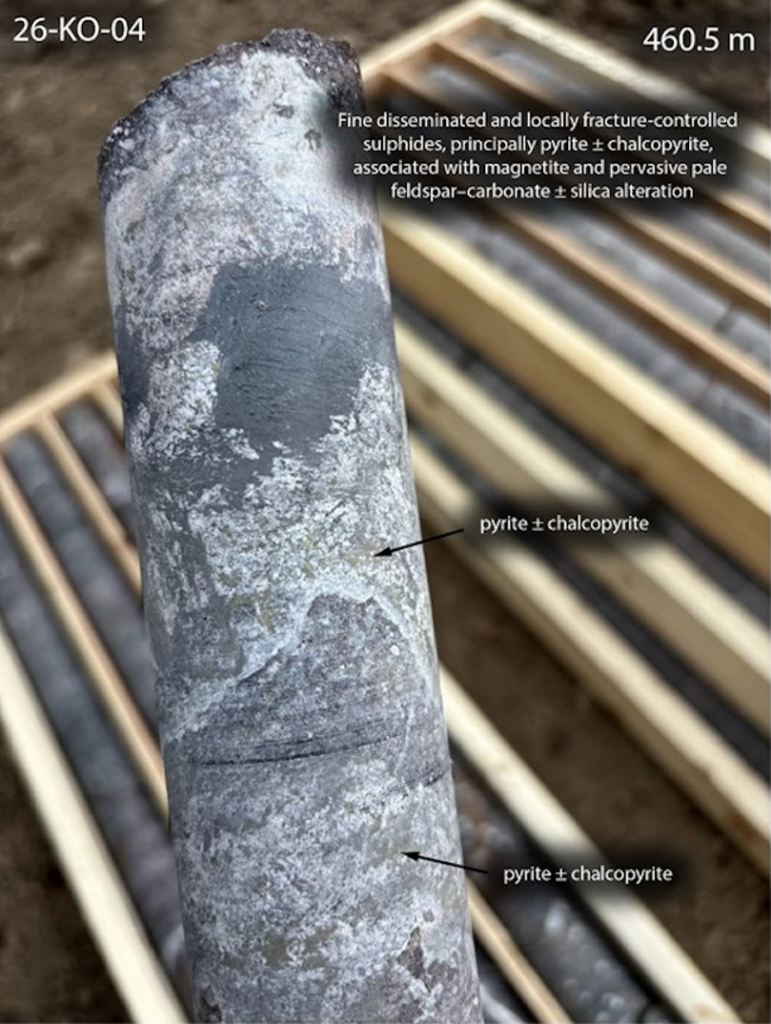
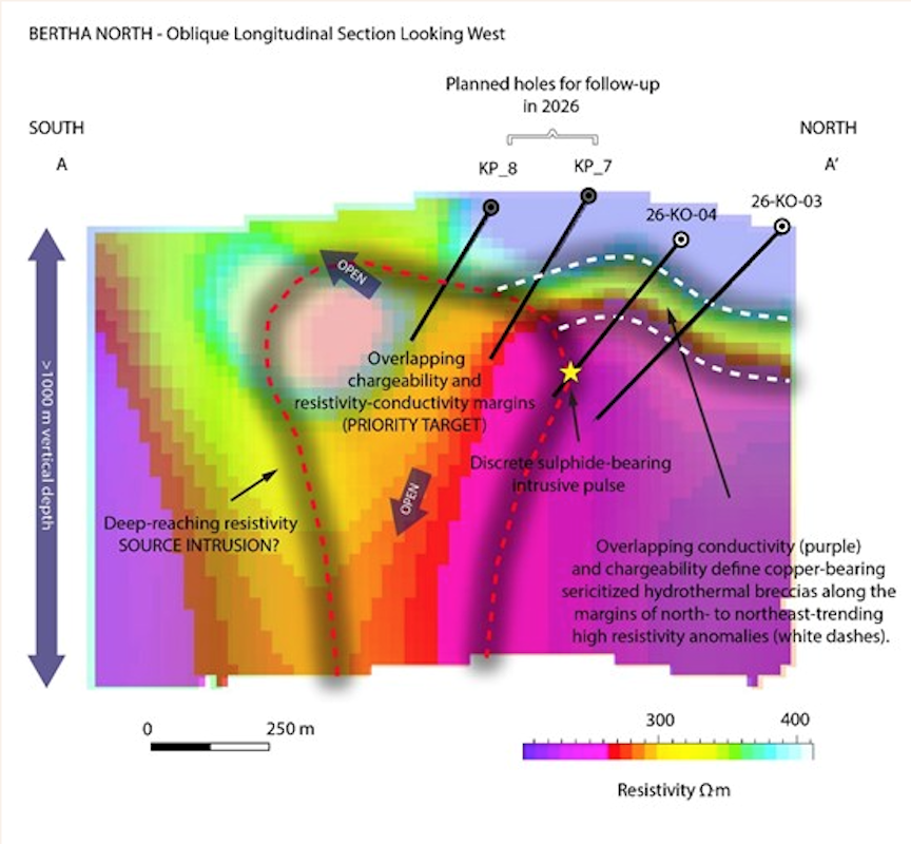
Phase II drilling is progressively defining Bertha North as a large copper-gold porphyry-style hydrothermal system, with drilling confirming copper-bearing breccias, mineralized structures and, importantly, a pyrite-chalcopyrite-bearing intrusive phase in Hole 26-KO-04 (Figure 1, Figure 2).
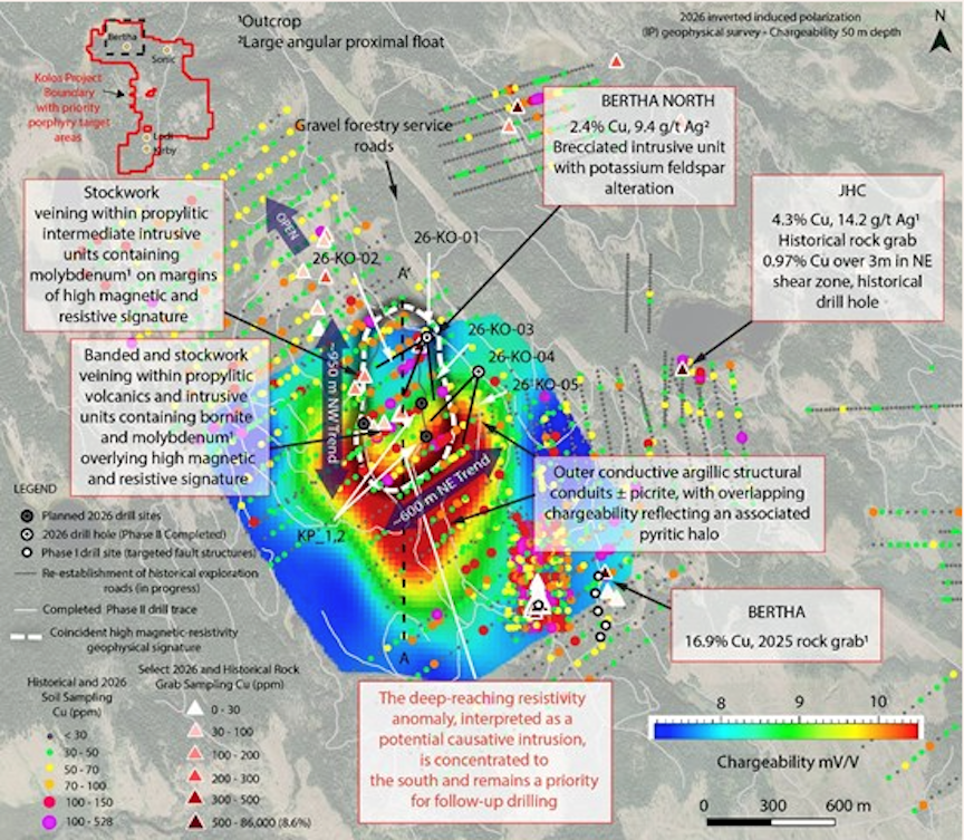
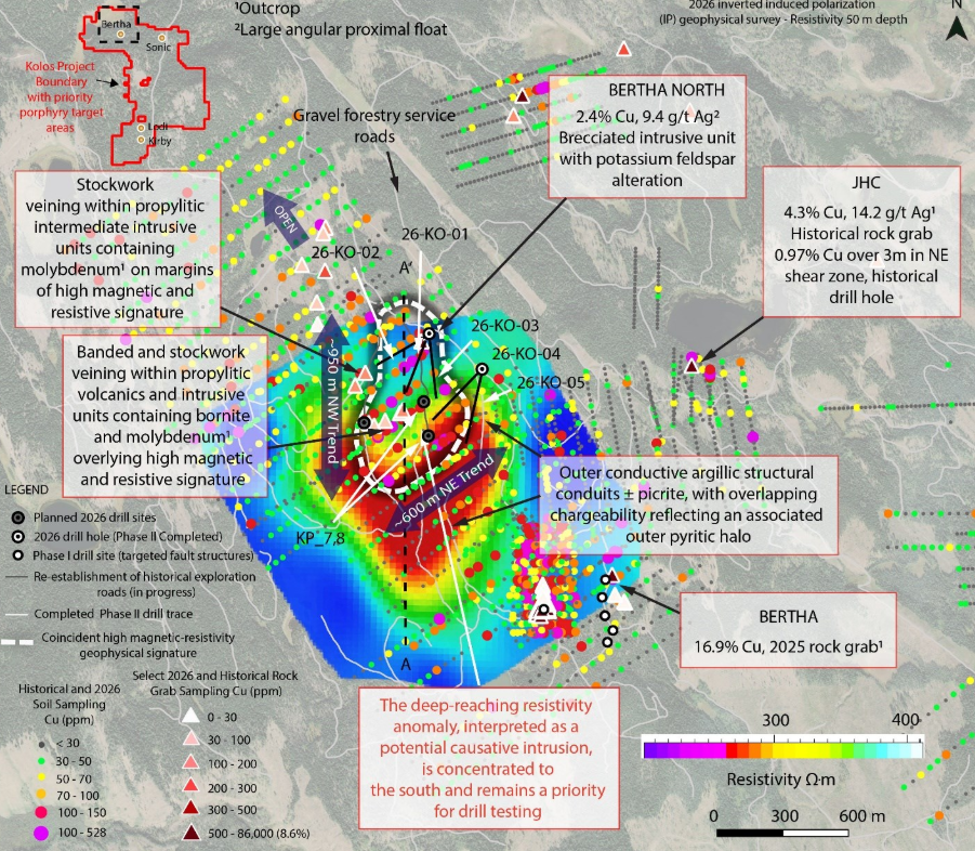
Integration with geophysics and surface geochemistry has provided increasingly focused vectors toward a priority target immediately south of current drilling (Figure 3, Figure 4).
Here, strong copper-in-soil anomalism and mineralized structural corridors converge with overlapping magnetic, resistive and chargeable signatures above a deep resistivity feature extending beyond 1,000m vertical depth (Figure 2), interpreted as a potential causative intrusive source. Follow-up drilling will test this convergence and the upper margin of the interpreted intrusion as part of Torr’s fully-funded drill program.
“Phase II drilling is demonstrating the scale of the mineralized hydrothermal system at Bertha North and, importantly, giving us a clearer path toward its interpreted centre,” said Malcolm Dorsey, Torr Metals’ President and CEO, in the Sept. 23 news release.
“We began by identifying copper-bearing hydrothermal breccias and structural conduits that carried mineralizing fluids through the system, and we are now following those conduits inward through increasingly proximal intrusive phases and alteration. Hole 26-KO-04 represents an important step in that progression, intersecting a sulphide-bearing, magnetite-rich intrusive dike within a broad brecciated, hematized and mineralized interval.
The scale and intensity of alteration and pyritic hydrothermal activity encountered across our drilling are encouraging for the style of porphyry system we are exploring for, with the nearby New Afton-style providing an important regional analogue. Our next holes will follow this progression south, where copper geochemistry, mineralized structures and multiple geophysical signatures converge above the interpreted deep intrusive source.”
Torr Metals’ Bertha North target — Richard Mills
Highlights:
- Phase II drilling is defining a brand-new large-scale porphyry-hydrothermal system: Holes 26-KO-01 through 26-KO-04 have confirmed copper-bearing hydrothermal breccias and mineralized structural corridors along north-south and northeast-southwest trends. These trends converge within the untested southern magnetic-resistive domain, coincident with strong copper-in-soil anomalism (Figure 3, Figure 4).
- Intrusive phases provide increasingly proximal vectors: Copper-mineralized biotite-phase and potassium-feldspar-altered intrusive dykes have been encountered within prospective portions of the hydrothermal breccia corridor. Hole 26-KO-04 provides an important vector, having advanced closest to the interpreted intrusive source and intersected a discrete magnetite-bearing intrusive dike with disseminated pyrite-chalcopyrite mineralization within a broader 40.6 m interval of brecciated, hematized and mineralized host volcanics (Figure 2).
- Deep resistivity defines potential intrusive source: A large resistivity feature extends beyond 1,000m vertical depth beneath the southern target (Figure 2). Its upper margin converges with mineralized structures and overlapping magnetic, chargeable and resistive signatures, providing a priority target toward the interpreted intrusive source.
- Near-term assays and follow-up drilling: Laboratory assays from Phase II drilling are pending and expected in the near term for 26-KO-01 and 26-KO-02. Torr is also in the process of re-establishing historical exploration roads to access planned holes KP_7 and KP_8, designed to directly test the southern structural convergence and upper margin of the interpreted deep intrusive source (Figure 4).
Bertha North: geological takeaways
Phase II drilling is progressively defining the architecture of a large mineralized hydrothermal porphyry system at Bertha North. Initial drilling identified broad pyritic and copper-bearing hydrothermal corridors, while subsequent holes have provided vectors toward the southern part of the target where structural, geological and geophysical features increasingly converge.
Key observations guiding ongoing drilling include:
- Copper-bearing hydrothermal conduits identified: Drilling has intersected broad zones of strong to intense hydrothermal alteration, brecciation, hematization and veining containing pyrite and magnetite, with local chalcopyrite and chalcocite where mineralization is apparent. The intensity of alteration and associated fracturing has resulted in difficult ground conditions and contributed to slower-than-anticipated drilling progress. However, the scale and intensity of alteration indicate substantial hydrothermal fluid flow through the system, with these altered zones defining north- and northeast-trending structural corridors interpreted as important pathways for copper-bearing fluids.
- Hole 26-KO-04 provides an important intrusive vector: Within a broader 40.6 m brecciated and mineralized interval from 429.2 to 469.8m, the hole intersected a discrete magnetite-bearing intrusive dyke with disseminated pyrite-chalcopyrite mineralization at approximately 460.5m. The occurrence of sulphide-bearing intrusive material within the mineralized hydrothermal corridor provides an important vector for follow-up drilling.
- Multiple vectors converge to the south: The interpreted intersection of major northeast- and north-trending structures occurs within the southern magnetic-resistive domain and coincides with strong surface copper geochemistry. Hole 26-KO-04 is the closest drilling to date to the interpreted upper margin of the deeper southern resistivity anomaly.
- Follow-up drilling is moving toward the interpreted centre: Planned holes KP_7 and KP_8 will test farther south across the deep-reaching resistivity anomaly and the convergence of major structural and geophysical features. This structural intersection is interpreted as a favourable zone for enhanced dilation and intrusive emplacement, where intersecting structures may have provided pathways for larger intrusive phases and focused mineralizing fluids. Drilling will test this convergence and the interpreted upper margin of a potentially larger intrusive body that may represent the causative source of the broader hydrothermal system.
Conclusion
Torr Metals has completed just over half (~3,500m) of its 6,000m second-phase drill program at Bertha North. Assays are pending. The work so far has pointed Torr to the potential intrusive source.
With holes 7 and 8 Torr is free to point the drills towards “copper-bearing breccias, mineralized structures and, importantly, a pyrite-chalcopyrite-bearing intrusive phase in Hole 26-KO-04. Integration with geophysics and surface geochemistry has provided increasingly focused vectors toward a priority target immediately south of current drilling. Here, strong copper-in-soil anomalism and mineralized structural corridors converge with overlapping magnetic, resistive and chargeable signatures above a deep resistivity feature extending beyond 1,000m vertical depth, interpreted as a potential causative intrusive source. Follow-up drilling will directly test this convergence and the upper margin of the interpreted intrusion.”
For the broader market, Bertha North represents an early-stage, fast-advancing copper-gold porphyry exploration play that is proving out a major system. The project has reached a significant developmental milestone: Wednesday’s update confirms that Phase II drilling is successfully advancing and validating their geological model. The core breakthrough is that they are actively defining a large-scale, hydrothermal porphyry system and drilling directly toward the interpreted “source” intrusion at depth.
Bottom line for me? The results confirmed a pyrite-chalcopyrite-bearing intrusive phase and magnetite-rich dikes, confirming they are tracking the hydrothermal system toward its core source.
Torr Metals
TSXV:TMET
2026.09.24 Share Price: Cdn$0.15
Shares Outstanding: 83.8m
Market Cap: Cdn$12.9m
TMET website
Richard (Rick) Mills
aheadoftheherd.com

Subscribe to AOTH’s free newsletter
Richard owns shares of Torr Metals TSXV:TMET. TMET is a paid advertiser on his site aheadoftheherd.com
This article is issued on behalf of TMET
Legal Notice / Disclaimer
Ahead of the Herd newsletter, aheadoftheherd.com, hereafter known as AOTH.Please read the entire Disclaimer carefully before you use this website or read the newsletter. If you do not agree to all the AOTH/Richard Mills Disclaimer, do not access/read this website/newsletter/article, or any of its pages. By reading/using this AOTH/Richard Mills website/newsletter/article, and whether you actually read this Disclaimer, you are deemed to have accepted it.