 RSS Subscribe
Under the Spotlight – Quinton Hennigh, CEO San Cristobal Mining
2026.08.09
Quinton, we’ve talked about BCM Resources (TSXV:B). I’m looking at the news release dated August 6th, and BCM encountered over 550 meters of strong porphyry-style mineralization.
We’ve talked a couple of times about why you like it so much, you talked about if you hit this thing could have extreme potential. The news says you’ve got the core of a strongly mineralized porphyry system.
Could you tell us about your target and what you’re drilling for here, and what exactly this one-hole result means?
Quinton Hennigh, CEO, San Cristobal Mining:
Absolutely. Look, this is a very large target and story. It’s not your average porphyry story.
This is in a part of southwest Utah that is fairly near Bingham Canyon, which is to the north, and then we’ve got the Robinson District, which is to the west. Those are both world-class deposits in their own right. They’re both porphyry copper, moly deposits.
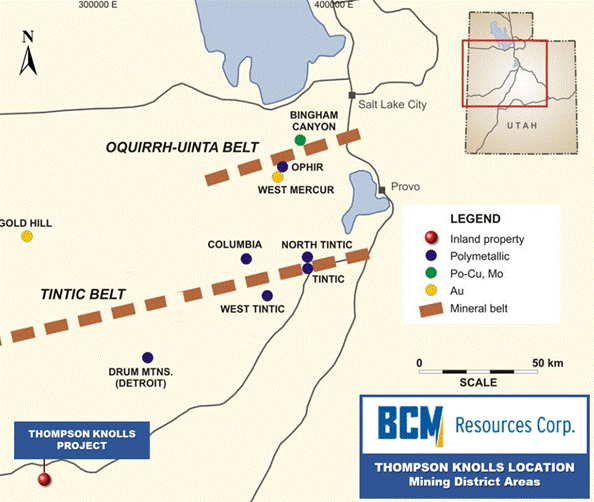
They also have appreciable gold and other metals, we’re trying to find the analog to those. We want to find a world-class porphyry system here.
And I think, quite frankly, we have stumbled into what could be a major discovery. I shouldn’t say stumbled. This is taking good science. Sergei Diakov, who’s the CEO of BCM is a good friend, but I also know that he’s a world-class explorer. The guy has a huge list of discoveries that he’s made, including Oyu Tolgoi, which is probably the single largest porphyry deposit in the world.
This team know what they’re doing. They know how to explore. And I’ve been a champion of the story since 2020, when I first saw it.
This was when I was at Crescat Capital. I saw the magnetic target underneath the pediment out in the valley. And the thesis behind this, I thought, wow, this thing could be something really special.
Now, the company was able to drill when the funding was, we’ll say, readily available in ‘21-22. But then, as we know, the market went south for about three or four years there from late ‘22 until 2025.
They announced a drill hole in 2023. It was about 155 meters of nicely mineralized copper skarn. It’s copper, gold and silver.
And the market was soft. It didn’t care. At that time, the news caused a little bit of excitement and the stock went up briefly. But the company was not able to garner the attention it needed to raise further capital. That was a bit of a shocker.
It shows you how bad things were just even a couple of years ago. Fast forward, BCM is now funded.
I helped them get funding last year and then again early this year for this drill program to basically follow up on what we knew was a discovery. Now, we had an initial thesis to drill a line of holes to the southwest from the previous discovery hole.
The discovery hole was called TK-8. And the subsequent holes that we drilled starting in April of this year were all about 250 meters spaced in a southwest direction from TK-8. And the reason we drilled in that direction was because the alteration, the mineralogic evidence that we saw in the previous drilling pointed to the southwest for a higher-temperature regime.
That’s where the mothership was. Now, interestingly, when we drilled those holes, we did end up hitting porphyry in hole number TK-18, which was the southwesterly most of that line of holes.
It wasn’t mineralized all that much. There is some interesting stuff in it. We’re awaiting assays, but it wasn’t really a gangbuster.
It was interesting, but not super interesting. Now, the holes in between TK-8 and TK-18 are quite interesting. There’s several in there that I expect to come back with some solid numbers, we’ll say.
But we saw that the porphyry down in TK-18 wasn’t quite the mothership that we thought it would be, so we decided to go back towards TK-8 and drill another hole. We call it TK-20. It’s east-northeast of TK-8 — about 200 meters or so.
Hole 20, when we started drilling, it went into bedrock. We could tell right away that this thing was something special.
This porphyry that we encountered started shortly after we hit bedrock. We hit bedrock about 1,930 feet, which is a little over 500 meters. Shortly after we went into bedrock, which was a bit of skarn, we went straight into porphyry.
The moly veining was simply unexpected. Truly, I haven’t seen anything quite like this in any porphyry drilling. Considerable stockwork veining.
The intensity of the stockwork veining in some of the intervals was just off the chart. 60-70% of the core was coarse veining. Quite a few of those stockwork veins have molybdenite in them. This was a shocker. Do we have grades yet? No, we don’t.
We’re going to have to wait a few weeks for assays. Visually, I would say this is a very strong interval. The news release tries to descriptively capture that.
There was also a fair bit of copper in places, especially when we started to see some skarns a bit lower in the hole. As we got deeper, we went into interlayered porphyry and skarn. There was a fair bit of copper in that.
Without question, this hole number 20 appears to be a major hole. I dare say a discovery hole. What does it mean? Well, moly is usually in the core of a porphyry copper system.
The highest-grade molly is usually in the highest temperature core of the system. I think we’ve actually drilled straight into the core of this darn thing.
RM: Wow, that begs the question, where’s the copper part of the system?
QH: As best as we can tell, there’s probably a stair-step faulting phenomena out here, where as you go westward, it drops down.
It doesn’t drop down out of range. It’s still within reach. Geologically, we see evidence that you go from this porphyry core to likely the copper part of the system.
We’ll call it the more copper-rich shell part, west of hole 20. I talked to Sergei after we drilled this hole 20. I said, let’s figure out where we should drill another hole.
We’ve picked a spot, I think it’s about 200 or 300 meters west of hole 20. We’re going to poke another hole in, it’s going to be 21. 21 happens to replicate a previous drill hole called TK-5.
TK-5 was drilled back in 2022. I happened to be on site when they were drilling that hole. Unfortunately, the hole ended in bad ground.
That hole ended in broken rock, and the drillers couldn’t advance it any further. But the last couple of meters, that hole had nice chalcopyrite. I mean beautiful chalcopyrite.
We’re basically going to go back. We think that the copper-rich part of the system is west of 20. So, we’re drilling hole 21.
It’s a duplicate of hole 5. We think that the copper-rich part of the system is in this area. This is going to be a very exciting hole. It’ll be a very exciting story.
I think as this thing unfolds, without question we have something absolutely enormous here. How big, we don’t know yet. But in every sense of the way, geologically, the intensity of the potassic alteration, the intensity of stockwork veining, the degree of molybdenum mineralization that we’re seeing is unprecedented in my experience in porphyry exploration.
So, I think those are all tell-tale signs that we’re going to see a big, big system here.
RM: Chalcopyrite over chalcocite preferable?
QH: Look, in the hypogene, meaning the fresh rock, yeah, the chalcopyrite’s going to dominate. And we’ve seen quite a bit of chalcopyrite in this hole, in hole 20.
I expect that to be the predominant copper phase in the fresh rock. Now there could be a chalcocite blanket somewhere out there too. Sergei takes the view that some of those holes we drilled in the line of holes to the southwest actually hit some oxide material that has visible copper in it.
We don’t have assays for it yet, but I wouldn’t be surprised if there is a bit of a chalcocite blanket out there too.
RM: It’s strange with these porphyries, in the type you’re looking for, you have moly, as you said, and then the copper, and then the gold and the silver would be most distal. Is that the same here? Moly, then the copper, then the gold, then the silver?
QH: Look, no two porphyries are exactly the same.
If I say this, I’m talking about the predominant theme, but usually moly’s in the core, copper’s a little bit outboard from moly, and then you start to see the precious metals outboard from that. And then lead-zinc as well, the lead and the zinc are out there too. So that’s the kind of zonation, schematic we’re working with here.
I think that’s applicable. Can we see a surprise? I don’t know, maybe.
RM: You mentioned two world-famous, long-lived massive mines. Who hasn’t heard of them? The mineralization here, how comparable is it to either one of those?
QH: Obviously Bingham is one of the biggest porphyries in the world, a huge copper deposit and it does have a high moly core. And while the moly in the core is not going to be 0.5% or something, it’s probably more average, like 0.1x%.
There are places in Bingham where there is high moly, like 0.5, 0.7%. Maybe that’s an analog to what we’re seeing, I don’t know. Now at Robinson, yeah, there’s also some moly in the core there, a high-temperature core that’s preserved in some of the places at Robinson.
The moly’s not as high there, I don’t think. It’s more like 0.05, 0.08% or something like this. It does have a moly core.
But the strength of this moly core is off the chart. This one’s unique.
RM: That’s the key here, right, is the strength of that moly. Like you said, each one’s a little different and each area could be different too, from the Quesnel Trough in British Columbia to where we are here. But the vectoring that you use is basically a very scientific method that homes in on the core.
You almost never hit the core on the first drill program. Instead, you do what you said. You do the research and you know what you expect in the outer aura. It gives you clues and you work in towards the core.
And this doesn’t change regardless of where you are. It’s porphyry hunting.
QH: Yeah, look, it’s really interesting. Every discovery has a unique pattern to it. This one it just so happens because of the nature of the faulting out in this country that we happened to poke a hole right into the core in the early stage of this program. I’m not going to say we found the stockwork copper shell.
There was stockwork copper veining in this, by the way. I don’t want to say there wasn’t. In the midst of the molybdenite, there was a fair bit of chalcopyrite here and there.
It’s clear this system can generate stockwork copper. We just have to find that stockwork copper and I think it’s just slightly out boarded because of the way things have been faulted. Basically, the block that was predominantly copper I think has shifted down into the west.
And I think hole 21 has a good chance of finding it.
RM: Excellent. It’s your turn to mention one here. What have you got?
QH: I have a project that I’m passionate about. I have been for 30-odd years since I was first introduced to it.
It’s currently in the hands of a company called NV Gold (TSXV:NVX).
NV Gold is run by a good friend of mine, John Watson. I actually encouraged John to pick up claims in this area way back in 2015 or 2016, I think it was. Anyway, John’s staked ground in a project called Slumber.
It’s in the Jackson Range. It’s way up in northwest Nevada. It’s about two hours drive from Winnemucca.
It’s west of a famous mine called the Sleeper deposit. So, it’s basically in the same Miocene volcanic-age rocks that Sleeper is hosted in.
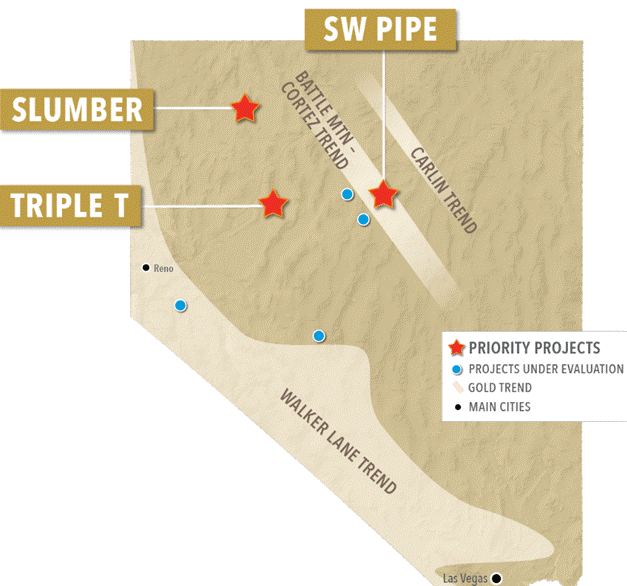
It’s not right next door to Sleeper, but it’s across the valley. And I think the geology of Slumber is very similar to Sleeper. It’s an epithermal system, so a hot spring system that’s preserved in a small subsidiary valley that kind of protrudes up through the Jackson Range.
John picked up those claims back a few years ago and actually drilled some holes and hit long intervals of 0.3, 0.4 grams per tonne gold. Very consistent.
It was all oxidized. It was all associated with epithermal textures and veining. It does leach, by the way.
That’s one of the things that encourages me is that it’s all oxidized and the cyanide leaches that were done on those chips from the drilling in the previous era all recover good gold. The gold recoveries are very high, very strong. So that’s encouraging.
Back to the punchline. John drilled some holes on the BLM claims that he had, but he didn’t have a missing very piece of ground. There’s ranch land in the middle of this target that hosts basically the guts of the system.
Now, John has been carefully negotiating a deal with the ranch for probably six or eight months. And as time went on, it was clear he was going to get a deal done here in the past two months. And so, as he did, I actually encouraged John to hire a geologist, a good friend of mine, to go out and map the property, including this ranch land, which the ranch allowed us to do.
They were very nice and cordial and let us do some work. But basically, John secured a deal for this ranch and announced it Thursday morning.
Nobody noticed it or cares about a company picking up land in Nevada. Who cares, you know? But in my book, this is a key piece of ground. So now we have the entire epithermal target under our control and we have a good geologic map that’s been prepared very recently that shows us that we have an absolutely enormous system here.
Without doubt, the alteration and mineralization that we see extending across the ranch land from our existing property says this thing’s probably about 3.5 kilometers long, about 700 meters wide, at least. And it’s hosted by a series of volcanic tufts and volcaniclastic rocks that are pervasively mineralized. So basically, think of it like a giant pool of mineralization, albeit low-grade, maybe 0.4 to 0.8 grams, somewhere in that range.
But imagine finding 200 or 300 million tons of 0.5, 0.6-gram oxide heap-leachable gold in this day and age in Nevada. It’s almost unheard of. The only other place I can think that’s been found like this recently is a silicon project at AngloGold Ashanti’s building down in southern Nevada.
So, I think this is an absolutely massive target. Could it be a 5- to 10-million-ounce gold facility? Yeah, easily. I think this one has that kind of scale.
And what’s really intriguing is there are structures now that we’ve identified that appear to be the feeders for this system. We don’t know exactly where they are, but we are going to try to test some of the core area that’s on the ranch that appears to be structurally controlled mineralization with a few angle holes. In the next few weeks, we’ll start a drill program.
We’re going to drill upwards of 40 holes that are mostly vertical to test this very thick volcanic and volcaniclastic package that’s mineralized. We should get a sense of the potential 200 or 300 million tons is there. But we’re also going to drill some angle holes into the structural area where it appears there’s a feeder underlying the thing.
And with a little luck, maybe we find something like the old Sleeper deposit. Sleeper was a very famous high-grade, structurally controlled deposit with a large cloud of low-grade around it. Maybe we find something like that and this thing ends up being just one of the biggest gold discoveries in Nevada for a couple of decades.
This one I get super excited about. I know everybody’s like, oh, it looks low-grade. Well, yeah, it’s low-grade because we drilled the low-grade part of it.
Wait till we drill the ranch, okay? We’re going to move into the higher grade here. So just bear with us. And I think we’re going to have a really good outcome.
RM: That is a great story, miles and miles of exploration upside.
QH: Yeah, exactly.
RM: How much do you know about Torr Metals (TSXV:TMET) and the last news release that they put out, Quinton?
QH: You know, I looked at that. You’re talking about the one that was in late July I believe.
RM: It was July 22. “The first drill hole confirmed an expansive long-lived hydrothermal system down to 563 meters with a highly prospective interval.”
Do you believe Malcolm Dorsey, the CEO, is on track here at Bertha North to maybe vector in on a core in this drill program, is he close?
QH: Look, the news release actually talks about the core, the visuals in the core. But it also has some images of the geophysics and the rationale for what they’re testing. The geophysics is suggesting that there’s a large potentially sulfide system down there, something that’s making this chargeable body of rock in the ground.
So, absolutely I can certainly see the target and its justification. And given its location too, it looks like a lot of targets in the porphyries that you would see in BC.
Now, the drill hole is quite interesting. They only had two or three photos, I think, of core in the news release is my recollection. It’s interesting because it shows pervasively altered rock for sure, but it’s also stained with hematite, which is an indication of many of the porphyries in BC.
Pic of red staining
You start to see lots of pinks and reds in many of those porphyries. So visually, yeah, it does look like something’s going on there. They don’t have photos of the entire core, so it’s really hard for me to say if it’s pervasive or continuous through that entire hole, but the news release does describe it being as such.
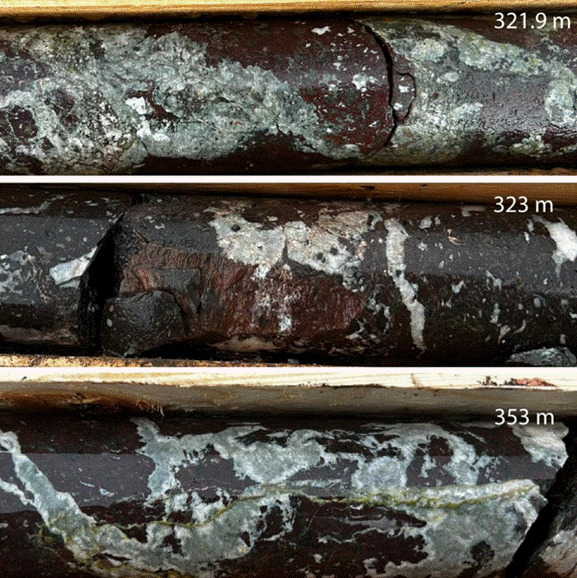
It sounds more than a little interesting. I don’t think it’s going to be a discovery hole from what I’ve seen because they would have talked about stockwork veins or something like this, but they did see a lot of brecciation and other evidence of hydrothermal activity.
Like a lot of discoveries, it takes a few holes to make it, right? Sergei’s comment to me when we were drilling at Thompson Knolls, he said, usually it’s the 24th hole that finds a porphyry. And I thought about that and I said, wow, you wouldn’t think it would take 24 holes to find a big porphyry. But it actually is the case.
It sounds like these guys at Torr are on the right path. But maybe they have to drill a few more holes to find the mothership.
RM: Yeah, it’s a patience game, isn’t it, for the investor? They have to know what’s going on and just sit and, okay, everything pointing towards a porphyry system, and there is a porphyry system here.
We’ve just got to find it and see how big it is and if it carries economically. Where we are, the average head grade in southern BC for porphyry is 0.4% copper-equivalent, that was published many years ago, obviously the bar is even lower with any near todays prices for copper and gold. I mean, it’s not like you’re setting the bar at 1%.
QH: Exactly. It’s a fun game, exploration. And when it pays off, it pays off big.
I like companies like Torr that actually do geologic work and have a thesis that they’re chasing because It’s companies that are persistent that usually make the discovery.
RM: Do you want to talk about your second stock, please?
QH: Okay, I’ve talked about Mogotes Metals (TSXV:MOG) prior, okay, mostly about the geologic context of the company, but I think Mogotes is one of the best discovery-level exploration stories in the market, and people are not quite appreciating it yet, but I think the attention is starting to pick up. Now, why do I say that?
Well, look, Mogotes did scout drilling on a number of targets over the southern hemisphere summer; they started drilling I think in November or December last year, and they carried on drilling until early May, so they got scout holes into a number of targets, and two of those holes, one in Los Mogotes target itself and then another in another target not too far away.
Both of these holes have hit what I would call discovery-level mineralization, okay. It’s very stout copper grades, 0.6, 0.7% copper plus appreciable gold, like 0.3, 0.5 grams per tonne gold, and so you’ve got two holes here that have hit long runs of ore-grade mineralization in a camp that’s effectively right next to Filo, which is one of the biggest discoveries in porphyry in modern history.
Well, look at the value that’s created in this district. BHP and Lundin bought Filo, the company, about a year and a half ago for $4.6 billion. We are immediately adjacent to them.
We have two apparent discoveries of the same nature. They smell the same. Copper-gold rich, driven by MT data and other geophysical data.
It looks almost identical, and in fact, it’s shallower. Believe it or not, Mogotes’ intervals are shallower than Filo. What’s not to love? Now this has picked up the attention of Rio Tinto, and Rio Tinto came in, took a 5% stake in Mogotes Metals, so Mogotes now has Rio Tinto on their register.
Why is Rio in there? Well, obviously if BHP has picked up Filo, Rio Tinto’s chief function in life is to compete with BHP, and that means that Rio Tinto doesn’t want to be left in the cold, and they recognize that Mogotes Metals has the goods, okay, so they’ve tipped in a fair bit of money.
We believe in the story, and we would love nothing more than Mogotes to find a gigantic porphyry or two akin to Filo, and that we all make an absolute ton of money. Whether we end up the top dog here or not, I don’t care, but Rio Tinto is a welcome addition to the story.
RM: It’s another one of those vectoring exploration programs where you are on trend, and you’re ahead of, say, BCM and Torr Metals in the fact that you already have assays. That’s huge.
QH: Yeah, exactly.
RM: I’ve got two more. You talked to David Hottman of Orestone Mining (TSXV:ORS)?
QH: Yeah not too far back, sure.
RM: They’ve got an oxide gold stockwork mineralized Zone at Francisca, and it’s starting to get some size to it, and basically they’ve got some assays that are left to come, but there’s nothing left but to go drilling here, am I correct in that?
QH: Look, that’s my view. First of all, this is in Argentina, so he calls it an oxide gold system, which kind of leaves you wondering what type of gold system it is. From what I can see, it looks like an epithermal system, but it’s probably something that’s associated with a porphyry-level-type system. It’s a big system.
It’s partly structurally controlled, too. It looks like there’s a bit of a structural fabric to it, but it’s big. It’s near-surface, thoroughly oxidized rock that bears a pervasive low grade, I’d call it 0.5 to 1 gram cloud, but within that cloud, there’s some very high grade, which really intrigues me.
There’s a lot of 5–10-gram assays in the middle of this. The company’s been quietly bolting together some land there. I think that they’re now in a position where they’ve got everything secure, and quite frankly, I do think it’s a drill story at this point.
I’m very interested to see them drill. That’s why I took an investment. That’s why I got Crescat involved a couple of years ago.
These guys need to drill this target. I think it could be a sleeper discovery in the making. Most people don’t know about it.
These are the kind of stories I like. I bought a lot of shares. If they hit big, it’s the kind of story where the company could go from, say, sub-$10 million up to a few hundred million dollars very quickly.
RM: It’s a perfect Ahead of the Herd story. We’ve been investing in it since very early last year. We’re very happy with the progress.
QH: They just need to drill. It’s winter down there right now. Hopefully, when summer picks up, they can drill.
RM: I have Electric Metals (TSXV:EML). Brian Savage’s company. You’re high on this company and Brian. We’ve talked about this one a couple of times. It’s about a mine, US security of supply, manganese products manufacturing.
Brian’s savvy in the manganese space.
To me, the mine itself is something special. What can you tell us about this? It’s a magnificent deposit. Give us a rundown on how damn good this deposit is right now.
QH: Yes, certainly. For disclosure, I am chairman of the company. I want to make sure everybody is aware of that.
As far as the deposit, Emily goes, it is in Minnesota. A lot of people say, Minnesota, it’s a tough place to permit a mine. That’s not quite our experience lately.
We’re starting to see a groundswell here of support for this project and making it happen. I’m actually quite optimistic about the future.
Importantly about the deposit itself, it is the highest-grade manganese deposit in the US. This is basically a go-to for the strategic manganese supply in this country.
The resource is somewhat modest at present. We’re talking about indicated and inferred, which combined is about 11 million tons, but it’s very high grade. Weighted average is about 19% manganese.
It’s got a bit of iron in it, too. The manganese grade is substantially higher than anything else we know of in the US. This is basically a go-to for strategic supply for manganese refineries in the United States. Manganese is very important for a lot of things like batteries, steelmaking, and other things like chemicals.
What better deposit to turn to in the United States than Emily? There’s a lot of support, especially from the current administration, to see this project advance. Now, while the resource is modest, you’ve got to understand, geologically, this is a vetted deposit. It’s a pretty extensive deposit.
How big is it ultimately? It’s going to be a lot bigger than this. It is sheet-like, so it can be drilled. It’s wide open in all directions, more or less.
It can be drilled and probably expanded by multiples from here. Do we need to expand it right now? No, we’ve got enough here to basically build a substantial mine. It’s got very good metallurgical qualities.
We’ve also done some ore sorting test work here recently that shows it can be mechanically sorted and upgraded. Now, where it gets interesting, and I can’t say a whole lot, but Electric Metals has aspirations to become a substantial manganese supplier in the industry.
Brian Savage is the brightest guy I know of in the manganese space. He knows manganese inside out and backwards. He went to the Colorado School of Mines, the same place I went to.
He’s about the same age as myself. Quite frankly, Brian has a vision for growing this company. I can’t say too much more about it right now, but I would say within the next six to 12 months, you’re going to see Electric Metals transform itself into a position where not only can it develop the Emily deposit, but it’s going to be a significant manganese supplier.
We’ll call it perhaps refined manganese products in the not-too-distant future.
RM: Excellent. Have you got another one?
QH: I do, look at PJX Resources (TSXV:PJX). PJX is an exploration company that’s located in southern British Columbia. It’s got properties near the old Sullivan mine that belonged to Teck.
Sullivan isn’t producing at this point, but it’s in the vicinity of Teck’s trail smelter in southern British Columbia. Okay, now, the PJX guys have a project, Dewdney Trail, which has been their flagship target for a few years now. It’s a Sullivan-type target, so it’s a lead-zinc-silver target, a SEDEX target that in every respect could be a replicant of Sullivan.
I’ve looked at this thing inside and out and backwards. I’ve invested in it alongside a number of other astute investors, technical investors, who think that they’re onto a potential Sullivan-type discovery. Now, they haven’t quite made it yet, but they have drilled some interesting holes in the past year, including a hole that hit a very long interval with stockwork feeder-type mineralization.
Not ore-grade zinc, but lots of thousands of PPM-type zinc over a very long interval. The company seems to now think it knows where the exhalative part of the system is, meaning the Sullivan-type system. And they’re going to be testing that this summer.
So, the company is aggressively pursuing drilling of this SEDEX target, and I’m hoping by the end of this season, they have that discovery in hand. But there’s something even more interesting about this company that I didn’t realize until early this year, when I met with John Keating, the CEO, back in January. He came to give a presentation to me.
This was at Roundup. And he talked about the SEDEX, the Dewdney Trail target, which was great, but he had some other rocks with him. One of the rocks he threw on the table was a piece of granite with sheeted quartz veining.
And I looked at that thing and I said that looks more interesting than just about anything John, and I said, what is this? He said well, this is intrusive-hosting gold mineralization that we found on another part of the property. So, about 60 kilometers southwest of Dewdney Trail, on PJX’s property, they have a series of reduced intrusions.
These are reduced granite intrusions that are similar to those that you would see up in the Yukon, for example. The things that made companies like Snowline so famous. And lo and behold, John and his prospecting team actually sampled some of these granites and they came up with amazing gold numbers, multi-gram gold numbers in some cases.
Well, I said, John, this could be the better target here. I mean, at least in the short term, this could be something you could really make some noise about. And he agreed.
That was January, when everything was getting pretty frothy. I said if you were to attract funding, you really should talk more about this reduced intrusive story. And he started to.
I think he put some news out in February or maybe March. But the market started coming up. It was a bit of a tough period to talk about a new potential discovery of reduced intrusions, especially given it’s in BC and not Yukon.
So, people are like, what? What is this? This is strange. So anyway, it took a little while, but my team and I helped John round up some money.
I put some money in the race, and he’s now got sufficient cash to drill both the lead-zinc-silver target, but he also has applied for permits to drill on one of the reduced intrusive targets that I think is very attractive.
I’m hoping that by maybe late September, he should be drilling holes in this reduced intrusive target. If they come back, like I hope they do, like early Snowline-type holes, 100, 200-meter intervals of sheeted quartz veining with gold, this could be a very exciting discovery.
It’s a bit of a long shot to think that you could find another Valley-type discovery, especially down in BC, but the rocks look like they’re the right kind of rocks. I’m supportive of it. I want to see this tested.
We’ll see. Hopefully they get the drill permit here so they can do this. It should be an exciting story if people want to get in at an early stage.
RM: That’s an excellent story. Exploration is risky. Don’t risk your money if you can’t afford to lose it, but you back great management teams with a track record they’re going to secure the good properties. You put money in and you let them go to work and you sit back and you wait. It’s not that hard, really.
QH: That’s right. Most of them don’t turn out, but the ones that do, they’re the ones that pay off.
RM: The ones that do make up for what, 20 misses? You only need to get paid once every year or once every two years on these things to make a sizable difference in your life. It’s not a roulette wheel. You’re betting on management.
Management that’s been there and done it before is a pretty good bet in my book.
QH: Rick, I love this game.
I’ve been doing this for a long time, and I just love the exploration side. I look at right-hand side of the Lassonde Curve stories. I don’t know them as well.
I’ve tested a few of them out and done okay, but this left-hand side, give me it any day. I love exploration.
RM: I do, too, and I love talking to top-shelf geos. I have two to get you to comment on. We’ve talked many times about Rick Mark’s Harvest Gold (TSXV:HVG), and there is absolutely nothing left to do on Central Mosseau except drill it and drill the hell out of it to follow up on a discovery last year, and they are going to do that. The drill program is getting underway.
They’re getting their drill targets, and we’re going drilling, Quinton, on the Central with a big drill program. That’s exciting.
QH: I do like that story. I still have a heap of shares in Harvest. Let’s pick this apart a little bit. First of all, you just look at the greenstone belt, and it’s more or less a continuation of the Windfall Belt, which is kind of the other end of the dumbbell over on the other side of the trend, but it’s the same geology. The same host rocks, same metamorphic grades, basically it’s a replicate geology.
The company went out last year after doing a modest amount of field work to develop some targets. They poked several holes in, one of which hit. It was 1.5 meters of 105-gram gold. Stuff like that doesn’t fall out of the sky. It doesn’t just magically apparate.
The fact that you can go out in the first-pass drill program and hit a sizable high-grade interval, meaning a gram-meter interval, on the first pass tells me there’s gold in that camp. When they find it, they’re going to find a bunch. It’s not going to be a little.
I think 105 grams does not just, like I said, magically apparate. There’s got to be more to it.
Look at the Windfall camp and look at the nature of the grade over there. Lots of high-grade and lots of short intervals of high-grade. That’s what we’re seeing already at Harvest.
I’m hanging in there. I’ve held onto my shares. I’ve bought a heap of them right after they announced that drill hole last year, and I still have them.
RM: Yeah, I’ve got mine. I’m not letting it go. Anytime you find that grade of gold over plus a meter…
There’s three of these stacked layers on top of each other. To hit that in basically what was a 30-kilometer long target of the Kiask River formation, I mean, holy God.
QH: Exactly. Like I said, you can get lucky. But I’ve never gotten that lucky.
RM: Well, you’ve got great geologists and a great team. They work hard to do the research, and funny, they get a little lucky now and then, right?
QH: That’s right.
RM: I’ve got one more. It’s Au Gold (TSXV:AUGC), Mark Blythe. You know a little bit about epizonal. This one here, they put together an amazing compilation of historical records.
They see things that aren’t visible from the surface. They see things nobody’s ever really looked at or known about outside the original OG’s for decades. It’s where the old guys were working and building mines and shafts.
I want everybody to keep in mind that these old guys, they were kind of using the Conan method of water extraction. A guy turning a frigging pole, and that’s how they got the water out, and they could only go to limited depths, but they certainly found some amazing grades on the Havelock. You talked to Marc, a little bit about this one would be nice.
QH: Okay. To put it in context where this is. This is down in Australia. It’s in Victoria State.
It’s in the same neighborhood as Fosterville and Costerfield. Don’t forget Mike Hudson’s discovery, the Sunday Creek deposit. That’s a classic example of epizonal.
I think people are really getting smart, geologically smart, and we have a number of companies that have made successful epizonal-level discoveries. What are the characteristics? High antimony is definitely one. There’s certain other aspects like the nature of the gold itself, the grain size of the gold, and the textures of the veining and stuff like this.
There’s also likely an association in my view at least with certain phases of granites that intrude the country. We see all of those at Au Gold’s project, Havelock. I know Marc reasonably well.
He recognized the nature of this particular target and the epizonal characteristics. And when he showed it to me, it reminded me of the day that I remember talking to Mike Hudson.
This was before the discovery at Sunday Creek, but I remember when Mike told me he was going to go after the project there. I think it was right before COVID hit.
Anyway, Mike showed me some data on his computer. And I remember thinking, wow, that does look pretty good. It looks very Fosterville-like.
Fast forward. When Marc Blythe showed me his data, this was back about seven or eight months ago, I thought, wow, that looks like it could be another Fosterville. And so, it was like deja vu all over again.
I think they have the right kind of system. I haven’t caught up with Marc recently to understand what their exploration approach is. But knowing Marc, he’s got a smart team.
I’m not too worried about whether they can make a discovery. I invest in projects because I can see that geology is telling me the right stuff.
Marc’s a very smart guy. He’s been around a long time and I think he’s on to a very good project here.
RM: One of the big things when I’m looking at this is I look at management.
I always do. Marc’s a consultant. He has been for a long time.
He’s been called in by major mining companies all over the world to consult on their projects and figure things out and see if they’re worth economically going forward. When I heard that Marc was putting something together last year, I had to give him a call. I had to talk to him.
I was so damn impressed with Marc. He didn’t even have a project then, Quinton. This was before he got Havelock. I told him I’d do whatever I could to help him out, just nothing but a pure bet on management at the time.
I pat myself on the back for recognizing what Marc had, his attributes.
QH: Absolutely. Fully agree.
RM: Thanks for your time, Quinton.
QH: Thanks Rick.
Richard (Rick) Mills
aheadoftheherd.com

Subscribe to AOTH’s free newsletter
Richard owns shares of ORS, AUGC, HVG, EML and TMET
ORS, AUGC, HVG, EML and TMET are paid advertisers on his site aheadoftheherd.com
This article is issued on behalf of ORS, AUGC, HVG, EML and TMET.
Ouinton owns shares of PJX, EML, MOGB, NVX, AUGC, HVG and B.
Legal Notice / Disclaimer
Ahead of the Herd newsletter, aheadoftheherd.com, hereafter known as AOTH.Please read the entire Disclaimer carefully before you use this website or read the newsletter. If you do not agree to all the AOTH/Richard Mills Disclaimer, do not access/read this website/newsletter/article, or any of its pages. By reading/using this AOTH/Richard Mills website/newsletter/article, and whether you actually read this Disclaimer, you are deemed to have accepted it.