 RSS Subscribe
Under the Spotlight – Jason Weber, CEO Silver North TSXV:SNAG
2026.09.04
Richard Mills, Editor AOTH: This morning I’m with CEO Jason Weber, he’s the CEO of Silver North trading on the TSX Venture under the symbol SNAG.
Silver North Resources is a junior mineral exploration company focused on its high-grade silver Haldane project in Northern Canada’s Yukon Territory.
The 100% owned project is in the historic Keno Hill Silver District. Silver North has another project, the contiguous Tim Carbonate Replacement Silver Project and the Carbonate Replacement Veronica Project in the Silvertip District spanning the Yukon-British Columbia border.
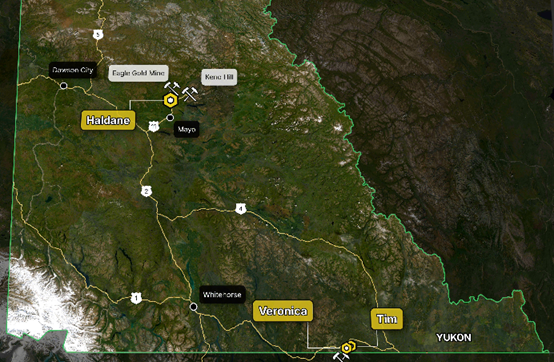
Silver North is fully funded for its active 2026 and 2027 exploration and drilling campaigns.
SNAG’s Haldane project is very interesting, being situated directly adjacent to Hecla Mining’s very high-profile Keno Hill silver mine.
Silver North is currently drilling with 2 drills on their Haldane Project where the company has made three discoveries in only 24 drill holes. The summer’s exploration program at Tim/ Veronica have wrapped up.
Exploration at Haldane currently centers heavily on the Main Zone/Main Fault target, where recent programs have returned wide intervals of high-grade silver and gold mineralization. High-grade intercepts include 2,014 g/t silver across 3.2 metres, as well as anomalous gold (unusual for the Keno Hill mining district), lead, and zinc credits.
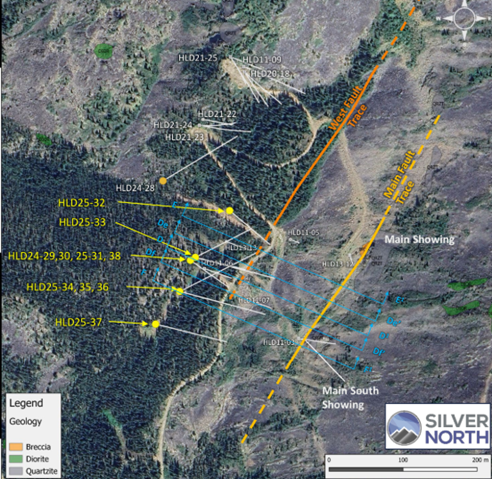
A fully funded multi-thousand meter diamond drilling program is underway, utilizing two rigs.
Approximately 85% of the 2026 drilling effort is dedicated to stepping out and extending the Main Zone along strike and at depth. There are also plans to drill at the 2019 Bighorn discovery.
RM: Does that pretty much sum up where we currently are at right now, Jason?
Jason Weber, CEO Silver North: Yes, that’s a fair summary of Silver North.
RM: Your recent drill programs at Silver North’s flagship project, Haldane, has yielded some of the highest-grade silver intercepts in the history of the property. Can you tell us some of the defining results from the Main Zone? You have drilled into some very strong poly-metallic mineralization.
JW: The key one for us is arguably the best hole we’ve drilled on the property prior up to this season, hole 31 returned 13.15m of 818 grams per tonne silver. That came with 1.39 grams per tonne gold and some lead and zinc as well.
RM: It’s a very strong zone of mineralization, both in width and grade.
JW: Of the 220moz oz of silver produced in the district, that was up until the 1990s, the average mine head grade was somewhere around 1,149 grams per tonne silver. It’s extremely high-grade, and that’s the kind of grades we’re chasing here. If you look at some of the other holes that we drilled in 2025, hole 36 was just under 3m of 1,069 grams per tonne silver.
Hole 30 was 2.5m of 1,088 grams per tonne. We had 0.8m of 1,438 grams per tonne. Then we had some wider intercepts as well, 7.95 m of 365 grams silver per tonne.
If you compare grades to what Hecla (NYSE: HL) is mining next door, the way we look at it is anything over 300g per tonne silver goes through the mill there. 300g per tonne over 3m is what we classify as a potentially economic drill intersection. We’ve got those types of intersections in pretty much every hole that we’ve drilled at the Main Zone to date.
RM: It is an exciting target you’re building out on this year. I call it matching historical greatness. I’ll explain.
The Yukon Government MIN files that came out in 2003, they had production statistics for the period of 1913 to 1989, indicating that 4.87m tonnes were mined at an average grade of 1,389g per tonne silver. You had a blind discovery at the West Fault of 1,351g per tonne silver. That matches the historical production grade pretty closely.
As for beating current reserve averages, Hecla’s massive modern footprint in the district operates at a reserve grade of roughly 700g per tonne silver. Your breakthrough hole was 818 grams per tonne over a 13.5m interval. That really comfortably eclipses the average grade of the active mine running next door.
The thing that I really appreciate about Haldane and what Silver North is finding, is the gold advantage. While Keno Hill is traditionally a pure silver/lead/zinc camp Silver North’s Main Fault target frequently displays anomalous gold. You had 1.39g per tonne and 0.73g per tonne intersections in your last drill campaign and potential gold recovery would be a unique by-product in this area.
JW: Yes, and I know it’s got Hecla interested as well. We’ve talked to them just about the gold content here, mainly asking if that’s something that they see. The answer from them has been spotty gold, not as consistent as we seem to see at the Main Zone.
What’s really interesting is the West Fault, where you quoted a nice high-grade silver intersection there. We hit 1,351g per tonne, but that was 0.3g or 0.4g per tonne gold.
A great example of higher grade gold would be a few intervals from hole 31. There are short intercepts including a 60cm in that 13m intersection of 818 g/t silver, where the individual sample returned 2,860 grams per tonne silver with 4 grams per tonne gold. Another example is in hole 36 where we’ve got another intersection that has 6 grams per tonne gold, in a 40cm interval of 3,370 grams per tonne silver.
RM: Those are numbers and values you’re just not accustomed to seeing in Keno, obviously it’s a nice little addition.
JW: In these systems, you don’t know what the gold recovery is going to be like, but that’s something you can look at even if you’re on a 1.39g. If you’re recovering 0.7g or 0.8g, when you convert that back into silver for valuation purposes, that’s a significant amount of silver, so it does add value. It remains to be seen if this is localized to just this part of the Main fault.
We’re working on that to try to figure it out this year, some thin-section work looking at the mineralogy of these veins to see what’s going on there, because it is different than most of what you see in this district. The bottom line is that any continuation of plus 800g/t silver, that’s drastically going to raise Haldane’s visibility to the market.
You can’t discount the fact that with the current silver market, trading in the $60s, that’s a significantly higher margin for a mine like Keno, where they were probably modeling in the $30 per ounce range for the price of silver.
A great example is they’ve been clearing about $30 million in free cash from the mine over the last few quarters, milling about 2,400 tonnes of material. They did the same in the first quarter of this year, mining 800 tonnes, so about a third of the tonnes that they were mining before, which just shows you the impact of the silver price on the economics of a project like this.
You’re probably comfortably with below 300g per tonne silver going through the mill economically.
In fact, Hecla’s average realized silver price for Q1 2026 was about $84 per ounce vs about $55 per ounce in Q4 2025. If you go back a year to Q2 2025, they realized an average of $35 per ounce. I think that changes the economics at the mine where they could probably be comfortable with below 300 grams per tonne silver material going through the mill.
RM: It also stands to reason that with the higher silver price you can open up bigger, wider parts of the system where it’s maybe not as high-grade.
JW: We’ve hit silver almost every hole, but it’s not always 800g per tonne. This why anything over 300g per tonne is going to play very favourably for us. Considering where I think the silver market is going, I don’t see us back in the $20 – $30 per ounce range in the near future.
RM: I think that we’re more likely to be up in the $60s, where we are now, or higher, and that is very, very positive for the future economics of a project like Haldane.
The last update we received was you had already completed 10 holes for 2,550m. Have you got an update for us about how many holes and metres done up to today?
Under the Spotlight – Silver in ‘26
JW: We’re currently on our 16th and 17th holes at Haldane. One rig’s been drilling the last few holes at Bighorn, with the other one is maintaining its position on the Main Fault, metre-wise, we’re at about 3,800m.
We’ll come in somewhere around that 5,000m range for the final numbers on the program in 21-22 holes. It just depends on whether we’re drilling shorter holes here at the end, or we go for some of our longer, deeper targets.
RM: What does it look like for Bighorn?
JW: We’ll drill at least three holes there, if not four, following up on the 2019 hole.
Having two drill rigs on site has given us the ability to take one off the Main Zone, which is where we can add the most value in the shortest amount of time, but we can still take a rig and put it onto Bighorn to assess that target, without sacrificing too much of the progress at the Main Zone.
RM: Why don’t you tell us a little bit about Bighorn, since we’re drilling it?
JW: Bighorn is located about three kilometres away from the core part of the property which we call the Mount Haldane Vein System, which is host to the West Fault, Main Fault, our Middlecoff targets and the historic Johnson target.
The Bighorn area was a focus of groundwork up until 2019 when we drilled just our second hole ever on the property at Bighorn. We had identified a nice soil geochemical anomaly there that had some of the highest soil numbers on the project.
We had over a percent lead, and just over 60 grams per tonne of silver from a soil sample, those are high numbers you don’t normally see in soil sampling.
There’s not a lot of bedrock exposure here and the structure is expressed as a small valley in the hillside rather than exposed mineralization.
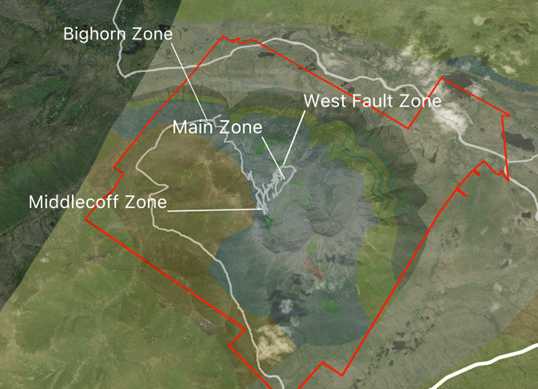
The one hole we drilled in 2019 hit four different zones of silver mineralization. It looked a little different than what we normally see at Haldane in that there’s more quartz with it. There’s still siderite, which is kind of our go to mineral that tells us we’re in the Keno style veins.
But when we got the results back we were a bit disappointed. There was 125 grams per tonne silver over 2.35m, that was our best intersection. But from what we know now and from what the Hecla people have told us and shown us, these veins go from narrow, sub-economic-style mineralization to what they consider economic over relatively short distances.
Within 50 or 100m you can be into, a potentially economic drill intersection. They were adamant that we were on to a discovery at Bighorn. We’ve wanted to get back there for a number of years.
Now with this year’s program we have that second drill to go in there and do a series of holes. What we want to get out of this is a vector to where those potentially economic drill intersections might be.
By drilling four holes, we can start to take the data, look at it, once we get the results back, look at the geo-chem, and then start to say, okay, this is the direction we want to go now at Bighorn.
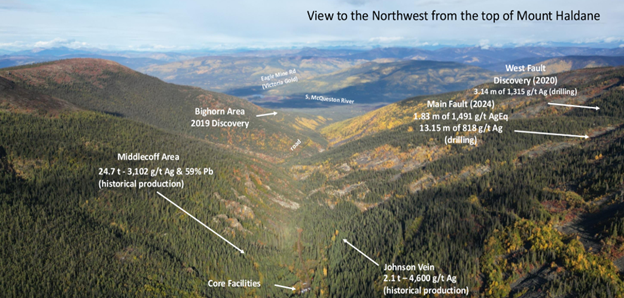
It’s an exciting target three kilometers away from the previously known mineralization. It just opens up the project’s potential and shows that this project has lots of potential to host mineralization that the old-timers just wouldn’t have been able to find.
RM: You did send some core from the early holes to the ASL labs. When do you expect the initial assay results?
JW: We’ve been waiting for results for quite a while. It was about three weeks ago our first batch was logged into the system, which was significantly longer than we thought they would take. At that time, they told us it would be at least four weeks for the prep, and then another week, at least, for the analysis, which would put us kind of mid to late September for that first set of results.
That’s about as clear a picture as I can give right now. I’d love to have some assays out mid-September, but I just don’t know that we’re going to get those back in time to do that.
RM: I talked to CEOs from three other companies operating in the Yukon, and they’re all suffering from the same thing, very slow turnover at the labs.
JW: It’s definitely not unique and unfortunately we’re going to be close to the end of the program by the time we start getting results.
RM: You are operating out of your brand-new Haldane camp this year.
JW: We were very, very fortunate the last few years to have such good neighbours in Banyan Gold (TSXV:BYN) who had room in their camp to house us.
We didn’t have the headaches of managing kitchen staff, cleaning staff, camp maintenance, and the less obvious benefit that we could use bulk fuel tanks – which can be significantly more cost effective than buying diesel by the barrel.
This year, Banyan expanded their program and as a result didn’t have the camp space for us. We had to build our own up on site, which has its own advantages.
The upside is the fact that we are 15 minutes away from the drill at all times. It’s much better for safety if there is an injury on site because our first aid attendant is there now 24 hours a day.
In the past, we’d have to have a night shift first aid attendant up in the valley where the drills were, which isn’t ideal. Now we’re all at the camp, everybody’s in the same location. We can go with one first aid attendant who can be called in the middle of the night if there’s an incident, which, fortunately, we haven’t had any.
But the other, maybe even more important factor is the fatigue aspect. It was about an hour drive in every shift from Banyan, and then the same again at the end of shift. So that fatigue aspect, which is manageable over a six to eight week program but wears on people over a four or five month program.
I’m much more comfortable with our setup now being a full camp up in the valley.
RM: Let’s talk about the Orogen (TSXV:OGN) royalty.
JW: When you look at it from the perspective of Oregen they bought this royalty at an exploration stage, and it’s only the second time they’ve ever purchased a royalty like this. And for it to be a fairly early-stage exploration I think it speaks highly of the project.
It’s also interesting because I’ve known Paddy Nichol, who runs Orogen, for a very long time. When I was running Kiska Metals we spun Oregen’s predecessor, Evrim, out of Kiska to be a project generator. Paddy was chosen to run that and he’s done a fantastic job in building Orogen into now a revenue-generating royalty company.
Orogen likes the project and its potential, but they’re also very, very comfortable with our team and our ability to move it forward.
They understand our technical abilities and not only to execute programs but to be smart technically and get the most out of our exploration dollars as we explore this project. They’re very comfortable with our team and the project and us advancing it. I think it’s a very strong endorsement of our group and happy to have them backing us now.
RM: Orogen’s involvement provides gravitas to the project, it’s strong third-party validation.
You do watch the markets, and you give some impressive talks at a lot of the high-power investment conferences. But you are a very focused explorer and developer.
It’s not usually something I talk about with a CEO, but I think in this case, maybe just explain to us, your support that you have and how strong it is.
JW: I’m more than happy to talk about the team because while I’m the face, they’re the ones that make it happen. The biggest key is having a strong technical group.
Our VP of exploration, Rob Duncan, is one of the smartest exploration geologists I’ve ever worked with and we’ve worked together on and off, over the last 20 years. He brings a knowledge and an understanding of mineral systems and how to explore them pragmatically that is a great balance between the science of it and the practicality of getting the most out of your exploration dollars.
Rob and I look after most of the technical aspects, but on our board we’ve got Marc Blyth (CEO, AU Gold TSXV:AUGC), he’s a mining engineer that has built mines.
We talk about this aspect of holding 300 grams silver over a few meters. We can ask Marc if we’re going to build something here, it might make sense at Hecla but will that make sense for us? We can run those ideas by him.
And he spent much of the later part of his career in exploration, so he actually has got a good understanding of what we do and how we do it. So that’s super important, obviously, for our team and moving it forward.
And then you layer in the crew that we’ve been able to add on the exploration side, who are from a Smithers-based exploration services company, Hardline Exploration.
They have been fantastic to work with, we have good solid geos on site who are very good at execution and worked with them for the last three years. Having the same people on site, that continuity, is really important as you move forward on a project like this.
And I’d be remiss to leave out Archer, Cathro and Associates and Kagani Catering who have done a great job to set up camp and catering services for us on short notice.
You back all that with the financial side of things. Mark Brown, our chairman, has built junior companies like ours before. His big success was Rare Element Resources back in the first rare element boom.
He took that from a few pennies a share up to $15 when it was listed on the NYSE AMAX exchange. He’s built companies like ours, he likes to call them 10-year overnight successes.
RM: I’ve had that conversation with him.
JW: He’s lived it right? And then also on our board is Nancy Curry and Craig Lindsay, both have a lot of experience in the junior markets. Craig’s run companies that he’s sold to producers and larger developers.
And Nancy brings an industry knowledge and strategic focus that is very, very much appreciated. This whole team contributes to what we do at Silver North. Everybody has a part in it.
I get to be the face to talk about it, and my job’s probably the most fun. But it really is a team. There’s always somebody who drives it, but there’s always a team there that supports and helps the execution and they are integral to success. It rarely, rarely happens without the contributions of others.
RM: What excites you the most right now, about your projects?
JW: I’m most excited about, yes we have the drilling ongoing, but we’re able to take the drilling, marry that with the geophysics that we just collected, and the ground-truthing of that geophysics that our field teams have done this summer.
I think this winter is going to be a lot of fun, everybody contributing, trying to build this picture through the various data sets that we’ve collected this year on our projects.
RM: You’ve got the Tim and Veronica Carbonate Replacement (“CR”) Silver projects. They call our modeling, our targets, for both projects CRDs, Carbonate Replacement Deposits.
In May of this year, Coeur Mining (NYSE, TSX:CDE) terminated their option agreement on the Tim property, which gave you back 100% ownership of the asset. But before the termination, Coeur had been funding exploration.
Why did they drop their option?
JW: If we had hit massive sulfides in one of the six holes that they had drilled, I think they’d still be around today.
But I think the fact was that there’s more work to be done there, vectoring to where the productive part of that CR system at Tim might be. I think they want to focus on their Silvertip deposit as they work towards bringing that mine back into production.
This year we just finished up a ground program, which is focused on bringing the Veronica project up to a similar level to Tim as far as the data sets go so that we can treat the two of them as one project for the purposes of targeting further work. The advantage being you get a wider breadth of stratigraphy that can potentially host mineralization.
This year’s program just wrapped up. It consisted of mapping and prospecting as well as a comprehensive soil geochemical sampling program. We collected over 800 soil samples with the goal of trying to ground truth the airborne geophysics that was flown earlier this spring.
We’re looking to identify targets for follow-up and potentially drilling in subsequent programs. The challenge up there is there’s not a lot of outcrop, so the soils are important to investigate areas of interest, and obviously, any outcrop mapping we can get done is important.
CRD style mineralization is reliant on being in the correct stratigraphic horizons, so that mapping to identify what rocks (and therefore potential) exists is extremely important. And then, of course, tying that back to Tim so that we can treat the two datasets as one is really the goal.
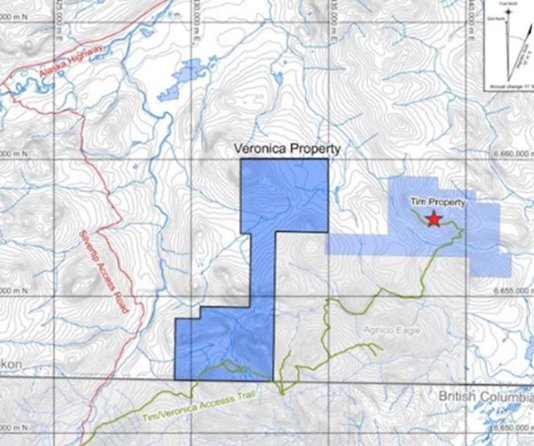
RM: You got $1.6M in free data because Coeur funded SkyTem, magnetics, radio metrics, mobile MT geophysical surveys, property-wide geochemical sampling and mapping. Silver North inherited all that high-resolution data for free without spending its own capital.
And Coeur also funded the six-hole program that you referred to, 2,250 meters of drilling. The interesting thing about that was while you didn’t hit the massive sulfides, the drill program did confirm the presence of a carbonate replacement-style system. Which is the geological signature of Coeur’s Silvertip mine, just 19km away.
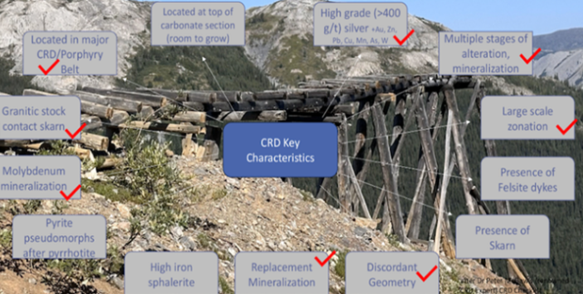
You retained 100% of the project, inherited $1.6 million of data and de-risked the project without ever having diluted your share structure to fund the initial identification.
It wasn’t an exit due to poor drilling results, it was a corporate-level mandate to aggressively pivot capital and focus exclusively on development of their Silvertip mine hub.
And when we move over to the Veronica property we see it’s a strategic asset because it sits directly west of and adjacent to the Tim property.
Your strategy to treat Veronica and Tim as a single contiguous entity and identify high-priority drilling targets on a unified front seems like a very, very smart plan.
JW: The more geological context you have, the better you can target your future work, right? So, that’s the idea.
RM: Veronica’s road accessible, and you had a target breakthrough, the Betty target looks phenomenal. You expanded a soil anomaly from 450 by 450 meters to a 1,000 by 1,000 meter area. Which is still open to the east and the south. And the float was ultra high-grade.
JW: Take the float with a grain of salt, we’re talking about fist-sized cobbles that aren’t necessarily representative of the mineralization underneath. However, we did find a structure that was mineralized nearby that was running a couple ounces of silver in outcrop but a very limited amount of outcrop.
When we tried to trench we couldn’t get down to the bedrock with the hand-excavated program. But the other point there is that that structure itself could not explain that full kilometer-by-kilometer multi-element soil geo-chem anomaly. Logically one would think that there’s other sources to account for the rest of that anomaly. We’ve expanded that soil grid to see if we’re able to expand the anomaly itself.
What’s also interesting is we’ve had some geophysical anomalies in the southern part of the project that we wanted to ground truth in this program as well.
RM: You completed a pretty comprehensive 253-line kilometer airborne VTEM and magnetic survey. You’ve done an extensive ground program, 850 new soil samples. Your target tracing.
When can we expect some of the results out of the VTEM, the ground program and the target tracing up there?
JW: I think you’re probably looking at November for results from the geo-chem.
From the geophysics, I think that’s going to be tied very tightly to the geo-chem in that you get geophysical anomalies and the next step is to go ground truth it.
It’s rare that when you get a geophysical anomaly, at least in Western Canada, that you would go and just drill immediately. You do more mapping, prospecting and soil geo-chem in that area to try to get a better handle on where you might drill.
That’s what this year’s program was all about, providing that backup information that could be used to determine drill targets. As far as specific geophysical results, we’re not putting anything out until we’ve got all the geo-chem compiled and we’ve matched that and done the analysis.
RM: On the Betty, you’ve got the Lodge showing, which was high-grade float, at 2,860 grams a tonne silver and 76.8% lead. You said, “Lead mineralization in the form of the mineral galena is an important component of carbonate replacement style mineralization in the Silvertip District.” That was interesting.
But the other thing that was very interesting and was also on the Betty, you have the Cooper showing, which is in-situ bedrock. Could this be a chimney or a mantos, what you tried to hand dig?
JW: That’s the structure I was referring to, it’s probably a chimney, the feeder part of the system. At least that’s our interpretation so far.
Although it can’t explain the entire soil geo-chem there. So, there’s either additional structures or potentially a mantos there that is responsible for some of that soil geo-chem as well.
RM: Why would people invest in Silver North right now?
JW: Silver is the right commodity now and I think silver is really poised to do well here, maintaining the highs or the levels that it’s now at.
There is a recognition that silver is not just a monetary asset but also a significant industrial metal. Silver is incredible in that it is used in almost everything we do, technology, energy, medical services and so on.
It is really the metal of 10,000 uses. That fundamental backing, that backstop for the current silver price, I think is solid, and I think it only means it’s going higher. You’ve got the right commodity, and I think if you look at where Silver North is exploring, we’re in the right areas.
Coeur and Hecla, two of the biggest silver producers in North America, are the dominant players in the two districts that we’re exploring. I think that, for investors, gives a peace of mind, a validation of what we’re doing. We’re in the right areas.
If you look at the success that our team has made at both projects, Tim and Veronica, proving there’s a CR system that has been active at Tim, the high-grade float mineralization at Veronica, those just strengthen that exploration thesis.
When you wrap into that the idea that we’ve got Haldane where we’ve made three new discoveries in a 100-year-old exploration district, that’s phenomenal.
We’ve had multiple new silver discoveries. If you’re a silver investor looking at where your leverage is going to be, it’s in a company like Silver North, we have the potential to deliver results, that our share price will increase with the price of silver.
But where we add the real value is when after further drilling, investors can look and say, OK, they’re starting to wrap their arms around silver resources in the tens of millions ounces at Haldane. We have the potential to do that and more and that’s when the share price really starts to appreciate.
The exploration business is risky but the things I’ve talked about go a long way to mitigating that risk. I think that just makes Silver North a prime candidate for any silver investor these days.
RM: What’s the plan going forward at Haldane?
JW: I think we have to build out these targets at Haldane. Rather than spending the money to basically come up with an MRE on one target, I’d like to develop multiple targets to the point where those two silver producers, Hecla and Coeur, or others silver companies can make their own judgments on what we’ve got. And that’s going to be the catalyst for them to look at acquiring the project or the company.
That’s the goal for us. We’ve got a silver market here that is amenable to that so the best value for our shareholders is building that framework rather than getting that increased level of confidence in those ounces. Those silver companies I mentioned can build their own data bases, we don’t have to spend to do it for them. If we continue to deliver strong drill results, we build the framework of that potential. That’s what’s going to interest a potential suitor for us.
Obviously, we’d like to open ourselves up to any silver producer that would be interested in taking on the project, but when you’ve got Hecla and Coeur right next door, who understands these systems, the intricacies of mining them, I just think it makes so much sense to make ourselves as attractive as possible to them as a take-out target. That’s really the focus for us.
Consolidation of both district’s, Keno and the Silvertip district, is probably the healthiest thing as well. It really directs us to take that approach to bring them in.
I think our capital and time is better spent on showing the bigger overall picture. You’re either a stand-alone acquisition for another company or a reserve replacement acquisition for two different miners.
RM: Exactly. Thank you for doing this Jason
JW: You are welcome, talk again soon.
Silver North Resources
TSXV:SNAG, OTCQB:TARSF
Cdn$0.26 2026.09.02
Shares Outstanding 108m
Market Cap Cdn$28m
SNAG website
Richard (Rick) Mills
aheadoftheherd.com

Subscribe to AOTH’s free newsletter
Richard does not own shares of Silver North Resource (TSX.V:SNAG). SNAG is a paid advertiser on his site aheadoftheherd.com
This article is issued on behalf of SNAG
Legal Notice / Disclaimer
Ahead of the Herd newsletter, aheadoftheherd.com, hereafter known as AOTH.Please read the entire Disclaimer carefully before you use this website or read the newsletter. If you do not agree to all the AOTH/Richard Mills Disclaimer, do not access/read this website/newsletter/article, or any of its pages. By reading/using this AOTH/Richard Mills website/newsletter/article, and whether you actually read this Disclaimer, you are deemed to have accepted it.