 RSS Subscribe
Banana’s, when humans act like apes – AOTH
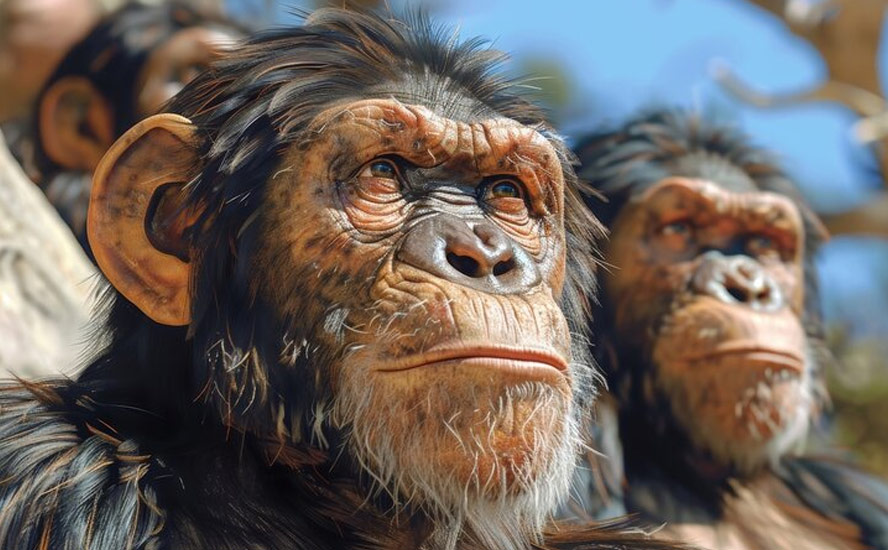
Homo Sapiens are more or less an advanced tribe of great apes, with one huge caveat. If one ape in the tribe had hoarded most of the bananas the tribe would not band together, take the bananas and redistribute them amongst members of the tribe. Most non-human primates social structures usually reinforce resource hoarding by the strongest individuals.
Alpha males and high-ranking individuals monopolize the best food sources. Lower-ranking members rarely unite to take it back because the risk of physical injury is too high. When sharing does happen among apes, it is often “tolerated theft.” A dominant ape eats until it is full and then allows others to take the leftovers rather than spending energy defending the food. Non-human primates occasionally share their success after a group hunt, but they typically give it to allies to build political support rather than distributing it equally to the whole troop.
As Homo sapiens evolved, our ancestors broke away from strict primate dominance hierarchies and developed what anthropologists call reverse dominance hierarchies.
Early human hunter-gatherers used language and group alliances to keep any single person from becoming a tyrant. If one hunter tried to hoard meat or boss others around, the group would mock, shun, or even expel them.
Humans evolved to rely on high-risk, high-reward foods like large game. Because hunting success is unpredictable, sharing food across the entire band acted as a vital insurance policy against starvation.
For most of human prehistory, social status came from generosity rather than accumulation. Giving away resources earned respect, while hoarding brought social punishment.
The Shift from Foraging to Farming
The shift from sharing everything to hoarding vast resources happened relatively recently in human history, starting around 10,000 years ago with the rise of agriculture.
Unlike fresh meat or fruit, harvested grain could be stored, locked away, and defended. This made long-term accumulation physically possible for the first time.
In a small tribe of 50 people, everyone knows who is hoarding and can apply direct social pressure. In societies of millions, wealth is abstract, protected by formal laws, and far removed from the daily social shame of a small group.
Modern economic systems evolved away from tribal norms through the transition to agriculture, large populations, and formal property laws. While hunter-gatherer economies relied on immediate sharing and social pressure to survive, modern systems are built to manage surplus, scale, and trade among strangers.
For roughly 95% of human history, Homo sapiens lived in small, mobile bands where hoarding was impractical and socially punished. That changed during the Agricultural Revolution.
- Hunter-gatherers consumed food quickly because meat and fruit spoiled. Farming introduced grains like wheat, rice, and maize, which could be dried, stored in granaries, and accumulated over years.
- Foragers moved across open territory, whereas farmers invested heavy labor into clearing and planting specific plots of land. This created the concept of private property and inheritance, allowing wealth to pass down through families.
- Because one farmer could produce enough food for several people, others were freed up to become builders, soldiers, merchants, and rulers.
As historian Yuval Noah Harari famously argued, humans are the only animals capable of cooperating in the millions because we can believe in shared, non-physical concepts like laws, money, nations, and gods. Harari makes this argument most famously in his 2011 book Sapiens: A Brief History of Humankind (specifically in Part One, on the Cognitive Revolution).
Chimpanzee tribes rarely exceed 150 individuals before fracturing, the great apes’ tribes fracture at much smaller numbers—usually between 10 and 55 individuals.
Even today, when human organizations—like hunter-gatherer bands, military companies, Hutterite farming communes, or tech startups—grow past 150 people, informal trust breaks down. Without formal rules, hierarchies, or bureaucracy, the group naturally splits.
Scaling
Anthropologists note that human brains evolved to track personal relationships in groups of about 150 people (often called Dunbar’s number). As settlements grew into cities and empires, tribal norms broke down.
- In a small tribe, everyone sees who is hoarding, and gossip, ridicule, or ostracization keeps individuals in line. In a city of thousands, people are anonymous, so personal shaming no longer stops resource accumulation.
- To trade with strangers safely, societies invented money, written contracts, courts, and police. These formal systems protect individual property rights rather than enforcing group redistribution.
How Tribal Instincts Still Show Up Today
Even though our economy runs on global markets and private accumulation, our evolutionary instincts toward fairness and redistribution have not disappeared.
- Progressive taxes, public healthcare, and social safety nets act as large-scale, institutionalized versions of tribal food sharing.
- Just as ancient hunters gained prestige by giving away meat, wealthy individuals today often donate to charities, universities, and public projects to earn social respect and legitimacy.
- Studies in behavioral economics show that humans are naturally wired to reject unfair splits—even when rejecting them costs us money—reflecting our deep ancestral sensitivity to hoarding.
Why the “Tribe” Cannot Take the Bananas
Elon Musk’s position as the world’s first trillionaire represents the exact opposite of a hunter-gatherer egalitarian tribe, functioning instead as a supercharged version of a primate dominance hierarchy. After SpaceX went public in June 2026, his net worth crossed the $1 trillion mark, fluctuating between roughly $850 billion and $1.1 trillion, giving one individual control over more resources than entire nations.
Gini Coefficient the current U.S. wealth gap
Viewed through the lens of evolutionary anthropology and modern economics, his position highlights how far modern systems have moved away from tribal resource-leveling norms.
In a small band of Homo sapiens, anyone hoarding a massive surplus would face immediate ridicule, ostracization, or physical confiscation. Today, several modern mechanisms prevent that kind of direct redistribution.
- Musk does not sit on a literal pile of cash or food that people can physically take. His fortune consists of equity stakes in companies like SpaceX, Tesla, and xAI. If the public tried to seize and liquidate those shares all at once, their market value would collapse.
- Modern property laws, corporate charters, and state enforcement protect individual ownership. Instead of a coalition of peers enforcing equality, formal institutions defend the right to accumulate capital at an unlimited scale.
- In a tribe of 50 people, everyone shares the same survival interests. In a global society of billions, people are divided into competing ideological tribes. Many view Musk not as a hoarder stealing from the group, but as a visionary leader whose technological projects justify his massive control of resources.
non-human primates Rather than resembling an egalitarian hunter-gatherer, Musk’s social role mirrors the dominance hierarchies seen in non-human primates and early agricultural empires.
- Like a great ape alpha distributing prized food to secure political support, ultra-wealthy figures deploy capital to build coalitions. Musk has used his financial resources to fund political campaigns and shape public discourse through platforms like X, converting financial wealth directly into political power.
- Modern power comes from controlling the tools society depends on, such as satellite communications (Starlink), transportation, and artificial intelligence. This creates a structural dependency where governments and millions of individuals rely on systems owned by a single person.
- Historically, industrialists like Andrew Carnegie or John D. Rockefeller used massive charitable giving to appease public anger and buy social legitimacy—a modern echo of tribal generosity. Musk’s philanthropy score remains low relative to his net worth, as he argues that reinvesting capital into his own companies is a better way to help humanity than traditional charity.
Even though modern laws protect extreme wealth, the ancient human instinct against hoarding has not vanished.
- The intense media criticism, regulatory battles, and public debates surrounding a trillionaire reflect our deep evolutionary discomfort with extreme inequality.
Gini Coefficient the current U.S. wealth gap
- Proposals for wealth taxes and higher capital gains rates are the modern, bureaucratic version of a tribe banding together to redistribute the surplus.
Food stamps
Viewed through the lens of evolutionary anthropology, modern debates over cutting public food assistance reflect a deep tension between two competing human instincts: universal group sharing and strict “in-group” reciprocity.
On November 10, 2026, the U.S. Department of Agriculture (USDA) under President Trump proposed a new rule that would eliminate automatic Supplemental Nutrition Assistance Program (SNAP) eligibility for families receiving Temporary Assistance for Needy Families (TANF).
According to USDA estimates reported by CNBC, this change would remove roughly 6.3 million people (nearly 18% of recipients) from food stamps and strip free school lunch eligibility from about 1.8 million children. This follows the July 2025 passage of the One Big Beautiful Bill Act, after which more than 5.5 million people lost SNAP benefits due to expanded work requirements and state cost-sharing shifts.
In the context of tribal hoarding and sharing, this policy shift illustrates how modern politics transforms ancient survival rules into competing moral arguments.
In small hunter-gatherer bands, survival depended on two strict social rules: everyone shared food during hard times, and everyone contributed effort when they were able.
Evolutionary psychologists note that humans are wired to watch closely for people who take from the group’s food pile without contributing. Supporters of the SNAP cuts invoke this exact tribal instinct. As stated in the USDA rule and by Agriculture Secretary Brooke Rollins, the administration argues that tightening eligibility and enforcing work requirements reduces waste and “preserves benefits for the truly needy”. From this perspective, cutting benefits is framed as protecting the tribe’s shared resources from people who exceed standard poverty thresholds or are not meeting work expectations.
Conversely, critics rely on the core egalitarian instinct that no member of the tribe should go hungry while surplus exists. Democratic Representative Angie Craig called the November 2026 rule “heartless and cruel,” arguing it makes it harder for families to meet basic needs. Anti-hunger advocates point out that in a wealthy society, cutting food aid while food banks face empty shelves violates the fundamental human duty to care for vulnerable members of the group.
In a hunter-gatherer band of 50 people, sharing was personal and direct. In a nation of over 330 million people humans figured out how to scale beyond 150 without fracturing. By inventing shared myths, laws, religions, currency, and corporations, millions of strangers can cooperate under the same banner despite never personally knowing one another. Sharing is managed through massive, impersonal bureaucracies, which changes how people perceive hoarding and generosity.
In a small tribe, you know the hungry family personally, which triggers immediate empathy and sharing. In a large nation, SNAP recipients are strangers represented by budget numbers—such as the $44.6 billion the USDA projects the new rule will save between 2027 and 2031. Because taxpayers do not see their neighbors directly, it is much easier for political leaders to argue for shrinking the shared pot.
Modern politics frequently draws boundaries around who deserves group support. For example, the July 2025 law ended SNAP eligibility for several categories of noncitizens, including many refugees and asylees, while the November 2026 proposal narrows eligibility strictly to households below 130% of the federal poverty line. In evolutionary terms, this narrows the definition of the “in-group” entitled to shared resources.
Agricultural train wreck and the 2027 global food crisis
When looking at the broader economic picture, critics often connect cuts to food assistance with tax policies to argue that modern systems enable upward hoarding.
The July 2025 legislation that initiated the first wave of SNAP cuts was part of a broader tax law. Critics and organizations like the Center on Budget and Policy Priorities argue that cutting nutrition programs for low-income families while maintaining tax cuts for corporations and high earners reverses the tribal norm—taking small portions of food away from those at the bottom while allowing those at the top to accumulate massive surpluses.
Supporters of free-market policies view the economy differently, arguing that wealth is not a fixed pile of bananas that gets hoarded, but something created through investment and work. From their viewpoint, reducing government spending and encouraging workforce participation strengthens the overall tribe by making individuals self-reliant rather than dependent on state redistribution.
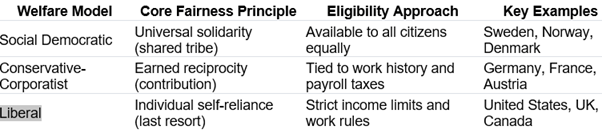
Countries organize their social safety nets around three distinct models of fairness, each reflecting a different version of tribal reciprocity and group belonging. Sociologist Gøsta Esping-Andersen famously categorized Western welfare systems into three main regimes—Social Democratic, Conservative-Corporatist, and Liberal—which show how different societies balance universal sharing against individual effort.
The Social Democratic Model (Universal Sharing)
Used in Nordic countries like Sweden,Norway,andDenmark, this model mirrors the egalitarian hunter-gatherer tribe most closely by treating basic security as an unconditional right of membership.
- Rather than separating society into “givers” and “takers,” universal programs provide healthcare, education, childcare, and family allowances to all citizens regardless of income.
- Research published by Tilburg University shows that countries with high trust in fellow citizens and institutions impose fewer strict conditions on aid. Because everyone receives the same core services, middle-class taxpayers feel they are sharing in the collective pot rather than having resources taken from them.
- While Nordic nations expect adults to work, they emphasize state-funded job training, childcare, and education to help people participate, rather than stripping away basic food or health support.
The Conservative-Corporatist Model (Earned Reciprocity)
Common in continental Europe—such as Germany,France,andAustria—this model structures fairness around strict reciprocity and contribution history.
- Benefits like unemployment insurance and pensions are tied closely to a worker’s past earnings and payroll contributions. In tribal terms, this reflects the rule that your share of the hunt depends on your documented role and effort in the group.
- Rather than leveling everyone to an equal baseline, these systems preserve existing social and occupational ranks while protecting families from sudden economic shocks.
- Historically rooted in traditional social norms, this approach expects extended families to care for their own members first, with the state stepping in when family support falls short.
The Liberal Model (Strict Means-Testing)
Found in English-speaking nations like the United States, Canada, theUnited Kingdom, andAustralia, this model views the market as the primary distributor of resources and treats government aid as a last resort.
- Because benefits are targeted narrowly at the poorest citizens through strict income limits and work rules, society becomes sharply divided between taxpayers who fund the system and recipients who rely on it.
- As noted in comparative welfare research from Aalborg University, moral frameworks in these cultures draw a hard line between people whose poverty is beyond their control (such as the elderly or disabled) and able-bodied adults seen as lacking work ethic.
- Means-tested programs require constant proof of poverty and compliance, which reduces political support from the broader middle class and makes benefits easier to cut during budget debates.
Conclusion
Cross-national studies from the Journal of Social Policy highlight that a country’s approach to fairness depends heavily on how broadly citizens define their “in-group”. Smaller, historically homogeneous societies have often found it easier to maintain universal sharing because citizens view strangers as part of the same extended tribe. In larger, more diverse, or lower-trust societies, political debates frequently center on who truly belongs to the group—leading to stricter rules, means-testing, and work requirements.
Proponents argue that ultra-high-net-worth individuals hold trillions of dollars in concentrated wealth (such as through global or state-level wealth taxes like California’s proposed 5% multi-year billionaire tax or global UN-backed humanitarian proposals), which could theoretically generate tens or hundreds of billions in public revenue.
Advocates contend that this new revenue can directly backfill or expand critical nutrition and anti-poverty programs—such as the Supplemental Nutrition Assistance Program (SNAP), school lunch initiatives, and global efforts managed by the World Food Programme.
Supporters emphasize that hunger in wealthy nations is often a matter of political choice rather than a lack of societal resources, pointing out that tax breaks for corporations and top earners frequently outpace funding for basic human needs.
Critics—including free-market think tanks like the Cato Institute—argue that wealth taxes are notoriously difficult to implement, often leading to capital flight, legal avoidance, or wealthy residents relocating to jurisdictions with lower tax burdens, which can end up reducing overall state or national tax receipts.
Fertilizer shortages to continue, even as oil flows resume
Skeptics note that collecting tax revenue from billionaires does not automatically translate into relieved food insecurity. Structural drivers of hunger—such as inflation, stagnant wages, supply chain costs, and the efficiency or design of government assistance programs—require systemic economic reforms beyond just wealth redistribution.
Critics often point out that several European nations that experimented with wealth taxes eventually abandoned them due to high administrative costs and disappointing revenue yields.
Kentucky’s approach to school nutrition highlights how targeted public investments can directly relieve childhood hunger without waiting for broad, untested tax overhauls. By leveraging federal options like the Community Eligibility Provision (CEP) alongside state-backed innovative delivery models, Kentucky has shown measurable improvements in student well-being, even while facing ongoing budget pressures.
Nearly 90% of Kentucky schools with free and reduced meal eligibility use the Community Eligibility Provision, providing no-cost breakfast and lunch to more than 527,000 students regardless of individual paperwork. This removes administrative barriers and eliminates the social stigma that often stops children from eating.
The Kentucky Department of Education promotes models like “Breakfast in the Classroom,” “Grab & Go,” and “Second Chance Breakfast”. Moving breakfast out of the traditional pre-bell cafeteria line solves transportation delays and ensures children actually eat.
Data compiled by the state and No Kid Hungry Kentucky shows that students who eat school breakfast attend more days of school, achieve higher standardized math scores, and show lower rates of behavioral issues.
Providing free school meals saves low-income families an estimated $800 per child each year in grocery costs, according to research from the University of Kentucky. Broader adoption of universal meals also reduces reliance on local food banks.

Legal Notice / Disclaimer
Ahead of the Herd newsletter, aheadoftheherd.com, hereafter known as AOTH.Please read the entire Disclaimer carefully before you use this website or read the newsletter. If you do not agree to all the AOTH/Richard Mills Disclaimer, do not access/read this website/newsletter/article, or any of its pages. By reading/using this AOTH/Richard Mills website/newsletter/article, and whether you actually read this Disclaimer, you are deemed to have accepted it.