 RSS Subscribe
Storm starts drilling massive VMS target at Gold Standard, Ontario – Richard Mills

2026.09.19
Storm Exploration (TSXV:STRM) has started to drill a large Volcanogenic Massive Sulfide (VMS) target at its 100%-owned Gold Standard Project in northwestern Ontario. Gold Standard is 60 kilometers north of Fort Frances, with year-round access via a network of forestry roads. Airborne and ground electromagnetic VLF-EM surveys have outlined a conductivity anomaly that is continuous over 5 km.
The anomaly is 50 to 100 meters wide and indicates strong potential for subsurface sulfide mineralization. We know this because Inco drilled four shallow holes on the property back in 1969 and 1970. Every hole intersected sulfide mineralization, including copper and zinc sulfides. Two holes intersected semi-continuous sulfides over 20 meters.
However, Inco never assayed the core because their focus was strictly on nickel.
The property comprises 373 mineral claims covering 7,869 hectares and lies within the Manitou-Stormy Lakes Greenstone Belt along the Manitou Stretch-Pipestone Lake Deformation Zone, a large crustal structure that spans over 60 km along its strike and up to 3 km in width.
Storm’s Gold Standard Project is also home to three historical gold mines that were operational between 1901 and 1903. Surface rock samples collected by Storm in 2022 near the HW-271 mine, on the southern end of the property, have returned impressive high-grade gold values, such as 166 grams per tonne, 88.6 g/t and 83.4 g/t.
“This is Storm’s first drill program at Gold Standard and represents an important step forward for the project,” said Bruce Counts, Storm Exploration’s President and CEO. “The goal of this drill program is to confirm that VMS-type mineralization is associated with the large conductivity anomaly. I am excited about the prospect of drilling this underexplored target with known base metals and look forward to sharing results as they become available.”
Under the Spotlight – Bruce Counts, CEO Storm Exploration TSXV:STRM
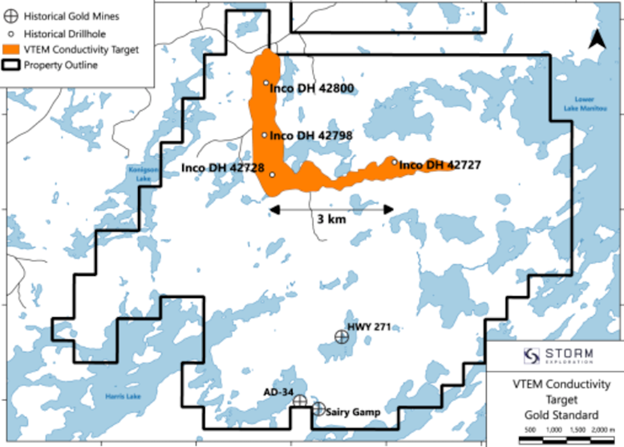
The company plans to drill up to 1,500 meters of core in this initial program to test the conductivity target identified in airborne and ground geophysical surveys. Drilling will focus on the north-south arm of the conductor with an estimated 10 holes over a 2-km strike length.
Forgotten Inco VMS Target Offers Massive Potential Leverage for 2026
Conclusion
Storm’s goal here is two-pronged. First, confirm the target is a VMS system. Second is to get an idea of its copper and zinc potential.
“I’m a believer that this could be a very large VMS system. All of the data we have collected points in that direction and we have not yet found a fatal flaw,” Counts told me earlier this month.
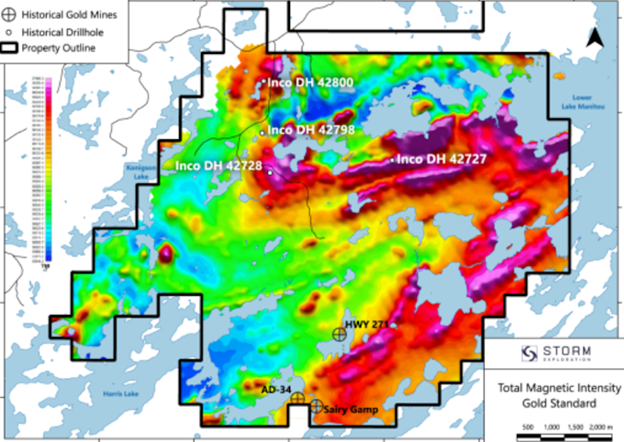
The Very Low Frequency EM (VLF-EM) data has confirmed that Storm has a strong, highly defined conductor sitting less than 100 meters below the surface, which perfectly matches the footprint of the airborne Versatile Time Domain EM (VTEM) data. Crucially, the VLF-EM data indicates that there are multiple, stacked conductive zones.
The company further refined this information with a TMI (Total Magnetic Intensity) survey. This is where magnetic data is utilized to differentiate between rock units and analyze the structural environment.
The final layer is the surface geochemistry. Storm discovered exposed surface sulfide mineralization, including chalcopyrite, on at least three separate locations directly on top of the geophysical conductor.
At AOTH, our take is that Storm has potentially come across a unicorn: an undiscovered massive sulfide deposit hiding in plain sight. If it is proven that there is copper and zinc massive sulphide mineralization then, imo, this is a new VMS camp in an under explored area.
Let’s be clear, it hasn’t been confirmed, and it might not be, that the conductive anomaly is a VMS deposit. Only drilling can prove that. But Storm has more than 5-km-long of stacked conductivity anomalies as confirmed by airborne and ground geophysical surveys. The cherry literally on top is that sulfide mineralization has been discovered in three separate locations at surface, coincident with the conductivity anomaly.
Storm’s focus, and rightly so, is the large conductive anomaly that Counts and his team identified through geophysical surveys. The goal is to determine whether a large VMS system, rich in copper and zinc, is the source of the anomaly.
So far, VLF-EM data confirms that strong conductors are present less than 100 meters below surface that coincides with the conductivity anomaly that Storm identified in an airborne VTEM survey. The next step is to drill it.
The VMS target sits beside a shear zone just 4 kilometers away containing high-grade gold, silver and copper that a lot of other juniors would be claiming as it’s flagship project. Gold up to 166 g/t Au, silver up to 197 g/t Ag, and copper up to 1.47% Cu. Incredible. (May 4, 2026, news release)
Storm isn’t forgetting about that gold-silver-copper project 4 kilometers to the south with eye-popping grades. Those three historical mines were last worked a very long time ago and have never been explored with modern techniques.
Storm has two bona fide targets, VMS & gold, at Gold Standard.
Storm Exploration Inc.
TSXV:STRM
Cdn$0.51 2026.09.16
Shares Outstanding 21m
Market cap Cdn$14.5m
STRM website
Richard (Rick) Mills
aheadoftheherd.com

Subscribe to AOTH’s free newsletter
Richard owns shares of Storm Exploration Inc. TSXV:STRM. STRM is a paid advertiser on his site aheadoftheherd.com
This article is issued on behalf of STRM
Legal Notice / Disclaimer
Ahead of the Herd newsletter, aheadoftheherd.com, hereafter known as AOTH.Please read the entire Disclaimer carefully before you use this website or read the newsletter. If you do not agree to all the AOTH/Richard Mills Disclaimer, do not access/read this website/newsletter/article, or any of its pages. By reading/using this AOTH/Richard Mills website/newsletter/article, and whether you actually read this Disclaimer, you are deemed to have accepted it.