 RSS Subscribe
Kodiak Copper: Geophysical survey identifies new target at MPD; 38% of 2026 drilling complete – Richard Mills
2026.08.15
Kodiak Copper’s (TSXV:KDK, OTCQX:KDKCF, Frankfurt:5DD1) fully funded 2026 exploration program includes drilling aimed at expanding the recently completed maiden resource estimate, and field investigations to advance multiple exploration targets.
New target
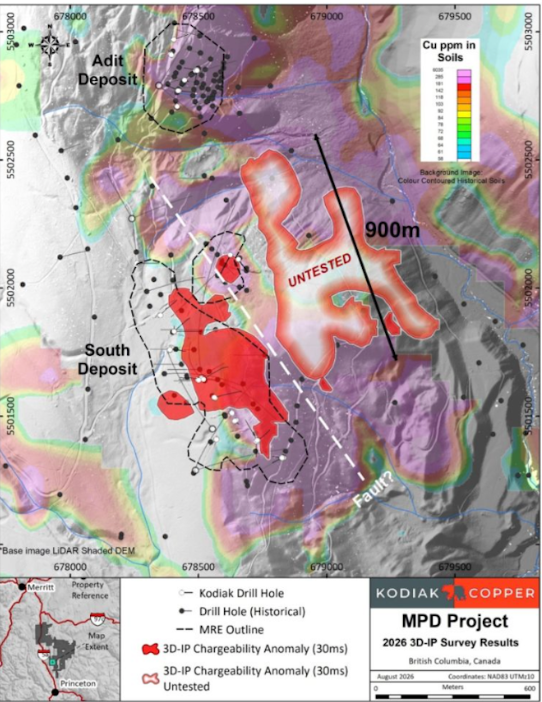
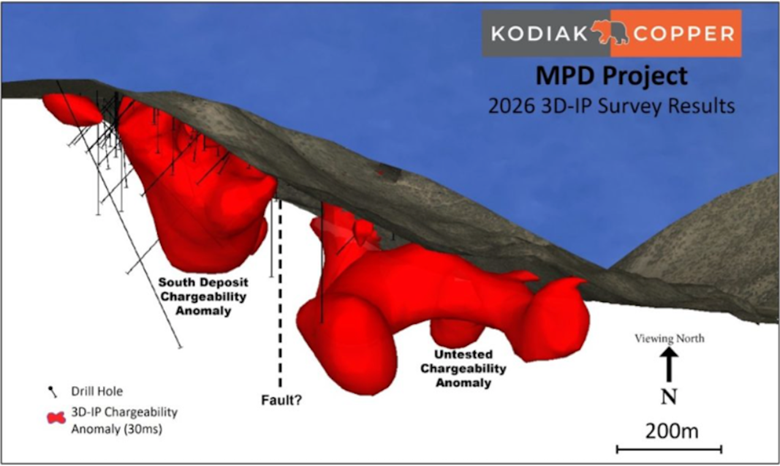
This week the Vancouver-based company provided an exploration update including the identification of a large new target adjacent to the South deposit in an area with limited historical work. The target has been slated for drilling this year. (Figures 1, 2 & 3)
A recently completed 3D Induced Polarization (3D-IP) survey identified
a chargeability anomaly which extends over 900 meters and is similar to the 3D-IP anomaly associated with the South deposit. The two anomalies are separated by a magnetic low feature interpreted to be a fault. Available data suggests the new 3D-IP anomaly may represent a fault-displaced extension of the South deposit porphyry system. (Figures 2 & 3)
(VRIFY Artificial Intelligence (AI) assisted targeting is leading KDK to new targets they are doing more IP on.)
Drill program
Meanwhile, the 2026 program is advancing on schedule with two diamond drill rigs currently operating. A total of 16,500 meters is planned and drilling is expected to continue into Q4 2026. The company has drilled a total of 6,348 meters in 32 core holes to date.
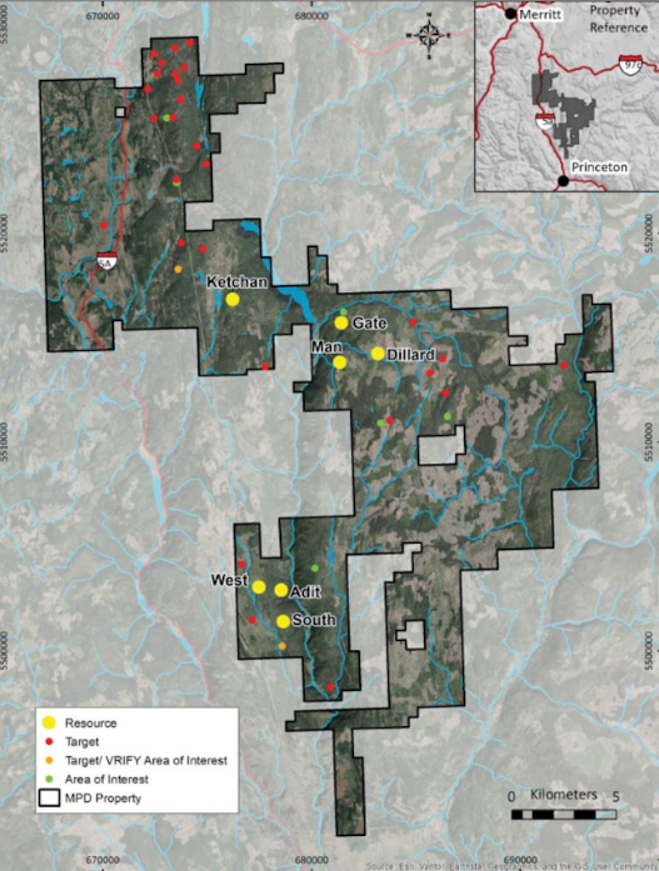
The 2026 drill program commenced at the Ketchan deposit, which is interpreted to have significant expansion potential. A total of 5,301 meters in 26 core holes has been drilled at Ketchan to date. Also, 1,047 meters in six core holes has been drilled to date at the West deposit which hosts near-surface, high-grade mineralization. (Figure 1)
Initial assay results for the 2026 drilling will be reported within a month, with further results released throughout the fall and winter.
Kodiak’s 2026 drill program focuses on expanding the initial Mineral Resource Estimate (MRE) at MPD by drilling multiple deposits. All seven deposits in the MRE are open to expansion and an updated MRE is planned for Q1 2027.
Several of the 36 prospective exploration targets identified to date will be drill-tested as part of Kodiak’s 2026 exploration program.
About three-quarters of this year’s exploration budget is being spent on resource expansion. The rest, around, 25%, will go towards testing new targets, which is expected to happen later in the season.
The company has $19 million in its treasury.
“Our 2026 exploration program continues to advance well, and we are encouraged by the results we are seeing to date,” said Kodiak Copper’s CEO Claudia Tornquist. “The newly identified 3D-IP anomaly is particularly exciting, as it represents a large geophysical target that could indicate an extension of the South deposit. The significant scale of the anomaly exemplifies the opportunity to further expand mineralization and highlights the considerable exploration upside at MPD. We look forward to drilling this compelling target this year alongside several other priority targets for resource growth and new discovery.
Peer comparisons
Along with completion milestones, junior resource companies are also rated based on peer comparisons. There are five copper companies KDK uses for this purpose. Kodiak isn’t hiding this information, in fact it forms an important part of the corporate presentation.
All five are farther along the development path because they started earlier — two to five years. Kodiak Copper sees them as aspirational — they represent the direction in which Kodiak wants to go. The way to get to where their peers are today is to increase the resource and eventually publish a Preliminary Economic Assessment (PEA), another major milestone on the development path.
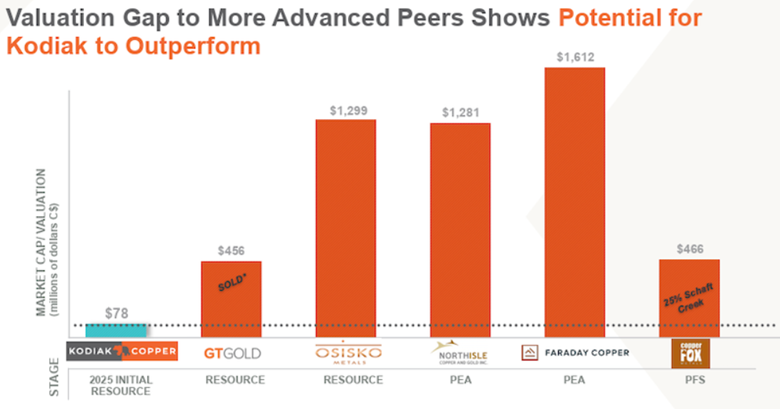
The first slide shows Kodiak’s August 11 market capitalization of $78 million is below GT Gold’s (acquired by Newmont Mining (NYSE:NEM)) $456 million, Osisko Metals’ (TSX:OM) $1.299 billion, NorthIsle Copper and Gold’s (TSXV:NCX) $1.281 billion, Faraday Copper’s (TSX:FDY) $1.612 billion, and Copper Fox Metals’ (TSXV:CUU) 25% share of the Schaft Creek Joint Venture with Teck Resources (TSX.B:TECK), worth $466 million. (all numbers in CAD$)
The answer why is obvious. Kodiak “only” has an initial (combined Indicated and Inferred) resource of 2.408 billion pounds of copper and 1.67 million ounces of gold. (0.7 Blbs Indicated and 2.5 Blbs Inferred, in copper-equivalent)
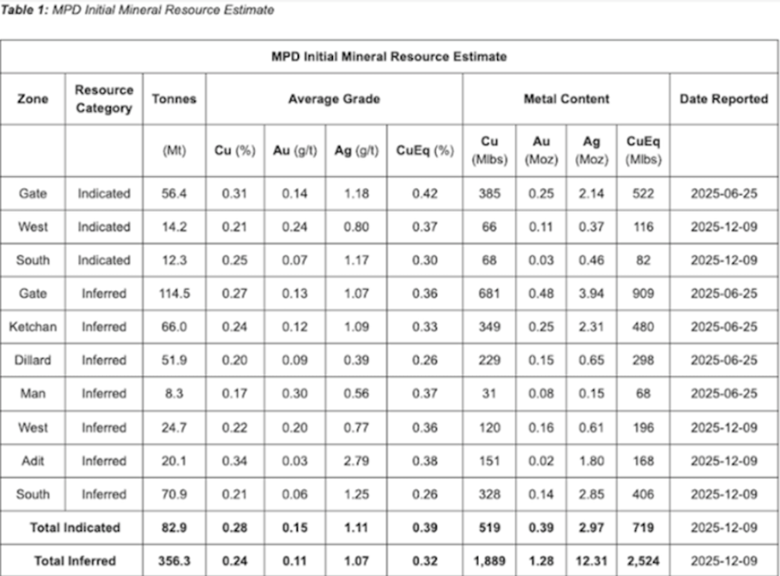
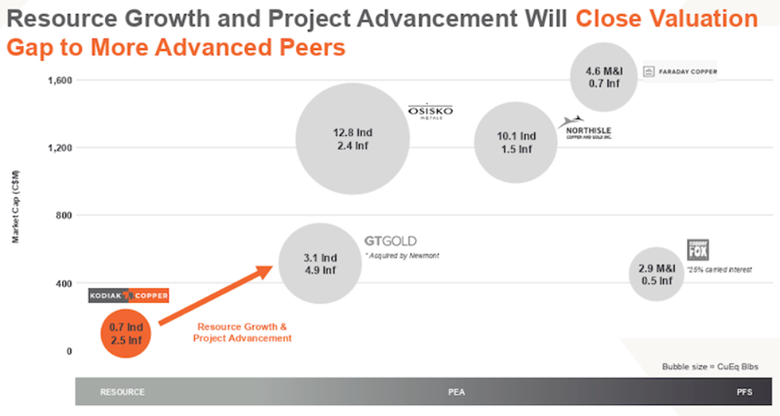
Newmont and Osisko both have larger resources. Newmont’s Saddle North Project MRE comprises a copper-equivalent resource of 3.1 billion pounds Indicated and 4.9 Blbs Inferred.
The updated MRE for Osisko Metals’ Gaspe Copper Project in Quebec show an Indicated 12.8 Blbs CuEq and 2.4 Blbs Inferred.
NorthIsle Copper and Gold has a PEA on its North Island Project on Vancouver Island, British Columbia. Its updated CuEq resource is an Indicated 10.1 Blbs and 1.5 Blbs Inferred.
Faraday Copper also has a PEA. Its Copper Creek Project, Arizona, combined open pit and underground, contains 4.6 CuEq Blbs in the Measured and Indicated category, and 0.7 Blbs Inferred.
Finally, the Schaft Creek Joint Venture which is 75% owned by Teck Resources and 25% by Copper Fox. Copper Fox’s interest in the project works out to a Measured and Indicated reserve of 2.9 Blbs and 0.5 Blbs of Inferred, copper equivalent. At the prefeasibility (PFS) stage, this project is the furthest advanced.
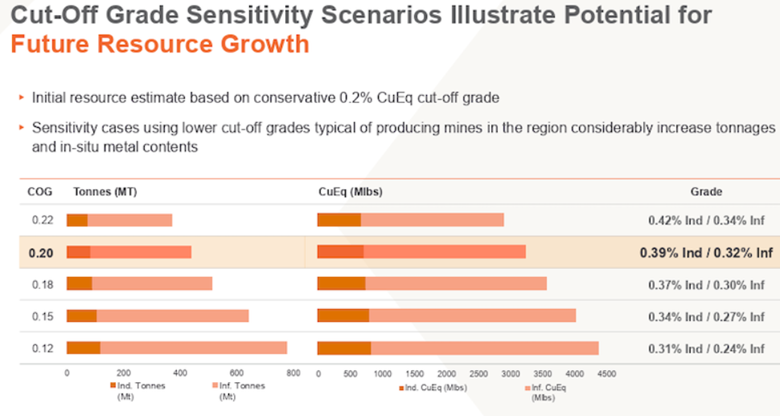
To get a clearer picture of these comparisons we need to look at the cutoff grades. A cutoff grade is the minimum concentration of a mineral required to classify extracted material as valuable ore rather than worthless waste.
Kodiak’s maiden resource estimate has a cutoff of grade of 0.2% CuEq.
A higher cutoff grade lessens the amount of ore a miner can glean from the gangue, or rock that surrounds the ore, but implies a more conservative evaluation of the amount of ore than can be extracted.
In Kodiak’s case, the 0.2% is seen as high enough to survive the lows of mining’s economic cycles.
Its peer comparisons have lower cutoff grades, meaning they can include more ore (pounds and ounces) in their resource calculations.
For example, Newmont’s MRE on Saddle North has an NSR (Net Smelter
Returns) cutoff grade of 0.13% CuEq; the North Island Project’s MRE base-
case cutoff is $11.50 NSR per tonne of resource estimation which equates to between 0.1% and 0.18% for their deposits; the Copper Creek Project’s MRE for the pit shell-constrained resources are 0.13% CuEq for oxide material and 0.14% CuEq for sulfide material; Osisko’s MRE for its Gaspe Copper Project has a cutoff grade of 0.13% Cu; and the Schaft Creek Joint Venture uses an NSR cutoff of $5.50/tonne for its MRE, which equates to a CuEq cutoff grade of 0.11% to 0.15%.
Closing the valuation gap
The question is how does KDK catch up to its peers, with their higher market capitalization based on higher resource estimates in the case of GT Gold/ Newmont and Osisko Mining, PEAs in the case of NorthIsle Copper and Gold and Faraday Copper, and a PFS in the case of the Schaft Creek Joint Venture between Copper Fox and Teck?
The answer is quite simply to do more exploration and more drilling. Kodiak believes that resource growth and project advancement will close the valuation gap to its more advanced peers and we at AOTH believe that will result in a significant stock re-rating.
Conclusion
Kodiak Copper’s aim is to expand the seven deposits it is focused on at MPD, resulting in an upsized new resource estimate in Q1 2027.
All seven deposits — Gate, Ketchan, Dillard, Man, West, Adit and South — are open for expansion. Significant high-grade mineralization has been found and the mineralization runs from surface to over 900 meters depth.
There is also the potential for new discoveries among the 36 targets that have been identified to date.
Kodiak derisked the project by putting out an initial Mineral Resource Estimate, and they are showing a pathway to increasing that resource.
Junior resource company stock prices move on the successful completion of the various stages necessary to develop a discovery into a mine. An initial mineral resource estimation is one of the key steps and Kodiak Copper obviously pleased the market with theirs.
The stock climbed from 35 cents at the beginning of 2025 to over a dollar a share upon the MRE’s release in December.
Still, at its current $0.73/share, KDK is undervalued compared to its peers, especially Northisle Copper and Faraday Copper. Kodiak is looking to close the valuation gap in the next 12 to 24 months.
The market will be looking for success at the drill bit. Kodiak still has two-thirds of its drilling left to complete and it will go well into the fall. Initial assay results for the 2026 drilling will be reported within a month, with further results released throughout the fall and winter.
Kodiak will be looking to show that they are expanding each of the zones they drill — Ketchan is first — which, if successful, will bring confidence to investors that the other zones also have expansion potential.
A total of 16,500 meters is planned and 75% of the meterage is going into resource expansion. In my opinion there is a high likelihood of an increased resource estimate in Q1 2027.
Kodiak Copper is at an interesting stage in its life as a junior resource company. In some ways it has moved from the exploration stage to the post-discovery resource definition stage, but it still has plenty of discovery potential to excite the market in the 36 identified targets, some of which will be drilled as part of this year’s program.
Project development stages and risk versus reward — Richard Mills
Kodiak Copper
TSXV:KDK, OTCQB:KDKCF, Frankfurt:5DD1
Cdn$0.73, 2026.08.13
Shares Outstanding 111.9m
Market Cap Cdn$81.1m
KDK website
Richard (Rick) Mills
aheadoftheherd.com

Subscribe to AOTH’s free newsletter
Richard does not own shares of Kodiak Copper (TSXV:KDK).
KDK is a paid advertiser on his site aheadoftheherd.com
This article is issued on behalf of KDK
Legal Notice / Disclaimer
Ahead of the Herd newsletter, aheadoftheherd.com, hereafter known as AOTH.Please read the entire Disclaimer carefully before you use this website or read the newsletter. If you do not agree to all the AOTH/Richard Mills Disclaimer, do not access/read this website/newsletter/article, or any of its pages. By reading/using this AOTH/Richard Mills website/newsletter/article, and whether you actually read this Disclaimer, you are deemed to have accepted it.