 RSS Subscribe
Cosa starts drilling partner-funded Aurora Project, Athabasca Basin – Richard Mills

Cosa Resources (TSXV:COSA, OTCQB:COSAF) has begun diamond drilling its Aurora uranium project in the southeastern Athabasca Basin of Saskatchewan, east of Cameco’s Key Lake mill and historical mine.
Drilling is fully funded by Traction Uranium (CSE:TRAC, OTCQB:TRCTF) per the option agreement between Cosa and Traction dated Feb. 10, 2026. Under the multi-year earn-in, Traction can earn up to an 80% interest in the Aurora Project by funding $9.15 million in exploration expenditures and completing cash and share payments.
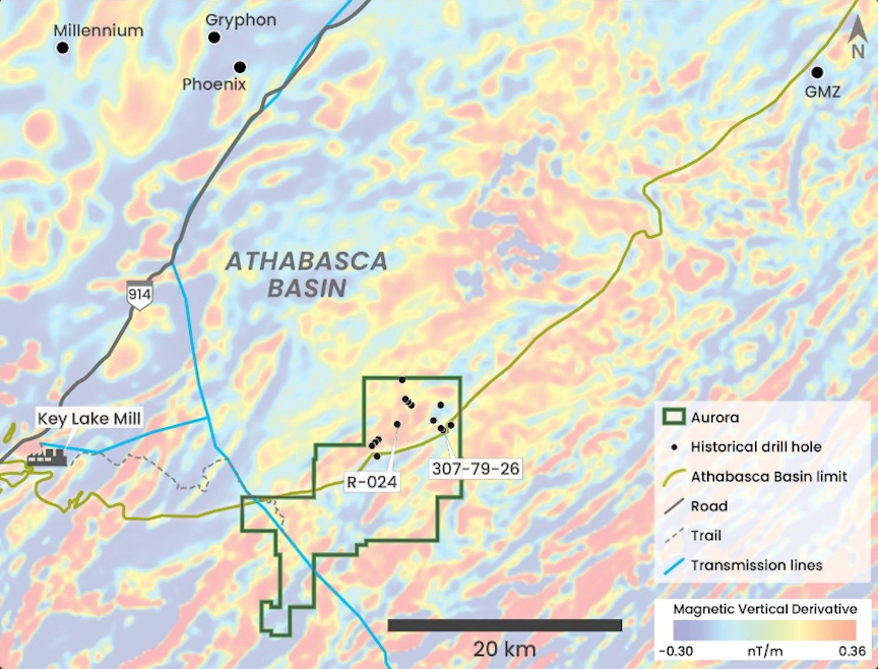
Aurora covers a 17-kilometer section of the southeastern rim of the Athabasca Basin located 16 kilometers east of Key Lake, the site of an operating uranium mill and past-producing uranium mine, and 40 km southwest of the Gemini Mineralization Zone (GMZ) (Figure 1).
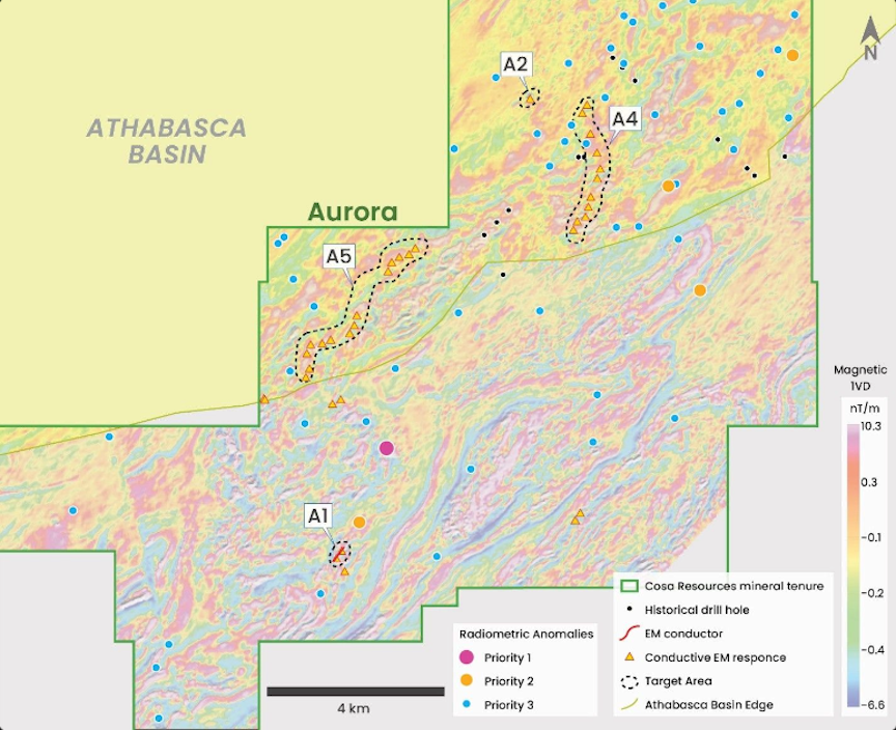
Sandstone cover is expected to be less than 100 meters thick in the northern third of Aurora and absent in the remainder. Though no diamond drilling has been completed on the project since 1979, review of historical drill hole logs has identified several zones of hydrothermal alteration. Airborne gravity gradient and Versatile Transient Electromagnetic (VTEM) surveying completed by Cosa in 2024 identified initial target areas at Aurora (Figure 2). A property-wide high-resolution airborne magnetic and radiometric survey identified or upgraded multiple target areas in July 2026.
According to Cosa, the first drill program at Aurora in over forty years significantly benefits from advances in geophysical technology and understanding of eastern Athabasca deposit models.
Drilling will evaluate multiple conductive anomalies adjacent to or up-ice from uranium-source radiometric anomalies.
“Within just 8 months of entering into the Agreement with Traction, we are pleased to be commencing the first drill program at the Aurora project in over 40 years,” said Andy Carmichael, Cosa’s VP Exploration, in the Sept. 28 news release.
“Benefitting from significant advancements in geophysical techniques, we are eager to begin drill testing initial target areas that are at very shallow depths.”
Drilling is planned to comprise approximately 800 meters in four to six holes. Targets are conductive anomalies identified by Cosa’s 2024 Versatile Time-Domain Electromagnetic (VTEM) survey, with three of four target areas having associated uranium-source radiometric anomalies located down-ice (Figure 2).
Target Area A1 is a northeast-trending conductive response adjacent to a uranium-source radiometric anomaly in the southwestern portion of the project. No sandstone is expected in this target area.
Target Area A2 is a conductive response in the northern portion of Aurora coincident with several interpreted magnetic lineaments at easterly to northeasterly orientations. Approximately 30 meters of Athabasca sandstone is present in the target area, and several radiometric anomalies are located down-ice.
Target Areas A4 and A5 are curvilinear conductive trends adjacent to lineaments interpreted from magnetic and/or Z-Tipper Electromagnetic (ZTEM) data. Both target areas are up-ice from uranium-source radiometric anomalies and located just inside the mapped rim of the Athabasca Basin.
The news from Aurora follows a drilling announcement at Cosa’s Darby property, and the results of summer drilling at Murphy Lake North.
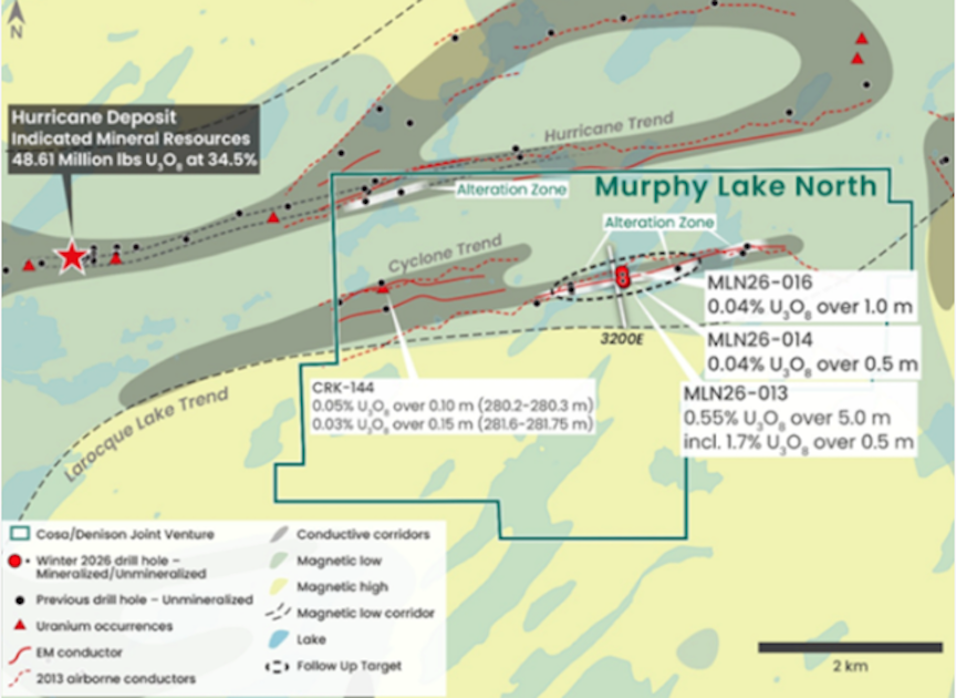
Murphy Lake North is a 70/30 joint venture between Cosa Resources and Denison Mines, located at the northern end of the Larocque Lake Trend, in the Eastern Athabasca Basin of Saskatchewan.
The project is within 3 kilometers of and on trend with the Hurricane deposit, discovered in 2018 by Cosa’s management; Hurricane currently holds the title as the world’s highest-grade Indicated uranium resource.
Ownership in Darby is also split 70/30, with Cosa holding the majority stake and Denison 30%.
Darby Project
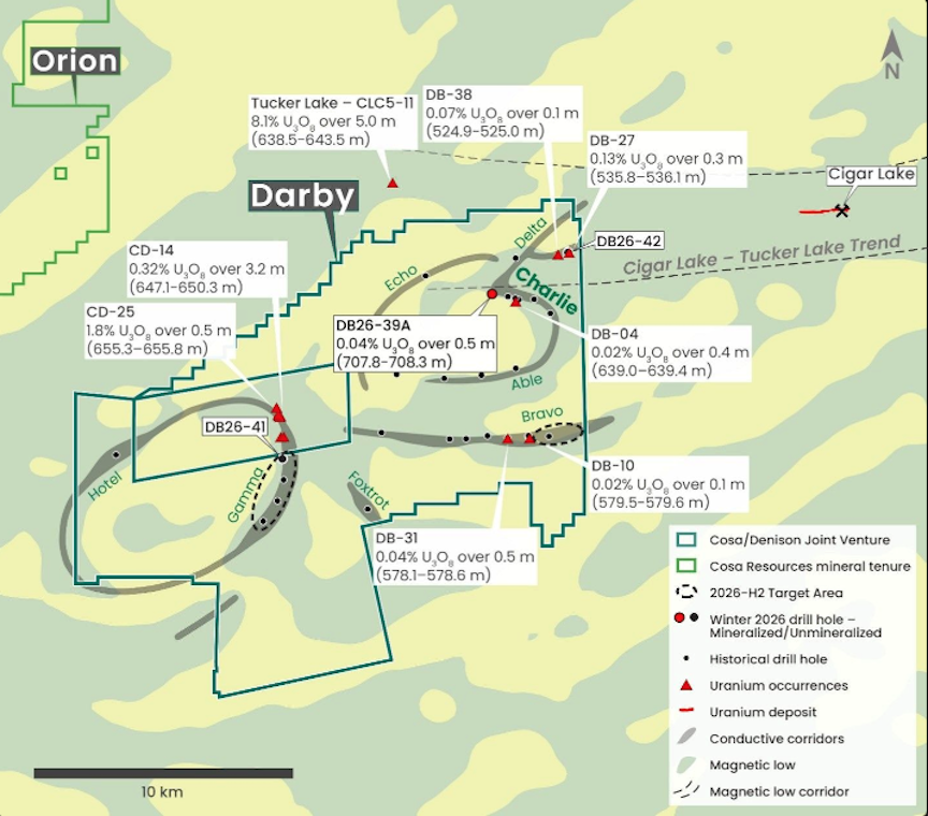
Drilling at Darby, located 10 km west of Cameco’s Cigar Lake, is planned to comprise up to 2,500 meters at the Gamma and Bravo trends.
Cosa highlights drilling at the Gamma trend to follow up structure, alteration and anomalous uranium geochemistry intersected during the winter 2026 drill program.
Drilling at the Bravo trend will follow up weak uranium mineralization proximal to structure and alteration intersected by historical drilling and within a magnetic low trend extending northeast to Cigar Lake.
“Having recently completed an encouraging and productive drilling program at Murphy Lake North, we are excited to be back drilling at the Darby Joint Venture with our partner and largest shareholder, Denison Mines,” Cosa’s President and CEO Keith Bodnarchuk stated in the Sept. 16 news release.
“Viewed by Cosa as a discovery-ready Project, Darby boasts an exceptional pipeline of high-upside drill targets in proximity to structure, alteration, and historical uranium mineralization.”
Murphy Lake North Project
On Sept. 14 Cosa announced the results of summer drilling at Murphy Lake North, aka MLN.
Highlights:
- Multiple zones of structurally controlled alteration and elevated radioactivity remain open along strike for several hundred meters and on multiple sections.
- Drilling evaluated multiple structures over 650 meters of strike length, with all 13 drill holes intersecting strong structure and/or alteration.
- Summer 2026 drilling prioritized unconformity targets with significant room for basement-hosted mineralization remaining.
“We remain very encouraged by the potential at Murphy Lake North. Having previously confirmed the trend hosts uranium mineralization, summer drilling has significantly advanced our understanding of the geology in the immediate area,” Bodnarchuk stated in the Sept. 14 news release.
“Highly prospective drill results paired with an abundance of open space emphasize our excitement and commitment to fully evaluating the Cyclone trend and multiple other strong target areas on the Project. With drilling expected to commence at both the Darby joint venture with Denison, and the Aurora project, we expect steady news flow for the remainder of 2026, followed by a return to MLN in early 2027. With $16 million in the treasury and support from our Joint Venture partner and largest shareholder, Denison Mines, the Company is well positioned and fully funded for additional drilling throughout 2027.”
Conclusion
Cosa is drilling for discovery in the Athabasca Basin of Saskatchewan.
The Athabasca Basin is famous for its high grades — at over 20 times global averages. Some deposits are over 100x the world average including Cameco’s Cigar Lake which contains an average grade of between 15% and 17% U3O8.
Hurricane, the deposit that Cosa’s management team is credited with discovering, averages an astonishing 34.5% U3O8 and is just a few kilometers away from Cosa’s Murphy Lake North Joint Venture.
The Basin produces about 15% of world uranium supply. Major mines include Cigar Lake — held jointly between Cameco (TSX:CCO), Orano Canada and Tepco Resources, and McArthur River.
Cosa has finished drilling at Murphy Lake North and is now turning its attention to Aurora and Darby. Drilling at these two properties will take place throughout the fall. January will see recommencement of drilling at both MLN and Darby, providing shareholders with ample upside should a discovery be made.
Cosa Resources Corp.
TSXV:COSA, OTCQB:COSAF
Cdn$0.50 2026.09.28
Shares Outstanding 136.7 m
Market Cap Cdn$67.1m
COSA website
Richard (Rick) Mills
aheadoftheherd.com

Subscribe to AOTH’s free newsletter
Richard does not own shares of Cosa Resources Corp.
TSXV:COSA. COSA is a paid advertiser on his site aheadoftheherd.com
This article is issued on behalf COSA
Legal Notice / Disclaimer
Ahead of the Herd newsletter, aheadoftheherd.com, hereafter known as AOTH.Please read the entire Disclaimer carefully before you use this website or read the newsletter. If you do not agree to all the AOTH/Richard Mills Disclaimer, do not access/read this website/newsletter/article, or any of its pages. By reading/using this AOTH/Richard Mills website/newsletter/article, and whether you actually read this Disclaimer, you are deemed to have accepted it.