 RSS Subscribe
Copper going forward: volatile but moving higher – Richard Mills

Investors are being warned to expect more volatility in metals markets, with copper the poster child due to the market’s unique dynamics showing strong demand outweighing weak supply.
Andy Home, metals columnist for Reuters, back in February pointed out the metals mania in China, where The Shanghai Futures Exchange and the Guangzhou Futures Exchange have between them raised margins and tightened trading rules 38 times to maintain order.
The spate of interventions has covered the metallic spectrum from precious metals gold and silver to industrial inputs such as nickel and lithium.
China has a long history of manias in markets as obscure as ferro-silicon but nothing before on this scale.
Moreover, metals fever has swept up the rest of the world. The speculative stampede has generated extreme volatility in the silver market and rocked even safe-haven gold.
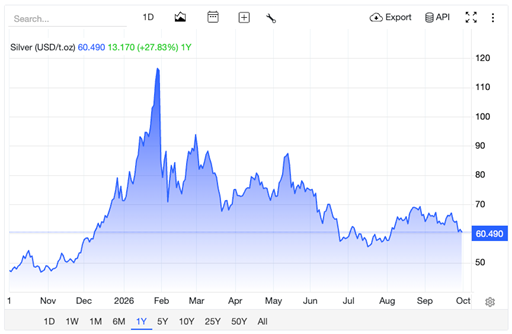
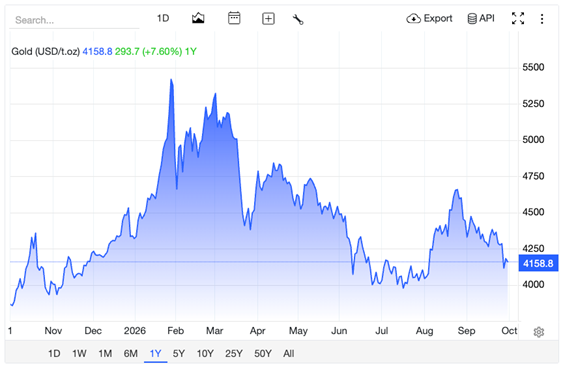
Silver and gold both hit record highs at the end of January, with gold reaching $5,608 an ounce and silver topping out at $121.67/oz.
Both precious metals have since pulled back significantly.
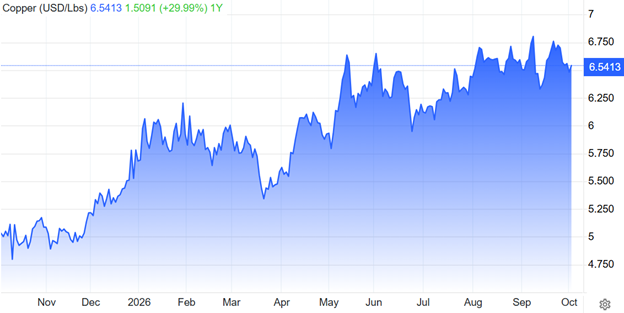
Copper also climbed to a January 2026 record high, briefly exceeding $6.57 per pound before falling back to $5.34 in March. The base metal on Sept. 10 reached a fresh record of $6.74.
Metals volatility was back in the news this week, with Goldman Sach’s co-head of commodities research, Dan Struyven, saying that investors should expect more volatility in critical metals due to trade war uncertainty. He specifically named copper, platinum and palladium — all industrial metals used in a plethora of applications, including catalytic converters (Pt and Pd), electronics, power generation, construction, transportation and emerging technologies (copper).
Hoarding
Copper’s criticality is causing governments to stockpile it to prevent shortages. According to Jose Torres, chief economist at Interactive Brokers, copper’s global strategic importance means prices will remain elevated.
“Broadly, it has to do with limited supply as nations want to stockpile the cyclical metal to bolster sovereign AI prospects,” he told Business Insider. “Governments are afraid that without enough copper, their economies won’t remain competitive in a world where advanced technology is increasingly adopted.”
Deutsche Bank forecasts copper prices hitting an eye-popping $10 per pound by mid-2027, a 50% rise from current prices based on stockpiling by the United States and China.
DB notes that by the end of the year, the two countries will hold 71% of copper supply. (China due to it building its copper reserves and the United States because, as mentioned, the threat of a tariff is driving supplies into American warehouses.)
Deutsche Bank warns that global copper inventories have fallen to historic lows, with the copper market shifting from demand-driven dynamics to a supply liquidity crisis as buyers race to lock up increasingly scarce spot supply in what it calls a “historic scramble for metal.” (Biggo Finance)
If the hoarding trend continues, copper may not be available to users worldwide by 2028, according to the bank’s analysis.
Struyven says the uncertainty surrounding expected US imports on refined copper — now delayed due to concerns over affordability after a June 30 deadline passed — is “pulling metal inventories into the US without requiring large-scale government purchases.”
He notes “trade wars and tariff tensions have resulted in weaker liquidity in markets outside the US” and that “Even if global stockpiles are high, metals can still be prone to extreme price swings in the event of a sudden buying frenzy as countries try to hoard supply.”
Project Vault is the official U.S. Strategic Critical Minerals Reserve, launched by the Trump administration in February 2026. It represents a massive, unprecedented $12 billion public-private partnership designed explicitly to protect the U.S. civilian industrial base from foreign supply chokeholds—particularly from China.
While the U.S. has long maintained a National Defense Stockpile for military use, Project Vault is uniquely engineered to act as an economic shield for domestic manufacturers (like automotive, tech, and semiconductor firms) so they don’t face plant shutdowns during severe market disruptions.
Global powerhouse traders like Glencore, Mercuria, Hartree Partners, and Traxys have been integrated into the project.
These mega-traders use their existing infrastructure to aggregate demand from thousands of smaller U.S. suppliers who wouldn’t normally have the leverage to secure raw materials globally on their own.
The reserve can target any of the 60+ minerals deemed “critical” by the U.S. Geological Survey.
Instead of buying foreign metals, several resource-rich nations are legally forcing metals to stay within their borders, self benefaction—a structural form of hoarding known as resource nationalism.
“While investor demand has softened as the market now prices a Fed hiking cycle, we expect much of the metal pulled into the US to remain trapped there, leaving available ex-US inventories tight and creating scope for a repeat of the 2025H2/2026H1 volatility should investor demand recover,” Struyven added via Business Insider.
The U.S. is not acting in a vacuum; rather, it is participating in a highly competitive global race where several other major players are executing systemic, state-backed hoarding of various metals. Governments and industries worldwide are aggressively stockpiling and hoarding critical metals as “resource nationalism” and geopolitical friction reshape the global economy.
China has long been the primary driver of state-led metal stockpiling, managed secretly through the National Food and Strategic Reserves Administration. This administration has been systematically purchasing massive quantities of cobalt, copper, nickel, and lithium to bolster its state reserves.
In addition to steady, strategic buying over the last few years, the China Nonferrous Metals Industry Association openly called for an expansion of state strategic copper reserves alongside boosting commercial inventories. Because China already controls roughly 70% to 95% of the global processing for lithium, cobalt, manganese, and graphite, their aggressive state-backed buying acts as an official mechanism to lock down the physical supply.
Fearing retaliation from Chinese export controls, European entities are transitioning from free-market reliance to rapid stockpiling targeting primarily heavy rare earth elements, lithium, and other technology metals crucial for electronics and automotive manufacturing.
A joint European Union purchasing and stockpiling effort was established to blunt dependence on Chinese exports. On a private-sector level, German industry trading houses (such as Frankfurt-based Tradium) have reported a massive rush by German corporations to aggressively hoard rare earths ahead of tense trade negotiations with Beijing.
Both Tokyo and Seoul maintain robust, long-running official state stockpiles ofrare earths, lithium, cobalt, and tungsten. To safeguard their supplies, Japan has formally pivoted state funding explicitly toward “processing and smelting” to bypass traditional bottlenecks and has actively signed bilateral critical mineral framework deals with the U.S. to guarantee minimum allocations.
Copper shortage fears
Lately fears of a copper shortage have arisen.
Global mined copper output is set to fall in 2026 for the first time since 2017. Key supply constraints include declining ore grades, mine disruptions, and slow project pipelines.
Demand drivers include AI data centers, which rely heavily on copper for electrical conductivity, power distribution and heat management; the energy transition characterized by the rapid adoption of electric vehicles and renewable energy grid expansions requiring intensive copper deployment; and global defense spending adding further pressure to raw material supply chains.
While the copper market was roughly balanced in 2025, meaning that refined production met consumption, mine supply was severely disrupted and will likely create a deficit in 2026, states the International Institute for Strategic Studies (IISS).
There were setbacks at major operations including Grasberg in Indonesia and Kamoa-Kakula in the DRC.
The International Copper Study Group (ICSG) found mine production was running at annualized 23Mt in July — the same amount mined in 2025 — down 4% compared to June. The group also said that refined demand rose 3% from a year earlier to an annualized 29 million tonnes, while refined supply slipped 1% to 28.4 million tonnes. (read more on refined supply below)
The global copper market is approaching a key inflection point as disruptions to mine supply, a lack of major discoveries and rising demand point to the market’s first structural shortage since 2009.
Copper production to decrease for first time in 9 years — Richard Mills
According to S&P Global, without new mines or technological advancements, copper production will peak in 2030. A “substantial shortfall” of up to 10 million metric tons is projected by 2040 as demand surges 50% to 42 million tonnes.
The January 2026 S&P Global report also said that “Reversing the current supply trajectory will be no small task. The copper sector faces a host of challenges above and below ground, ranging from declining ore grades; rising costs for energy, labor and other inputs; increasingly complex and difficult extraction conditions; environmental opposition, lengthy judicial reviews, and pressures from investors and governments. It takes 17 years, on average, for a new copper mine to go from discovery to production.”
On the demand side, an earlier article by Business Insider states the AI boom might be the key to another 15 years of surging demand at a time when supply is expected to remain constrained.
S&P Global agrees that copper is essential for AI and electrification but goes further:
“The future is not just copper-intensive, it is copper-enabled. Every new building, every line of digital code, every renewable megawatt, every new car, every advanced weapon system depends on the metal,” said Aurian De La Noue, Executive Director, Critical Minerals and Energy Transition Consulting, S&P Global Energy.
Pending strikes in Chile
Global copper supply is heavily influenced by what happens in Chile, the number one producer.
Chile’s total copper production in 2025 declined by 1.6% compared to the previous year, totaling 5.415 million tonnes — a drop of about 77,300 tonnes across major operations — according to data reported by state copper commission Cochilco.
So far 2026 has thrown major headwinds at global copper supply, driven heavily by compounding operational difficulties in the world’s largest producer, Chile. State copper commission Cochilco drastically downgraded its full-year output forecast following an “exceptionally weak” first half, which culminated in Chile’s copper production hitting a 15-year low in August (Roughly 70–80% of the world’s silver supply is produced as a byproduct of mining for copper, lead, and zinc, as goes copper supply so does silver’s.)
Along with droughts and poor weather, the country is frequently hit with labor unrest at its mines. This week it was reported that workers at Antofagasta’s Centinela copper mine have voted to strike.
A second strike is looming at BHP’s Escondida, the world’s largest copper mine. Mine supervisors rejected a collective contract offer on Wednesday, meaning the parties must now enter a mandatory five-day, government-led mediation process.
95% of the 1,020-member union voted to down tools.
The last major strike at Escondida took place in August 2024. The historic 44-day strike in 2017 was the longest private-sector mining strike in Chilean history. An estimated 140,000 tonnes of copper production was lost, which is about a third of the mine’s current quarterly output.
The current labor unrest darkens the supply picture for Chile. Severe winter weather has disrupted major mines in the north including Lundin Mining’s Caserones operation, while state-owed miner Codelco’s output is at multi-decade lows. The company’s chairman expects flat production in coming years.
Resource nationalism
Because so many factors are in play in the copper market, and so many sectors are desperately bidding for the metal, countries with heavy copper reserves are using their leverage to change tax codes, ban raw exports, and demand that processing happen on their own soil.
Self-beneficiation, a big part of resource nationalism, takes many forms — from introducing steep mining royalties to banning the export of unrefined rocks. Today, over 33% of global copper production happens in countries considered “high risk” for resource nationalism, up from just 17% a decade ago.
Panama is a good example. First Quantum Minerals’ Cobre Panama copper mine was shut down in 2023 following a Supreme Court ruling that its operating contract was unconstitutional.
The mine could restart but it would only be to “fund its eventual orderly closure” a ministerial committee recently recommended to President Jose Raul Mulino.
China’s refined copper output plummets
Raw copper (ore and concentrate) is the extracted material containing 20% to 30% copper, while refined copper is the metal processed to 99.9% or higher purity for commercial use.
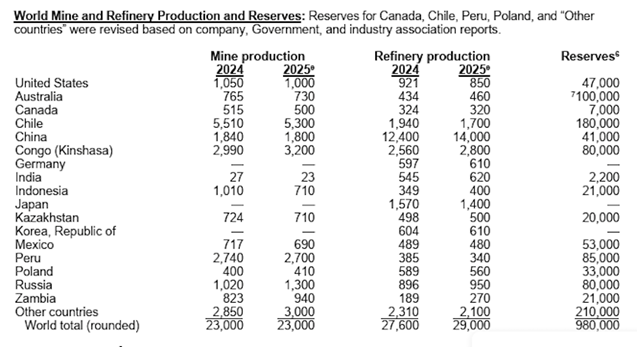
China is the number one copper refining country, processing between 45 and 60% of the global total. In 2025 the country refined 14 million tonnes. The closest country, the Democratic Republic of Congo, processed a fifth as much, or 2.8Mt, according to the USGS.
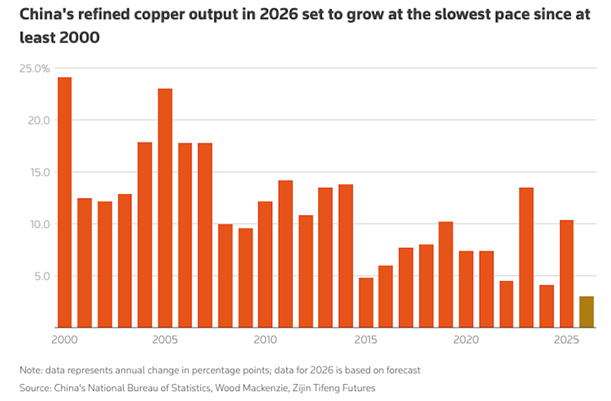
But analysts say China’s refined copper output is on track for the lowest growth in decades this year, as a tax crackdown reduces copper scrap and aggravates a long-running shortage of copper concentrate, the main feedstock for smelting.
Reuters reports output is forecast to grow between 3 and 3.4% compared to 10.4% in 2025 — the lowest rate since 2000.
Sulfur/ sulfuric acid
For a massive portion of global copper mining—specifically operations utilizing solvent extraction and electrowinning (SX-EW)—sulfuric acid is not a byproduct, but the primary raw material required to dissolve copper out of oxide ores.
Following a strict export ban from China (the world’s largest supplier) and intense maritime shipping bottlenecks in the Strait of Hormuz, global seaborne sulfur supplies collapsed.
Spot prices for sulfuric acid doubled in major import hubs like Chile. This extreme scarcity and surging price environment forced regional processing facilities to drastically scale back operations or face insolvency, restricting primary copper output right at the source.
Conclusion
Mixed economic data out of top consumer China saw copper futures falling to around $6.50 a pound Thursday, near a two-week low. Industrial profits rose 15.7% in the first eight months from a year earlier but slowed from a 17.6% increase during January-July. Data released Wednesday showed China’s manufacturing sector returned to growth in September, improving the demand outlook in the world’s largest metals consumer. (Trading Economics). The country’s PMI (purchasing managers’ index) increased to 50.1 compared to 49.8 in August. Any reading over 50 indicates an economic expansion.
Despite the price pullback, copper is set to post its third straight monthly gain in September. Reuters reports a monthly rise of 0.9% and a quarterly gain of 7.9%. Commodities Research Unit (CRU) is targeting a fourth-quarter average of $6.57/lb.
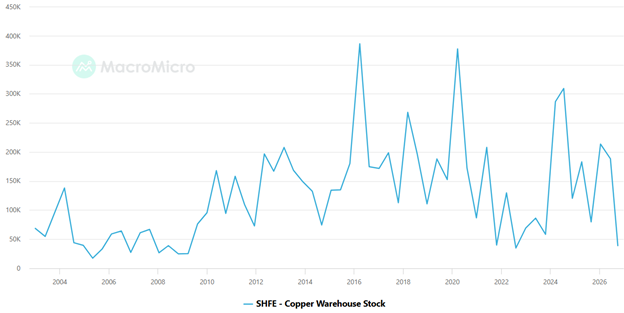
In another bullish signal for demand, copper stocks in Shanghai Futures Exchange warehouses declined by 17.8% from last week to 38,744 tons, the lowest since January 2024, Reuters said.
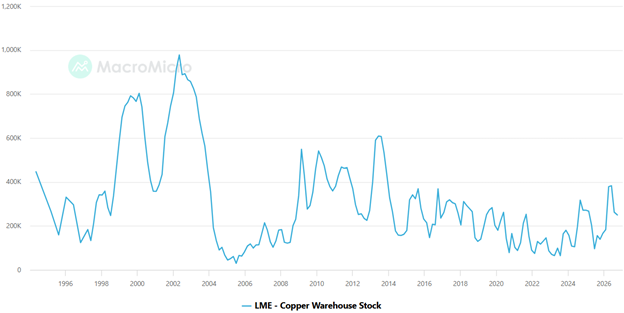
Metal markets are in turmoil due to the trade war and tariffs. Copper has had a choppy year but the price trend is up and moving higher. The base and critical metal on Sept. 10 hit a new record high of $6.74.
Copper’s criticality is causing governments to stockpile it to prevent shortages. By the end of the year, the US and China will hold 71% of copper supply.
Deutsche Bank forecasts copper prices hitting $10 per pound by mid-2027.
This year copper production is set to decrease, putting the market in a structural deficit for the first time since 2009. Number one producer Chile is facing output problems due to bad weather, declining ore grades, operational challenges at some of its biggest mines (El Teniente, Radomiro Tomic, Cerro Colorado, Los Bronces) and now, two pending strikes.
Resource nationalism continues to dog the industry, restricting production. Examples include Panama’s actions regarding First Quantum’s Cobre Panama mine; and Chile, which recently enacted a sweeping Mining Royalty Act. Large copper producers now face an effective tax rate as high as 46.5%, composed of sales taxes and profit-margin taxes.
A “substantial shortfall” of up to 10 million metric tons is projected by 2040 as demand surges 50% to 42 million tonnes. Demand drivers include copious copper used in AI data centers; the shift from decarbonatization to electrification including copper used in electric vehicles and renewable energies; plus, all the traditional uses of copper in electronics, power generation, construction and transportation.
The refined copper market is also facing supply pressures. China’s refined copper output is on track for the lowest growth in decades this year. A tax crackdown is reducing copper scrap and aggravating a long-running shortage of copper concentrate in the world’s largest copper refining country. Smelters are also cutting output because of falling prices of sulfuric acid — a byproduct of copper smelting.
Richard (Rick) Mills
aheadoftheherd.com

Legal Notice / Disclaimer
Ahead of the Herd newsletter, aheadoftheherd.com, hereafter known as AOTH.Please read the entire Disclaimer carefully before you use this website or read the newsletter. If you do not agree to all the AOTH/Richard Mills Disclaimer, do not access/read this website/newsletter/article, or any of its pages. By reading/using this AOTH/Richard Mills website/newsletter/article, and whether you actually read this Disclaimer, you are deemed to have accepted it.