 RSS Subscribe
Gold and silver pullbacks temporary – Richard Mills
2026.06.11
Reuters had this to say about the ongoing record setting current streak of inflation.
“The worst U.S. inflation outbreak in a generation turns five years old this month, a defining economic shock that is still driving policy debates, influencing national politics, and frustrating Federal Reserve officials trying to restore the pace of price increases to their 2% target after a monumental miss.
When nose-diving inflation at the start of the COVID-19 pandemic touched off concerns of a dangerous downward spiral in wages and prices, it was actually considered a good sign when prices across a variety of gauges began rising by more than 2% annually in March 2021. Fed officials even planned to encourage the emerging trend with continued low interest rates.
“We want inflation at 2%, and not on a transitory basis,” Fed Chair Jerome Powell said at a press conference that month in a be-careful-what-you-wish-for statement that would haunt the central bank. Central bankers said they expected inflation to remain above their target that year, but not by much, and that they would wait on any effort to slow the economy with interest rate hikes until the increase proved durable.
But the pace kept accelerating. At year’s end the Personal Consumption Expenditures price index the Fed uses to set its target was rising at more than a 6% annual rate, triple its target. It did not peak until passing 7% in June 2022, with the Fed at that point scrambling to catch up with steep, rapid-fire rate hikes. Inflation as measured by the separate Consumer Price Index topped 9% that month, the fastest pace since 1981, when the Fed was in the process of taming an even worse unmooring of prices.”
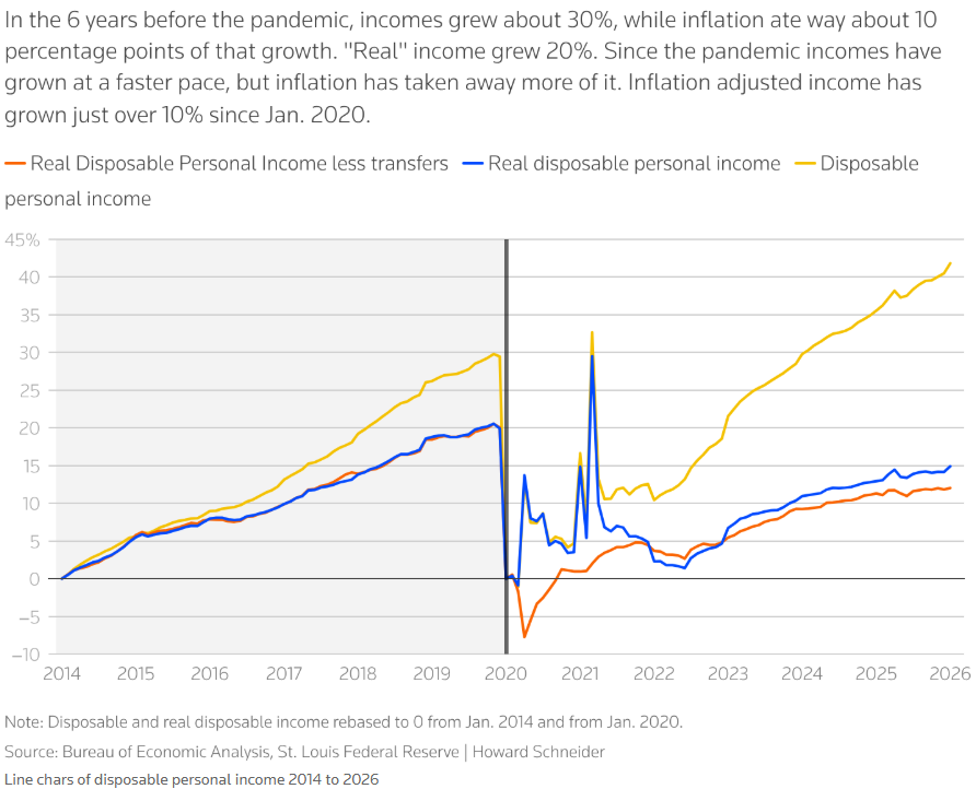
Consumer spending is 70% of the Global and US economy. NerdWallet has this to say regarding recent consumer spending.
“After accounting for inflation, the primary driver of economic growth slowed in April, as consumer spending was essentially flat. Households seem to be reining in spending a bit as they face continued elevated inflation along with the uncertainty of ongoing war. Inflation appears to be quickening, both due to the oil price shock and its downstream effects, and the ongoing impact of tariffs. While prices are rising faster than comfortable, incomes are not, putting consumers in an uncomfortable spot.
Rising prices, sluggish income and economic uncertainty could set the stage for a broader pullback in consumer spending and therefore economic growth. We’ve been watching consumer sentiment measures for months and waiting for the lackluster vibes to translate to changed behavior. The longer that current pressures persist, the more likely they are to hit more and more households, and the greater chance the consumer resilience we’ve seen in recent years will falter. In other words, for an increasing share of consumers, the bad feelings about the economy are likely no longer just vibes.
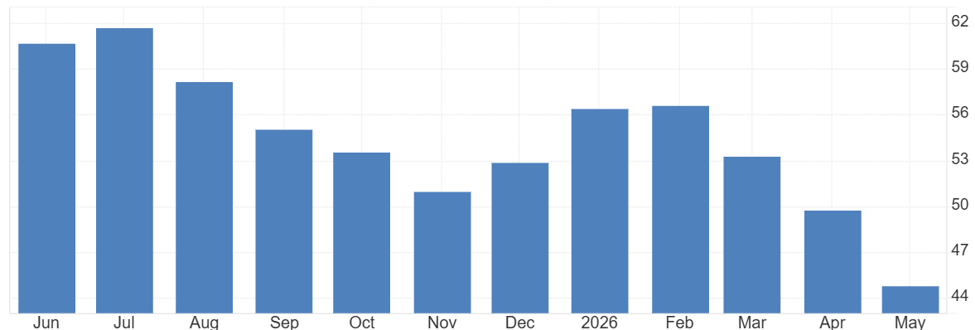
The producer price index (PPI), which tracks prices at the wholesale level, went up 1.4% in April after a 0.7% increase in March, according to the most recent data from the BLS released on May 13. The increase was the largest since March 2022 when PPI rose 1.7%. On an annual basis, the index rose 6% — the highest 12-month increase since December 2022 when PPI rose 6.4%.”
RBC Economics expects headline inflation to increase by 0.5% month-over-month in May, bringing the year-over-year pace to 4.2%.
The Federal Reserve’s preferred measure of inflation is the personal consumption expenditures (PCE) price index. In April, it increased by 3.8% year over year.
Rising energy and commodity costs are ripping through the broader economy.
Many, most think the US Federal Reserve will have to raise interest rates at some point in 2026.
The new Fed chair, Kevin Warsh, has his first Federal Open Market Committee meeting on June 16–17. There is a very real possibility the door will be opened to potential rate hikes later in 2026.
The CME FedWatch Tool now assesses one or two hikes as relatively likely in 2026, even though holding rates steady is possible, too.
“Recent jobs data show that the labor market appears to be stabilizing and the unemployment rate is fairly low and stable. But higher energy and commodity prices are pushing up headline inflation and prices for other goods. Inflation is not headed in the right direction. Based on this recent data, I would support removing the ‘easing bias’s language in our policy statement to make it clear that a rate cut is no more likely in the future than a rate increase. That doesn’t mean, however, that I think we should be considering rate increases in the near future.” Fed Gov. Christopher Waller
Ed Yardini thinks the Fed is going to be forced to placate the bond market by raising rates in July. “The Fed has clearly shown that they’re dropping their easing bias they had in their April meeting, and moving not to a neutral bias, but to a tightening bias at the June meeting coming up in a few weeks. After that I think they have to follow up and actually show that they’re willing to raise rates and do it by 25 basis points.” Ed Yardeni, Yardeni Research
Interest rate hikes deployed by central banks to combat high inflation make borrowing expensive, cooling off consumer and business spending. There’s a loss of confidence in households and businesses causing a hoarding of cash.
January 2016 the Consumer Price Index (CPI, which excludes volatile food and energy prices) was 237. April 2026 the CPI is 332.
From January 2016 to April 2026 the CPI rose 95 points or 40%. Has your income increased by 40%?
Remember inflation compounds year after year.
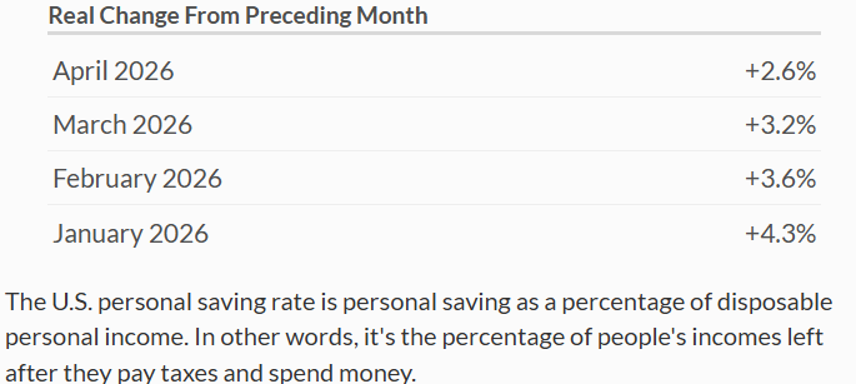
Sometimes there is no cash left to save.
Global bond and U.S. Treasury yields are already surging to multi-decade highs, driven by stubborn, war-induced inflation and rising term premiums. The 10-year yieldis testing multi-month highs near 4.60%-4.70%, while the 30-year bond yield breached the 5.1% threshold—reaching its highest level since mid-2007.
The rout is international, the U.K. 30-year gilt yields hit their highest point since 1998, and Japan’s 30-year government bonds (JGB) recently set all-time historical records.
Bond investors are demanding even higher yields.
When global and US consumers stop spending, it triggers a catastrophic economic contraction known as a demand-driven recession. Because consumer spending makes up about 70% of the US GDP and drives global supply chains, a sudden halt instantly chokes off the lifeblood of business revenue.
According to consumer reports by McKinsey & Company, persistent cost-of-living concerns have resulted in declining intent to spend within discretionary categories globally.
In the United States, consumer spending growth is moderating to roughly 2.0% as labor market weakness and widening fiscal deficits weigh on household income. Similarly, S&P Global Ratings points out that consumption growth remains soft in China, constraining its economic growth.
Supply-driven downturns, like the stagflation of the ‘70’s, are triggered by production bottlenecks or soaring energy costs. Which we are certainly currently seeing because of the US/ Iran war.
The current economic downturn is best described as hybrid and structurally driven. It leans heavily on demand constraints, though it is triggered and complicated by ongoing supply shocks.
A supply-driven downturn can cause a demand-driven recession, often referred to in macroeconomics as a Keynesian supply shock. When severe supply chain disruptions or shortages occur, the resulting drop in production and loss of income can trigger a secondary collapse in consumer and business spending. So, stagflation then recession remains a real possibility.
Ai Overview
The downturn’s primary drivers are bifurcated:
Demand-Driven Elements: The slowdown is deeply rooted in weak business confidence, cautious consumer spending, and the compounding weight of high interest rates. Global policy shifts, prolonged trade uncertainty, and a structural re-alignment in migration levels have prompted businesses to pull back on investments and hiring.
Supply-Driven Elements: Periodic energy and commodity shocks—partly exacerbated by geopolitical conflict—and the ripple effects of ongoing trade tariffs have continuously disrupted supply chains. These supply disruptions push up production and import costs, eroding business margins and leading to “stagflation-lite” dynamics where growth remains low while inflation proves sticky.
This description points to high volatility for precious metals. Gold’s price is primarily driven by monetary policy, inflation and systemic uncertainty. While silver leans heavily on both industrial demand and investment demand. Widening supply deficits mean that physical shortages should move silver’s price floor higher
Many institutional strategists believe gold prices will push higher throughout 2026 regardless of immediate short-term rate volatility.
“The current rally was distinguished from prior cycles by the simultaneous reinforcement of three primary demand pillars: central bank gold demand at historically elevated rates, strong retail demand from China and India operating in tandem, and broad investor appetite linked to what Russell characterises as the fear trade encompassing inflation anxiety, geopolitical instability, and concerns about U.S. dollar hegemony under the Trump administration’s policy approach.” (Reuters commodities columnist Clyde Russell Reuters / Mining.com, June 5, 2026)
“While this rally in gold has not, and will not, be linear, we believe the trends driving this rebasing higher in gold prices are not exhausted,” said Natasha Kaneva, head of Global Commodities Strategy at J.P. Morgan. “The long-term trend of official reserve and investor diversification into gold has further to run. We expect gold demand to push prices toward $5,000/oz by year-end 2026.”
Overall, J.P. Morgan Global Research is forecasting prices to average $5,055/oz by the final quarter of 2026, rising toward $5,400/oz by the end of 2027.
Conclusion
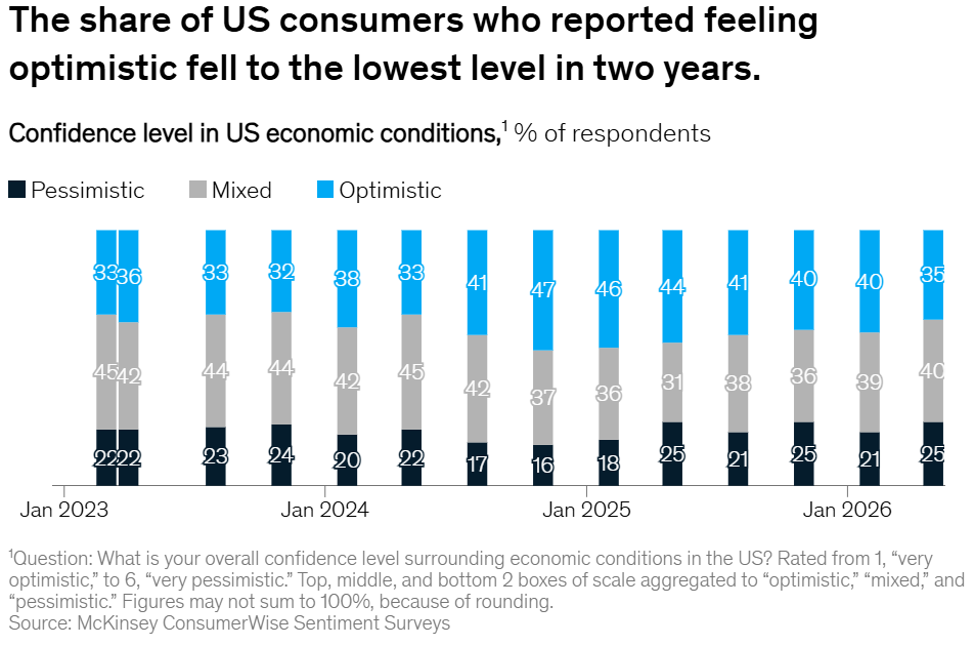
Consumers will not stop spending completely, but, as we’ve shown a “break” is already happening with consumer sentiment about the economy falling through the floor and heavily constrained and selective purchasing. Rather than a sudden halt, households are shifting to “justification-based” shopping. However overall consumption is slowing significantly.
At AOTH we believe gold and silver’s outlook, because of global debt concerns and continued central bank accumulation, remains strong.
I find it hard to believe that inflation, and interest rates, are not going higher due to a combination of global geopolitical conflicts causing surging global energy prices, the continued climb in the price of food, the lagged economic impacts of international trade tariffs, ongoing labor shortages driving up wage costs, expansive government fiscal policies causing climbing debt, dedollarization and fiscal deficits.
Higher interest rates will ‘break the consumer’s backs’ causing them to drastically slow spending which results in a rapid economic contraction. This pullback, left to go on long enough, will trigger stagflation and recession.
The Fed, and all other Central Banks, will have to be very alert and quick with the ‘easing trigger finger’ and start to drastically lower rates which will weaken their currencies but boost precious metals and commodity prices.
Central banks and policymakers try to prevent supply downturns from becoming demand recessions by deploying a mix of expansionary monetary and fiscal policies. Basically, they lower interest rates and purchase long-term government securities to directly inject cash into the financial system.
When interest rates are low bonds and cash yield very little. The cost of holding gold shrinks, making it a much more attractive store of value, which pushes prices higher.
Let’s not forget about Russell’s three primary demand pillars: central bank gold demand at historically elevated rates, strong retail demand from China and India operating in tandem, and broad investor appetite linked to what Russell characterises as the fear trade encompassing inflation anxiety, geopolitical instability, and concerns about U.S. dollar hegemony under the Trump administration’s policy approach.
The global bond rout is a de facto tightening of financial conditions and is already directly pressuring borrowing costs such as mortgages.
The standard inverse correlation between interest rates, the dollar, and gold isn’t absolute. During times of intense geopolitical tension, massive inflation, or heavy central bank buying like the buying sprees seen in recent years, gold prices have occasionally surged alongside both rising interest rates and a strong dollar.
While near-term pullbacks caused by hot inflation data and fluctuating interest rates present volatility, longer-term macroeconomic conditions continue to support a bullish outlook for both metals.
Richard (Rick) Mills
aheadoftheherd.com

Legal Notice / Disclaimer
Ahead of the Herd newsletter, aheadoftheherd.com, hereafter known as AOTH.Please read the entire Disclaimer carefully before you use this website or read the newsletter. If you do not agree to all the AOTH/Richard Mills Disclaimer, do not access/read this website/newsletter/article, or any of its pages. By reading/using this AOTH/Richard Mills website/newsletter/article, and whether you actually read this Disclaimer, you are deemed to have accepted it.