 RSS Subscribe
Torr Metals’ Bertha North target – Richard Mills
2026.08.25
The very deep oxidized supergene area at Torr Metals’ Bertha North target is interpreted to be strongly influenced by the picrite contact due to a combination of high structural permeability and a strong chemical “redox” trap.
The contact zones in between the picrite on one side and the surrounding volcanic/intrusive rocks on the other side because of repeated pulses of magma super heated fluids create an intensely fractured, brecciated corridor.
Because this fault-controlled boundary area is highly fractured and porous, surface-level meteoric and oxidizing fluids may be able to penetrate to significant depths—potentially reaching vertical depths of 450 to 580+ metres.
On the one side of the conductive body is the host volcanic-intrusive complex, which is highly oxidized, whereas the iron-rich footwall picrite unit on the other side of the conductive body is strongly reducing.
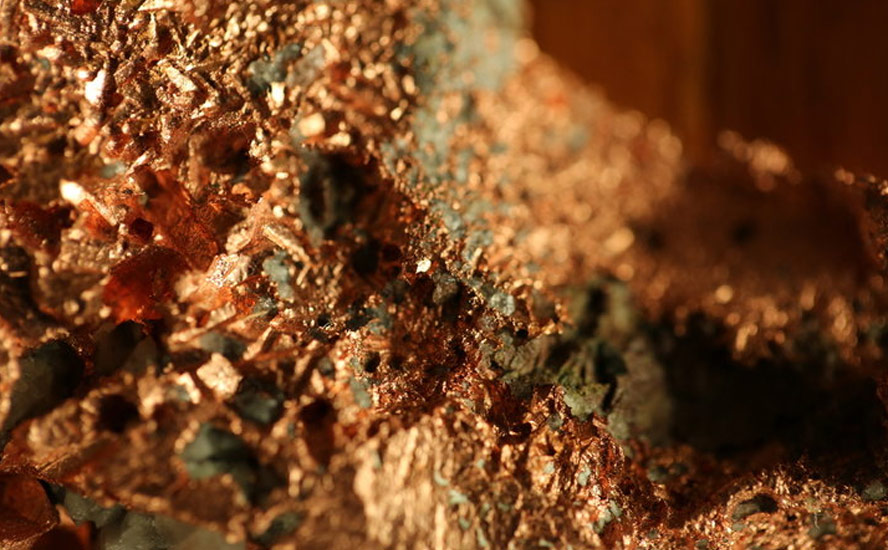
As copper-leached oxidizing fluids travel down through the shattered zone and hit the margins of the highly reducing picrite fragments, a severe reduction (redox) reaction triggers. This forces the dissolved copper out of the solution, precipitating it directly along the picrite boundaries as native copper and chalcocite.
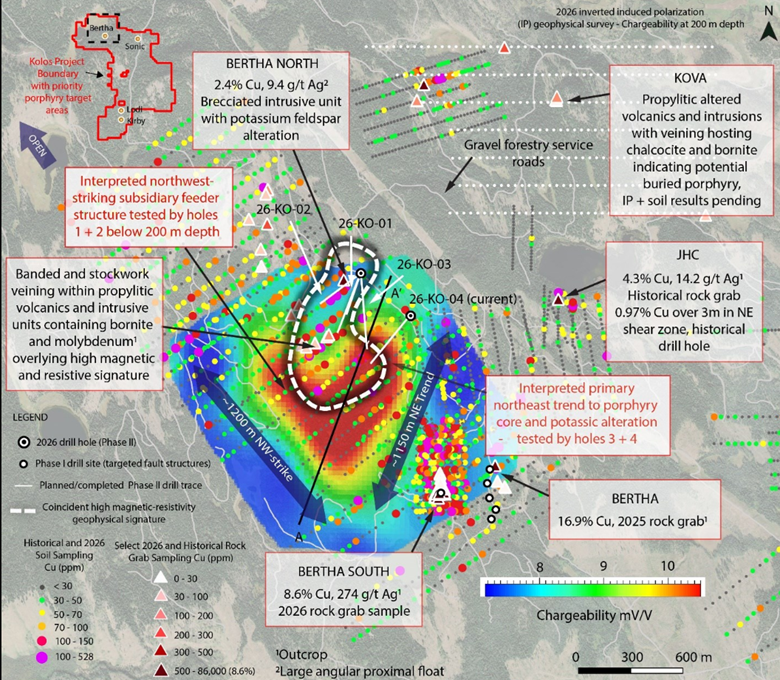
The geophysical chargeability anomalies mapped at Bertha are closely spatially associated with the shape, depth, and mineral composition of this picrite-controlled contact.
Induced Polarization (IP) surveys track how well subsurface rocks hold an electrical charge. At Bertha, the anomaly acts as a roadmap for the deep structural system.
The overall geometry of the IP chargeability anomaly appears to be influenced by the footwall picrite unit.
The following quote is based on Phase I drilling completed at Bertha at the end of 2025: “With approximately 2,100 metres drilled during Phase I at Bertha and plans to extend the program to 2,800 metres, we are steadily defining a system with geological features that warrant continued testing for a New Afton-style alkalic copper-gold porphyry system. Having now completed drilling across the initial width of the target area, our focus shifts to a major step-out to the west to evaluate the down-plunge and dip extent of the system beyond 500 metres. The presence of high-grade copper at surface in the Bertha exploration pit highlights the importance of testing both the picrite contact and the adjoining large, structurally controlled chargeability system to depth, further emphasizing Bertha’s potential as a significant hydrothermal-supergene copper-gold target.”
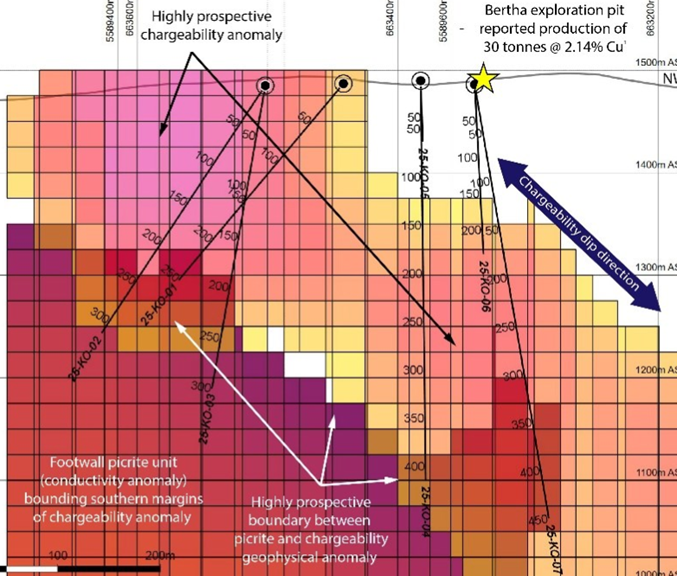
Shifting Orientation: The geophysical anomaly mirrors a major structural twist in the earth. It shifts from dipping northwest in the southeastern area to dipping north-to-northeast in the western section.
Near the surface, the moderate chargeability anomaly tracks the strongly oxidized volcanic and intrusive host rocks interspersed with shattered picrite.
The chargeability highlights where copper-bearing fluids have dropped high-grade native copper and chalcocite directly along those redox boundaries.
As exploration moves deeper down-dip and down-plunge, the chargeability strengthens, broadens, and remains open at depth. This may indicate a shift away from the near-surface supergene (weathered) zone into primary, unweathered hypogene sulphide mineralization (such as pyrite and chalcopyrite), providing a vector toward a potential higher-temperature portion of the system.
The chargeability anomaly overlaps significantly with moderate-to-high resistivity anomalies.
In alkalic porphyry systems, matching high-chargeability and high-resistivity suggests secondary porosity from deep shattering and hydrothermal alteration. This serves as the direct geophysical signature of the deeply fractured pathways that allowed water to travel down and cook the rock
The rising pyrite content in recent drill holes provides a mineralogical vector toward a potential higher-temperature, copper-bearing portion of the porphyry system.
In large-scale copper-gold porphyry exploration, minerals form distinct concentric zones around the central heat source.
The transition in pyrite content provides several critical indicators for Torr Metals’ targeting:
Hotter, Acidic Fluids: The increase in pyrite content (specifically noted in holes like 25-KO-07 and 25-KO-08) tracks a transition into progressively hotter and more acidic hydrothermal fluids.
The Phyllic Halo: This mineral signature is characteristic of the phyllic alteration zone, which typically forms a prominent “halo” or shell wrapped directly around or immediately above a buried porphyry-style core.
Northeast Pathing: By mapping where the pyrite content strengthens alongside gold and supergene overprinting, Torr Metals identified a coherent geochemical and mineralogical vector moving to the northeast.
Targeting the IP Anomaly: This northeast trend aligns with a broad, untested Induced Polarization (IP) chargeability anomaly at depth, supporting it as a priority target for testing a potential magmatic-hydrothermal source.
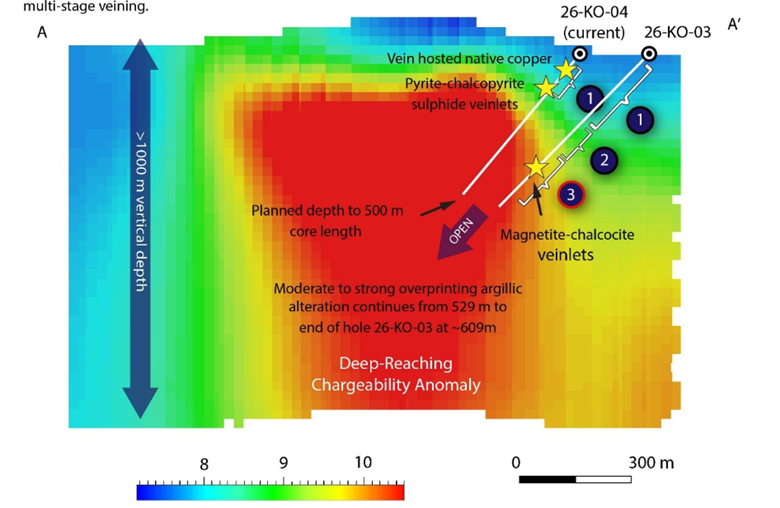
Northeast-southwest longitudinal IP chargeability section through holes 26-KO-03 and 26-KO-04 illustrating interpreted alteration zonation in 26-KO-03 and current 26-KO-04 together with the relationship of the drill holes to the deep-reaching chargeability anomaly. Hole 26-KO-04 is currently advancing southwestward toward the stronger portion of the anomaly.
In more recent Phase II drilling at Bertha North (such as hole 26-KO-04), the appearance of pyrite-chalcopyrite veinlets near the outer margin of the main chargeability anomaly shows that drilling is moving out of the low-temperature argillic alteration zone.
Porphyry systems commonly feature a pyrite-rich conductive core at depth where copper fluids leak upward and outward through faults. Intersecting mixed pyrite-chalcopyrite (copper iron sulphide) confirms the drill path is actively tracking the pathways of these copper-bearing hydrothermal fluids down toward the potassic-altered core.
The New Afton analogy provides a useful regional exploration analogue for Torr Metals’ Kolos Project. Located just 28 kilometres north-northeast of Bertha, New Afton is a premier silica-saturated alkalic copper-gold porphyry deposit.
Several geological features provide useful points of comparison with a New Afton-style alkalic copper-gold porphyry system:
Near-Surface Oxidation: At New Afton, weathering processes dissolved surface copper and washed it downward. This formed a high-grade, near-surface supergene copper zone directly overlying the deep, primary porphyry orebody.
Deep Vertical Corridors: Supergene zones usually sit flat and shallow, but at New Afton, oxidation plunges 400 to 500 metres deep in the west and surpasses 600 metres along major faults. Phase I drilling at Bertha has documented deep oxidation extending past 580 vertical metres.
The presence of high-grade copper at surface at Bertha provides another broad regional point of comparison with historical surface mineralization at New Afton.
The Picrite Boundary: Picrite is an important structural unit at New Afton and, at Bertha, the picrite contact is being evaluated as a potential structural control. The mechanical contrast between tough, brittle picrite and softer surrounding volcanic rocks may create long-lived fracture zones that can facilitate deep oxidation.
Fluid Conduits vs. Chemical Traps:
- North-Northeast Faults: May serve as deep plumbing pathways for magmatic-hydrothermal fluids.
- Northwest-Trending Contacts: Picrite boundaries may redirect fluids and locally influence the precipitation of native copper and chalcocite.
Beyond the shallow supergene zone, New Afton’s main copper-gold wealth is hosted within intense K-feldspar and biotite-dominant potassic alteration inside the Cherry Creek monzonite intrusion.
Torr Metals is using this style of geological model to guide its Phase II drilling at Bertha North. Recent drill holes have begun intersecting copper sulphides and potassic alteration along intrusive margins. These observations support continued testing for a higher-temperature magmatic-hydrothermal footprint consistent with a New Afton-style alkalic porphyry system.
In alkalic porphyry systems, matching high-chargeability and high-resistivity suggests secondary porosity from deep shattering and hydrothermal alteration. This serves as the direct geophysical signature of the deeply fractured pathways that allowed water to travel down and cook the rock.
Phase II drilling at Bertha North, Hole 26-KO-04, the appearance of pyrite-chalcopyrite veinlets near the outer margin of the main chargeability anomaly shows that drilling is moving out of the low-temperature argillic alteration zone.
Porphyry systems commonly feature a pyrite-rich conductive core at depth where copper fluids leak upward and outward through faults. Intersecting mixed pyrite-chalcopyrite (copper iron sulphide) confirms the drill path is actively tracking the pathways of these copper-bearing hydrothermal fluids down toward the potassic-altered core.
The New Afton geological analogy is the core exploration blueprint that Torr Metals uses at its Kolos Project. Located just 28 kilometres north-northeast of Bertha, New Afton is a premier silica-saturated alkalic copper-gold porphyry deposit.
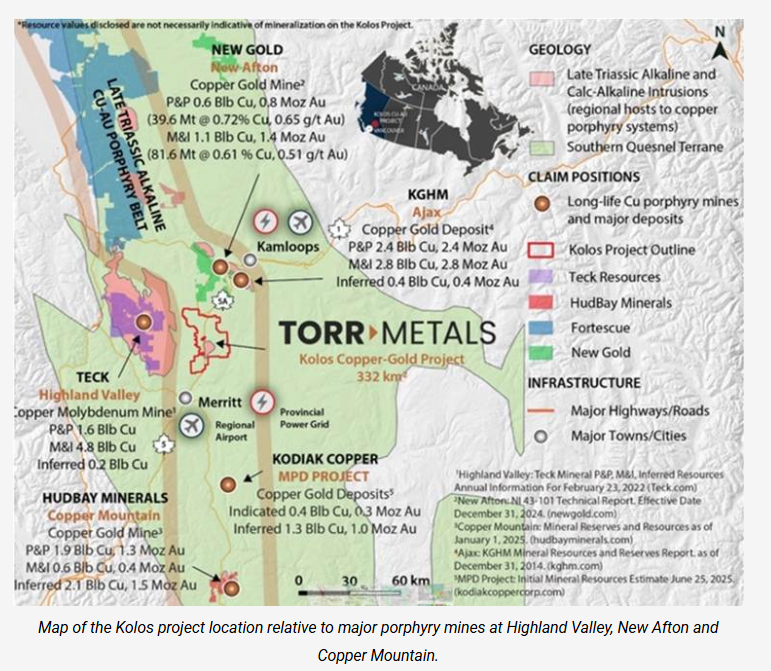
The physical, chemical, and structural blueprints match New Afton across three distinct layers:
The High-Grade Layer: At New Afton, weathering processes dissolved surface copper and washed it downward. This formed a high-grade, near-surface supergene enrichment cap directly overlying the deep, primary porphyry orebody.
Deep Vertical Corridors: Supergene zones usually sit flat and shallow, but at New Afton, oxidation plunges 400 to 500 metres deep in the west and surpasses 600 metres along major faults. Torr Metals’ drilling at Bertha has proven that its oxidation zone matches this exact behavior, extending past 580 vertical metres.
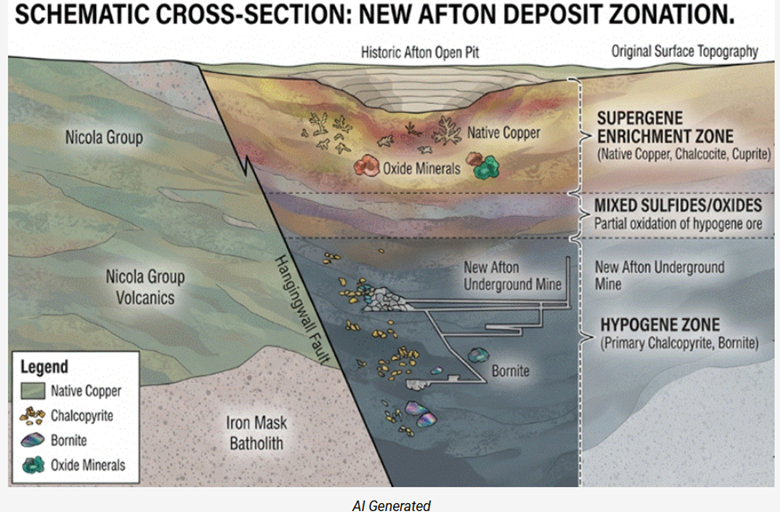
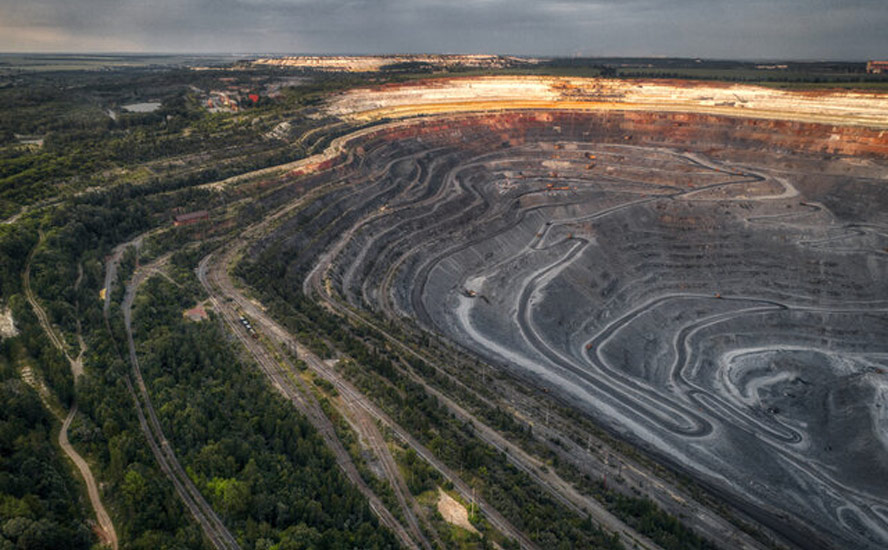
The surface of the Bertha target looks remarkably similar to New Afton’s historical exploration pits from the 1970s. Those original pits yielded ultra-high-grade copper-gold mining before operations moved underground.
The Picrite Boundary: In both deposits, the picrite unit acts as the essential structural wall. The mechanical contrast between tough, brittle picrite and softer surrounding volcanic rocks creates long-lived fracture zones. These fractures are what allowed surface water to dive hundreds of metres into the earth to build the deep oxidation zone.
Richard (Rick) Mills
aheadoftheherd.com

Subscribe to AOTH’s free newsletter
Richard owns shares of Torr Metals (TSXV:TMET). TMET is a paid advertiser on his site aheadoftheherd.com
This article is issued on behalf of TMET
Legal Notice / Disclaimer
Ahead of the Herd newsletter, aheadoftheherd.com, hereafter known as AOTH.Please read the entire Disclaimer carefully before you use this website or read the newsletter. If you do not agree to all the AOTH/Richard Mills Disclaimer, do not access/read this website/newsletter/article, or any of its pages. By reading/using this AOTH/Richard Mills website/newsletter/article, and whether you actually read this Disclaimer, you are deemed to have accepted it.