 RSS Subscribe
Silver North and Silver market update – Richard Mills
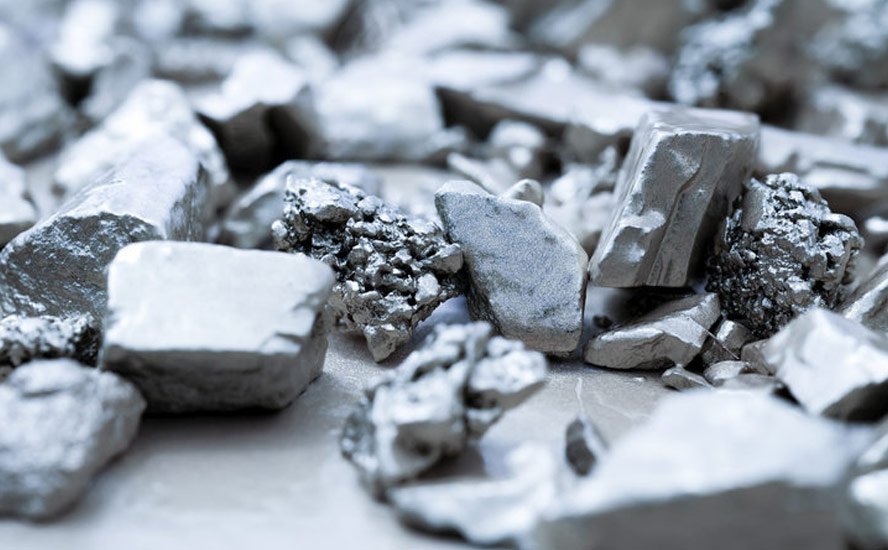
The silver market is experiencing a severe structural deficit, with demand consistently outstripping both primary mining output and recycling, leading to a sixth consecutive year of shortfalls.
When macro forces cause paper liquidations (like the heavy selloff we saw in October), silver gets hammered. But because industrial silver inventories have been in a structural deficit for consecutive years, physical buyers step in during deep price drops, using the physical crunch to overpower the paper-market short sellers.
For critical industrial inputs, physical reality always wins the tug-of-war in the end.
It’s estimated around 60% of silver is utilized in industrial applications like solar and electronics, leaving only 40% for investing.
Silver: 5 metals in one: Richard Mills
The amount of silver used by industry is climbing sharply — Richard Mills
Silver is the most conductive metal on the planet.
GE Reserve’s ‘Industrial Uses of Silver: Complete 2025 Guide’ says that “Silver’s unmatched electrical conductivity makes it essential for printed circuit boards, semiconductors, and electrical contacts. No viable substitute exists for applications requiring maximum conductivity in minimal space.”
Silver’s declining usage in photography has been replaced by silver needed for solar, solid-state batteries and new applications like AI data center chips, advanced electrical relays, smart grid infrastructure upgrades, and every US manufacturing facility. Silver is also heavily used in defense and health care.
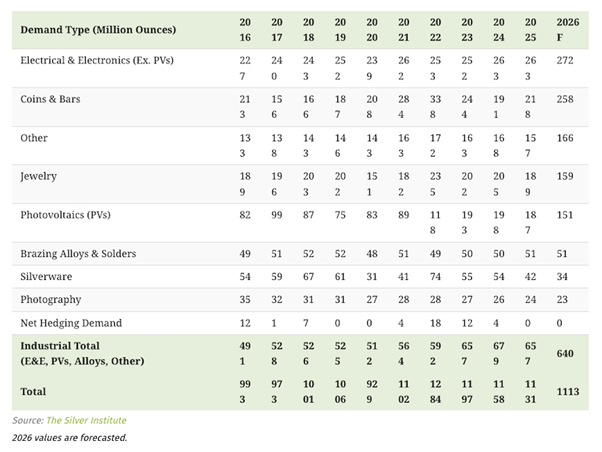
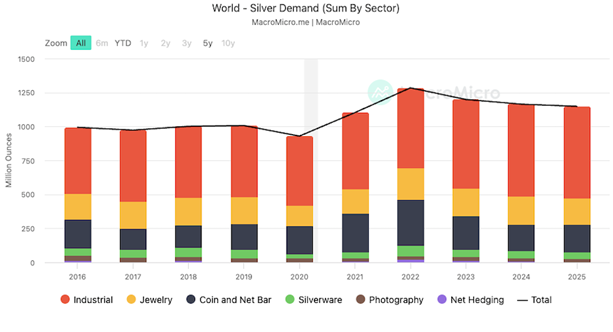
Between 2016 and 2026, the top drivers of silver demand were, in order of millions of ounces consumed, electrical & electronics, coins & bars, photovoltaics, other industrial, jewelry, photovoltaics, brazing alloys & solders, silverware and photography.
According to Visual Capitalist, industrial silver demand is forecast to reach 640 million ounces in 2026, accounting for nearly 58% of total demand, up from about 49% in 2016.
Net physical investment (coins & bars) is forecast to reach 258 million ounces in 2026, making it the second-largest source of silver demand after industrial uses.
Silver, like gold, is a precious metal that offers investors protection during times of economic and political uncertainty.
According to The Silver Survey 2026, “2025 was marked by exceptional gains in silver investment, driven by a combination of a supportive macroeconomic and geopolitical backdrop, favorable supply-demand fundamentals, and increasingly tight physical market conditions. Across all segments, growth in investor activity was most pronounced during the final four months of the year, when silver prices reached successive record highs. As a result, in value terms, the increase in silver investment in 2025 was even more impressive, with the combined total comfortably setting a new all-time record high.”
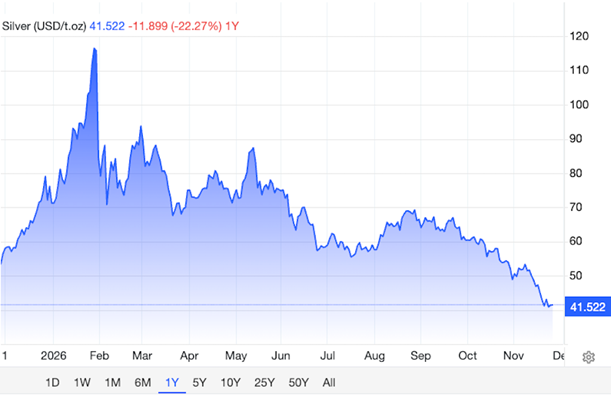
Safe-haven buying amid escalating geopolitical tensions drove silver to an all-time high on Jan. 29, 2026 of $121.67 per ounce. While silver prices have been cut by nearly two-thirds to around $41 as of this writing, the Silver Institute expects this weakness to be temporary.
“Regardless of the [Iran] conflict’s eventual outcome, ongoing US policy uncertainty, combined with elevated geopolitical and macroeconomic risks, is expected to continue supporting portfolio diversification into precious metals,” the Silver Survey 2026 states.
Silver ETP [exchange-traded products] inflows last year were the second highest on record and the highest in value terms.
As for investment in physical silver, it rose by 13% in 2025, marking the first annual increase in three years.
Silver deficit widening
Falling silver prices have disincentivized pure silver miners from producing more metal. Still, the silver market has been in deficit for the past six years, and the shortfall is widening.
According to the Silver Institute and Metals Focus, the new (Nov. 12 press release) projected deficit for 2026 is 35Moz.
Goldsilver notes that because silver wears two hats (monetary and industrial), a slowdown in one demand category doesn’t automatically end the deficit.
Moreover, six years of deficits have drawn 762.1 million ounces out of above-ground stockpiles. That reserve, not new mine supply, has absorbed the gap.
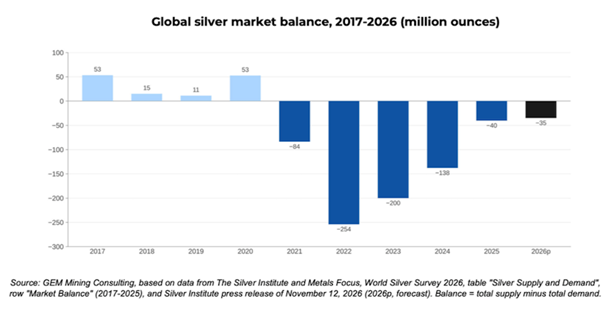
Why haven’t silver miners been able to shrink the deficit? The key reason has to do with the inability of the silver market to respond to increases in the price.
Between 2006 and 2011, inflation-adjusted silver prices surged 172%, while mine output increased by about 18%, according to GEM Mining Consulting. In 2024 industrial silver demand hit records, consuming 680 million ounces, yet mine production increased just 0.9%.
Byproduct metal
This goes against conventional wisdom that increases in commodity prices naturally spur higher production from mines. “The disconnect,” writes King Global, “stems from a structural reality most investors overlook: silver supply operates differently than almost any other commodity because of how the metal actually gets mined.”
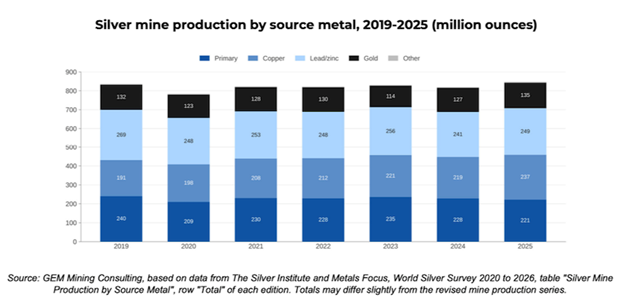
According to the U.S. Geological Survey, about 72% of mined silver arrives as a byproduct of operations focuses on other metals. In descending order, the metals are lead-zinc (29.4% of global silver in 2024), copper and gold. Primary silver mines accounted for only 27.8% of worldwide production the same year.
Two other facts from King Global are worth mentioning:
- In the United States, silver was produced at four primary silver mines and as a byproduct from 31 domestic base and precious-metal operations in 2024.
- Mexico remained the world’s largest silver producer at 185.7 million ounces, followed by China, Peru, Bolivia, and Chile. Most of this production flows from polymetallic operations where silver represents a secondary revenue stream.
A few examples illustrate the concept:
- A copper mine in Peru makes its decisions based on copper prices, whereas silver represents a byproduct credit. If silver prices double, the mine won’t double silver output because mine plans, equipment and orebodies were designed around copper extraction.
- Lead-zinc operations in Australia face similar constraints. Gold mines in Mexico operate on gold economics. The primary metal drives investment decisions, expansion plans, and production targets. Silver follows passively.
This creates what economists call inelastic supply, where quantity supplied responds weakly to price changes. Approximately 70% of silver production comes as a byproduct, limiting producers’ ability to respond to price signals by ramping up production.
Goldsilver agrees that “mine supply barely moves with price,” due to silver’s byproduct reality.
Chile is another good example. Between 2019 and 2025, silver production from its copper mines fell 10% despite a 95% increase in inflation-adjusted silver prices. Dedicated silver operations have also struggled, with output falling 7.9% over the same period due to declining ore grades and operational challenges.
A shortage of sulfuric acid is throwing another wrench into silver production. Silver recovered during the processing of zinc and copper concentrates relies heavily on leaching, which requires significant amounts of sulfuric acid. From CMC Markets:
Sulfuric acid is itself produced from sulfur, which often comes from oil and gas refining. This is where the link becomes systemic: any strain on energy supplies or crude oil flows (as we are currently seeing with geopolitical disruptions) directly results in a decline in sulfur production… and thus in sulfuric acid production.
In concrete terms, to simplify:
Less refined oil → less recovered sulfur → less available sulfuric acid → less ore processing capacity → less metal recovery… including silver.
While Metals Focus expects primary silver mines to add 6.5Moz this, year, mostly in Mexico, the additional ounces would cover less than one-fifth of 2026’s projected 35Moz shortfall.
Although, Deutsche Bank notes that rising silver inventories are providing a buffer against shortages, with London’s commercial vaults holding more than 914Moz at the end of August.
Solar usage declining
Another silver deficit is predicted for 2026 but next year it could be less or even revert to a surplus. That’s because of demand destruction caused by less usage of silver in solar panels. Record-high prices in January accelerated efforts by industrial consumers to reduce their reliance on the metal, a practice known as “thrifting”.
Canadian Mining Report asks whether investment buying can support prices despite a reduction in solar consumption:
BMO’s view is that investment demand stays a key pillar of the market but will fall short of offsetting the loss of solar demand, Kitco reported.
BMO sees the silver consumption surplus rising to a record high by 2030, and the bank expects solar to “give back roughly half of that increase by 2030, turning silver’s biggest recent growth engine into an outright drag.”
Solar accounted for 55% of the increase in silver demand in the past five years, the publication notes.
The Silver Institute said earlier this month that industrial demand in 2026 is forecast at 640Moz, down 3% from 657Moz. Bloomberg reports that PV silver demand is set to slump 21% this year.
In a fourth quarter update, BMO said faster-than-expected thrifting and slower solar deployment were loosening industrial imbalances, and it expects silver to keep underperforming gold in the coming quarters.
A Reuters poll of 30 analysts and traders published Oct. 27 put silver’s yearly averages at $70.30 for 2026 and $66.75 for 2027, Canadian Mining Report states.
Silver undervalued, oversold
While a silver rally does not appear imminent, there are those who point out the metal is undervalued. A Nov. 22 post on Goldseek points out that silver settled at $41.08, representing a 66% fall from silver’s record-high $121.78 reached in late January.
Compare this to the S&P 500’s high-to-low correction of -12.3%. Yet even at 6,910 (now 7,182), “the S&P is actually more overvalued today than ‘twas on 28 August at 7,712.”
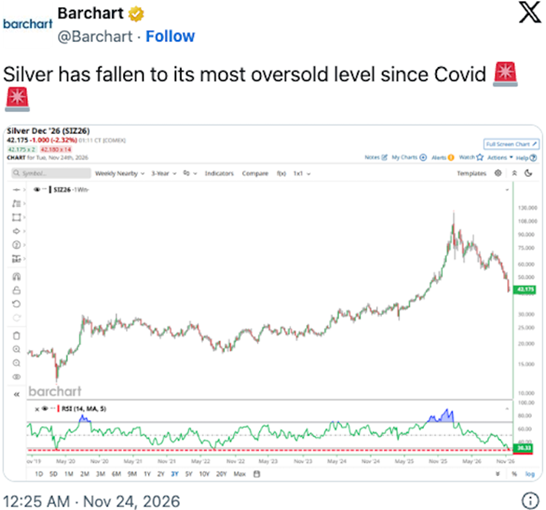
Gold Republic notes that “leveraged positions and forced selling amplified the subsequent decline” after silver’s record high and points out that “the silver market is considerably smaller and less liquid than the gold market. As a result, large capital flows can cause relatively sharp price movements.”
Sounding a more positive note, Gold Republic says that while the current crisis around AI investment poses a risk to silver due to the metal’s heavy usage in data centers and other related infrastructure, the 2008 financial crisis showed that silver is particularly vulnerable during financial panic. At the time, the precious metal lost more than half of its value.
Yet a remarkable turnaround followed. Central banks cut interest rates and introduced large-scale stimulus measures. In the years that followed, silver embarked on a spectacular rally.
A similar scenario is conceivable if problems around AI investment spill over into the wider economy and financial markets. The initial reaction may be negative, but any rate cuts and monetary easing could create favourable conditions in the longer term.
Silver North Resources (TSXV:SNAG, OTCQB:TARSF, FSE: I90) has announced its second batch of analytical results from the 2026 drill campaign at its flagship Haldane Silver Project in the historic Keno Hill Silver District, Yukon.
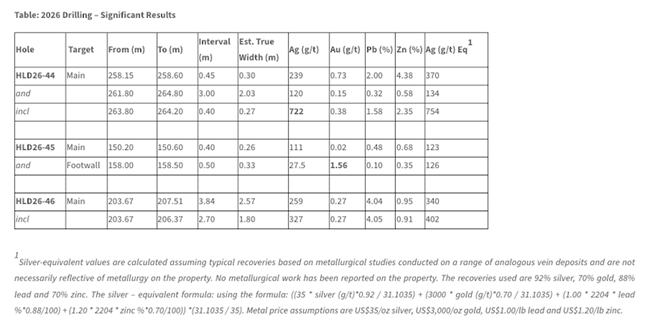
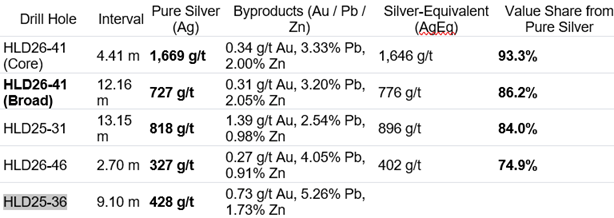
Five holes testing the Main Fault and the Main Fault footwall have been received. Mineralization has now been extended 100 meters along strike to the southwest by HLD26-46, which intersected 2.7m of 327 g/t silver, 0.27 g/t gold, 4.05% lead and 0.91% zinc (402 g/t AgEq) from 203.67m down hole. A total of 24 holes totaling 6,169m were completed in the 2026 program, focusing on expanding silver, gold, lead and zinc mineralization along strike and down dip at the Main Fault target. Assay results for 16 holes remain outstanding.
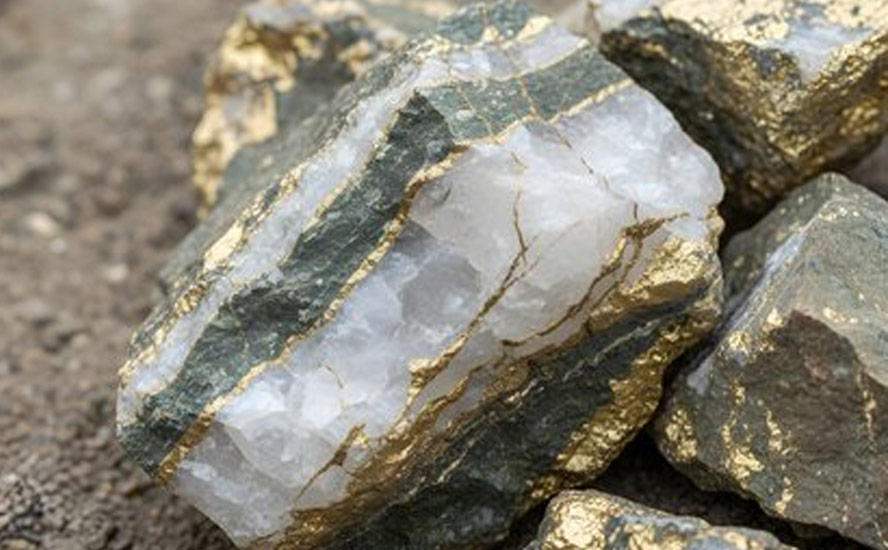
The road-accessible, 8,579 hectare Haldane property is located 25 km west of Keno City, YT, adjacent to Hecla Mining’s producing Keno Hill silver mine. Haldane hosts several occurrences of silver-lead-zinc-bearing quartz siderite veins resembling the ore-bearing veins being mined at Keno Hill.
“Step-out drilling to the southwest from the Main Zone discovery section continues to intersect broad Main Fault structure,” said Jason Weber, Silver North’s president and CEO, in the Nov. 10 news release. “Strong, wide structures tend to be better hosts for Keno-style silver-lead-zinc mineralization and that appears to be consistent as we move southwest. We feel quite confident that the structure hosting the Main Fault has significant potential along strike in both directions as well as down dip.”
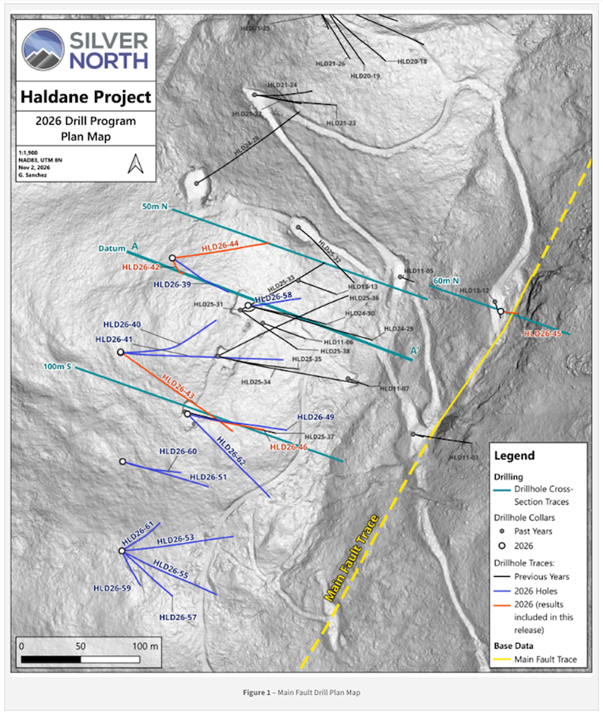
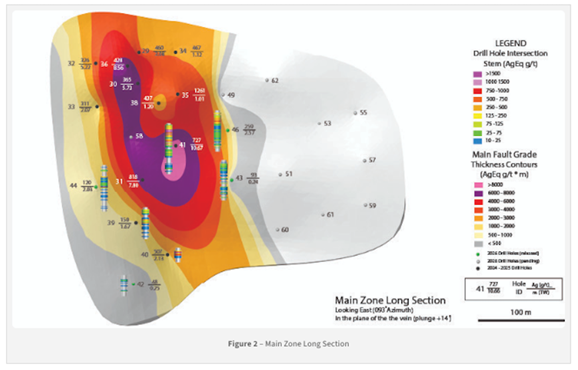
HLD26-43 and 46 tested the Main Fault approximately 100m along strike to the southwest of the discovery section (HLD24-29, 30 and HLD25-31). HLD26-46 intersected the Main Fault at 203.67m, with a 2.70m (1.8m TW) intersection of 327 g/t silver, 0.27 g/t gold, 4.05% lead and 0.91% zinc within the wider 3.84m (2.57m TW) intersection mentioned above.
The entire width of the Main Fault structure intersection totaled 22.2m (14.85m TW), with the strongest veining occurring in the hanging wall portion of the structure. HLD26-43 intersected the Main Fault structure approximately 50m down dip, cutting a similarly wide 22.3m (16.5m TW) of structure that appears less coherent and with lesser amounts of siderite-sulfide veining.
HLD26-45 tested below the footwall of the Main Fault. Prior drilling and surface sampling indicated the potential for vein mineralization in the footwall of the Main Fault, either as parallel structures or splays of the Main Fault itself. HLD26-45 was collared in the footwall damage zone of the Main Fault, intersecting three narrow mineralized structures between 150.2m and 166.8m depth.
One 0.50m (0.33m TW) intersection at 158m down hole returned 1.56 g/t gold with 27.5 g/t silver — a gold/silver ratio much higher than normally observed on the property. These intersections are thought to be reflected on surface where grab sampling has returned 0.906 g/t gold, 288 g/t silver, 1.95% lead and 1.80% zinc. Figure 1 shows a plan view of drill hole locations at the Main Fault target. A long section depicting the Main Fault is shown in Figure 2. A table of drill hole collar data can be found on the company’s website.
HLD26-42 and 44 tested the Main Fault northeast of the discovery section, intersecting the Main Fault 50m along strike (HLD26-44) and 120m downdip (HLD26-42) of HLD25-31. HLD26-44 intersected the upper contact of the Main Fault at 253.9m, cutting strongly fractured and faulted phyllitic quartzite, quartzite and lesser veining over 24.1m (16.3m TW). A 3.00m (2.03m TW) interval returned 120 g/t silver, 0.15 g/t gold, 0.32% lead and 0.58% zinc with a subinterval averaging 722 g/t silver over 0.40m (0.27m TW). Further work in this area will focus on evaluating the presence of a cross structure to the northeast that may be influencing the Main Fault locally.
Conclusion
What’s important to remember from the supply side is that with input costs up (diesel), some mines need higher prices to survive. If production is curtailed or high grading starts, production could actually fall below forecast levels at these prices or if mine-life is shortened because lower grade ounces get left in the ground, effectively sterilizing them until prices rise to very high levels. In reality not a lot changes …demand may level off but so might production.
Something else to remember on the supply side is that explorers raise money for their yearly exploration and drilling budgets. They budget a certain amount of dollars for a drilling program of so many meters. Because input costs, like diesel, have gone up, exploration and drilling on many projects has been cut back putting off work until the next year. Delays in advancing projects is going to effect future production.
Companies with full treasuries, like Silver North, were able to fully accomplish 2026’s drilling goals and SNAG is also fully funded for 2027’s program.
Silver North is also positioned as a pure-play primary silver explorer—a rarity in the junior mining sector, where most “silver” companies derive the bulk of their value from gold, lead, zinc, or copper byproducts.
Multi-metal juniors rely on base metals (zinc/lead) or gold to offset mining costs, which buffers downside but dilutes upside during a silver price spike. Pure-play silver explorers offer maximum torque to silver spot prices, though veins like Haldane still carry minor gold, lead, and zinc credits.
Silver North has demonstrated high structural hit rates on its Main Fault target—intersecting the mineralized fault zone in nearly every hole drilled on the structure across 2025 and 2026—with pure silver accounting for roughly 71% to 93% of the total recoverable metal value in its key drill intercepts.
Operating in the Yukon does entail seasonal drilling windows and higher logistical costs but Haldane benefits from existing road access (Silver Trail Highway) and proximity to an active mill (Hecla’s Keno Hill), creating a clear M&A path if a 25–35+ million ounce resource is delineated.
Assays for the remaining 16 holes from the 2026 program (including four holes testing the blind Bighorn target 3 km away) are still pending.
Silver North Resources
TSXV:SNAG, OTCQB:TARSF, FRA:I90
Cdn$0.165 2026.11.26
Shares Outstanding 108.0m
Market Cap Cdn$17.5m
SNAG website
Richard (Rick) Mills
aheadoftheherd.com

Subscribe to AOTH’s free newsletter
Richard does not own shares of Silver North Resource (TSX.V:SNAG).
SNAG is a paid advertiser on his site aheadoftheherd.com
This article is issued on behalf of SNAG
Legal Notice / Disclaimer
Ahead of the Herd newsletter, aheadoftheherd.com, hereafter known as AOTH.Please read the entire Disclaimer carefully before you use this website or read the newsletter. If you do not agree to all the AOTH/Richard Mills Disclaimer, do not access/read this website/newsletter/article, or any of its pages. By reading/using this AOTH/Richard Mills website/newsletter/article, and whether you actually read this Disclaimer, you are deemed to have accepted it.