 RSS Subscribe
Cosa identifies significant anomalies at the Astro uranium project, Athabasca Basin, Saskatchewan – Richard Mills
Cosa Resources (TSXV:COSA, OTCQB:COSAF) this week announced the results of a summer ambient noise tomography (ANT) survey at the Astro Project located in the eastern Athabasca Basin approximately 28 kilometers west of Cameco’s McArthur River uranium mine.
The survey and supporting work were funded by Cosa’s partner, Global Uranium Corporation, per the option agreement announced by the company on April 9, 2025. Global has the right to earn up to an 80% interest in the Astro Project by funding $9.5 million in exploration expenditures and completing cash and share payments.
Cosa highlights extensive velocity anomalies located along the AS-1 conductive corridor may represent alteration in the lower sandstone consistent with a prospective eastern Athabasca geological setting.
Modeled unconformity surface indicates up to 250 meters of unconformity relief adjacent to velocity low anomalies, potentially representing significant structure.
A priority target area has been identified as possible drill target.
Survey and supporting work were fully funded by Global, with follow-up ground-EM in planning.
“The ANT survey at Astro successfully identified zones of anomalous seismic velocity at the AS-1 conductive trend. These results suggest extensive low velocity zones which may represent significant hydrothermal alteration in the lower sandstone and which generally parallel both the AS-1 conductive trend and prominent magnetic features in the area, an ideal setting for large uranium-bearing structures in the eastern Athabasca. The potential combination of parallel and juxtaposed magnetic and conductive features, velocity low anomalies reflecting alteration, and significant unconformity topography clearly prioritizes northeastern AS-1 for continued exploration. We are excited to continue working with our funding partner, Global Uranium, towards a drilling program in 2027,” Cosa’s VP, Exploration Andy Carmichael stated in the Nov. 24 news release.
ANT survey results
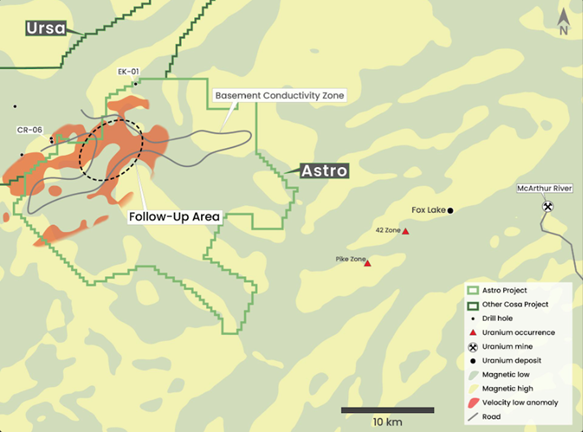
The AS-1 conductive trend (Figure 2) was identified by a project-wide airborne survey completed in 2025 and was prioritized for follow-up based on the presence of east-northeast trending conductors with several bends in strike, a structural setting that underpins many of the eastern Athabasca’s uranium deposits.
Eastern Athabasca uranium deposits are commonly enveloped by alteration zones many times larger than the deposits themselves. Since unaltered and unstructured Athabasca sandstones are relatively homogenous, variations in seismic velocity may be due to faulting and/or alteration. ANT surveying was completed over all of AS-1 to identify velocity anomalies over the 15-kilometer-long zone of basement conductivity (Figure 2).
The ANT survey and data modeling were completed by CAUR Technologies of Quebec. Forty days of ambient seismic noise data recorded by 298 seismic nodes was processed to generate high-resolution 3D models of the sub-Athabasca unconformity surface and shear wave velocity in the sandstone and basement.
The 3D unconformity model indicates up to 250 meters of unconformity topography across the survey area, which may represent large structural offsets like that which underpins Cameco’s McArthur River uranium mine 28 kilometers east of Astro. The modeled unconformity depth is within 35 meters of the actual depth in all three historical drill holes within the survey area, increasing confidence in the model.
Sandstone velocity models show widespread and continuous low velocity anomalies along the northeastern half of the AS-1 conductive trend which may reflect hydrothermal alteration typical of eastern Athabasca uranium deposits. These anomalies lie along the edges of the AS-1 conductive trend and are conformable to the edges of magnetic highs in the survey area.
Next steps
Plans are currently being finalized for a partner-funded, ground-based electromagnetic (EM) survey expected to commence in Q1 2027. Targets generated from the ground EM survey are expected to guide inaugural drilling, tentatively scheduled for summer 2027.
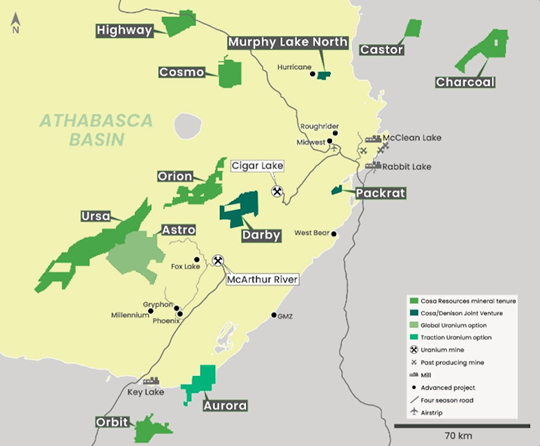
Astro Project
The Astro Project is located roughly 28 kilometers west of Cameco’s McArthur River mine, the world’s largest high-grade uranium mine, and approximately 10 kilometers west of CanAlaska Uranium’s Pike Zone which boasts world-class intersections. (Figure 2) Only one historical drill hole, EK-01, has been completed on the project.
EK-01 failed to explain the strong conductive response it was targeting, suggesting the hole was not ideally located. The historical drill log notes favorable features in the sandstone including a brecciated and silicified interval in the upper portion, decameter-scale intervals of illite-dominated clay mineralogy throughout, and moderately bleached and slightly friable intervals in the lower 150 meters. All features are commonly associated with unconformity-related uranium deposits of the Athabasca Basin. Roughly 11 kilometers to the southwest of EK-01 and within 700 meters of the Astro Project, strongly anomalous uranium geochemistry and pervasive hydrothermal alteration was intersected in the lower to medial sandstone of historical drill holes CR-06 and CR-15. Based on regional drilling, the depth to the unconformity at Astro is estimated to be between 850 and 975 meters.
Uranium market
Uranium futures rose were at $90 per pound in November, holding the steady increase since February this year on strong demand in the long term. The world’s top producer Kazatomprom posted a 25% growth in sales turnover in the third quarter, amid an increase in sales volumes and a 17% jump in its average prices. This was consistent with the International Atomic Energy Agency’s upward revision of global nuclear capacity over the next two decades, taking in more uranium. The agency noted that there are currently 78 nuclear reactors under construction as major economies pile into alternative power sources to achieve decarbonization goals and limit exposure to volatile commodity markets due to geopolitical tensions in Russia and the Middle East. Italy was the latest to express interest in approving a legal framework to restore nuclear power, while Meta, Amazon, and Microsoft signed agreements to secure fresh nuclear capacity for their future AI data center operations. (Trading Economics)
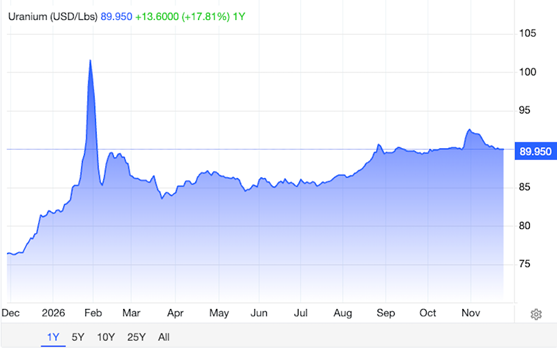
There is currently a disconnect between the spot uranium price, up 10% since the start of the year, and uranium miners and explorers, which have seen their share prices plummet. The same disconnect applies to the uranium term price — the monthly reported price which best reflects contract terms between nuclear power utilities and miners —which is at a multi-decade high of US$98/lb.
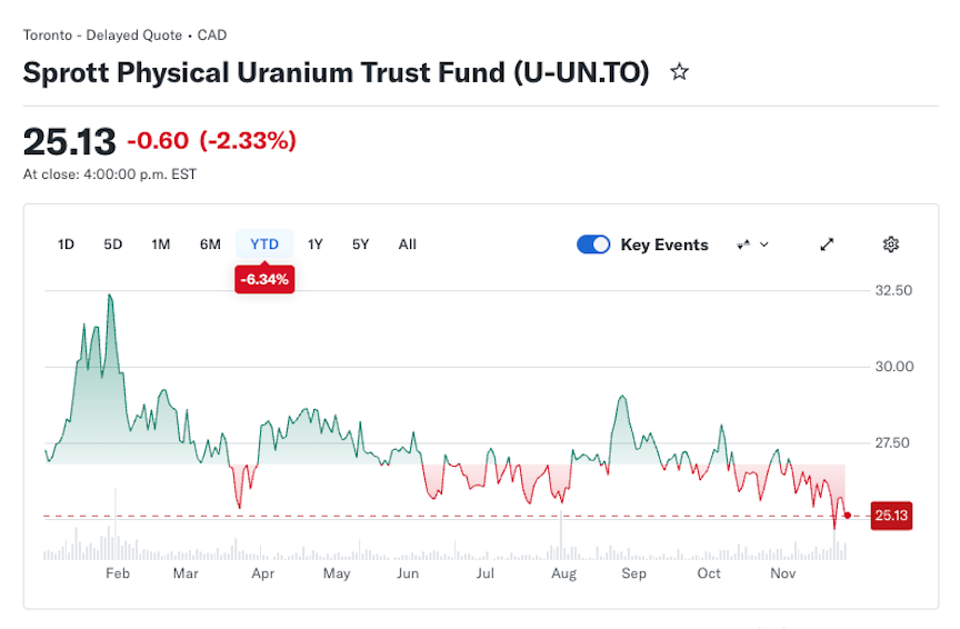
The Sprott Physical Uranium Trust (SPUT) (TSX:U-UN) acts as a direct benchmark for physical U3O8 value, helping investors spot when uranium mining stocks lag behind underlying commodity prices. As of November 24, 2026, SPUT units trade at roughly a 16.3% discount to Net Asset Value (NAV) — USD$18.02 market price vs. USD$21.55 NAV (and CAD$25.73 vs. CAD$30.75 NAV)—signaling broad liquidity stress across both physical and equity uranium vehicles.
We can also take a look at the Sprott Uranium Miners ETF (NYSE:URNM), which serves as a proxy for how undervalued the sector is. URNM is down a whopping 35.7% year to date, trading near a 52-week low of $32.93.
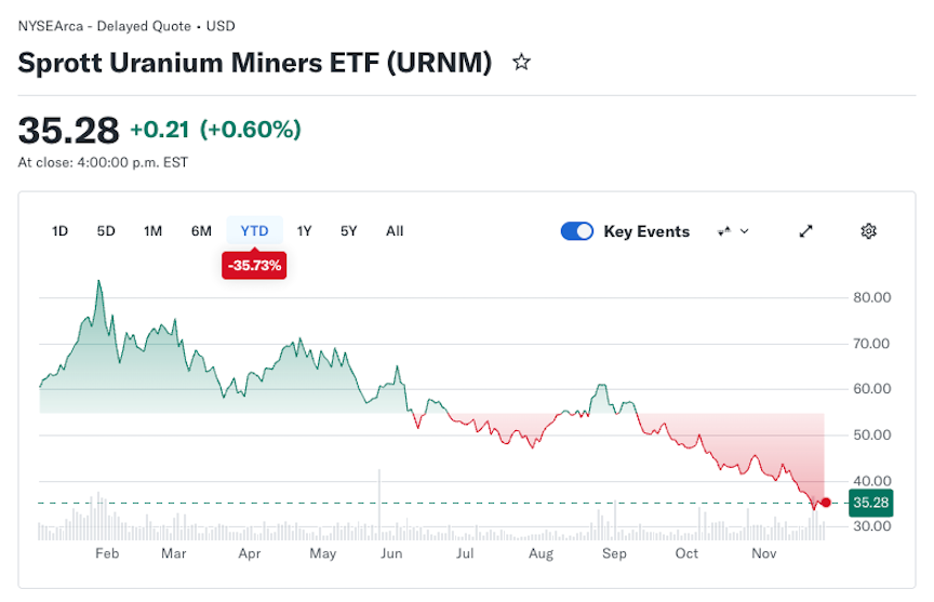
The median among seven larger producers and developers (Paladin, Energy Fuels, Uranium Energy, Ur-Energy, enCore, NexGen and Denison) is down 36%.
So, what is behind the disconnect? According to Stockhead, the main perception is that uranium mines take longer than other metal mines to be developed, due to higher environmental, safety and permitting standards. But the development discount isn’t necessarily fair, given it can take longer for a copper mine to get up and running — up to 18 years compared to 15 to 20 for a uranium mine.
At the same time, regulatory support for nuclear power has grown in the past two years. To meet government goals, the World Nuclear Association estimates 548GWe of capacity not yet planned or proposed will be needed by 2040. That’s a massive signal that higher uranium prices are needed, with Benchmark earlier this year tipping thick deficits will emerge as soon as 2027.
If the overhang is unfair then uranium explorers, properly funded, have a much better chance of moving up the ‘Lassonde Curve’ from discovery through development and into production than the market is giving them credit for.
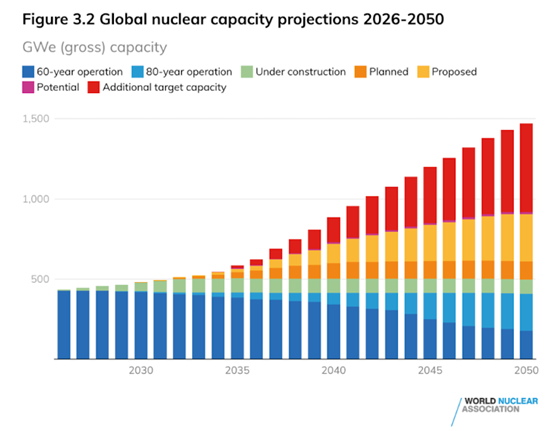
Another source explains that four factors are pushing the uranium price up: utilities have a lot left to buy; new mines are getting harder to finance; buyers are paying more for later delivery; and the spot market is thin.
As for why stocks are falling, there are also four principal reasons: producers are paid on old contracts; utilities are contracting slowly; generalist money has left resource stocks; and the Sprott Physical Uranium Trust has stopped buying.
When the gap will close depends on term contracting, realized prices, the Sprott discount, project decisions, and money flows.
“For exploration companies, both sides of this split land hardest. Explorers have no revenue to catch up, so they depend entirely on investor money, which is exactly what has left. But the 1.3 billion pounds that must come from mines not yet identified is the clearest statement of why exploration matters. Somebody has to find them.
The price has already moved. For the stocks to follow, the contracts and the money need to move too.”
A deeper analysis is provided by Sprott’s Paul Wong, who wrote in the ‘Sprott Uranium Report’ that liquidity pressures appear to have driven the selloff: “Elevated volatility, deleveraging and pressure on high-beta small-cap equities appear to be driving uranium-mining equities, which are trading more in line with broader risk assets than underlying uranium fundamentals.”
Here are the most important paragraphs and charts in Wong’s report:
[U]ranium miners are experiencing a drawdown comparable to that of a broad-market correction, but without a similar decline in either the broader equity market or the underlying commodity. Other technical measures also point to deeply oversold conditions. The defining feature of the current setup, therefore, is the widening disconnect between stable-to-improving uranium fundamentals and sharply deteriorating uranium-equity prices.
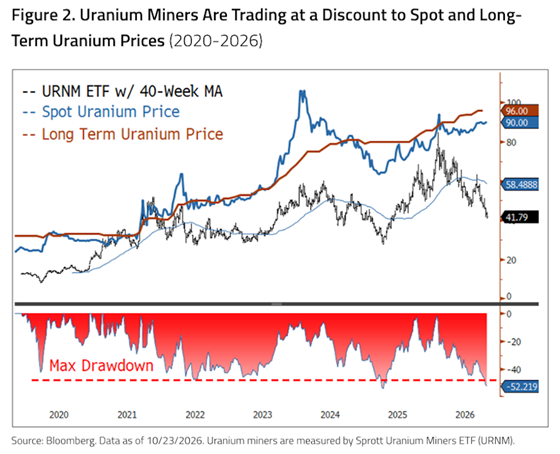
Modern market structure can produce abrupt price moves that have little immediate connection to company-specific fundamentals. When volatility rises, leveraged investors reduce gross exposure, risk managers cut position limits, and systematic strategies sell assets with high realized volatility. The result is indiscriminate liquidation: what can be sold is often sold before investors distinguish between strong and weak fundamental stories.
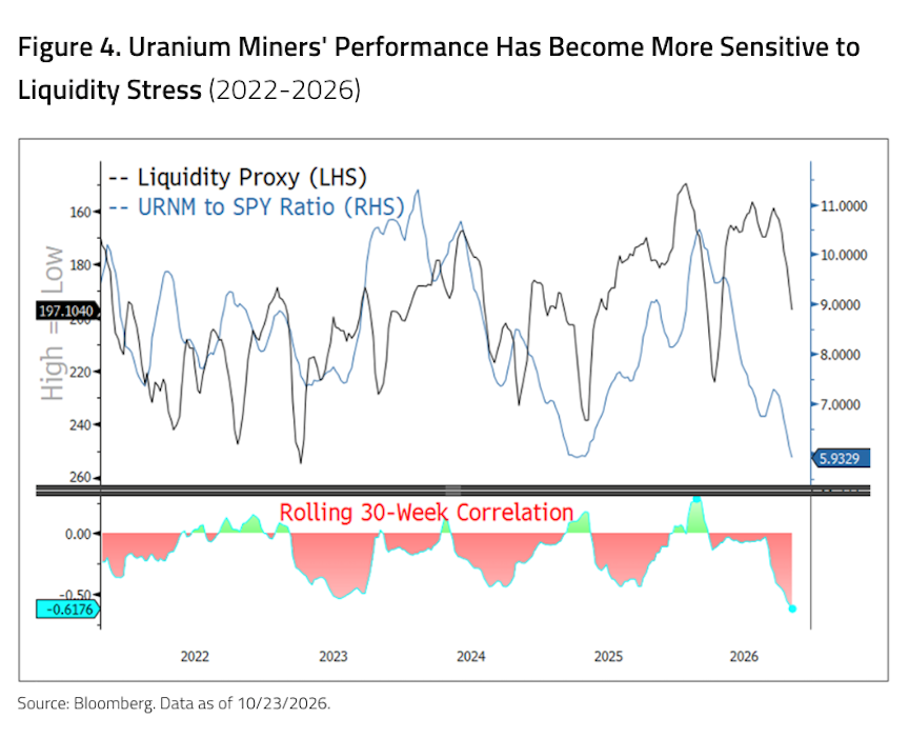
Our liquidity-pressure proxy combines the MOVE Index, which captures Treasury-market volatility and associated funding or collateral stress, with the VVIX Index, a measure of volatility-of-volatility, that provides an indication of hedging demand. It is not a direct funding-market indicator, but it provides a practical gauge of the conditions that often force position reduction. The ratio of URNM to the S&P 500 Index has broadly moved in line with this proxy, while the rolling correlation has recently turned strongly negative.
In other words, the relative performance of uranium miners is currently behaving more like a liquidity trade than a uranium trade, as shown in Figure 4.
Wong summarizes:
The uranium-miner correction appears to be a liquidity-driven dislocation layered over an improving physical uranium market and contracting backdrop. The near-term risk is that deleveraging remains dominant, pushing valuation ratios beyond historical extremes. The longer-term opportunity is that uranium prices have held while miners have repriced sharply lower. If liquidity conditions stabilize, the sector should again trade on the variables that ultimately determine value: contract pricing, production, project economics and the widening need for secure uranium supply.
The long-term fundamentals for uranium certainly appear bullish. Here’s Canadian Mining Report on the reasons why:
The uranium market is in a structural deficit. Global mine production is insufficient to meet reactor demand, and the gap is widening as nuclear energy gains policy support worldwide. The uranium sector outlook remains constructive, with demand growth driven by:
- Reactor life extensions and uprates in existing fleets.
- New builds, particularly in Asia (China, India) and emerging markets.
- Rising electricity demand from AI data centers, electrification, and energy security priorities.
- Policy shifts favoring nuclear as a low-carbon baseload source.
On the supply side, new mine development faces long lead times (10+ years), high capital costs, and permitting challenges. Existing mines are maturing, and restarts have largely been exhausted. Kazakhstan dominates production, creating concentration risk, while Western producers are ramping up but remain limited in scale. This supply deficit supports higher uranium spot prices over time. Term prices (used for long-term contracts) have also risen, reflecting utilities’ growing focus on supply security. The uranium bull market is driven by these fundamentals rather than short-term speculation.
Warren Gilman, chairman and CEO of Queen’s Road Capital, “remains bullish on uranium, arguing that out-of-favor uranium equities offer buying opportunities despite relatively strong underlying prices,” states a summary of a recent Kitco Mining Interview at Deutsche Goldmesse 2026 in Frankfurt, Germany.
Conclusion
One company working hard to drill a discovery during this market disconnect period, between uranium prices and uranium equities is Cosa Resources.
The top part of the article explains the progress the company is making at its Astro Project, thanks to an option agreement with joint-venture partner Globa Uranium Corporation. Global has the right to earn up to an 80% interest by funding $9.5 million in exploration expenditures. Cosa operates the project and has significant exposure to discovery success without any dilution required to advance the project.
Cosa has a large stable of wholly owned and partner-funded projects. Murphy Lake North, or MLN, is a joint venture with Denison Mines where mineralization was intersected just 5 km east of the Hurricane deposit. The Darby JV features abundant drill targets west of the Cigar Lake mine. And Packrat is another Denison JV that is underexplored and under limited sandstone cover.
In November Cosa completed partner-funded diamond drilling its joint ventured Aurora uranium project in the southeastern Athabasca Basin of Saskatchewan, east of Cameco’s Key Lake mill and historical mine. The Aurora is another earn-in project that Cosa operates which offers significant upside with no dilution.
Cosa starts drilling partner-funded Aurora Project, Athabasca Basin – Richard Mills
Cosa earlier this month released results from the summer drill program at Darby, which highlighted the Gamma and Bravo trends for follow-up winter work and continues to demonstrate the prospectivity of Darby as a discovery-ready project alongside Murphy Lake North.
Highlights from summer drilling at MLN include:
- Multiple zones of structurally controlled alteration and elevated radioactivity remain open along strike for several hundred meters and on multiple sections.
- Drilling evaluated multiple structures over 650 meters of strike length, with all 13 drill holes intersecting strong structure and/or alteration.
- Summer 2026 drilling prioritized unconformity targets with significant room for basement-hosted mineralization remaining.
Follow-up drilling for both Darby and Murphy Lake North is tentatively scheduled to commence simultaneously in January.
Junior resource companies are all about discovery, and management with the skills and experience needed for success at the drill bit.
Cosa’s award-winning management team has a long track record of success in Saskatchewan. In 2022, members of the Cosa team were awarded the AME Colin Spence Award for discovering IsoEnergy’s Hurricane deposit. All four individuals — Andy Carmichel, Craig Perry, Steve Blower and Justin Rodko — are part of Cosa’s team.
Prior to Hurricane, Cosa personnel led teams or had integral roles in the discovery of Denison Mines’ Gryphon deposit and held key roles in the founding of both NexGen Energy and IsoEnergy.
In January of 2025, the company entered a strategic collaboration with Denison Mines that has secured Cosa access to several highly prospective eastern Athabasca uranium exploration projects.
Cosa has acquired a 70% interest in and will operate the Murphy Lake North, Darby and Packrat uranium projects. Denison Mines will remain as minority contributing partner.
Denison offers strong corporate, technical, and financial support to Cosa through participation in equity financings and joint venture funding.
If you’re looking for discovery potential in an undervalued sector, Cosa Resources, in my opinion, offers a rare opportunity. The company is well-funded with CAD$15 million in the bank, and a shareholder base that includes 19% ownership by Denison, 17% management and advisors, 31% funds and strategic, and 33% retail.
Cosa Resources Corp.
TSXV:COSA, OTCQB:COSAF
Cdn$0.235 2026.11.25
Shares Outstanding 136.7m
Market Cap Cdn$31.5m
COSA website
Richard (Rick) Mills
aheadoftheherd.com

Subscribe to AOTH’s free newsletter
Richard does not own shares of Cosa Resources Corp. (TSXV:COSA). COSA is a paid advertiser on his site aheadoftheherd.com This article is issued on behalf of COSA
Legal Notice / Disclaimer
Ahead of the Herd newsletter, aheadoftheherd.com, hereafter known as AOTH.Please read the entire Disclaimer carefully before you use this website or read the newsletter. If you do not agree to all the AOTH/Richard Mills Disclaimer, do not access/read this website/newsletter/article, or any of its pages. By reading/using this AOTH/Richard Mills website/newsletter/article, and whether you actually read this Disclaimer, you are deemed to have accepted it.