 RSS Subscribe
The amount of silver used by industry is climbing sharply – Richard Mills
2026.05.16
According to GR Reserve, “Industrial applications consumed 680 million ounces of silver in 2024, representing 59% of total global demand. This marks a dramatic shift from just a decade ago when industrial uses accounted for roughly half that share.
Silver’s unique properties make it irreplaceable across critical industries. The metal conducts electricity and heat better than any other element while offering natural antimicrobial characteristics and exceptional reflectivity. These qualities create persistent demand regardless of economic cycles.
Electronics, solar energy, electric vehicles, and medical devices now depend on silver for core functionality.”
Electronics
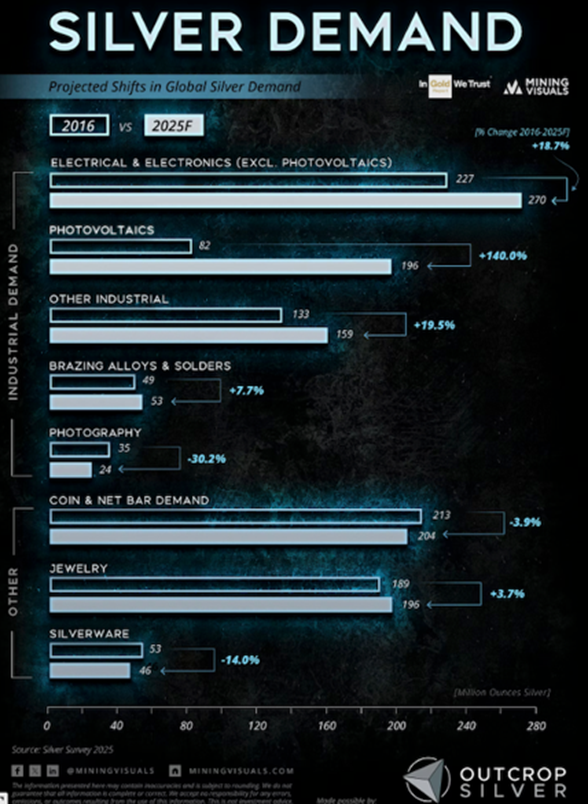
The Silver Survey 2025 and accompanying infographic shows that electrical and electronics is the single largest silver consumer. The sector represents about a third of total silver demand.
GE Reserve’s ‘Industrial Uses of Silver: Complete 2025 Guide’ says that “Silver’s unmatched electrical conductivity makes it essential for printed circuit boards, semiconductors, and electrical contacts. No viable substitute exists for applications requiring maximum conductivity in minimal space.”
Every smartphone, laptop and television contains silver in critical components. Phones contain 200-300 milligrams per device in circuitry and connections; laptops and tablets have 750 mg in motherboards and interfaces; TVs 1-2 grams per unit in display technology and processors; gaming consoles 2-3 g due to advanced graphics processing; and servers have higher concentrations supporting data center infrastructure.
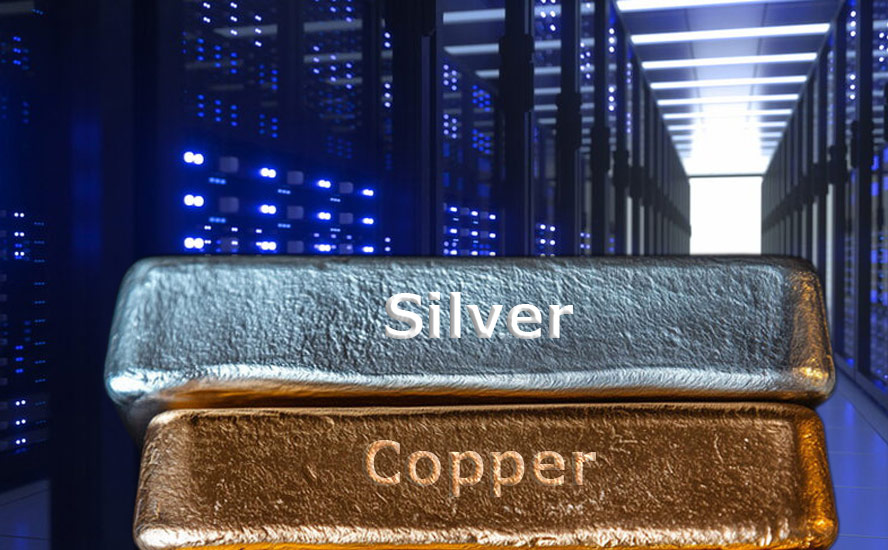
The guide says “Data centers represent the fastest-growing electronics category for silver consumption. Cloud infrastructure, high-speed networking equipment, and thermal management systems all require silver’s superior performance characteristics. The rise of AI computing intensifies these requirements.
AI workloads demand more processing power and generate more heat than traditional computing. Silver’s combined electrical and thermal conductivity makes it essential for managing both challenges. Industry projections suggest data center silver consumption could increase by millions of ounces annually as AI infrastructure expands globally.”
Boab Metals names semiconductors, IoT (Internet of Things) devices and cabling among emerging technologies that are driving silver demand. A few points on each:
- Semiconductors: As the most conductive metal on earth, silver is used in semiconductor chips, printed circuit boards, CPUs, and mobile phones. Demand for consumer technology isn’t slowing down. Since 2020, the world has been facing a shortage of semiconductors. Almost all devices contain at least a few milligrams of silver, and there’s no viable alternative in electronics.
- IoT devices. Like semiconductors, IoT (Internet of Things) devices use silver in electricity transfer. With the increasing prevalence of technology in industrial applications, plus 5G infrastructure rolling out worldwide, there are more connected devices than ever coming online. The Silver Institute says demand for silver in 5G technology like IoT and semiconductors will increase by 200% in a decade, reaching 23 million ounces by 2030.
(Silver’s exceptional conductivity and reliability make it pivotal in the development of 5G networks. In turn, the high-speed, low-latency connectivity of 5G enables advanced technologies like Internet of Things (IoT) sensors, which can be used to monitor emissions, water leakage, fuel and energy consumption, and more, all in real time. Studies have shown that IoT sensors and other “Industry 4.0” digital technologies can provide the insights and automations needed to reduce energy consumption and carbon footprint, improve air quality, and decrease waste across many industrial sectors. (Mint)
- Cabling. Silver’s unbeatable conductivity makes it more effective than copper in high-performance wires and cables. From recording studios to aircraft, and even in aerospace applications, silver-core cables are a proven solution for high-fidelity information transmission.
According to The Silver Institute, “Silver – the world’s best metal conductor of electricity – is found in virtually every electronic device from light switches to mobile phones to supercomputers used for Artificial Intelligence.
Silver in electronics and electrical demand hit another record high last year, growing 4 percent to 465.6 million ounces. Underpinning these overall gains was the limited scale of thrifting and substitution, as silver remains irreplaceable in many applications. At the same time, other silver-related applications, including power grid construction and automotive electrification, contributed to the gains.
Silver membrane switches, which require only a light touch, are used in buttons on televisions, telephones, microwave ovens, children’s toys and computer keyboards. These switches are highly reliable and last for millions of on/off cycles.
For printed circuit boards used in consumer items from mobile phones to computers, silver-based inks and films are applied to composite boards to create electrical pathways. Similarly, silver-based inks produce RFID tags (radio frequency identification), antennas used in hundreds of millions of products to prevent theft and allow easy inventory control.
RFIDs are also used in prepaid toll road passes and keyless locks. Many plasma display panels are also fabricated using silver. In addition, the evolving and growing 5G mobile phone network relies on the excellent electrical conductivity of silver.
Silver-oxide batteries are also used extensively in applications that require a high energy-to-weight ratio, a multiyear shelf life, as well as in button batteries for products such as doorbells, toys and hearing aids.”
Solar
The Silver Survey 2025 says photovoltaics is the most powerful growth catalyst for silver. Demand from the solar sector in 2025 was projected to hit 196Moz, a 140% increase from 2016.
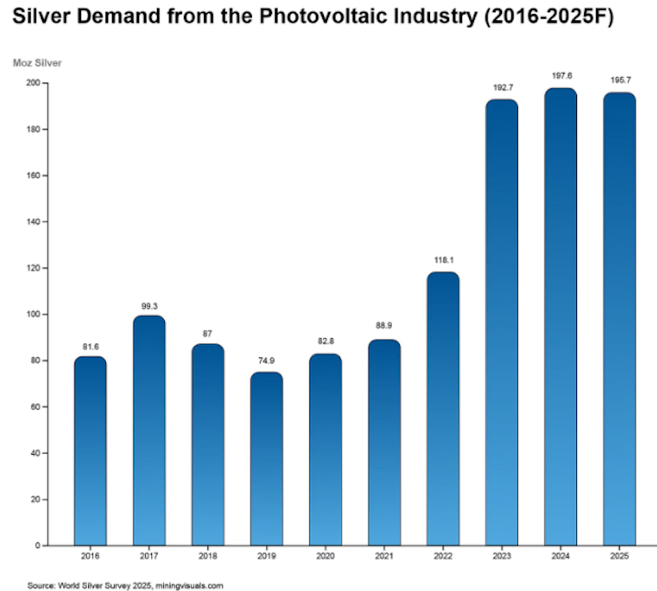
According to Industrial Uses of Silver: Complete 2025 Guide, “Solar panels absorbed 197 million ounces of silver in 2024, representing nearly one-fifth of total global demand. This figure has more than tripled since 2015 as renewable energy adoption accelerates worldwide. Each solar panel requires approximately 20 grams of silver in conductive paste applied to silicon wafers.
The silver creates electrical pathways that capture and transport energy generated by photovoltaic cells. Attempts to substitute copper or aluminum have consistently failed because these metals cannot match silver’s conductivity in the thin layers required for efficient panel design. Silver remains technically irreplaceable in current photovoltaic technology…
Research from the University of New South Wales warns that solar production alone could consume 85-98% of available silver resources by 2050 at current growth rates…
The structural imbalance between accelerating solar demand and limited silver production creates long-term support for the metal’s value. As renewable energy becomes non-negotiable for developed and developing nations alike, silver’s role as a critical material intensifies.”
The Silver Institute notes that silver plays a vital role in the production of solar cells and the transmission of electricity that they produce and adds that PV power is the leading source of green electricity.
Automotive
The institute says “As motor vehicles become more computerized, silver is playing a vital role in their operation. Over 60 million ounces of silver are used annually in motor vehicles.
For example, every electrical connection in a modern car is activated with silver-coated contacts that start the engine, open power windows, adjust power seats, close a trunk and power on and off other features.”
According to Industrial Uses of Silver: Complete 2025 Guide, “The automotive sector consumes approximately 85 million ounces of silver annually, driven by the rapid transition to electric powertrains. Silver appears in electrical connections, switches, membrane controls, and increasingly in battery management systems.

Electric vehicles require nearly double the silver of conventional cars due to additional electrical systems and power management components. Every percentage point increase in EV market share translates to millions of additional ounces of industrial demand.
The International Energy Agency projects that 50% of all vehicles sold globally will be electric by 2035…
Charging station deployment amplifies automotive silver demand beyond the vehicles themselves. Each fast-charging unit requires 1-2 kilograms of silver in power electronics and connections. Plans for millions of public charging installations by 2030 represent substantial additional consumption.”
Silver is becoming a critical component in next-generation solid-state batteries (SSBs), particularly in Samsung’s high-performance designs, which use a silver-carbon (Ag-C) composite anode to increase energy density, enable faster charging (9 minutes to 80%), and improve safety. These batteries can utilize up to 1 kilogram of silver per 100 kWh pack potentially adding up to 16,000 metric tons of annual demand if 20% of the EV market adopts this technology, threatening to cause a massive silver supply deficit.
Medical
Healthcare and medical technology consume approximately 30 million ounces of silver annually in applications largely immune to economic cycles. Silver’s natural antimicrobial properties make it valuable for infection control in hospital environments and medical devices, the guide states.
“The metal disrupts bacterial cell membranes and binds to proteins essential for microbial survival. This mechanism proves effective even against antibiotic-resistant strains, making silver increasingly important as traditional antibiotics face resistance challenges. Hospital surfaces, surgical instruments, and device coatings all utilize silver’s protective characteristics.
Advanced wound care represents a rapidly growing application, with the market expanding at roughly 6% annually. Silver-containing dressings treat burns, surgical wounds, and chronic injuries by preventing infection while promoting healing. The effectiveness of these products drives consistent adoption across healthcare systems.
Catheters, stents, and implantable electronics incorporate silver alloys to prevent bacterial colonization and improve long-term device performance. Medical grade silver reduces infection rates and complications, creating value that justifies its cost in critical healthcare applications.
The silver nanoparticles market for healthcare applications shows particularly strong growth trajectories. These specialized materials enable new antimicrobial treatments and medical device innovations that weren’t possible with traditional silver compounds.”
The Silver Institute notes that “During World War I, battlefields wounds were wrapped in silver foil and silver sutures were used to close deep wounds.
More recently, medical devices such as breathing tubes, prosthetics and catheters are coated with silver to help fight infections. Silver is also being applied to artificial bones and scaffolding used to keep bones in place while they mend. Silver is found in bandages and ointments because it keeps bacteria at bay, allowing the body to heal faster.
Silver has also been shown to be effective against bacteria that are becoming drug-resistant because of overuse. For example, a life-threatening Staph germ called MRSA (Methicillin-resistant Staphylococcus aureus), often referred to as a “superbug” found in healthcare facilities, is becoming resistant to most antibiotics. To fight back, many facilities are employing silver-imbedded equipment including surgical tools, needles, stethoscopes, furniture, door handles, furniture, linens and even paper files.
Only during the past few years have scientist learned how silver works as a biocide. Silver ions can penetrate the cell walls of bacteria — without injuring mammalian cells — thus destroying the chemical and structural bonds essential for the bacteria’s survival and growth. In some special situations, silver is used to breach a cell wall thus allowing a drug to enter and kill the cell.
Brazing and soldering
Industrial metal joining applications consumed silver at rates 3% higher in 2024 compared to the previous year. Brazing alloys containing silver join components in aerospace manufacturing, shipbuilding, HVAC systems, and plumbing installations. The strength and reliability of silver-brazed joints make the metal essential for critical connections.
Aerospace and defense applications particularly value silver brazing for components that must perform flawlessly under extreme conditions. (Industrial Uses of Silver: Complete 2025 Guide)
Metal pieces such as pipes, faucets, ducts and electrical wires are usually joined together either by brazing or soldering, similar processes based on how much heat is applied to the junction. Without the addition of silver none of these connections would be as strong, leakproof, corrosion resistant or as electrically conductive as the original materials.
Silver-tin solders are used for bonding copper pipe in homes, where they not only eliminate harmful lead-based solders, but also provide the piping with silver’s natural antibacterial action. Major faucet manufacturers use silver-based solder to incorporate these advantages and refrigerator manufacturers use silver-based solder to provide the flexibility required for constant changes in the temperature of cooling tubes.
Silver brazing alloys are used in everything from air-conditioning and refrigeration to electric power distribution. They are also crucial in the automobile and aerospace industries. It is especially useful in joining different metals with high melting points. (The Silver Institute)
Chemical catalysts
Silver catalysts enable the production of ethylene oxide, a precursor for plastics, antifreeze, and detergents. The metal also catalyzes formaldehyde production used in textiles, adhesives, and building materials. These chemical processes consume silver that becomes embedded in catalyst substrates. (Industrial Uses of Silver: Complete 2025 Guide)
Because of its unique chemical properties, silver is a commonly used catalyst that is vital for producing two major industrial chemicals: ethylene oxide and formaldehyde. Both chemicals are crucial elements to everyday items such plastics, adhesives, carpets, textiles, antifreeze and even clothing.
Because silver is not affected by the reaction, it is almost completely recovered after use.
Nearly 10 million ounces of silver are needed each year to produce ethylene oxide.
Silver catalysts are also vital to manufacturing formaldehyde, a chemical produced from methanol. It is the building block of solid plastics adhesives, laminating resins for construction plywood and particle board. (The Silver Institute)
Water purification
Developing nations increasingly adopt silver-based water purification technologies. The metal’s antimicrobial properties prevent bacterial and algal growth in community water supplies, swimming pools, and hospital water systems. Silver filters require no chemical additives and maintain effectiveness over extended periods. (Industrial Uses of Silver: Complete 2025 Guide)
Millions of water purifiers are sold each year and silver is inside many of them. Silver prevents bacteria and algae from building up in their filters so that they can do their job — getting rid of bacteria, chlorine, trihalomethanes, lead, particulates and odor. Silver, in concert with oxygen, acts as a powerful sanitizer that offers an alternative to, or an augmentation of, other disinfectant systems. (The Silver Institute)
Silver bearings
Engines operating continuously at high temperatures require a strong durable type of bearing such as those coated with silver.
When steel ball bearings are electroplated with silver, they become stronger than any other type of bearing. Jet engines, for example, rely on silver bearings because they can function continuously and at very high temperatures without breaking down.
Not only is a silver-coated steel ball bearing robust, but the silver acts as a lubricant, reducing friction between the bearing and its housing. This increases the performance and longevity of the engine. Moreover, in the event of an oil pump failure silver-plated bearings provide enough lubrication to allow a safe engine shutdown before the mechanism seizes up and causes permanent damage. (The Silver Institute)
New applications
New applications for silver are rapidly expanding beyond traditional industrial and monetary uses.
According to Industrial Uses of Silver: Complete 2025 Guide, several categories show particularly strong growth potential:
- Electromagnetic shielding: Protects sensitive electronics in 5G infrastructure and AI computing systems from interference.
- 3D printing: Silver inks enable additive manufacturing of electronic circuits and conductive pathways.
- Photographic and imaging: X-ray and medical imaging in developing markets maintain traditional silver halide uses.
- Antimicrobial textiles: Clothing and fabrics incorporating silver nanoparticles resist odor and bacterial growth.
Silver nanoparticles are used in flexible, transparent conductive films that act as a superior, more durable alternative to Indium Tin Oxide (ITO) in touchscreens, smartphones, and OLED displays.
Silver serves as a catalyst in the production of hydrogen fuel cells, facilitating the electromechanical reaction between hydrogen and oxygen to produce clean electricity—with water being the only by-product. This process, known as electrocatalysis, enables the efficient and sustainable conversion of hydrogen into electrical energy. Engineering experts have suggested that this may help bring down production costs, enhancing the viability of fuel cells not only in heavy-duty transportation but also in clean energy storage. (Mint)
Other cutting-edge new uses for silver include adding silver to vanadium oxide batteries, which prevents crystal growth that can cause failures.
Solid state batteries
The guide says emerging battery technologies may intensify silver requirements further. Solid-state battery prototypes in development potentially need up to 1 kilogram of silver per 100 kWh battery pack. If this technology reaches commercial scale, automotive applications could become silver’s dominant industrial category.
FX Empire reported earlier this month that a Chinese startup backed by one of the world’s largest automakers rolled the first A-sample all-solid-state battery cells off a production line in Guangzhou. The company, Greater Bay Technology (GBT) is targeting GWh-scale output by the end of 2026.
The article notes that GBT’s April 14 announcement puts A-sample production hardware in Guangzhou now, ahead of solid-state battery market leader Toyota, which is aiming for 2027 to 2028.
Toyota is also facing competition from Samsung SDI. Its “leading solid-state architecture uses a silver-carbon (Ag-C) composite anode, approximately 5 grams of silver per cell, and roughly 200 cells per pack, producing around 1 kilogram of silver per 100 kWh of battery capacity. In a mid-size EV with a 75 kWh pack, that is roughly 750 grams of silver per vehicle.
Current liquid lithium-ion EVs use between 25 and 50 grams of silver per vehicle, primarily in electrical contacts, sensors, and thermal management. Solid-state architecture at Samsung SDI’s silver intensity would represent a 15x to 30x increase per vehicle in silver content.”
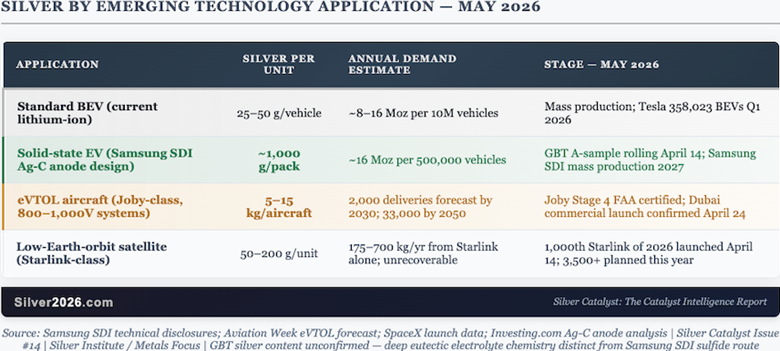
The GBT announcement was accompanied by three positive-silver developments in the two-week April 14-28 period:
- On April 23, Tesla confirmed that volume production of the Cybercab has begun at Giga Texas, the first fully autonomous vehicle model entering mass production at a major Western automaker. Tesla delivered 358,023 battery electric vehicles in Q1 2026, reclaiming the global quarterly BEV crown from BYD (310,389 units). At 25 to 50 grams of silver per current-generation BEV, Tesla’s Q1 deliveries alone consumed roughly 9,000 to 18,000 kg of silver from a single manufacturer in a single quarter. As solid-state architectures enter the mix, that per-vehicle figure rises.
- On April 24, Joby and Uber confirmed that air taxi service will launch in Dubai later this year, bookable directly through the Uber app at four vertiports. Joby has cleared Stage 4 of FAA type certification, with Stage 5 the final pre-commercial barrier. eVTOL aircraft operate at 800 to 1,000 volts, significantly higher than the electrical systems of conventional aircraft, and require an estimated 5 to 15 kilograms of silver per aircraft for power distribution in weight-critical applications. Aviation Week forecasts 2,000 eVTOL deliveries by 2030, rising to 33,000 by 2050.
- SpaceX launched its 1,000th Starlink satellite of 2026 on April 14, putting the constellation on track for more than 3,500 launches this year. The total operational constellation now exceeds 10,000 satellites. Satellite Constellation Deployment Acceleration puts silver content at 50 to 200 grams per satellite for space-qualified components in a radiation-hardened environment. At 3,500 satellites per year, that is 175 to 700 kilograms of silver annually from Starlink alone.
Conclusion
There is a significant ongoing structural shortage of physical silver in 2026, marking six consecutive years of deficits where industrial and investment demand outweighs supply. While exchange-traded paper silver exists, physical silver is increasingly scarce, with major inventories in London, New York, and Shanghai experiencing rapid depletion.
Analysts estimate the cumulative supply deficit since 2021 at roughly 820 million ounces — nearly a full year of global mine production, gone.
Metals Focus forecasts a 46.3-million-ounce deficit this year.
Silver gets its mojo back amid record demand and structural supply deficit
Richard (Rick) Mills
aheadoftheherd.com

Legal Notice / Disclaimer
Ahead of the Herd newsletter, aheadoftheherd.com, hereafter known as AOTH.Please read the entire Disclaimer carefully before you use this website or read the newsletter. If you do not agree to all the AOTH/Richard Mills Disclaimer, do not access/read this website/newsletter/article, or any of its pages. By reading/using this AOTH/Richard Mills website/newsletter/article, and whether you actually read this Disclaimer, you are deemed to have accepted it.