 RSS Subscribe
Current compounding risk much more dangerous than what the world faced 50 years ago – Richard Mills
2026.09.14
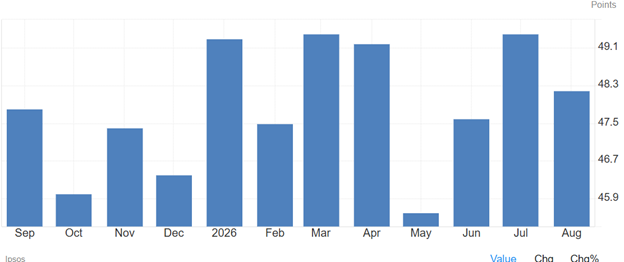
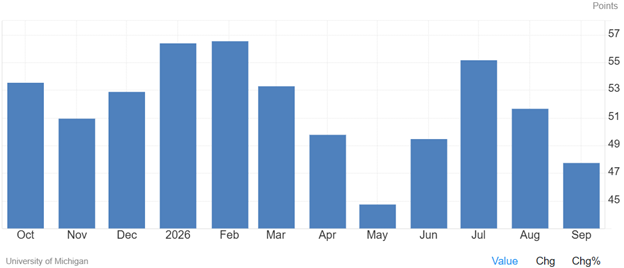
According to the University of Michigan Survey of Consumers, consumer confidence plummeted to a dismal 47.8 points in September 2026. Historically, when sentiment sits in this bottom tier, the economy rarely escapes without a rough ride.
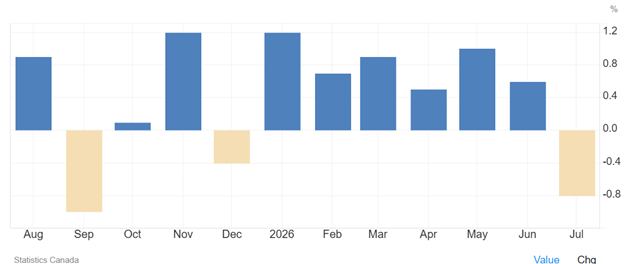
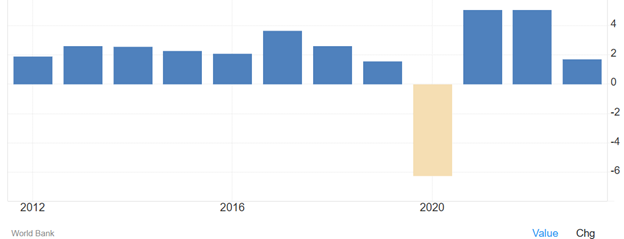
Canada’s household debt-to-GDP ratio stands at approximately 98.8% to 100.3%, remaining among the highest in the G7.
- Canada: Hovering around 98.8% to 100.3% of nominal GDP as of mid-2026.
- United States: Significantly lower at roughly 59.3% to 68.1% of GDP.
- G7 Comparison: Canada consistently registers the highest household debt relative to economic output and income among major advanced economies
Roughly 75% of Canadian household debt is tied up in residential mortgages.
Canadians owe about $1.76 in credit market debt for every dollar of disposable income, though income growth recently outpaced borrowing to edge ratios slightly lower.
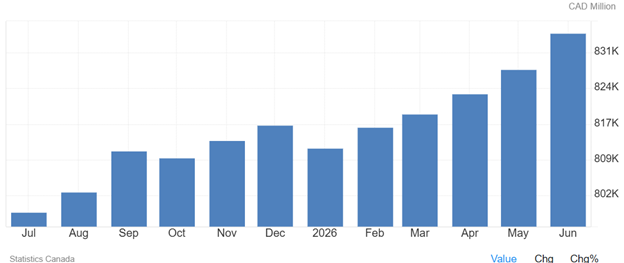
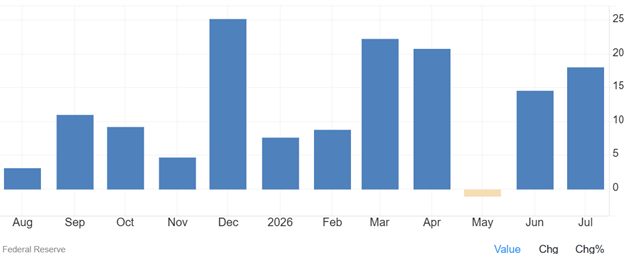
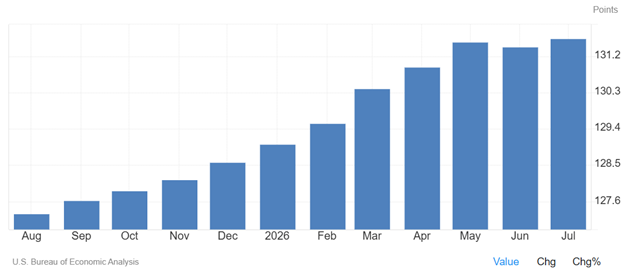
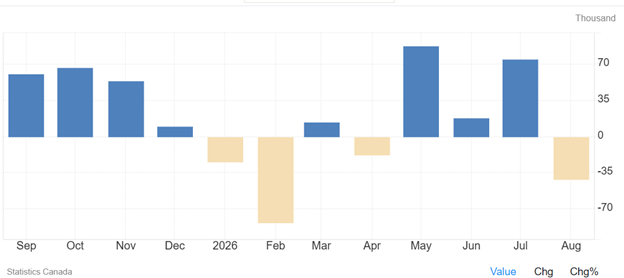
The recent charts show a stressed, anxious consumer on both sides of the border. Even though jobs remain steady, severe living-cost pressures have severely dampened consumer confidence and altered shopping habits.
A direct breakdown of what the data trends reveal about American and Canadian households highlights key similar pressures:
- Households are actively tightening belts and cutting back on extras
- Consumers are highly vulnerable to prolonged high interest rates
- Near-term inflation fears remain elevated due to energy costs and trade
United States: The Credit Card Crunch
The University of Michigan Consumer Sentiment Index fell sharply heading into September 2026. A combination of rising fuel prices and global trade tensions has consumers deeply worried about their personal finances.
While overall household debt dipped slightly by 0.1% to $18.8 trillion, credit card debt tells a different story. Balances hit $1.26 trillion. Worryingly, the percentage of credit card debt in severe delinquency (90+ days late) jumped to 12.8%, showing that lower-income households are running out of breathing room.
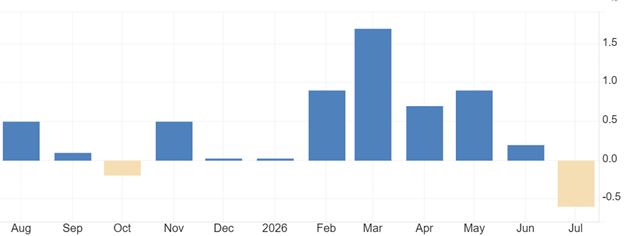
Due to these money anxieties, core U.S. Retail Sales fell by 0.6% in July. Shoppers are heavily hunting for deals, trading down to cheaper generic brands, and stretching budgets where they can.
Canada: Bracing for Inflation and Trade Storms
The Bank of Canada’s Canadian Survey of Consumer Expectations (CSCE) index remains locked at historically low levels. High living costs and macroeconomic uncertainty are keeping household sentiment thoroughly depressed.
Consumers are increasingly stressed by a resurgence in oil and gas prices. Furthermore, looming negotiations over the Canada-US-Mexico trade agreement have consumers highly fearful that incoming tariffs will drive retail prices even higher.
Household spending plans are noticeably weak. Canadians are adjusting by substituting cheaper grocery essentials, aggressively cutting back on discretionary (wants) spending, and choosing to drive less to save on gas. Even when the government provided a one-time Groceries and Essentials Benefit top-up, nearly half of recipients reported they would hoard or save the majority of the cash rather than spend it right away.
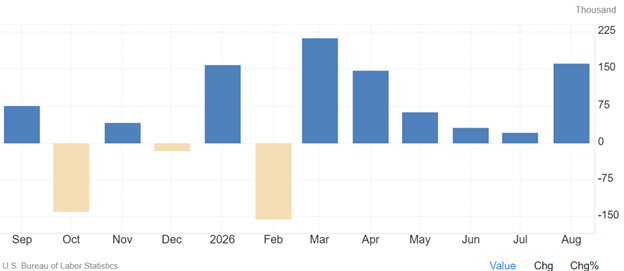
Even though US employment numbers look okay on paper, the everyday reality for people in both countries is a tough, daily grind. High interest rates and stubborn living costs have finally caught up with household budgets.
The American Trap: Running Out of Credit
For a long time, the U.S. consumer kept shopping by relying on plastic. Now, that safety valve is breaking.
- Credit card debt is at an all-time high ($1.26 trillion).
- Delinquency rates jumping to 12.8% means more than 1 in 10 credit card users are falling seriously behind on payments.
- People are tapped out. When gas prices spike, they can no longer just put it on the card. They have to stop buying other things, which is why retail sales are dropping.
The Canadian Trap: The Housing and Trade Squeeze
The Canadian consumer is dealing with a different kind of pressure cooker—mostly tied to shelter and global uncertainty.
- Canadians carry some of the highest household debt in the world, mostly tied up in expensive mortgages. When interest rates stay high, it eats up money that would normally go into the local economy.
- Canadians are deeply worried about what is coming next. Between high gas prices and potential trade tariffs with the U.S., people are terrified that things will get even more expensive
- Instead of spending extra money—like government benefits—Canadians are hoarding cash out of fear.
Both populations have moved from “spending freely” to “survival spending.” They are trading down to cheaper grocery brands, skipping vacations, and focusing entirely on the basics like rent, mortgages, and food.
Both countries citizens fear a painful cycle of stagflation—a destructive mix of stagnant economic growth paired with rising, stubborn inflation.
While standard economic slowdowns usually bring prices down, a destructive, newly ignited trade war between the U.S. and Canada threatens to do the exact opposite. Both sides heavily fear that upcoming economic pain won’t be solved by just cutting interest rates, leaving everyday citizens stranded in a high-cost, low-growth trap.
There are specific, overlapping fears deeply worrying economists, policymakers, and consumers in both nations
The Tariff-Driven Inflation Spike
In late August, the U.S. implemented 50% tariffs on roughly $20 billion worth of Canadian products, hitting critical sectors like vehicles, machinery, and paper. In a direct “dollar-for-dollar” response, Canada retaliated with its own 15% to 50% counter-tariffs on $20 billion of American goods, including steel, aluminum, clothing, and dairy.
Tariffs are essentially heavy taxes on imports. Both nations consumers fear that businesses will pass these multi-billion-dollar costs directly onto them. This means grocery store items, vehicles, and everyday retail goods will see immediate, artificial price spikes.
Central Banks Becoming Trapped
Usually, when consumer spending plummets and the economy shrinks, central banks like the U.S. Federal Reserve and the Bank of Canada cut interest rates to rescue the economy.
If the trade war continuously pumps up the prices of goods, central banks will be trapped. If they cut interest rates to save struggling consumers, they risk making inflation even worse. If they keep interest rates high to fight tariff inflation, they risk triggering widespread bankruptcies and mass job layoffs.
A Deepening Supply Chain “Self-Harm” Loop
The U.S. and Canadian economies are deeply intertwined. For example, auto parts routinely cross the border multiple times before a single car is finished.
Economists describe the breakdown in trade talks as an act of massive “economic self-harm”. Disrupting these highly integrated supply chains raises production costs for factories on both sides. This lowers regional productivity, delays major business investments, and chips away at overall economic growth.
Splintering Consumer Despair
As regular citizens realize that cross-border relief isn’t coming anytime soon, a toxic psychological shift is occurring.
Lower- and middle-income families are already heavily defaulting on credit cards. A trade war-induced spike in energy or grocery bills could completely break their household finances.
A massive “Buy Canadian” movement has erupted, with consumers actively boycotting American goods, canceling cross-border vacations, and dropping American streaming services. While patriotic, experts warn that entirely avoiding cheaper U.S. imports will ultimately force Canadians to pay a premium for domestic alternatives, further fueling the cost-of-living crisis
Stagflation high-cost, low-growth trap
A high-cost, low-growth trap is like a financial quicksand for a country. It happens when the prices of everyday things keep going up, but the economy slows down, and people’s paycheques do not grow.
This is stagflation. It is a combination of two words: stagnant (which means stuck in place) and inflation (which means rising prices).
Investors in stocks, bonds and commodities should be aware of the rate of inflation and how it is affecting the value of their investments.
When a currency loses value as it does during bouts of inflation, cash, bonds and stocks are not where investors want to be.
A pile of cash today is worth 3% less a year from now if inflation is running at 3%. A bond promises to pay a certain amount of currency (the yield) in future (the term), so during inflation the purchasing power of that currency is being diluted.
Stocks don’t fare much better during high-inflation periods. When inputs are higher businesses make less profits, meaning less earnings per share. Also, an unstable currency makes planning harder.
Commodities, some more than others, are a much better place to park your money when inflation + low economic growth = stagflation.
Inflation is back on the rise, it’s walking away from, not walking towards, the Fed’s 2% target. Seems like the days of the Goldilocks economies, where inflation was coming down without slowing GDP ended half a decade ago.
The era of smooth, painless cooling in prices has hit a major wall.
Gold
How has gold done during stagflation? As it turns out, quite well. The chart below by Sunshine Profits shows the gold price climbing during the stagflationary 1970s, surging from $100 per ounce in 1976 to around $650 in 1980, when CPI inflation topped out at 14%.
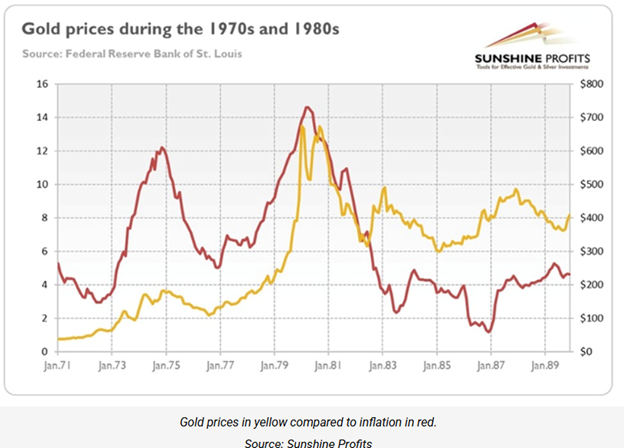
In fact, gold outperforms other asset classes during times of economic stagnation and higher prices. Of the four business cycle phases since 1973, stagflation is the most supportive of gold, and the worst for stocks, whose investors get squeezed by rising costs and falling revenues. Gold returned 32.2% during stagflation compared to 9.6% for US Treasury bonds and11.6% for equities.
Ole Hansen, head of commodity strategy at Saxo Bank, explains why commodities shine during inflationary eras:
- Inflation Hedge: Traditional commodities like gold and silver are perceived as safeguards against inflation. As inflation erodes the value of paper currency, tangible assets, particularly precious metals, often keep their worth through rising demand and prices.
- Diversification: Amidst a stagflation backdrop where standard financial assets like stocks might underperform, investors often look to diversify their holdings. Commodities offer an asset class with minimal correlation, potentially enhancing portfolio performance during such times.
- Interest Rates: Central banks may be reluctant to hike interest rates in a stagflation setting for fear of hampering growth further. Moreover, a weaker dollar can make dollar-denominated commodities more affordable for non-dollar-based buyers, potentially amplifying demand and prices.
- Real Returns: In a climate where nominal returns on conventional financial assets are diminished by inflation, tangible assets like commodities can provide positive real returns. This is particularly pronounced when commodity prices surge due to supply limitations or strong demand.
Stagflation lite
At AOTH we believe the U.S., Canada, and the global economy currently face rising risks of “stagflation lite,” which means sluggish economic growth paired with stubborn inflation. Current conditions back up our belief:
United States Economy
- U.S. economic growth sits below the standard 2% trend.
- Sweeping new tariff policies have sharply raised effective import taxes and business costs.
- Price increases hover around 3.5%, keeping pressure on the Federal Reserve to hold interest rates steady rather than cutting them.
- Hiring has cooled into a low-hire, low-fire equilibrium, though unemployment remains relatively low at 4.3%.
Canadian Economy
- Trade conflicts and retaliatory tariffs between the U.S. and Canada disrupt supply chains and raise consumer costs.
- Canada’s GDP growth is projected to limp along around 0.8%, hitting manufacturing-heavy regions hardest.
- The Bank of Canada has held interest rates steady amid domestic labor market softness and external trade uncertainties.
Global Economy
- Geopolitical conflicts in the Middle East have disrupted oil transit routes and pushed crude oil prices above $100 a barrel.
- The International Monetary Fund warns that persistent high energy prices could drag global growth down toward 2.5% or lower.
To turn “stagflation lite” into full-blown 1970s-style stagflation, the economy would need to experience a massive, systemic supply-side collapse alongside a breakdown in consumer confidence.
Currently, the primary shield against true stagflation is a resilient labor market. If the following three specific economic tripwires are crossed, it would bridge the gap from a slow economy to a full-blown crisis:
A Toxic “Wage-Price Spiral”
- If inflation remains sticky at 3.5% or pushes higher, workers will begin demanding much higher wages just to maintain their standard of living.
- To protect their profit margins, businesses would raise their prices again to cover those higher labor costs. This forms a vicious feedback loop where higher wages cause higher prices, permanently unanchoring inflation expectations and rendering normal interest rate hikes ineffective.
Escalating Trade Wars and Supply Chains Snapping
- If the current regional tariffs expand into an all-out, global retaliatory trade war—with sweeping duties on critical components, minerals, and microchips—the “lite” stagnation would deepen.
- Manufacturing in Canada and the U.S. would grind to a halt due to missing parts. This creates structural demand-supply imbalances. Companies would face lower sales and higher costs simultaneously, forcing them to pivot from “low hiring” to “mass layoffs”.
A Massive Energy Shock
- With Brent crude oil already elevated and testing the $105-per-barrel mark due to escalating drone and missile strikes on infrastructure in the Middle East, a complete closure of critical shipping straits would be disastrous.
- Pushing oil over $150 a barrel would act as an immediate tax on every sector of the global economy. Because energy is required to make and move everything, production costs would soar while consumer discretionary spending would instantly evaporate, dragging GDP into negative territory while spiking inflation
Major trigger
The simultaneous disruption of the Black Sea, the Strait of Hormuz, and the Bab el-Mandeb strait is acting as a major trigger for a massive global commodity price shock. Economists call these places chokepoints—narrow channels that are essential for global shipping. Having all three blocked or heavily restricted at the same time is historic, causing oil to surge past $100 a barrel and threatening global food and industrial supplies.
The Three Chokepoints: What is Happening Right Now
The current situation is severely choking three of the world’s most critical trade paths:
- The Black Sea: The ongoing war between Russia and Ukraine has heavily paralyzed this route. Severe port attacks since July have knocked out one-third of Ukraine’s grain export capacity, while Russian Black Sea exports have plummeted, forcing them to attempt long land routes to the Far East.
- The Strait of Hormuz: The high-intensity war between the U.S. and Iran has effectively blocked the Persian Gulf. This single channel usually carries about 20% of the world’s oil and liquefied natural gas (LNG), which is now trapped or heavily constrained.
- The Bab el-Mandeb Strait: As a direct extension of the Iran conflict, Yemen’s Houthi rebels have seized total control of the coastline and strategic islands like Perim Island. They have placed a strict naval blockade on Saudi Arabia and choked off the Red Sea. Daily ship transits here have plummeted to single digits.
When these seaborne three doors close, it creates a domino effect across different markets:
Energy (Oil and Gas)
- Brent and WTI Crude Oil prices have exploded by over 65%. Brent is currently trading above $100 to $110 a barrel.
- Saudi Arabia tried to bypass the closed Strait of Hormuz by pumping oil across the desert to the Red Sea. But because the Houthis now control the Bab el-Mandeb at the bottom of the Red Sea, that backup plan has failed. Saudi crude exports have dropped to their lowest levels in decades
- Global natural gas prices are projected to surge by 25%.
Agriculture and Food (The Double Squeeze)
- Russia and Ukraine supply 27% of the world’s wheat. With Black Sea shipping paralyzed, global grain prices are soaring sharply. Ukraine alone stands to lose over $5 billion in grain revenue.
- The Fertilizer Crisis: Making food requires fertilizer, which requires natural gas and chemicals from the Middle East. The closure of Hormuz has thrown the fertilizer market into chaos. The World Bank expects fertilizer prices to shoot up over 30%.
Industrial Materials and Shipping Costs
- Metal & Chemicals: The Strait of Hormuz is a vital path for aluminum, steel, and chemicals. Aluminum prices have spiked due to supply disruptions, and Ukrainian steel exports via the Black Sea have been entirely cut off.
- Shipping Costs: Ships can no longer use the Suez Canal route safely. They must travel all the way around Africa (the Cape of Good Hope). This adds weeks to travel times, burns massive amounts of fuel, and has driven Black Sea war insurance up to 2% of the entire ship’s value. Tanker rental costs have crossed $300,000 a day.
Above is the absolute textbook definition of how a global stagflation crisis starts.
Stagflation, as I mentioned earlier happens when an economy gets hit with two terrible things at the same time: slow economic growth and high unemployment and rising prices. It is a nightmare scenario for central banks because the tools used to fix one problem usually make the other problem worse.
How the Chokepoints Trigger Stagflation
When the Black Sea, the Strait of Hormuz, and Bab el-Mandeb close together, they act as a massive supply shock. This forces stagflation through a two-sided trap
| Simultaneous Chokepoint Closures | |
| THE INFLATION ENGINE | THE STAGNATION ENGINE |
| • Oil surges past $100/barrel | • Factory production slows down |
| • Shipping fees skyrocket | • Consumers cut back on spending |
| • Food & fertilizer prices spike | • Global trade routes break down |
| FULL STAGFLATION | |
The Inflation Engine
- As oil stays above $100 a barrel and grain routes remain blocked, the cost of everyday essentials climbs.
- Businesses must pay massive shipping fees to route goods around Africa. To survive, they pass those costs directly onto consumers.
The Stagnation Engine (Growth Grinds down)
- Factories cannot get the raw metals, chemicals, or parts they need. Production lines slow down or stop entirely.
- When regular people have to spend way more money on gasoline and groceries, they stop buying other things like clothes, electronics, or dinners out. This causes businesses to lose money and freeze hiring.
The Policy Trap: Central Banks Are Stuck
Usually, if the economy slows down, a central bank (like the U.S. Federal Reserve) will lower interest rates to make borrowing cheap and jumpstart growth. If prices are rising too fast, they raise interest rates to cool the economy down.
| If Central Banks Choose To… | What Happens to Inflation? | What Happens to Economic Growth? |
| Raise Interest Rates (To fight high prices) | Helps lower inflation over time. | Makes stagnation worse. High interest makes it too expensive for businesses to borrow, leading to layoffs and a deeper recession. |
| Lower Interest Rates (To protect growth/jobs) | Makes inflation worse. Adding more money to the economy while oil and food supplies are physically blocked just causes prices to explode faster. | Helps keep businesses open temporarily. |
Because of this trap, central banks are often forced to let the economy go into a recession just to break the back of inflation.
Historical Analogy: The 1970s Redux
The world has seen this movie before. In 1973 and 1979, geopolitical conflicts in the Middle East caused massive oil supply shocks. Inflation skyrocketed globally, economic growth collapsed, and unemployment soared.
In the 1970s, only oil was choked. Today, we are seeing a simultaneous shutdown of oil, natural gas, grain, and key manufacturing supply lines all at once.
This makes the current compounding risk much more complex than what the world faced 50 years ago.
Richard (Rick) Mills
aheadoftheherd.com

Legal Notice / Disclaimer
Ahead of the Herd newsletter, aheadoftheherd.com, hereafter known as AOTH.Please read the entire Disclaimer carefully before you use this website or read the newsletter. If you do not agree to all the AOTH/Richard Mills Disclaimer, do not access/read this website/newsletter/article, or any of its pages. By reading/using this AOTH/Richard Mills website/newsletter/article, and whether you actually read this Disclaimer, you are deemed to have accepted it.