 RSS Subscribe
Manganese was a critical metal in 1940 – Richard Mills
2026.09.14
Manganese is designated a critical metal primarily because of its irreplaceable role in global steel production and its rapidly growing importance in electric vehicle (EV) battery technology and high-performance drone and missile batteries.
Over 85% to 90% of all manganese is used to produce steel. It acts as a crucial desulfurizing and deoxidizing agent, removing impurities that weaken steel, while also serving as an alloying element that adds strength and durability.
Manganese is a key component in advanced lithium-ion and lithium-manganese-oxide (LMO), also called manganese-rich, batteries. Automakers are shifting toward manganese-rich cathode chemistries because they offer higher energy density, lower costs, and stable chemical properties.
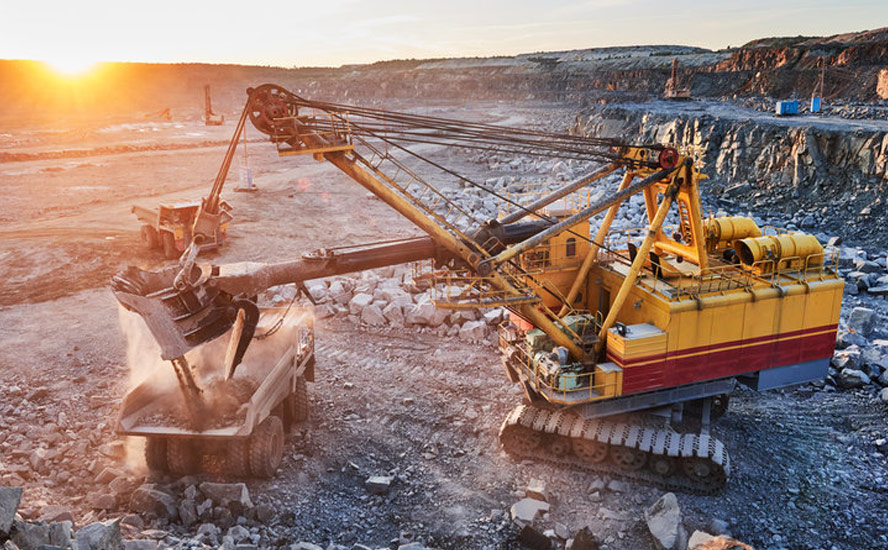
Despite being abundant in the Earth’s crust, global supply is heavily concentrated. Over 70% of the world’s manganese ore and reserves come from just a few countries—primarily South Africa, Gabon, and Australia—making the supply chain vulnerable to geopolitical events and labor disruptions. Gabon announced that it will completely ban the export of raw, unprocessed manganese ore starting January 1, 2029
Manganese is also vital for agricultural fertilizers, animal feed, rubber additives, and specialty ceramics, including manganese-zinc ferrites used to manufacture high-performance ceramic magnets and magnetic components for electronics, power systems, communications, and defense applications.
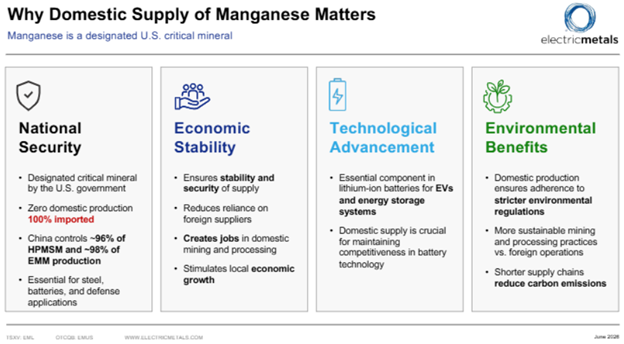
While the United States imports unrefined raw manganese ore mostly from countries like South Africa and Gabon, it relies almost entirely on China for highly processed, finished manganese products. The United States has zero domestic manganese mining or refining capacity. This means it is 100% dependent on foreign trade for every pound of manganese it uses.
The real problem lies in turning those rocks into specialized, ultra-pure chemicals and metals. China has built a near-total monopoly on the chemical processing phase of the supply chain:
- High-Purity Manganese Sulfate Monohydrate (HPMSM): This is the specific chemical needed to make electric vehicle (EV) batteries. China processes roughly 96% of the world’s supply.
- Electrolytic Manganese Metal (EMM): This highly refined metal is critical for the U.S. defense sector, weapon systems, and aerospace engineering. China controls about 98% of global production capacity.
- Electrolytic Manganese Dioxide (EMD): Used heavily in standard alkaline and electronic batteries. The U.S. is relatively self-sufficient in EMD production, but it imports 100% of its manganese ore. The USITC extended the antidumping duty order on imports of electrolytic manganese dioxide (EMD) from China in February 2026 for another 5 years. The antidumping duty order has been in place for 18 years.
Because the U.S. lacks factories to process the metal, the journey of a single piece of refined manganese looks like this:
- Raw ore is dug out of the ground in places like South Africa or Gabon.
- The bulky raw ore is shipped thousands of miles away to China.
- China processes the ore into pure liquids, powders, or metal sheets and flakes.
- The finished material is finally shipped across the ocean to U.S. steel mills and battery manufacturers
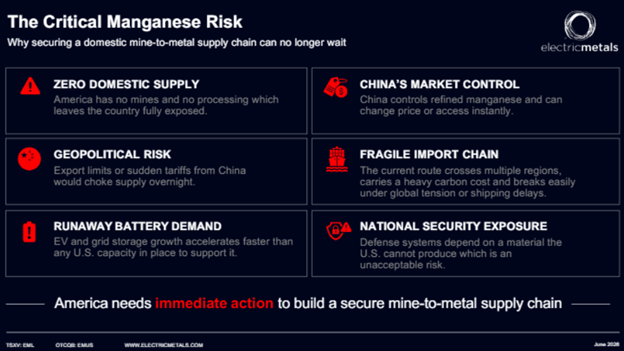
According to the latest U.S. Geological Survey Reports, this dynamic poses severe economic and defense risks. If geopolitical tensions worsen, or if China passes sudden export restrictions—similar to their recent restrictions on other critical metals like gallium, graphite, rare earths and antimony and the entire U.S. steel industry, domestic EV and defense market could face immediate gridlock.
The U.S. government is using a highly targeted strategy of aggressive tariffs to try to break China’s processing monopoly.
Historically, both political parties avoided taxing Chinese manganese because the U.S. had zero alternative suppliers. However, the U.S. shifted away from this policy to aggressively levy multi-layered tariffs on critical minerals.
The 25% Critical Mineral Tariff (Section 301)
The primary weapon being used is the Section 301 tariffs, which are taxes designed to penalize countries for unfair trade practices.
- The U.S. established a 25% tariff specifically targeting Chinese manganese ores, concentrates, and refined products.
- This instantly makes importing refined manganese chemicals from China 25% more expensive for American companies, forcing them to look for alternative suppliers.
High Tariffs on the End Products (EVs and Batteries)
The U.S. isn’t just taxing the raw metal; it is taxing the final products that contain Chinese manganese. This blocks China from circumventing the mineral tariffs by simply selling pre-made batteries.
- The U.S. slapped a 25% tariff on Chinese lithium-ion EV batteries.
- The tariff on finished Chinese electric vehicles was quadrupled to a massive 100%.
The Carrot-and-Stick Strategy
Tariffs are the “stick” meant to punish reliance on China, but the U.S. pairs them with a “carrot” (financial rewards) to build a domestic supply chain:
- The Inflation Reduction Act created a $7,500 consumer tax credit (IRC Section 30D) for new EVs, with sourcing rules requiring a rising percentage of battery critical minerals to come from the U.S. or its free-trade-agreement partners, and a “Foreign Entity of Concern” (FEOC) restriction that zeroed out the credit if battery components or, started in 2025, applicable critical minerals were sourced from FEOC-linked entities (effectively targeting Chinese-affiliated supply chains).
- However, that credit no longer exists. The One Big Beautiful Bill Act (OBBBA) eliminated the New Clean Vehicle Credit (30D) and the Qualified Commercial Clean Vehicle Credit (45W), effective September 30, 2025. Vehicles purchased before that date could still qualify, but anything acquired October 1, 2025, or later gets no federal credit at all. Congressional analysts project the repeal will reduce federal deficits by roughly $190 billion over FY2025–2034.
While these tariffs are a powerful national security tool, they have created a temporary mess for U.S. manufacturers. Because it takes years to build a new manganese refining plant, American battery and steel companies still have to buy from China for now. As a result, the tariffs act as a heavy tax on U.S. tech and car companies, driving up production costs while the domestic mining and refining industry scrambles to catch up.
Warfighting
Manganese is directly used in warfighting, and it is officially classified as a defense-critical raw material by both NATO and the U.S. Department of Defense.
While military drones, loitering munitions, and electronic systems heavily rely on manganese-based batteries, the metal’s impact on warfighting actually stretches far beyond just energy storage.
Heavy Armor and Ballistic Protection
Before manganese ever entered a battery, it was a legendary armor material. In fact, its toughest warfighting application is protecting soldiers and vehicles from explosions.
Military vehicles, bunkers, and ballistic shields use a specialized alloy containing 12% to 14% manganese. This steel has a unique property called “work-hardening.” The harder it is hit by a bullet or shrapnel, the tougher and more dent-resistant the metal’s outer layer becomes.
Because it absorbs shock waves without shattering, manganese steel is used to manufacture blast-resistant hulls for armored personnel carriers and lightweight combat helmets.
Aerospace and Firepower
Manganese is an essential structural element in advanced weapon systems:
It is blended into high-strength, lightweight aluminum and copper alloys used in military aircraft structures and submarine hulls.
High-Performance Drone and Missile Batteries
Modern warfare relies heavily on unmanned systems (like reconnaissance and kamikaze drones), which are the largest driver of defense industry battery demand.
The absolute mainstream battery technology for high-end military drones is Lithium Nickel Manganese Cobalt (NMC). Manganese provides structural stability and safety, allowing drone batteries to handle high power output, rapid maneuvers, and long flight times.
Missiles, torpedoes, and loitering munitions require batteries that can sit in storage for years but activate instantly under extreme heat and vibration. Manganese-rich chemistries prevent the battery from overheating or catching fire during high-speed combat flights.
U.S. National Defense Stockpile
Because a modern military cannot function without drones, electronics, and armor plates, the U.S. military is incredibly vulnerable to the Chinese processing monopoly discussed earlier. If a conflict broke out tomorrow, a cutoff of Chinese refined manganese would freeze the manufacturing of both electronic drone components and the heavy armor needed to protect troops.
To combat this, the U.S. Defense Department issued urgent funding solicitations to build a National Defense Stockpile of manganese and bypass foreign supply chains entirely.
Following the raw material shortages of World War I, military planners and geologists first urged the U.S. government to build a national emergency stockpile that included manganese. President Franklin D. Roosevelt signed the Strategic and Critical Materials Stock Piling Act of 1939. This law officially created the stockpile to lower America’s trust on foreign countries for wartime goods.
Manganese was placed on the original list of 42 critical items added to the U.S. National Defense Stockpile in May 1940. The government bought its very first physical batches of manganese, along with tin, rubber, and chromite, just as World War II was intensifying in Europe.
Today, the U.S. government has shifted away from storing raw manganese ore. Instead, they are focusing on upgrading what they already have and investing heavily in securing high-purity, battery-grade manganese to keep up with modern technology.
The modern strategy, broken down by numbers, policies, and specific actions reveals a highly targeted approach to this critical resource:
The government has established a ceiling to acquire up to 5,000 metric tons of Electrolytic Manganese Metal (EMM). This high-purity metal is essential for advanced military gear, aircraft components, and aerospace tech.
Under DLA’s FY2023 Annual Materials Plan (October 2022–September 2023), the government authorized disposal of up to 151,000 metric tons of low-grade metallurgical manganese ore and up to 45,400 metric tons of high-carbon ferromanganese from the National Defense Stockpile, while capping acquisition of electrolytic manganese metal (EMM) at 5,000 metric tons. The pattern reflects DLA’s broader stockpile strategy: shed legacy low-value raw material — and the ore disposal ceiling itself dropped by nearly half compared to the prior two years — while prioritizing acquisition of higher-value, processed materials like EMM, where the U.S. currently has no domestic source.
With global tensions rising, the Pentagon and the White House are stepping up domestic manufacturing. The Defense Department’s Defense Industrial Base Consortium issued an urgent solicitation. They are looking to fund companies that can mine, refine, alloy, or recycle manganese right here in North America.
This is where Electric Metals steps into the picture.
Electric Metals (USA) Limited (TSXV:EML, OTCQB:EMUS) has the highest-grade manganese deposit in North America and is potentially poised to emerge as a low-cost producer of 100% domestically sourced, high-purity, battery grade, manganese products (HPMSM) for the electric vehicle battery and energy storage sectors.

North Star Manganese Project
Electric Metals (USA) Limited has the highest-grade manganese deposit in North America and is poised to emerge as a low-cost producer of 100% domestically sourced, high-purity, battery-grade manganese products (HPMSM) for the electric vehicle battery and energy storage sectors.
The North Star Manganese Project comprises two parts that will be completed in parallel. Developing the Emily manganese deposit into an underground mine and building an HPMSM plant with an EMM circuit, likely in the Gulf Coast of America.
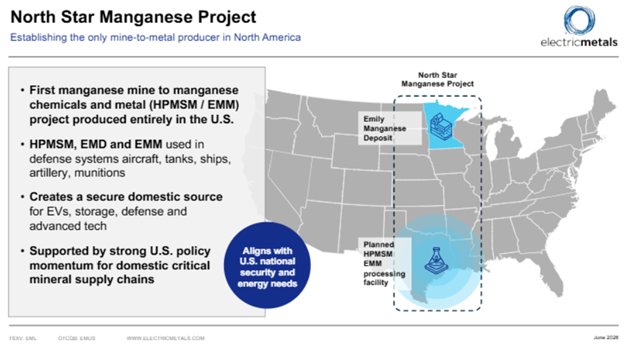
The Emily manganese deposit is the highest-grade manganese deposit in North America. It is within the Cuyuna Iron Range in central Minnesota that supplied the vast majority of the domestic manganese-bearing ore mined in the United States during the major 20th-century wartime periods.
“The Emily District contains the highest-grade manganese deposits in the Northern Hemisphere,” states the US Geological Survey (USGS).
The primary manganese mineral to be mined is manganite, a manganese oxide-hydroxide, not a sulfide; as a result, it cannot produce sulfuric acid through sulfide oxidation, significantly reducing permitting risk.
At a 10% cutoff grade, the Emily deposit has an Indicated NI 43-101 resource of 7.6 million tonnes (Mt) of 19.07% manganese (Mn) and 22.33% iron (Fe), and an Inferred resource of 3.7Mt of 17.04% Mn and 19.04 % Fe.
This yields roughly 2.1Mt of contained manganese in the Inferred and Indicated classifications, or about 4.2Mt if the cutoff grade is 5%.
The project has undergone extensive technical evaluation, including a Preliminary Economic Assessment (PEA) and multiple phases of metallurgical test work that have successfully produced HPMSM, EMM, and EMD.
It includes the construction of a 100,000 tonnes per year HPMSM plant with a 10,000 tonnes per year EMM circuit at a yet-to-be-determined location in the United States — a US first. The company is evaluating multiple candidate sites based on chemical input costs, power rates, transport logistics, permitting, workforce availability, incentives, and proximity to US battery manufacturers.
Electric Metals’ executive team and board includes CEO Brian Savage, who has a history of identifying, building, growing, and transforming mining and metals businesses, and substantial experience in the manganese industry; Dr. Sylvia Chen, a director who is VP, Finance at Dundee Precious Metals (TSX:DPM); director Dr. Quinton Hennigh, an internationally renowned exploration geologist with 33+ years of experience; and director Dr. Henry Sandri, a professional mineral economist with 40+ years in the metals and minerals, energy, power and transportation industries.
Conclusion
The global manganese market is valued at between $33 billion and $35 billion. The compound annual growth rate (CAGR) is projected to be around 4.2% to 7.2% over the next decade.
Militaries are incredibly desperate for specialized, high-purity manganese batteries. This urgency isn’t about powering electric trucks—it is about combat survival, weapon range, and breaking China’s chokehold on military technology.
The Pentagon, the UK Ministry of Defence, and other global militaries are throwing billions of dollars into securing manganese-rich battery supply chains
Modern combat relies heavily on battery-powered equipment. Militaries need advanced batteries because current, standard options are either too heavy or explode under fire.
A single modern infantry soldier carries roughly 15 to 20 pounds of batteries just to power their night-vision, radios, thermal scopes, and jammer gear.
Small unmanned aerial vehicles (UAVs) are the defining weapon of 2026 warfare. Standard batteries limit flight times to about 30 minutes. Militaries need advanced chemistries like LMFP (Lithium Manganese Iron Phosphate) to give drones up to 20% more flight range without adding dead weight.
For years, high-performance military batteries used nickel and cobalt (NMC batteries). Militaries are desperate to get rid of them.
Cobalt is highly explosive if punctured by shrapnel or a bullet. Manganese-based chemistries are far more chemically stable, shock-resistant, and less likely to burst into a thermal fire on the battlefield.
If a major conflict breaks out, China can instantly shut off the supply of the ultra-pure manganese required to make military communication packs, submarine backup power systems, and smart missile guidance grids.
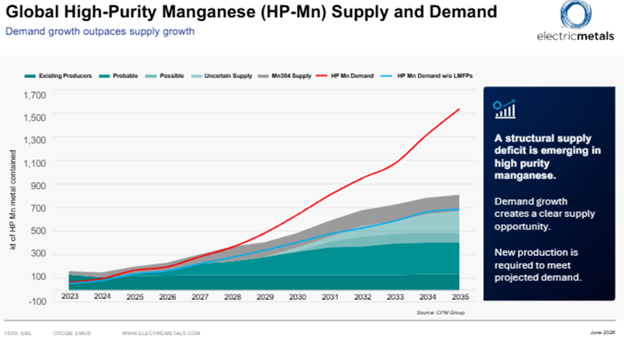
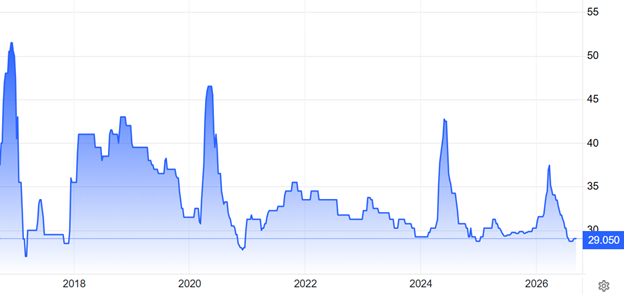
Market dynamics show demand outstripping supply; manganese cathode demand is expected to grow by over 600% by 2040. But China controls refined manganese and can change the price or access to the commodity instantly.
Defense systems depend on a material the US can’t produce, which is an unacceptable risk. America needs immediate action to build a secure mine-to-metal supply chain for manganese.
Richard (Rick) Mills
aheadoftheherd.com

Subscribe to AOTH’s free newsletter
Richard does not own shares of Electric Metals (TSXV:EML). EML is a paid advertiser on his site aheadoftheherd.com
This article is issued on behalf of EML.
Legal Notice / Disclaimer
Ahead of the Herd newsletter, aheadoftheherd.com, hereafter known as AOTH.Please read the entire Disclaimer carefully before you use this website or read the newsletter. If you do not agree to all the AOTH/Richard Mills Disclaimer, do not access/read this website/newsletter/article, or any of its pages. By reading/using this AOTH/Richard Mills website/newsletter/article, and whether you actually read this Disclaimer, you are deemed to have accepted it.