 RSS Subscribe
Stagflation and commodities – AOTH
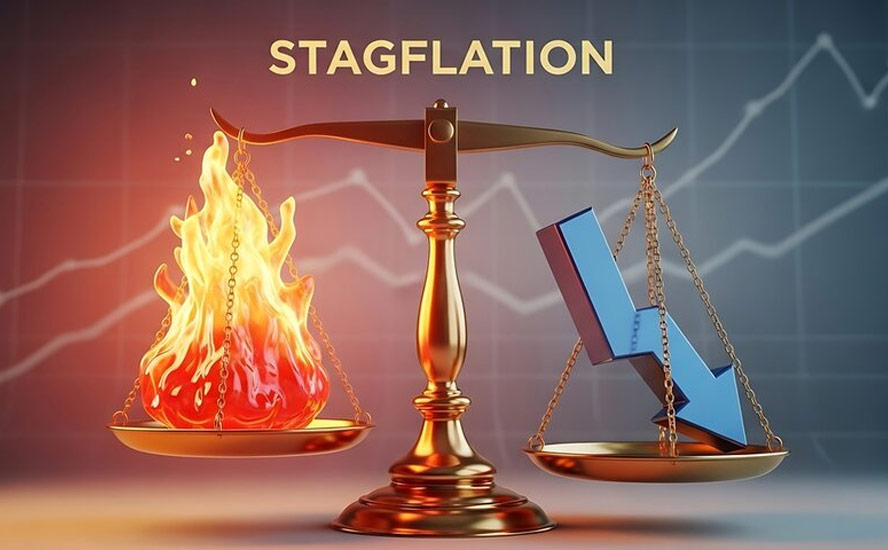
Both the U.S. and global economies are experiencing a sharp resurgence in inflation, driving intense fears of “stagflation,” though full textbook stagflation has not yet firmly set in. A perfect storm of geopolitical conflict, most notably the ongoing war in Iran and the war in Ukraine have pushed commodity prices above a tenable level, combined with aggressive tariffs, supply chain shocks, and massive infrastructure spending on the AI boom has caused headline prices to accelerate significantly worldwide.
The Global Overview: Heightened Inflation Risks
The global economy is caught between a major energy shock and surprisingly resilient demand.
The International Monetary Fund (IMF) forecasts a global headline inflation rate of 4.7% for the year, while global economic growth is projected at a moderate 3.1%.
Oil prices hovering around $90–$100 a barrel are filtering heavily into consumer goods. Concurrently, central banks across Europe, Asia, and Latin America have shifted to a hawkish stance, pausing interest rate cuts or actively raising rates to contain the surge.
While global growth hasn’t entirely collapsed, the combination of hot prices and rising interest rates has drastically amplified the cost of living.
The U.S. Overview: “Stagflation Lite”
In the United States, economic indicators reflect a highly divided landscape. Economists frequently describe the current status as “stagflation lite,” the inflation part is undeniably present, but the total economic stagnation part is being temporarily staved off.
The current economic indicators highlight this tension:
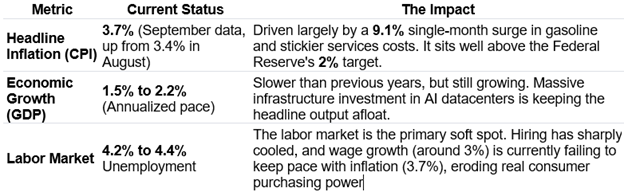
Why it isn’t “True” Stagflation (Yet)
By definition, stagflation requires high inflation, stagnant growth, and high or rapidly surging unemployment simultaneously.
The U.S. Bureau of Labor Statistics (BLS) confirmed that the American jobs engine has hit a major soft patch. The labor market is visibly changing, and the era of “historically low” unemployment is beginning to crack. While the numbers are still low by long-term historical standards, the trend has clearly reversed from structural tightening to clear cooling. The disappointing September jobs report firmly establishes a downshift in both the U.S. and key global economies.

In a K-shaped recovery consumers feel squeezed
With market sentiment highly anxious, Federal Reserve officials are under immense pressure to decide whether to hike interest rates further to choke off the localized energy/tariff inflation or hold steady to protect a visibly cooling labor market.
“Cost-push” inflation
Manufacturing is the central transmission mechanism for stagflation; it is usually where stagflation begins and where its economic damage is most visibly felt. In a healthy economy, inflation is driven by “demand-pull” (consumers buying more things), which benefits manufacturers because factories expand to meet demand. However, stagflation is driven by “cost-push” inflation, where supply shocks or political disruptions aggressively drive up the cost of raw materials and logistics, forcing factories to cut production while simultaneously raising prices.
The manufacturing sector acts as both the engine and the victim of stagflation through a distinct structural cycle:
Stagflationary cycles almost always originate from an upstream supply shock that slams factories first.
Geopolitical conflicts (such as shipping blockades in the Persian Gulf) or sweeping international tariffs rapidly inflate the baseline cost of industrial essentials.
Heavy manufacturing relies on cheap energy, steel, copper, and specialized chips. When global supply chains fracture, purchasing managers see immediate spikes in their Input Price Indices.
Once input costs explode, manufacturers enter a high-stakes bind that begins slowing down the broader economy.
To protect their margins, factories must raise their selling prices (output inflation). This forces inflation directly down the supply chain into retail items, packaging, electronics, and food.
As consumer purchasing power is eaten away by the cost of living, businesses and households stop buying new vehicles, machinery, or home goods. New factory orders slump.

Consumers gaslit by inflation gauges that always alter reality to favor the issuer
High inflation forces workers to demand higher wages to survive. Manufacturers find themselves trapped between skyrocketing raw material costs, higher wage demands, and collapsing consumer demand—forcing a reduction in total output (the “stagnation” component).
When manufacturing output shrinks, it triggers the third leg of standard stagflation: job losses.
[Supply Shock / Tariffs] ──> [Factory Costs Skyrocket] ──> [Product Prices Rise]
│
[Manufacturing Layoffs] <── [Orders Drop / Output Falls] <─────────┘
Because manufacturing is highly capital-intensive and tied to global commerce, it behaves like an economic canary in a coal mine. For instance, prolonged economic uncertainty can lead directly to manufacturing contraction, forcing job cuts across sectors like machinery, plastics, and industrial components.
When the physical engine that creates goods slows down while making those fewer goods more expensive, textbook stagflation is effectively realized.
An almost 50% year-over-year surge in the commodities index (as seen in recent data for benchmarks like the CRB Commodity Index) acts as a massive supply-side tax that severely compresses factory profit margins, fractures supply chains, and accelerates stagflationary pressures across global manufacturing.
Because commodities (energy, metals, and agricultural products) are the primary raw inputs for factories, a spike of this magnitude destabilizes industrial operational structures in three distinct phases:
Delayed inflation shockwaves
The most critical immediate effect is a severe jump in input costs that takes months to fully filter through the economy.
Global benchmarks like the S&P GSCI have experienced immense upward pressure, largely driven by the ongoing war in Iran and shipping disruptions.
According to historical data from the CME Group, commodity index jumps correlate aggressively with a 4-to-5 month lag on finished consumer goods. Factories are currently burning through older, cheaper inventories; the true brunt of today’s 50% surge will slam retail shelves and corporate budgets in early 2027.
Flattening of the curve predicts economic downturn in mid ‘27
Industrial gauges like the ISM Manufacturing Report indicate that while overall manufacturing output is fighting to remain positive, the “Prices Paid” component has suddenly skyrocketed.
Squeezing Trucking
A broad commodity surge creates a highly polarized manufacturing landscape.

Sub-sectors that sit at the absolute beginning of the supply chain actually thrive. For example, Statistics Canada reports that primary metal and chemical manufacturing sales recently jumped 14%, hitting record highs because they refine the very copper, aluminum, and chemicals that are soaring in price.
Downstream sectors like automotive, industrial machinery, and consumer appliances are devastated. With copper up over 38% and energy costs volatile, the cost to build a car, a refrigerator, or a factory turbine expands exponentially.
When raw materials become volatile and drastically more expensive, logistics break down. Suppliers delay shipments because they are waiting out price spikes or dealing with localized material shortages. Manufacturing output loses momentum because factories are forced into intermittent shutdowns while waiting for missing components, leading directly to the “stagnation” side of the economic equation.
Diesel is the literal “workhorse fuel” of the economy, and the current global diesel crisis is supercharging the manufacturing crunch. Unlike gasoline, where regular consumers can cut back on elective road trips, diesel demand is almost entirely inelastic. Trains, cargo ships, agricultural harvesters, and long-haul trucks cannot operate without it.
Because of supply shocks stemming from the war in Iran, structural closure of the Strait of Hormuz, and strikes on Russian energy refineries, global diesel benchmarks have exploded, severely amplifying both the “inflation” and “stagnation” components of the economic squeeze.
A manufacturer gets hit by high diesel prices at two completely different ends of their operations.
A factory pays fuel surcharges to truck massive bulk materials (steel, plastic pellets, timber) to its facilities.
Once the item is built, a truck fleet charges heavily inflated prices to ship it to retail distribution centers or customer doors.

Dumpster fire economics, consumers red-lined
According to data tracking logistics metrics, the price proxy for diesel jumped from roughly $60 a barrel in late 2025 up to nearly $100 a barrel by late October 2026. This rapid rise means almost every business shipment now includes non-negotiable fuel surcharges, systematically bleeding manufacturing profit margins dry.
The logistics networks that manufacturers rely on to move goods are experiencing critical cash flow failures.
In the United States, carriers are fiercely passing the fuel shock entirely onto customers via higher freight trucking producer prices. Long-haul truckload pricing recently recorded multi-month spikes of over 11% to 20%.
The Canadian Trucking Alliance noted that overnight diesel spikes of 60 to 80 cents per litre are pushing smaller logistics companies into survival mode, forcing some operators to delay vehicle maintenance or disregard safety compliance simply to stay solvent.
Ultimately, the diesel crunch cements stagflation by creating economic drag while keeping prices artificially high.

The International Energy Agency (IEA) warns that global diesel tightness will extend well into 2027 due to depleted inventories and refinery bottlenecks.
When logistics become too expensive, manufacturers slow down factory volume to prevent carrying heavy financial risk. As fewer goods are moved, but the goods that do move cost more to ship, the economic engine enters a state of persistent, structural stagnation.
Infrastructure boom
U.S. manufacturing just climbed sharply because a massive artificial intelligence infrastructure boom and robust domestic consumer demand are temporarily overpowering intense inflationary and trade-related headwinds. Recent macroeconomic data reveals a substantial turnaround, with overall U.S. industrial production jumping 0.7% and business activity striking a five-year high.
The foremost driver of the manufacturing climb is a monumental surge in spending on data centers, infrastructure, and hardware to support artificial intelligence.
Production of semiconductors and related electronic components skyrocketed at a blistering annualized rate of 28.4%.
This digital arms race has created a massive downstream demand shock for physical machinery, cooling systems, electrical equipment, and power-grid appliances.
While international sales have withered, with new export orders contracting due to steep tariffs and global shipping strains, domestic buyers are filling the gap.
Highly resilient American consumers are continuing to spend through price hikes. Fearing future price surges or supply chain delays stemming from ongoing global conflict and newly implemented international trade tariffs, domestic businesses are actively front-loading their orders to build up inventory buffers.
According to the Institute for Supply Management (ISM), five of the six largest U.S. manufacturing industries explicitly expanded, led heavily by computers/electronics, machinery, and chemical products.
While physical factory output has genuinely expanded, economists from TD Economics note that the “climb” looks exaggerated on paper by nominal revenue values. Because the underlying cost of energy and raw commodities has surged 50%, factories have aggressively raised their own selling prices.
Roughly half of the recorded growth in manufacturing shipments is concentrated in petroleum, chemicals, and plastics, sectors whose baseline values are inflated by rising oil costs, rather than just raw volume growth.
The current AI-and-domestic-demand-driven manufacturing expansion is approaching a critical breaking point, with consensus suggesting it can sustain its momentum for another 3 to 6 months before escalating costs trigger a structural contraction.
Leading economists and industrial data show that while headline manufacturing indices remain resilient, the underlying cost engine is becoming unsustainable. Industry experts predict the expansion will collide with a “cost wall” by early-to-mid 2027.

A Debt Spiral, Breaking Point, Doom Loop and Hard Landing
Supply Management’s (ISM) Price Index
As tracked by the CME Group, there is an inevitable 4-to-5 month lag between a massive spike in raw commodity indices and the moment that financial pain fully destabilizes downstream factories. Because the commodity index surged over the course of 2026, manufacturers are currently insulated by older, fixed-price material contracts and remaining inventory buffers. Once those inventories are exhausted by the end of Q1 2027, factories will be forced to absorb today’s $100-per-barrel oil and soaring metals prices all at once.
The financial toll is already breaking records at the logistics level. The Institute for Supply Management’s (ISM) Price Index recently surged 6.8 points to a staggering 77.9, driven heavily by diesel costs and sudden tariff-related inflation. Concurrently, Less-Than-Truckload (LTL) shipping rates have jumped nearly 8%. Manufacturers can pass these logistics surcharges down to retail buyers for a short period, but historical trends show that consumer demand begins to rapidly collapse (“demand destruction”) after roughly two consecutive quarters of aggressive price hikes.
Groceries increasingly expensive
While September industrial production managed a 0.7% bump, the overall ISM Manufacturing Gauge trickled down to 54.5, missing economist projections because resurgent costs and severe shipping delays began neutralizing new orders.
In August, overall factory production actually fell 0.3%, proving that outside of the core AI and defense technology sectors, standard durable manufacturing (like motor vehicles, plastics, and rubber goods) is already contracting under the weight of high interest rates and energy spikes.
Conclusion
When the cost correction firmly takes hold in 2027, the manufacturing landscape will split into two distinct tiers.
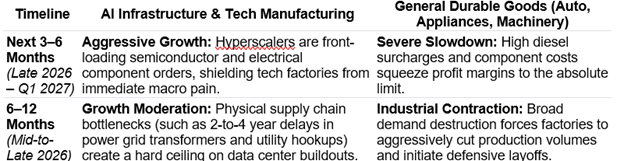
Chief economists, such as Christopher Rupkey at FWDBONDS, warn that soaring energy prices are directly chipping away at the localized “manufacturing renaissance”.
The AI technology boom acts as a highly effective cushion, but it cannot entirely outrun a structural 50% commodity spike and record-high diesel across the entire domestic trucking network.

Legal Notice / Disclaimer
Ahead of the Herd newsletter, aheadoftheherd.com, hereafter known as AOTH.Please read the entire Disclaimer carefully before you use this website or read the newsletter. If you do not agree to all the AOTH/Richard Mills Disclaimer, do not access/read this website/newsletter/article, or any of its pages. By reading/using this AOTH/Richard Mills website/newsletter/article, and whether you actually read this Disclaimer, you are deemed to have accepted it.