 RSS Subscribe
Cosa Resources Hurricane Deposit discovery team registered up to 13,900 CPS at Murphy Lake North Project – Richard Mills

2026.04.15
The global push for energy security and the resurgence of nuclear power are intensifying the hunt for high‑grade uranium in Saskatchewan’s Athabasca Basin. In the eastern Athabasca region, discovery‑stage exploration has reached a fever pitch, where closeness to established high‑grade deposits can turn a single drill result from noteworthy to extraordinary almost overnight.
Cosa Resources
Cosa Resources (TSXV:COSA) (OTCQB:COSAF) is a Canadian uranium exploration company operating in northern Saskatchewan. The project portfolio comprises roughly 237,000 hectares and includes a mix of underexplored 100% owned and Cosa-operated joint venture projects in the Athabasca Basin, the majority of which reside within or adjacent to established uranium corridors.
Cosa’s award-winning management team has a long track record of success in Saskatchewan. In 2022, members of the Cosa team were awarded the AME Colin Spence Award for discovering IsoEnergy’s (TSX:ISO) Hurricane deposit. All four individuals — Andy Carmichel, Craig Perry, Steve Blower and Justin Rodko — are part of Cosa’s team.
Prior to Hurricane, Cosa personnel led teams or had integral roles in the discovery of Denison Mines’ (TSX:DML) Gryphon deposit and held key roles in the founding of both NexGen Energy (TSX:NXE) and IsoEnergy.
President and CEO Keith Bodnarchuk led strategy and corporate development for IsoEnergy and was project geologist at Denison Mines. VP Exploration Andy Carmichael is a professional geoscientist with 19+ years in mineral exploration, more than 17 of which has focused on exploring for mineral deposits in the Athabasca Basin, Hornby Bay Basin, Colorado Plateau and Namibia.
Carmichael served as VP Exploration at IsoEnergy, where he was also a member of the team that discovered the Hurricane deposit, currently the world’s highest-grade Indicated uranium resource. Previously, Carmichael worked at the Triple R, Phoenix, Gryphon, and J-Zone deposits.
Rounding out the team is Chad Sorba, technical advisor, who was instrumental in the discovery of Denison’s Phoenix and Gryphon uranium deposits.

Cosa-Denison collaboration
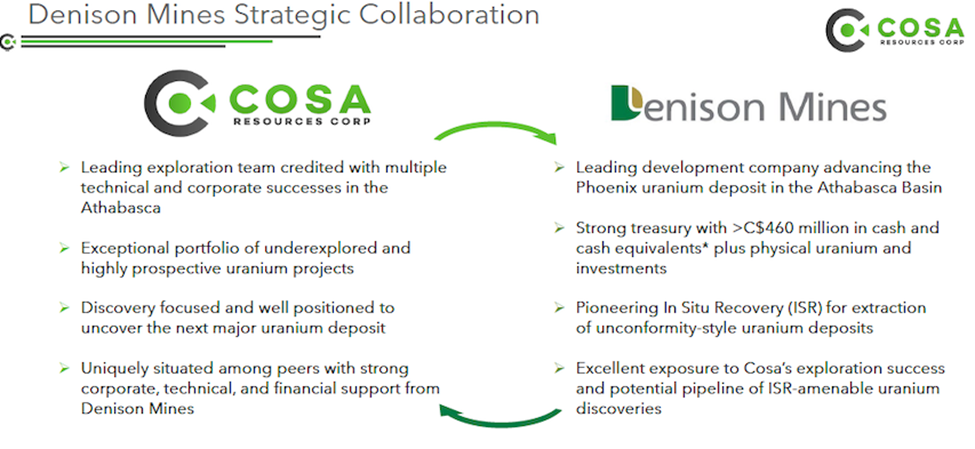
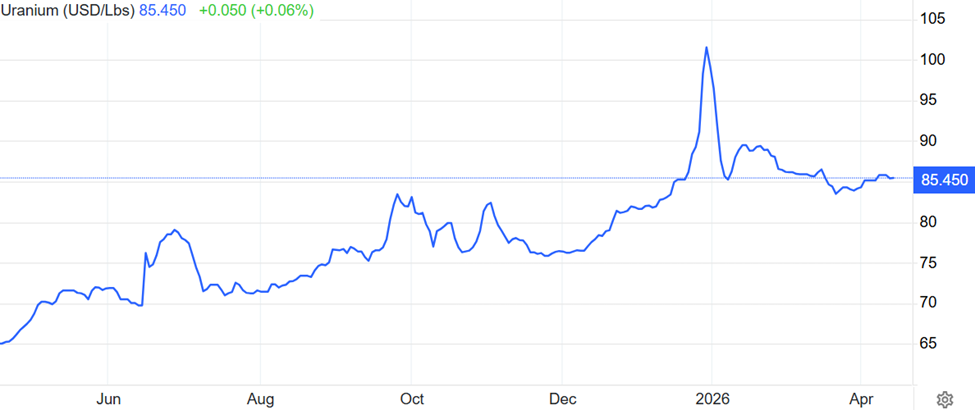
In January of 2025, the company entered a strategic collaboration with Denison Mines that has secured Cosa access to several highly prospective eastern Athabasca uranium exploration projects. The projects offer Cosa over 20,000 hectares of additional exposure into what the Cosa considers to be mature, discovery-ready projects that are well-situated close to existing eastern Athabasca infrastructure and boast several walk-up drill targets based on encouraging results from historical drilling.
As Cosa’s largest shareholder, with equity rights to retain up to 19.95% ownership, Denison gains exposure to Cosa’s potential for exploration success and its pipeline of uranium projects.
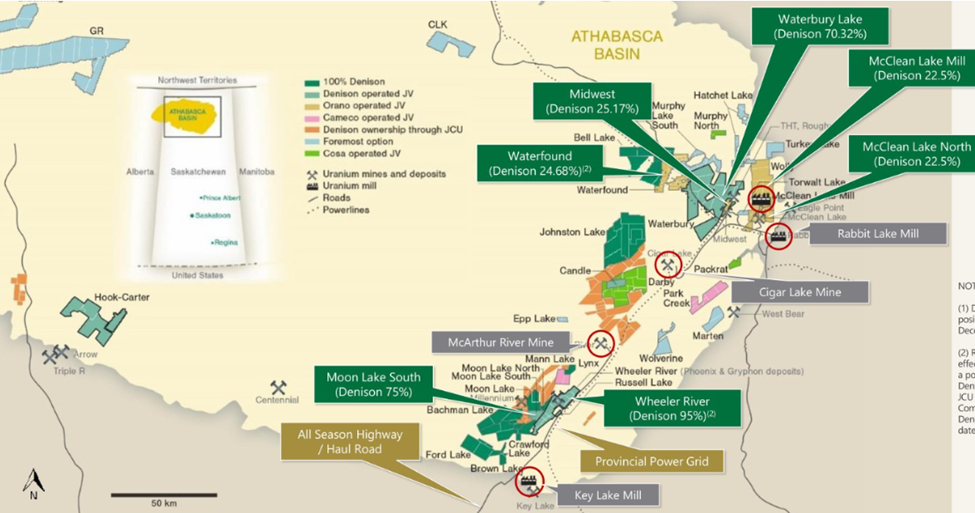
Cosa has acquired a 70% interest in and will operate the Murphy Lake North, Darby and Packrat uranium projects. Denison Mines will remain as minority contributing partner.
Denison offers strong corporate, technical, and financial support to Cosa through participation in equity financings and joint venture funding.
As of September 2025, DML has a large treasury with over CAD$460 million in cash and cash equivalents, plus physical uranium and investments. It is a pioneer in In Situ Recovery (ISR) for extraction of unconformity-style uranium deposits. Denison has exposure to Cosa’s exploration success and potential pipeline of ISR-amenable uranium discoveries.
Athabasca Basin
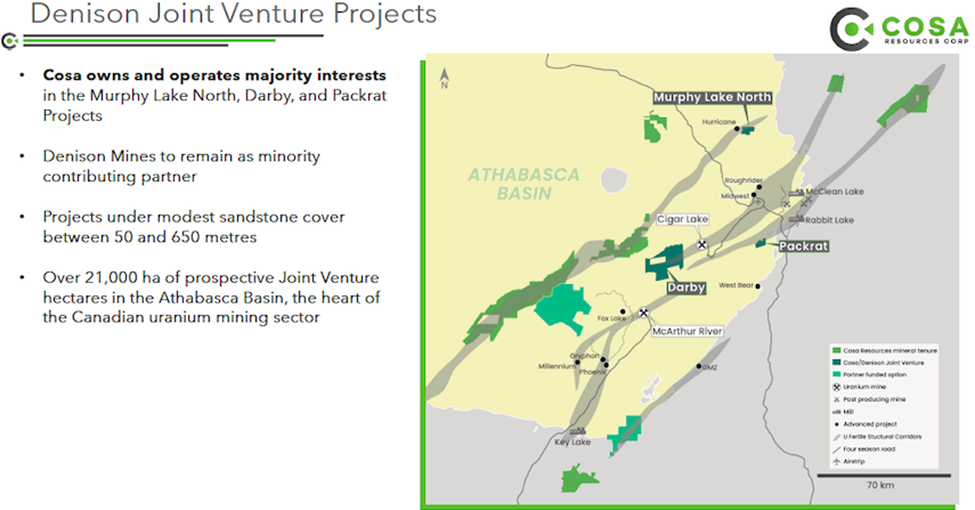
The Athabasca Basin is famous for its high grades — at over 20 times global averages. Some deposits are over 100x the world average including Cameco’s Cigar Lake which contains an average grade of between 15% and 17% U3O8.
In comparison, the Priargunsky underground uranium mine in Russia has grades of just 0.15%. Or Rio Tinto’s Rossing open-pit mine in Namibia, with grades of 0.03%, compared to over 19% in Denison’s Phoenix deposit – a difference of 630X. Hurricane, the deposit that Cosa’s management team is credited with discovering, averages an astonishing 34.5% and is just a few kilometres away from Cosa’s Murphy Lake North joint venture.
The Basin produces about 15% of world uranium supply. Major mines include Cigar Lake — held jointly between Cameco, Orano Canada and Tepco Resources — McArthur River and Rabbit Lake mines. While Rabbit Lake has been on care and maintenance since 2016, its license was renewed in 2023 for 15 years.
Uranium market
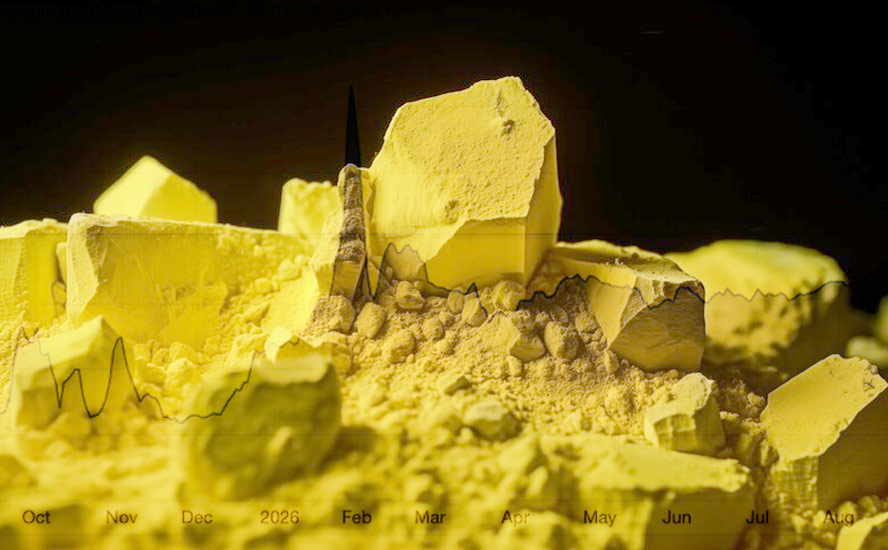
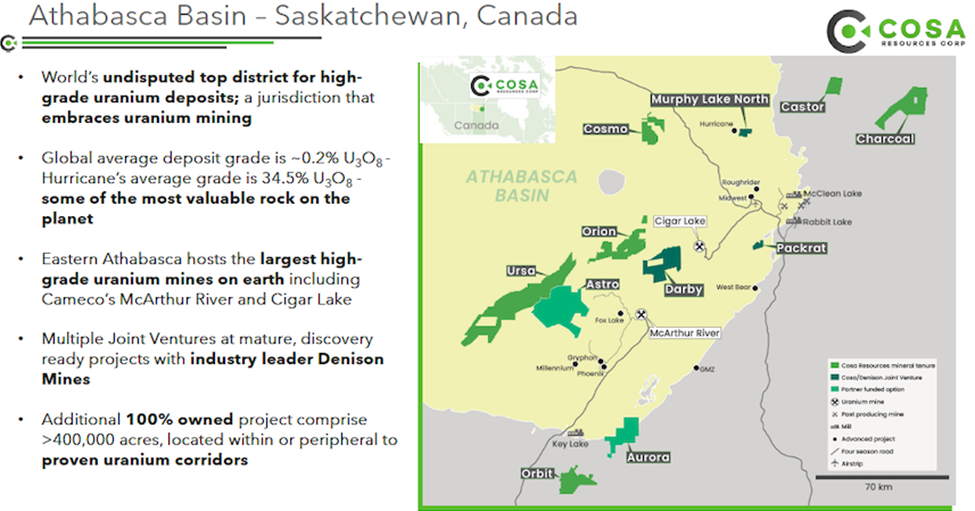
As of April 2026, the uranium market is experiencing sustained long-term price growth, reaching over 18-year highs of USD$93/lb, driven by severe structural supply constraints and rising, high-volume nuclear fuel demand. While the spot market has remained thin and volatile, recently tightening around $85-$100/lb, long-term contracting for new reactors remains the primary focus, with 75+ reactors under construction worldwide. (AI Overview)
Murphy Lake North Project
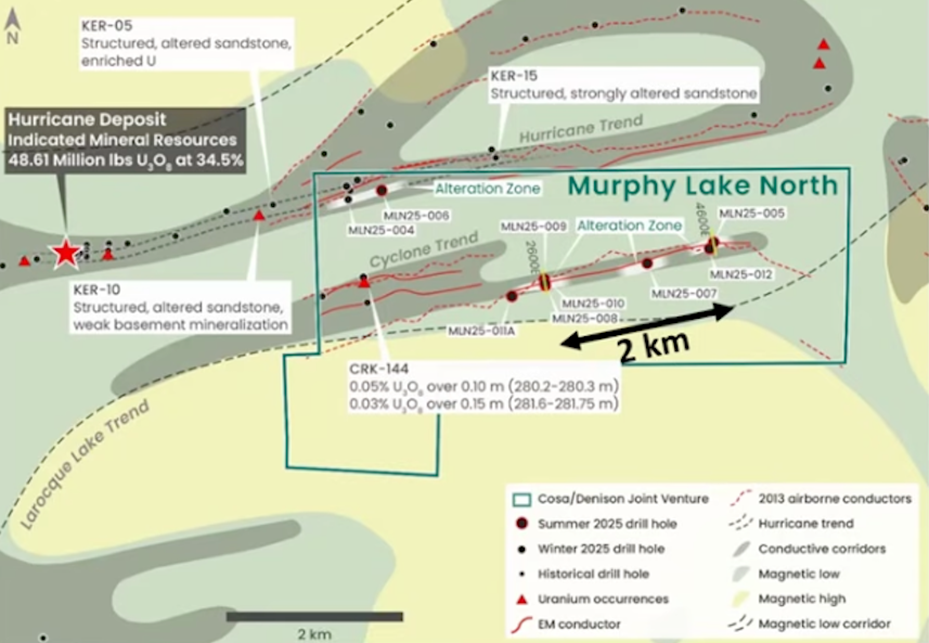
Murphy Lake North (MLN) is a 70/30 joint venture between Cosa and Denison and is located at the northern end of the Larocque Lake Trend. The project is within 3 kilometres of and on trend with the Hurricane deposit. Initial drilling completed by Cosa during winter 2025 intersected broad zones of hydrothermal alteration of the sandstone, associated with prospective basement structures interpreted as the strike extension of those controlling the Hurricane deposit.
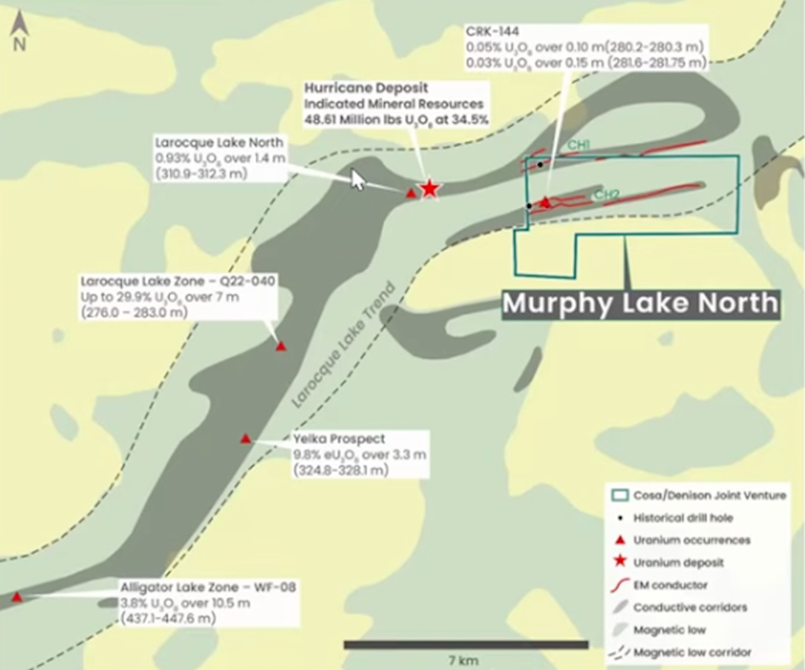
As mentioned, IsoEnergy’s Hurricane deposit was discovered in 2018 by Cosa’s management and currently holds the title as the world’s highest-grade Indicated resource in uranium.
The Larocque Lake Trend hosts the high-grade Larocque Lake Zone, Yelka prospect and Alligator Lake Zone.
Initial drilling in winter 2025 confirmed that up to 2 kilometers of Hurricane trend basement geology is present within the project. While testing the southern portion of the Hurricane trend, the fourth and final drill hole of the program intersected a broad zone of alteration and structure in the lower sandstone that is open along strike in both directions. The depth to the unconformity at Murphy Lake North is approximately 250 meters.
Summer drilling at Murphy Lake North totaled 3,323 meters in eight holes completed as initial reconnaissance of the Cyclone Trend and to follow up winter 2025 drilling results on the Hurricane Trend. Positive results and greater exploration space led to a focus on Cyclone during the program.
The Cyclone Trend is located south of and oriented sub-parallel to the Hurricane Trend. Since 1996, a series of historical airborne and ground electromagnetic (EM) surveys at MLN mapped several discrete conductors within the broader Cyclone Trend.
Conductivity at Cyclone is best defined in the central portion of MLN where 2020 EM surveying completed by Denison mapped a basement EM conductor coincident with a conductive trend identified by 2013 airborne surveying. Summer drilling planned to evaluate Cyclone at wide spacing for prospective structure and/or alteration.
In August 2025, Cosa reported that summer drilling successfully identified 2 km of highly prospective strike length characterized by strong sandstone alteration and graphitic faulting at the Cyclone Trend.
Cyclone was drilled on four sections over 2.4 kilometers of strike length. Six of seven drill holes intersected positive results; the seventh was interpreted as an overshot of the optimal target. Drilling identified geology considered highly prospective for an eastern Athabasca-style uranium deposit including significant unconformity relief associated with major structures hosted within graphitic basement rocks. Faulting controls broad zones of alteration in the sandstone and basement which are comparable to those associated with the region’s uranium deposits. Weakly elevated radioactivity was intersected at the unconformity and in the basement and is typically associated with hematite and/or clay alteration.
Results at Cyclone are exemplified by Section 2600E where the broadest and strongest alteration and structure were intersected. Three drill holes on 2600E define a significant graphitic basement fault zone within a broader package of graphitic rocks associated with 30 meters of unconformity relief.
Basement-rooted faulting is interpreted to extend through the entire 220-meter thickness of the sandstone as faulting is evident beginning at the top of bedrock. These vertically extensive structures control broad zones of hydrothermal alteration. In MLN25-010, nearly half of the sandstone is structured including a 70-meter interval with strong fracturing, faulting, fault gouges, increased clay content and sections of near-massive clay, rotated sandstone bedding, strong bleaching, desilicification, and decimeter-scale zones of increased radioactivity.
The continuity and intensity of alteration and structure are considered highly encouraging. The Cyclone alteration zone remains open in multiple directions and includes untested sections of up to 1.2 kilometers strike length.
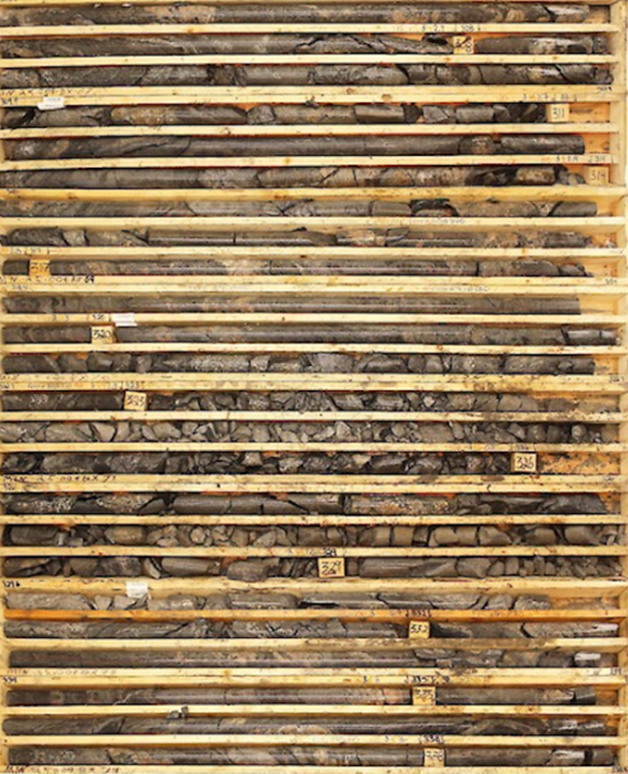
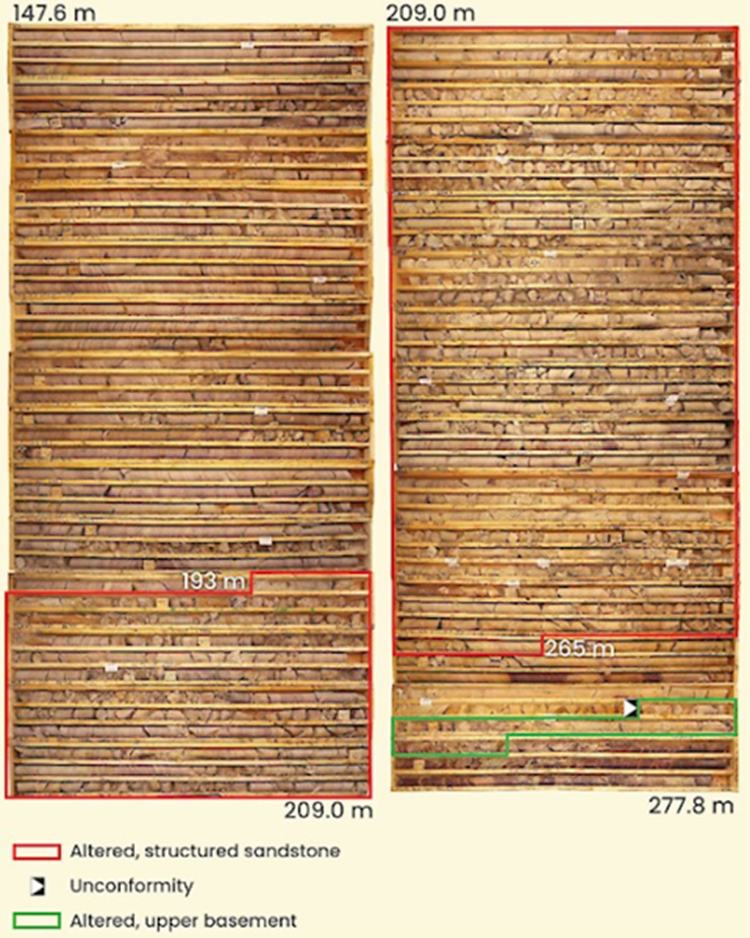
In a video, VP-Ex Andy Carmichael said it wasn’t only the strength of the alteration and faulting they were seeing, but the scale of it.
“It’s hard to visualize these things, but if you plopped the zone as it existed at the end of 2025 down in San Francisco Bay, it would be as long as the suspended bridge portion of the Golden Gate Bridge. If the bottom of the zone, the unconformity, was sitting on sea level, the top of it would be like 50% higher above the water than the road deck. The faults that were controlling it that went right to the top of bedrock would be like 25% taller than the bridge tower,” he told the KE Report.
2026 drilling
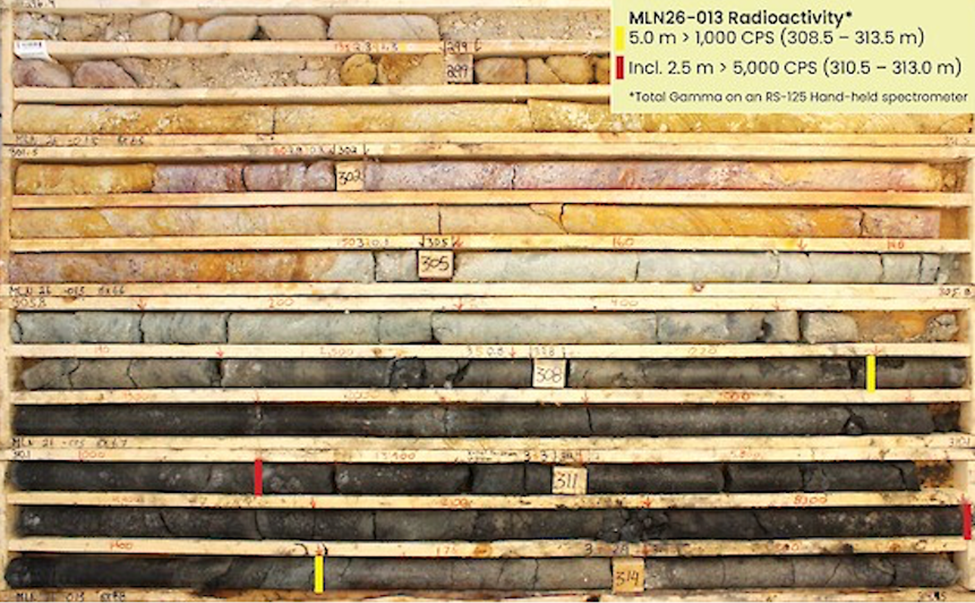
On March 24, 2026, Cosa reported that its first hole of the winter drill program at the Murphy Lake North Joint Venture intersected 5.0 meters of anomalous radioactivity.
Hole MLN26-013 registered up to 13,900 Counts Per Second (CPS) in the upper basement approximately 260 meters vertically from surface.
According to Cosa, strong, structurally controlled alteration in the sandstone and basement is open in all directions.
MLN26-013 is the lone drill hole within a 1.2-kilometer section of the Cyclone Trend where no previous drilling had been conducted.
Drilling is ongoing and will test the immediate area around the radioactivity. Chemical assays from MLN26-013 are pending.
“This intersection is an exceptional result. The shallow depth, proximity to existing infrastructure, and our team’s history with this area, elevates the significance of this result. With a healthy treasury and strong support from our largest shareholder and Joint Venture partner Denison Mines, we are well positioned to ambitiously drill test Murphy Lake North for the remainder of 2026,” Keith Bodnarchuk, President and CEO, commented in the news release.
“We are very encouraged that our first drill hole of the winter program intersected a significant width of anomalous radioactivity while following up the alteration identified in 2025. The mineralization, structure, and alteration intersected by MLN26-013 are open in all directions and the nearest drilling is 600 meters away along strike to the east and west,” said Andy Carmichael, Vice President of Exploration.
Winter drilling at MLN was planned to follow up summer 2025 results at the Cyclone Trend where broad zones of structure and alteration were intersected over a 2-km strike length. The program’s objectives were to target a gap in drilling at Cyclone and evaluate a potential untested trend approximately 100 meters south of Cyclone. MLN26-013 was the first drill hole of the program and targeted the main Cyclone Trend within a 1,200-meter gap between existing drill fences.
MLN26-013 intersected broad zones of moderately to strongly altered sandstone from 200 meters to the unconformity at 299.4 meters. The strongest structure was intersected from 221 to 242 meters and is pervasively bleached and desilicified. The basal 9 meters of sandstone contains meter-scale zones of moderate to strong argillization within broader pervasively bleached sections and hosts hydrothermal hematite in the basal 1 meter.
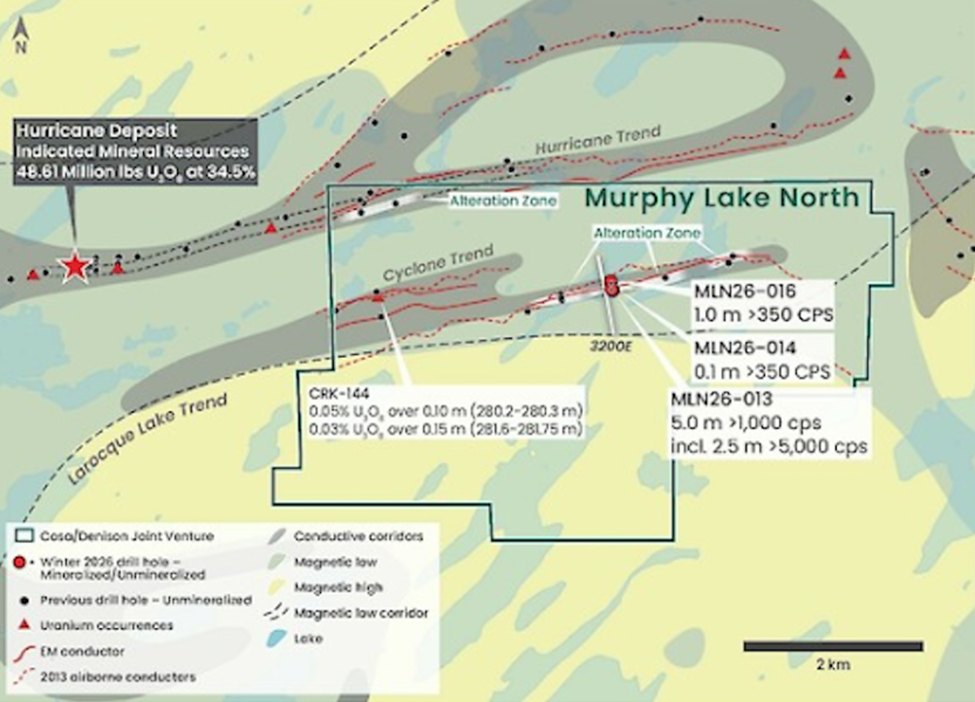
On April 13, Cosa reported the intersection of anomalous radioactivity in multiple drill holes and completion of the winter 2026 drilling program at MLN.
Five drill holes totaling 2,015 meters were completed during the program, with three drill holes intersecting anomalous radioactivity.
Radioactivity remains open in multiple directions including for at least 600 meters along strike to the east and 600 meters to the west within the larger kilometer-scale Cyclone alteration zone.
The depth of the radioactivity is shallow at approximately 260 meters vertically from surface.
The Cyclone Trend structural corridor is over 100 meters wide and hosts significant alteration consistent with major eastern Athabasca uranium deposits.
The first drill hole of the program, MLN26-013, intersected the strongest radioactivity including a 5.0-meter interval of continuously anomalous radioactivity in the upper basement. Two holes were completed to directly follow up radioactivity in MLN26-013. Two additional holes were completed to define underlying geology ahead of summer drilling and follow up another radioactive intersection. All drill holes were completed on Section 3200E.
Drilling also defined highly prospective geology with similarities to the Hurricane deposit and other unconformity related uranium deposits of the eastern Athabasca Basin (Figure 3).
The company and its joint venture partner, Denison Mines, will be finalizing summer plans in the coming weeks. The drill remains on site for rapid startup when drilling resumes this summer. Assays for all winter drill holes remain outstanding.
According to Red Cloud Securities, the first winter drill hole points to the discovery potential at MLN:
“While assays are pending, we view these as encouraging results with a clearly visible uranium mineralization in core photos, which could very well translate into a discovery,” writes David Talbot, managing director and head of equity research. “The shallow mineralized zone (<400m) and proximity to infrastructure are an added bonus. The program is led by a strong, ex-Denison and ISO team, under Keith Bodnarchuk (President & CEO) and Andy Carmichael (VP Exploration).
The target sits in one of the Athabasca Basin’s most compelling corridors, anchored by the nearby Hurricane deposit — the highest-grade uranium deposit in the world, hosting 50M lbs at 35% U3O8. Cosa has pivoted its entire winter program to follow up on this hit, and if assays confirm, this has the makings of a discovery that could attract significant investor attention and act as a meaningful re-rating catalyst, backstopped by Denison’s 18% ownership in the company.”
Conclusion
Whereas real estate is all about location, in mining everything flows from management. Cosa Resources is headed by CEO Keith Bodnarchuk, Chairman Steve Blower, and VP Exploration Andy Carmichael who were with IsoEnergy when it discovered the Hurricane deposit, currently the world’s highest-grade Indicated uranium resource.
Four members of the management team including Carmichael in 2022 were awarded the AME Colin Spence Award for discovering Hurricane.
Cosa is exploring its Athabasca Basin properties with the help of Denison Mines, a much larger companies with deep pockets. The strategic collaboration with Denison Mines has secured Cosa access to several highly prospective eastern Athabasca uranium exploration projects. Cosa owns and operates majority interests in Murphy Lake North, Darby and Packrat joint venture projects. Denison has an 18% stake in the company.
The uranium market is experiencing sustained long-term price growth, reaching over 18-year highs of USD$93/lb, driven by severe structural supply constraints and rising, high-volume nuclear fuel demand.
The Athabasca Basin is famous for its high grades — at over 20 times the global average grade of 0.2% U3O8. Hurricane’s average grade is 34.5% U3O8, which is some of the most valuable rock on the planet.
Eastern Athabasca host the largest-grade uranium mines on earth including Cameco’s McArthur River and Cigar Lake.
Cosa appears to have made a discovery during its 2026 winter drill program at Murphy Lake North. Hole MLN26-013 intersected 5.0 meters of anomalous radioactivity, registering up to 13,900 Counts Per Second (CPS) in the upper basement approximately 260 meters vertically from surface.
This was followed by two more holes intersecting anomalous radioactivity, which remains open in multiple directions.
While assays are pending, the anomalous radioactivity combined with the uranium mineralization evident in core photos, potentially alludes to a new discovery in the Athabasca Basin.
The company is cashed up from an upsized $7.5 million private placement in December. The successful winter drill program is complete, and Cosa will soon be announcing its plans for the summer, providing steady news flow and further discovery potential.
Cosa Resources Corp.
TSXV:COSA, OTCQB:COSAF
Cdn$0.675 2026.04.14
Shares Outstanding 116.1m
Market Cap Cdn$76.2m
COSA website
Richard (Rick) Mills
aheadoftheherd.com

Subscribe to AOTH’s free newsletter
Richard owns shares of Cosa Resources Corp. (TSXV:COSA). COSA is a paid advertiser on his site aheadoftheherd.com This article is issued on behalf of COSA.
Legal Notice / Disclaimer
Ahead of the Herd newsletter, aheadoftheherd.com, hereafter known as AOTH.Please read the entire Disclaimer carefully before you use this website or read the newsletter. If you do not agree to all the AOTH/Richard Mills Disclaimer, do not access/read this website/newsletter/article, or any of its pages. By reading/using this AOTH/Richard Mills website/newsletter/article, and whether you actually read this Disclaimer, you are deemed to have accepted it.