 RSS Subscribe
Rule of the Rich – AOTH
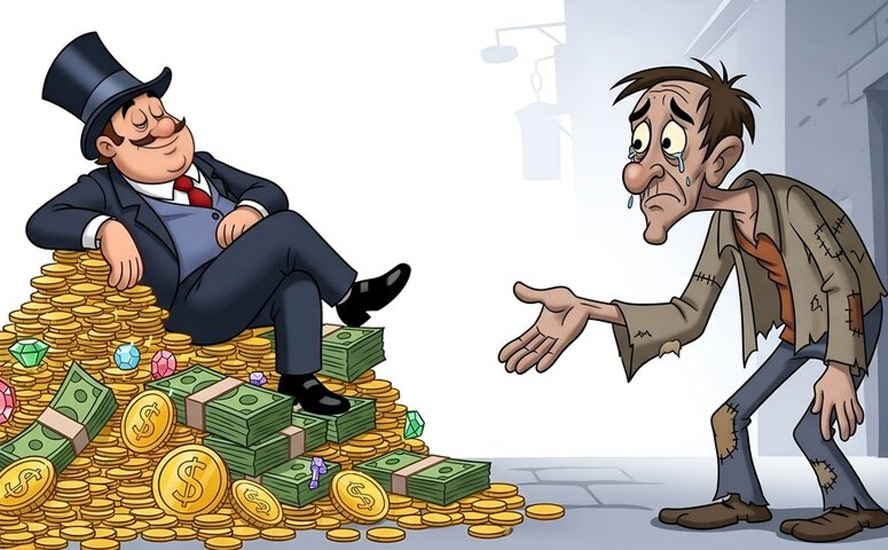
‘‘What is to become of these propertyless millions who own nothing and consume today what they earned yesterday? The English middle classes prefer to ignore the distress of the workers and this is particularly true of the industrialists, who grow rich on the misery of the mass of wage earners.” Friedrich Engels, The Condition of the Working Class in England in 1844
“The Springtime of the Peoples” (also known as the Revolutions of 1848 or the Spring of Nations) was a massive wave of simultaneous political upheavals and revolts that swept across Europe between January 1848 and October 1849. It remains the most widespread revolutionary wave in European history, ultimately affecting more than 50 countries.
The Springtime of the Peoples erupted because of a lethal intersection of mass starvation, economic collapse, and deep-seated political oppression. While the spark that set the continent ablaze was political—beginning with local revolts in Sicily and exploding with the overthrow of the French monarchy in February 1848—the entire European continent had essentially spent the previous three years becoming a highly flammable economic tinderbox.
Historians categorize the exact conditions at the time into two main areas: immediate economic desperation and long-term systemic frustration.
The years immediately leading up to 1848 are known historically as “The Hungry Forties.” Immediate economic misery, and the sheer terror of it, was the ultimate catalyst for the uprisings.
Following the defeat of Napoleon in 1815, European monarchs established the Congress of Vienna, an alliance designed to freeze European politics in place. Spearheaded by Austrian Chancellor Klemens von Metternich, this system relied on strict censorship, secret police networks, and immediate military intervention to violently crush any hint of democratic thought.
The majority of Europeans lived under rulers who claimed a divine right to govern without elections, constitutions, or basic civic protections. Even in France, which theoretically had a constitutional monarch (King Louis Philippe), the system was corrupt; only a tiny elite fraction of wealthy landowners were allowed to vote.
By the winter of early 1848, these forces collided.
While the vast majority of these revolutions were quickly defeated and their political gains rolled back by conservative forces, they fundamentally reshaped Europe by permanently weakening absolute monarchies and laying the groundwork for the modern nation-states we see today.
Though the immediate political movements failed, the Springtime of the Peoples was a crucial turning point in world history:
- It led to the permanent abolition of serfdom and feudalism in Austria and Prussia, freeing millions of peasants.
- The nationalist fervor planted the seeds that directly led to the unification of Germany and Italy a few decades later.
- Monarchs realized they could no longer rule by divine right alone; over the following years, many were forced to adopt constitutions and expand voting access to keep the peace.
Arab Spring
When historians and political analysts compare the Springtime of the Peoples to the modern era, they find striking parallels in how protests spread, how broad coalitions fracture, and how economic anxieties trigger sudden political shifts.
The most common comparisons center around global protest waves, changing economic strains, and the double-edged sword of decentralized movements.
The most frequent modern comparison to 1848 is the 2011 Arab Spring.
Both began with a single spark in a localized area (Sicily in 1848; Tunisia in 2010) and triggered a rapid, region-wide domino effect. In both eras, citizens in neighboring countries watched authoritarian regimes look vulnerable and used cognitive shortcuts to assume they could easily overthrow their own leaders.
Just like 1848, the initial “spring” of optimism in 2011 was followed by a harsh political winter. Most of the uprisings were ultimately crushed, reversed, or devolved into civil war, with only a few lasting democratic gains.
Both eras were primed for unrest by widespread financial desperation and a lack of upward mobility.
The underlying fuse was physical survival. Severe crop failures (like the potato blight) caused skyrocketing food prices, mass starvation, and urban poverty.
Modern societies confront a different kind of economic suffocation. Instead of mass famine, younger generations and the middle class face sustained erosion of real incomes, soaring housing costs, and chronic indebtedness.
The underlying feeling remains identical: a growing belief that the current economic and political system is rigged against the average citizen.
Conclusion
Ultimately, 1848 was a transitional checkpoint where older political frameworks (absolute monarchies) crumbled to make way for new ones (liberalism and nationalism). Many political scientists argue that today is a similar period of profound uncertainty, where the traditional post-Cold War liberal democratic model is increasingly questioned, and nationalism and populism are rising in response to global instability.
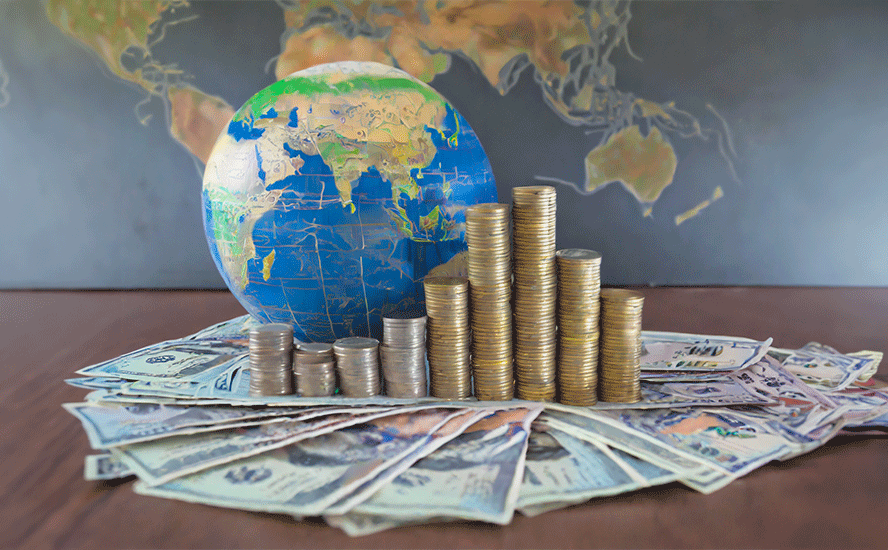
Economic inequality has reached absolute historic highs, mirroring the intense levels of concentration that directly triggered the Springtime of the Peoples in 1848. Data from the World Inequality Report 2026 shows that the top 10% of the global population captures 53% of total income and controls 75% of all personal wealth, while the bottom 50% shares less than 10% of income and a mere 2% of wealth.
The structural similarities between our modern era and the pre-revolutionary 1840s are undeniable, though the nature of the economic squeeze has shifted.
The economic landscape of today is increasingly defined by what economists call the ultra-concentration of the top 0.001%. To see how this compares to the pre-revolutionary period, we can look at the distribution of assets:
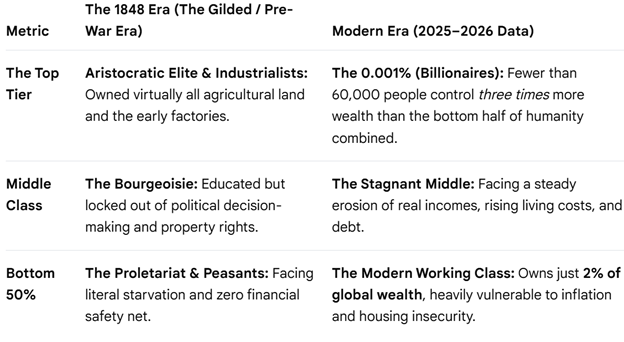
A central theme in recent analyses, such as Oxfam’s 2026 Inequality Report, is that extreme wealth is no longer just about consumption; it is about systemic political control. In 1848, activists rebelled against monarchs who used divine right to protect their wealth. Today, the super-rich are increasingly leveraging their immense fortunes to buy political campaigns, acquire media networks, and influence the law to preserve their status, a phenomenon researchers term the “Rule of the Rich”.
In the 1840s, inequality became a physical emergency because of the European Potato Failure, which caused bread prices to skyrocket and left the urban poor starving.
Today, the modern equivalent is not a crop failure, but housing and basic cost-of-living inflation. While upper-income households saw their wealth surge post-2020, lower- and middle-tier households have seen their wage growth completely swallowed by soaring rental markets, high interest rates, and food costs. The emotional response is the same: the crushing feeling that working hard no longer guarantees an average, dignified life.
We are currently living through a level of economic divergence that rivals the eras that produced history’s most volatile revolutions. This staggering imbalance is a primary engine behind the deep political polarization, rising populism, and civil discontent defining global politics today.

Legal Notice / Disclaimer
Ahead of the Herd newsletter, aheadoftheherd.com, hereafter known as AOTH.Please read the entire Disclaimer carefully before you use this website or read the newsletter. If you do not agree to all the AOTH/Richard Mills Disclaimer, do not access/read this website/newsletter/article, or any of its pages. By reading/using this AOTH/Richard Mills website/newsletter/article, and whether you actually read this Disclaimer, you are deemed to have accepted it.