 RSS Subscribe
Under the Spotlight – Marc Blythe, CEO AU Gold TSXV:AUGC
2026.09.17
The Victoria region is famous for its rich gold-mining history. Over time, it has produced roughly 80 million ounces of gold. Experts believe there are still millions of ounces of hidden gold deep underground in this region, which is why companies like Au Gold Corp are utilizing modern technology to reopen these old, forgotten fields
Au Gold Corp (TSXV: AUGC) is actively exploring the Havelock Gold-Antimony Project located within the world-class Victorian Goldfields of Australia.
The company has successfully built a historical database and completed surface testing. They have narrowed their primary efforts down to two high-priority drill targets along the Shaw-McFarlane Trend.
The two high-priority areas chosen for phase 1 diamond drilling are McFarlane’s and Shaw’s No.1 North.
McFarlane’s Trend
At the McFarlane’s site, historic mining went as deep as 350 feet (107 meters). Records from the 1880s show they pulled out incredibly rich ore, averaging close to 23 grams of gold per tonne.
The drill program is specifically searching for the continuation of gold and antimony (a valuable metal used in technology and energy storage) that extends deep underground below the old mine workings.
The McFarlane’s target is the primary reason Au Gold Corp initially acquired the Havelock Gold-Antimony Project. It is a highly attractive, high-grade historic mining site that has never been tested with modern drilling tools.
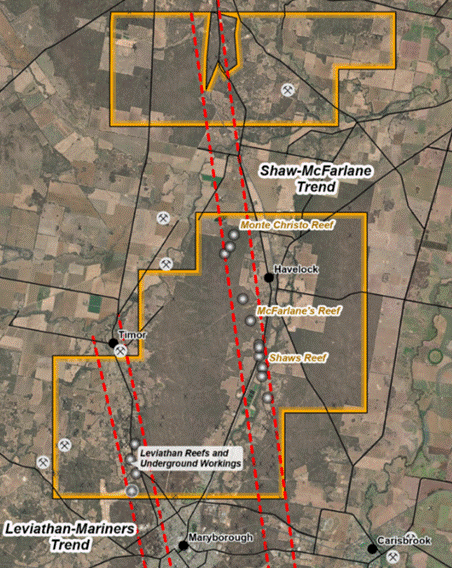
The target consists of two key areas located just 150 meters apart: the McFarlane Shaft and the McFarlane Dam.
In the 1880s, miners pulled ultra-high-grade gold from the McFarlane Shaft, averaging roughly 23 grams of gold per tonne (with some parcels reaching up to 1 to 10 ounces per ton). However, early miners suddenly stopped working when they hit two major obstacles.
They hit a large amount of a metal called antimony (stibnite) mixed into the gold quartz. In the 1880s, miners did not have the technology to separate gold from antimony, making it a nuisance. Today, antimony is a highly valuable, critical technology and defense metal.
The old miners hit strong underground water flows at deep levels and could not pump it out fast enough with 19th-century equipment.
Au Gold Corp’s modern research shows that the gold and antimony structure dips steeply underground. The old mine stopped at a depth of about 350 to 400 feet (107 to 122 meters).
Geologists believe this is an epizonal gold system. This is the exact same type of geological system as other famous, highly successful Victorian mines like Fosterville, Sunday Creek, and Costerfield—all of which have proven to hold rich gold deposits deeper than one kilometer straight down.
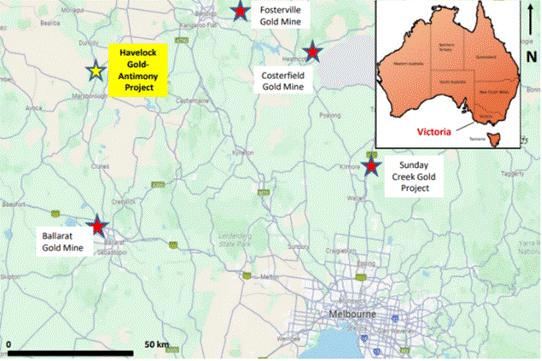
Old records from the historic mine manager has, so far, revealed two bonus targets that the company plans to test.
- The Western Reef: A historical exploration tunnel discovered a separate, highly mineralized “parallel reef” (a parallel wall of gold-bearing quartz) about 24 meters west of the main mine, which the old miners never followed up on.
- The Dam Target: Just 150 meters away at the McFarlane Dam, prospectors recently recovered 514 ounces of coarse gold right near the surface. Au Gold Corp believes this might be another entirely parallel gold system sitting east of the main mine.
Au Gold Corp’s phase 1 diamond drilling program is specifically designed to punch straight through the ground below the historic 350-foot mine floor. They are aiming directly for the “down-plunge continuation”—the deep, untouched extension of the gold and antimony that the old-timers had to leave behind.
Shaw’s No.1 North target
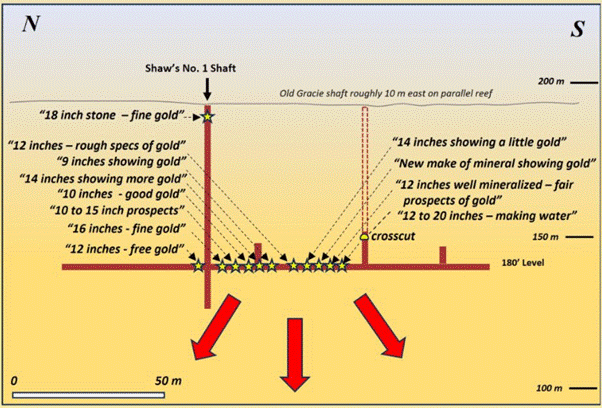
The Shaw’s No.1 North target is located right in the central portion of the 9-kilometer-long Shaw-McFarlane Trend. Like McFarlane’s, it represents an old 1880s gold mining site that has sat completely untouched by modern exploration.
The historic Shaw’s No.1 mine is a single-level underground operation. It features a “drive” (a horizontal underground tunnel) that stretches for 140 meters along the gold reef. Historical mine records show that gold-bearing reef mineralization was documented across nearly the entire length of these old underground workings, meaning the gold structure is highly continuous rather than just a lucky patch.
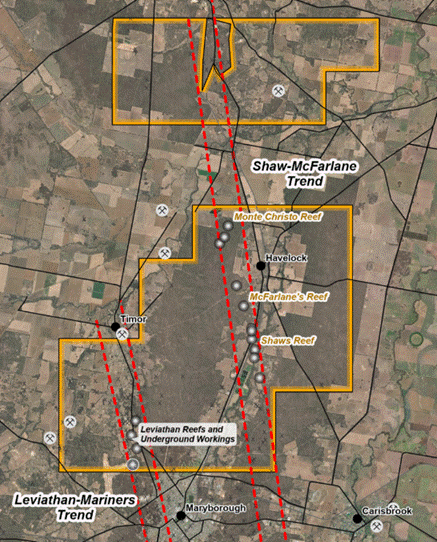
The old-timers only mined Shaw’s No.1 North down to a depth of 180 feet (55 meters) before stopping. For context, other nearby mines along the trend went as deep as 500 feet (152 meters), where they pulled out over 11,400 ounces of gold. Because the historical mining at Shaw’s No.1 North stopped so close to the surface, the deep potential is wide open.
Historical records reveal that the main mine isn’t the only gold structure here. There is a second, parallel quartz reef sitting just 10 meters east of the main Shaw’s No.1 workings. Early miners did some minor work on it but left it largely unmined. This gives the company two closely spaced targets to test with a single drilling setup.
Au Gold Corp’s phase 1 diamond drilling program at this site has three specific goals:
- Target the Under-Explored Deep Zone: They are aiming their drill bits directly beneath the historic 180-foot level to see how far down the gold continues.
- Map the “Plunge Geometry”: The drilling will help geologists figure out the exact angle and shape of the high-grade “mineralized shoots” (the richest vertical tubes of gold ore) so they know where to aim future, deeper holes.
- Punch Through Both Reefs: The drill holes will be angled to pierce both the main Shaw’s reef and the untouched eastern parallel reef in the same run.
To see how Shaw’s No.1 North fits into the bigger picture, here is how it compares to the McFarlane’s target:
| Feature | Shaw’s No.1 North Target | McFarlane’s Target |
| Location on Trend | Central portion | Central portion |
| Historic Depth | Shallow—180 feet (55 meters) | Deeper—350 feet (107 meters) |
| Main Highlight | Consistent gold across a 140m tunnel | Ultra-high-grade gold (~23 g/t) |
| Bonus Structure | Parallel reef 10m to the east | Western parallel reef & Dam target |
| Drill Objective | Map the shape & flow of the gold shoots | Test the deep continuation of gold/antimony |
RM: Good morning Marc, with everything that has been accomplished in such a short period of time you must be run a little ragged, are you?
MB: lots been going on Rick but it’s all good, we’re making great progress.
RM: Great minds must think alike, I was thinking about how far we’ve come in such a short time period as I was putting together that summary.
What sticks out for you in all you have gotten done?
MB: My background is technical and when I see something like those long sections, it jumps out at me, hey this is pretty special. What was your reaction when you saw those long sections?
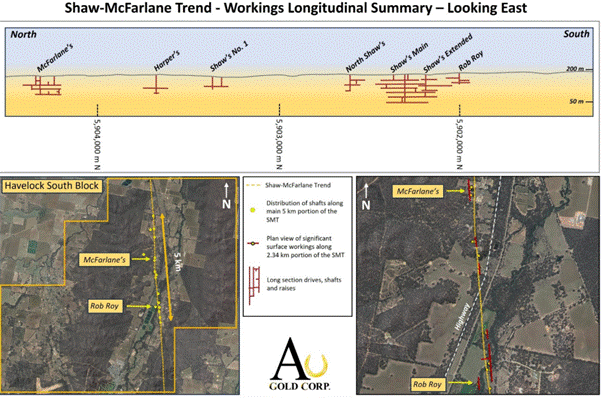
RM: Well, I have to admit, I got excited. I remembered back to what we were talking about before with the old guys, those OG’s. They couldn’t get deep, they had water problems and maybe even widths reported and for sure their grade following was extremely focused, absolutely laser focused on ultra high grade.
I just started thinking, like, ‘what the hell are we going to find,’ that’s what popped into my head.
MB: Most drill programs, you’re going out, you’re looking for gold, you’re hoping to get some. We kind of already know there’s gold here, you know with reports like that in front of you, you tick that box, we know there’s gold here.
Then the questions become about grade and thickness, do we have interesting grades and thicknesses of gold mineralization. And that’s what is going to continue to drive the story forward. With those kinds of long sections to refer to they tell you, you’ve got a good shot here.
If you could see gold in quartz that tells you there’s a reasonable content in there, if someone’s got a deposit that’s two grams a ton, you generally don’t see anything in the rock, but if you’re seeing gold it’s telling you this is potentially a high-grade system.
RM: VG gets everybody excited for a reason. And those OG’s they just followed the gold, today if you looked at the intersections, I think there might even be a decent shot at bettering the intersection.
MB: For us when you look at the old timers, the evidence on the gold fields says they’re very good at finding things that stick out at surface, and they’re also very good at mining things very narrowly, in places you see the underground workings are less than a metre in width, they’re very, very accurate miners, and they even sorted the ore before they sent it to the crusher, so if there was ore and waste, they probably picked the ore out of it.
What they sent for processing was probably just a high-grade vein like one we’re interested in talking about here. You look at modern mining these days with highly productive systems, and mining less than a metre is very uncommon, a metre and a half is kind of where you can get down to, and if the grade is high enough to take the dilution that’s how it works these days with mechanised. Of course you also get much higher productivities than the old timers did.
But the other thing that’s really changed with gold is the gold price, the economics, the grades that people are mining. For the old timers to be doing this kind of work that they were doing they’re probably in the realm of needing a half an ounce or 15g a tonne, 10 to 15g a tonne is our estimate of what I call their cut-off grade, where if they don’t meet that grade, they’re not making any money or they’re not interested in pursuing mining.
If these structures are in that kind of realm, then I think we have a chance. Even when you do add a bit of extra dilution with modern mining methods you still end up with something that’s still reasonably high grade.
RM: Maybe it’s not an ounce a ton maybe it’s only 8 or 10 g/t. But they were crawling around these little tunnels as wide as a desktop printer. They’re not risking their lives in those wormholes for nothing but bonanza grades.
You can go in and possibly take two meters and be way ahead of the game than they ever dreamed of being.
Why don’t you talk a little bit about how you picked the drill targets and what you based everything on?
MB: We have obviously got a lot more data that we’ve used in our decision-making than what we’ve put out in this release but when you look at those comments, there’s obviously subjective mentions of gold, in some of those workings, that visible gold was seen here or payable stone, the old timers called it payable stone, that’s what they wanted to work.
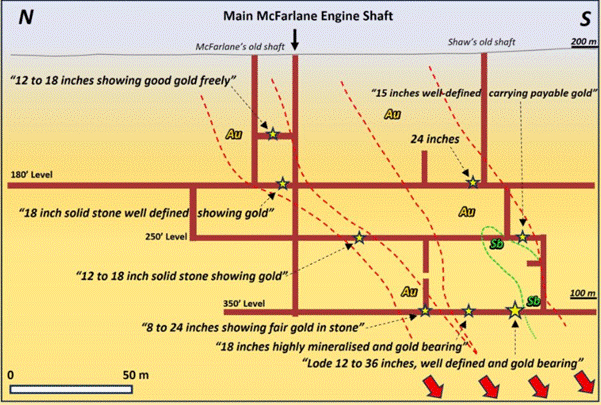
That’s really difficult to reconcile, you know we engineers like numbers, what was the grade? That isn’t there, but what is there in parts of these long sections is thickness, and having somebody provide a thickness of a vein well that hasn’t changed over time, a one foot vein is still a one foot vein or a two foot vein is still a two foot vein.
You mentioned that maybe they didn’t measure it with a laser but if they reported that the vein was a certain width, it’s probably not far off what they’ve reported, whether they had a measuring tool or whether they used their eye, that’s a solid sort of measurement that you can have some level of confidence in when they’ve mentioned a width. So, you know where we’ve got gold reported and widths that are interesting, those are the places that are most interesting to us.
RM: Tell us, tell me what you like most about the McFarlane target.
MB: Well, from a technical perspective, the association with antimony is very interesting to us because as you and I have talked before that can be indicative of potentially an epizonal gold system.
That puts this system in a whole other category, along with Fosterville, Costerfield and Sunday Creek, so that’s Agnico Eagle, Alkane Resources and Southern Cross Gold. Those places have proven to be very productive in terms of grades, tonnage and particularly depth.
All three of those systems have been chased to depths of more than a kilometre, either through production or through drilling. That’s the thing, that’s compelling, is how shallowly McFarlane has been exploited.
It’s still very close to surface. We’ve got this antimony association with the high-grade gold and it’s potentially an indicator of an epizonal system.
I’m excited, we’re maybe moving the boundaries of where these epizonal gold systems can be found in Victoria.
And if that’s what turns out to be true there’s a lot of potential ahead of us. I was just looking last night at the surface footprint of the Fosterville Gold Mine, up near Bendigo, and I looked at a slide in one of their presentations from the Diggers and Dealers Conference in Australia.
I think they have our Maryborough Goldfield in their slide there as well it’s hard to tell but I think their surface footprint is a little less than 10km, we have that amount of real estate in front of us here at Shaw McFarlane.
I’m not saying that’s where we’re going to end up, but we certainly have some of the same sorts of things that perhaps were present at Fosterville before they really started to turn that mine into success.
RM: Tell us more about the potential system.
MB: These ore systems are formed by fluids that come from roughly 5 or 6km deep generally, and they come up under great pressure, and they’re basically being forced up along listric faults, which are flat dipping structures, from down deep in areas where it’s hot.
And then as they get close to surface, they short circuit through some of this folded stratigraphy that’s the host rocks for these kinds of systems. when they start intersecting the folded stratigraphy near surface, when I say near surface, I’m talking maybe up to a couple of kilometres deep and then coming up to surface through those structures.
That’s the best explanation that we have so on how these things form.
RM: They’re of an orogenic origin?
MB: Correct. The way the gold precipitates out, it’s like a pressure release mechanism.
Anywhere that you have void space in the rock, or dilation occurring in the rock, you’re creating a pressure drop. If you have two bits of rock that are moving apart, coming apart, then that provides a pressure release opportunity to deposit that gold into a structure.
You see these things in quartz veins and probably the most interesting quartz veins that you see on the Maryborough Goldfield are laminated quartz veins.
Those are the most interesting ones because a laminated quartz vein is a quartz vein that’s made up of multiple quartz veins, they used to call it book quartz. So, when you see that in the old records, that kind of got my attention.
Each quartz vein in that laminated system is a separate event. And some of those events carry gold and some didn’t. But if you have a lot of events, you have a lot of laminations and the chances that there was a gold bearing event(s) in that series is probably a bit better.
RM: It’s not very common to have gold and antimony drop out at the same time, is it?
MB: No, it’s pretty unusual.
There’s the occurrences that I mentioned previously, there’s a number of other ones as well. The antimony is less common. And the antimony does appear at the top of the system.
If you’re finding antimony, it potentially bodes well for what’s beneath you. At Fosterville, they had a lot of antimony at the top, and the antimony diminishes as they go deeper into the system and the gold grades increased. If you’re getting high grade gold and antimony that’s a good sign that the system is preserved below you..
RM: Let’s move to Shaw’s number one North target.
MB: I like that grade thickness relationship here that we talked about, there’s obviously some width there that we think are adequate, and the mention of gold there.
We see a linear trend like at Shaw’s number one, we’ve got 80 metres of interesting reports and the mine was extremely shallow there so again things that are close to surface, very interesting.
The other thing I haven’t talked about at all, but is a feature for pretty much all of the zones on the trend, is the potential for parallel structures. And it looks like at Shaw’s number one, there were two structures that were exploited fairly close together, I think maybe 10 metres apart laterally. And if you’ve got two veins that are both carrying gold, then yeah, that can be very helpful from an economics perspective, if you’re putting down an underground mine, that you have access to two veins instead of one.
You know, in some respects, if both veins were similar kind of grade and thickness, then you’d be able to split the costs of the capital development amongst two veins instead of just one vein. It can really improve the economics of a mine if you have multiple veins. Yeah.
RM: And a system like this, it should be the mineralogy would be the same. The metallurgy, the recovery should be the same.
MB: I can’t say that without any test work, but that’s a reasonable assumption.
RM: The old timers were very good, but they mainly exploited things that they could see at surface to begin with. You know they wouldn’t have gone over there, they didn’t have the same sort of techniques and technologies that we have now, like geophysics and LIDAR surveys and drilling.
They were just out there and had a good eye for detail and exploiting things that they saw and that to some degree is pretty interesting for us on the Shaw-McFarlane trend, because there may be things that exist here that don’t stick out at surface, you’ve got a chance of finding other things.
MB: Well, the thing is when you drill something like this, where these, these veins are quite steep, you try and drill them with angled holes.
We’re going to drill angled holes to target these veins that we know about. And there’s a good chance that those angled holes will test the ground beside the existing known-veins. And if there’s other veins there, then we’re likely to see them too.
RM: We’re going to step back, angle them and drill underneath where the old timers worked. You want to find the gold that’s still in place and hasn’t been disturbed by mining.
MB: Yes, exactly, we want to try and target underneath the old timers workings. We don’t want to insect the old timers workings, that’s not part of the plan.
RM: Now that we’ve talked about all this, the big question is, when are you going to go drill it?
MB: We’ve had conversations with a number of drilling companies, had another meeting with one of them last week. It’s actually relatively tight for drill rigs right now in Victoria. There’s a lot going on.
I think they have a dozen drill rigs at Southern Cross, the Sunday Creek project. And Fosterville is doing a lot of drilling and Costerfield is also doing quite a bit drilling. And there’s a number of other explorers that have got some pretty big exploration programs underway.
It’s a little bit competitive to get a rig. And we’re trying to find a company that we align well with. Our drilling, because of where we are, we’re relatively close to some houses and stuff like that.
We’re going to be drilling day shift only. And some drill companies prefer that, and other drill companies would prefer to have a rig spinning 24 hours a day. So, we’re trying to align with a company that would prefer the day shift only kind of work, so there’s not a big cost or noise impact from that.
But I’m hoping we’re going to get to some paperwork with a drill company pretty soon here. And maybe we’re a little bit delayed in our approach. They did have a lot of rain, but things are starting to dry out around the project, some areas might be a little soft to operate on.
I’m hopeful that we can get going in October.
RM: Have we got enough dollars to do this?
MB: We have enough money to do the drilling that we had originally talked about in our 43-101, which was a 2,000m program.
But with the targets that we have identified, we’re starting to wonder whether that’s actually sufficient. So, yeah, there’s some discussion going on about whether we should be trying to aim for a 3,000m to 5,000m program initially. And maybe we need to top up the treasury.
RM: We’ve still got a decent share structure and a miniscule MC, we’re tight. We can afford to do what you want.
| Shares Issued | 58,539,157 |
| Market Cap | 11,708,000 |
MB: For sure. Great, yeah. I’m excited, Rick.
RM: I am too, I think that we got a tiger by the tail and you’re just the guy to give it a great big yank.
Thank you for doing this.
MB: Thanks Rick, talk again soon.
Richard (Rick) Mills
aheadoftheherd.com

Subscribe to AOTH’s free newsletter
Richard does own shares of AU Gold (TSXV:AUGC). AUGC is a paid advertiser on his site aheadoftheherd.com
This article is issued on behalf of AUGC
Legal Notice / Disclaimer
Ahead of the Herd newsletter, aheadoftheherd.com, hereafter known as AOTH.Please read the entire Disclaimer carefully before you use this website or read the newsletter. If you do not agree to all the AOTH/Richard Mills Disclaimer, do not access/read this website/newsletter/article, or any of its pages. By reading/using this AOTH/Richard Mills website/newsletter/article, and whether you actually read this Disclaimer, you are deemed to have accepted it.