 RSS Subscribe
Uranium retraces $90/lb amid supply risks and strong demand – Richard Mills
2026.09.12
US uranium futures reached $90 a pound this week — nearly replicating Aug. 26th’s over six-month high of $90.60 — amid bullish market fundamentals.
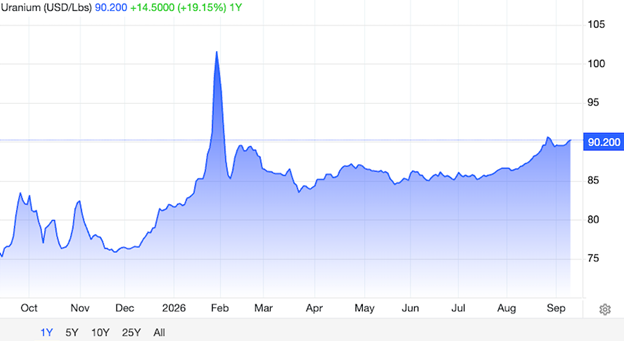
U3O8 was at $100 a pound in late January, the highest the nuclear fuel has been since February 2024, when it reached a 5-year high of $106.
The Wall Street Journal quotes miners saying that long-term prices, reflecting what power companies are willing to pay under multi-year contracts, are at their highest level in at least 18 years.
Jefferies last week raised its long-term uranium-price forecast by 36% to $95 a pound. In the shorter term, analysts at Citi think uranium could jump to $140 a pound by late 2027, WSJ reported.
The market’s structural setup is driven by three forces:
- AI data centers/ tech deals
- Western sanctions on Russia leading to a supply deficit of about 25 million pounds and higher long-term prices
- 13 years of under-mining
Data centers are growing rapidly in size and number, leading to a significant increase in their consumption of energy, water and minerals. This expansion is largely driven by the increasing demand for Artificial Intelligence (AI), cloud computing and digital services.
Data centers: Gluttons for power, water and minerals Part 1 — Richard Mills
Massive tech companies such as Meta, Amazon and Microsoft are signing direct power agreements with nuclear utilities to feed power-hungry AI infrastructure.
The Wall Street Journal notes that The tailwinds for uranium prices extend beyond data centers and the boom in artificial intelligence. Countries are investing in new power projects to meet energy security goals and phase out fossil fuels such as coal, which are blamed for emitting greenhouse gases into the atmosphere.
According to the World Nuclear Organization, about 440 reactors with combined capacity of 390 GWe (gigawatt electric) require 80,000 tonnes of uranium oxide concentrate containing about 67,500 tonnes of uranium from mines (or the equivalent from stockpiles or secondary sources) each year.
Shortage forecast
Demand for uranium is outstripping supply.
Research by Teniz Capital said the global uranium market is entering a “tipping point” where sustained demand for the nuclear fuel and supply constraints could see prices rally in the coming years.
The UAE-based investment bank put out a report saying the market has reached what analysts believe to be an acute structural deficit that is incapable of meeting demand due to the slow pace of mine development and years of underinvestment. Demand, meanwhile, is projected to rise 28% by the end of the decade and double by 2040.
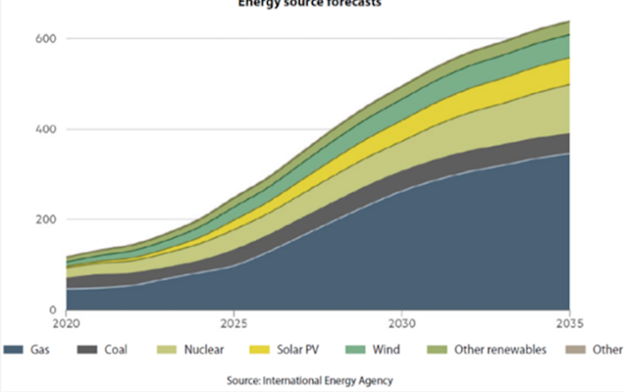
According to Teniz, mines can only cover 74-90% of current needs. While in the past the gap could be met with secondary sources, now these have largely been depleted as well.
The current project pipeline is effectively exhausted and developing new mines could take 10-15 years, it added.
“The supply deficit in the 2030s is already programmed. It cannot be eliminated by any political decisions or investments. The physical constraints of time are insurmountable,” the report said, warning that even higher uranium prices would not offer a quick fix.
WSJ adds another factor pressuring supply: higher costs. The publication quotes Meirzhan Yussupov, CEO of major producer Kazatomprom: “New realities are signaling that the era of ‘cheap’ uranium is fading away.”
A report by Sprott Asset Management highlighted the slow pace of mine development and an underinvested supply base are set to widen the market deficit.
Furthermore, contracting is in catch-up mode. Nuclear utilities buy uranium ahead of time through long-term contracts. But contracting undershot the replacement rate for a 13th straight year in 2025, pushing uncovered needs into the future.
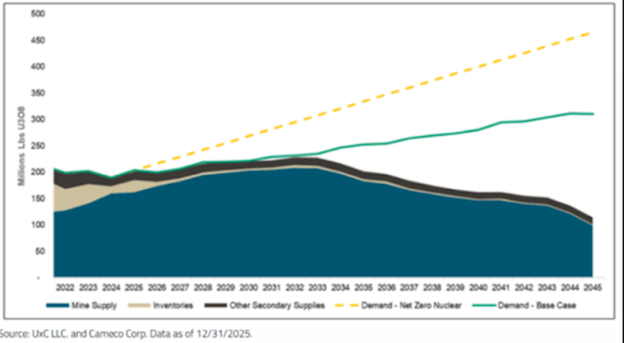
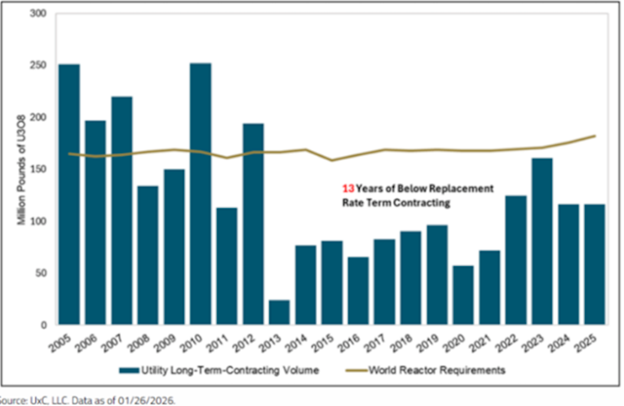
Western utility contract coverage falls off sharply between 2028 and 2030, meaning they will soon be forced to aggressively bid up prices to replace expiring supply.
Major producers like Kazakhstan, Canada and Australia handle 75% of global output. With the US and Europe actively banning Russian supply chain imports, the Western market faces an immediate localized crunch.
Trading Economics reported on Friday that The outlook on yellowcake supply from Kazatomprom, the world’s largest uranium producer, faced fresh uncertainty as its TQZ sulphuric acid plant faced delays, limiting capacity for leaching uranium. The producer also noted that demand was accelerating as large economies continued to invest in nuclear power to achieve decarbonization goals and limit exposure to volatile commodity markets due to geopolitical tension in Russia and the Middle East. Italy was the latest to express interest to approve a legal framework to restore nuclear power, in line with measures from the US and Japan as power consumers expand sources for generation to account for the higher demand from data center projects.
Conclusion
Global uranium mines supplied an estimated 105 million to 115 million pounds of U3O8 in 2025. This total primary mine supply was well short of the estimated 65,000 tonnes needed to meet global reactor requirements, resulting in a significant structural market deficit.
As well as existing and likely new mines, nuclear fuel supply may be from secondary sources including:
- Recycled uranium and plutonium from used fuel as mixed oxide (MOX) fuel
- Re-enriched depleted uranium tails
- Ex-military weapons-grade uranium blended down
- Civilian stockpiles
- Ex-military weapons-grade plutonium as MOX fuel
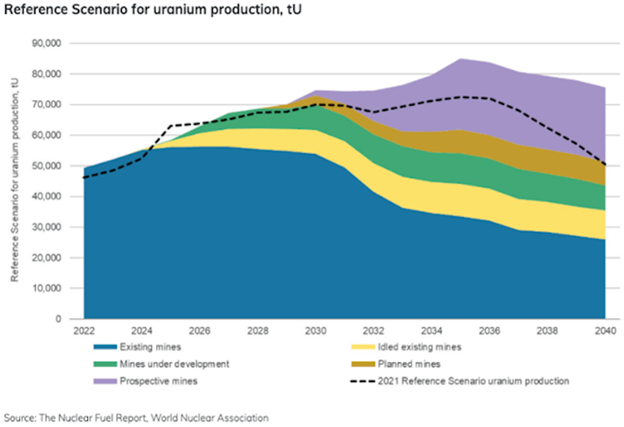
The following graph suggests how these various sources of supply might look in the decades ahead. To meet the Reference Scenario requirements from early in the next decade, in addition to restarted idled mines, mines under development, planned mines and prospective mines, other new projects will need to be brought into production.
A massive deposit in a politically unstable country carries a constant threat of resource nationalism or sudden tax hikes. Most institutional cash heavily favors safe jurisdictions, like Canada’s Athabasca Basin.
Richard (Rick) Mills
aheadoftheherd.com

Legal Notice / Disclaimer
Ahead of the Herd newsletter, aheadoftheherd.com, hereafter known as AOTH.Please read the entire Disclaimer carefully before you use this website or read the newsletter. If you do not agree to all the AOTH/Richard Mills Disclaimer, do not access/read this website/newsletter/article, or any of its pages. By reading/using this AOTH/Richard Mills website/newsletter/article, and whether you actually read this Disclaimer, you are deemed to have accepted it.