 RSS Subscribe
Airborne geophysical survey underway at Silver North’s Veronica Silver Project, YT – Richard Mills

2026.05.20
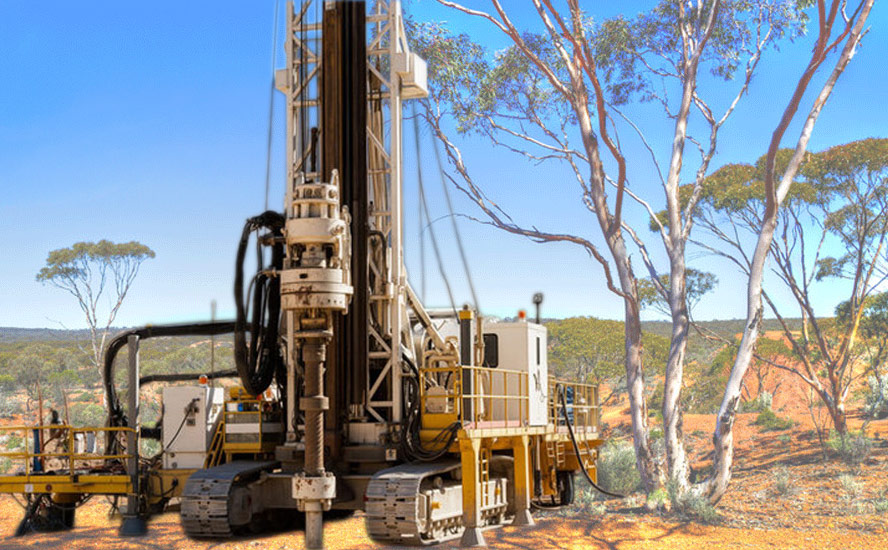
Silver North Resources (TSXV:SNAG, OTCQB:TARSF) has started an airborne magnetics and VTEM geophysical survey at the company’s Veronica Project in the Silvertip-Midway District of the Yukon Territory.
“The primary focus of this survey is to advance the mapping of stratigraphy and structure,” President & CEO Jason Weber stated in the May 14 news release. “In addition, we believe it has potential to identify conductive or low-resistivity CRD manto targets in the subsurface. By integrating this new data with our adjacent Tim property dataset, we expect to gain greater insight into a much larger mineralizing system extending across both projects.”
According to the company, Geotech Ltd. is conducting magnetics and time domain electromagnetic VTEM surveys at Veronica, consisting of 100-meter-spaced flight lines with 1,000-meter-spaced tie lines for a total of 253 line-kilometers of survey. The results of this work will aid in mapping lithology and host stratigraphy as well as revealing the structural architecture for potential faults that could host and control mineralizing systems like the Lodge showing, where 2,860 g/t silver was found in a float cobble and 33.2 g/t silver was found in a NE trending fault at the Cooper showing.
Veronica Project
In May 2024, Silver North announced an option agreement with the three prospectors who own the GDR Project.
Under the terms, Silver North will make a series of cash payments totaling $102,000 over four years, and staged share payments totaling 1,560,000 shares over four years, to earn a 100% interest in the project.
The deal is subject to a net smelter return (NSR) royalty of 2.4% — 0.9% of which can be purchased for $2 million.
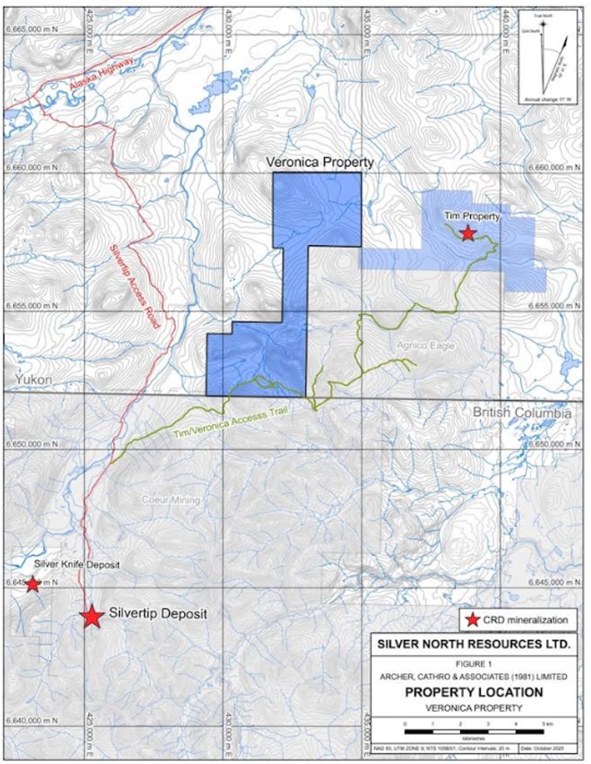
One of the GDR properties, Veronica, has a multi-element soil anomaly (the “Betty Target”) defined over a 1,000 by 1,000 m area that is open to the east, with values ranging from 1.0-31.1 parts per million (ppm) silver, 50-8,850 ppm lead, and 200-3,830 ppm zinc. Mapping and prospecting work at the Betty Anomaly in 2025 discovered the first ever mineralization found at Veronica, consisting of massive galena-bearing cobbles in float, and subsequently, in outcrop. Float cobbles found on surface include a 15-cm wide massive sulphide cobble which returned 2,860 g/t Ag, 0.412 g/t Au, 76.8% Pb, 0.13% Cu, 0.18% Zn and 2,250 ppm Sb, and a cobble uncovered in a hand trench in the same area that returned 213 g/t Ag, 9.6% Pb and 367 ppm Sb .Limestone and quartzite outcrop in the area and mineralization identified to date resembles Carbonate Replacement Deposit (CRD)-style mineralization.
Silver North’s Veronica property yields high-grade silver-lead-zinc mineralization — Richard Mills
Management’s next steps are to incorporate the data from Coeur Mining’s (TSX:CDE) work at Tim (see below), and data from Silver North’s programs, including the just-announced airborne magnetics and VTEM geophysical survey at Veronica, to derive vectors to target drilling based on the combined datasets.
Haldane Project
The survey at Veronica follows a SkyTEM312 airborne geophysical survey SNAG completed earlier this month at Haldane, its flagship silver project located in the Yukon Territory’s historical Keno Silver District.
The purpose of the 944-line-kilometer survey was to aid detailed drill hole targeting by refining the underlying geology, as well as helping define Haldane’s complex structural architecture, the company stated on April 9.
“We eagerly anticipate the receipt of the final data from this survey so we can incorporate it into our 2026 program planning,” said Weber in the April 29 news release. “With much of the drillhole location planning well underway, we anticipate that the data collected will aid in prioritizing the order in which we carry out this year’s program as well as revealing new target areas for follow-up work.”.
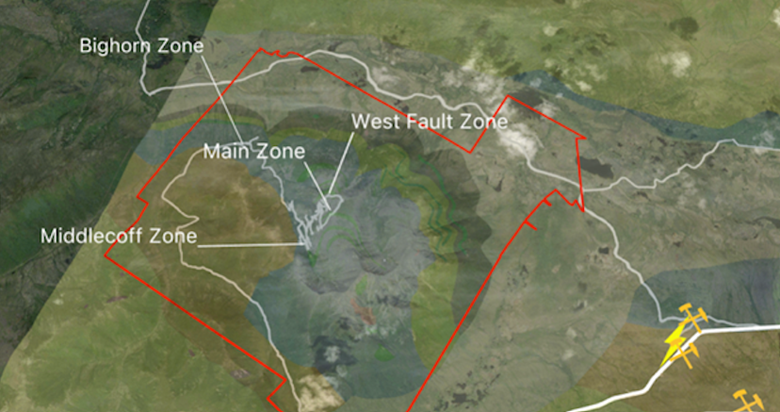
The road-accessible, 8,579-hectare Haldane property is 25 km west of Keno City, YT, adjacent to Hecla Mining’s (NYSE:HL) producing Keno Hill silver mine. Haldane hosts several occurrences of silver-lead-zinc-bearing quartz siderite veins resembling the veins being mined at Keno Hill.
SNAG completed its 2025 drill program in mid-November at Haldane.
Highlighted results included 3.2 meters averaging 2,014 g/t silver, 1.72 g/t gold, 4.73% lead and 1.1% zinc within a larger 13.15-meter intersection of 818 g/t silver, 1.39 g/t gold, 2.54% lead and 0.98% zinc from 249.9 meters down hole.
Another sub-interval starting at 256.1m averaged 1,112 g/t silver, 4.61 g/t gold, 7.11% lead and 1.51% zinc over 1.25m.
On Dec. 10 an additional two holes were released. With five holes reported, the Main Fault has been extended to 100 meters on strike and 150m down dip in drilling and 300m down dip from surface.
Silver North’s geological theory was proven on its first hole, with consistent high-grade silver combined with significantly higher gold concentrations than seen anywhere else on the property.
The high silver grades indicate that Haldane is a pure silver play — a rarity in silver exploration, with most silver found as a byproduct of lead-zinc or gold. For example, hole HLD25-31 contained 81% silver, 12% gold, 5% lead and 2% zinc (by value).
Weber tells me two drill rigs will be going all summer for a 5-7,000-meter drill program focused on the Main Fault. The company is cashed up with CAD$11.6 million in gross proceeds from a brokered LIFE private placement.
Under the Spotlight – Jason Weber CEO, Silver North
Silver North’s drill results set the table for bigger 2026 drill program — Richard Mills
Tim Project
Silver North has been working with partner Coeur Mining to develop the Tim property, located on the Yukon side of the Yukon-British Columbia border.
Tim consists of 72 mineral claims located 72 km west of Watson Lake, Yukon and 19 km northeast of Coeur’s Silvertip deposit. The property is accessible by road via a spur off the Silvertip mine access road, which connects to the Alaska Highway.
At Tim, Silver North had an option agreement with Coeur by which Coeur could earn 80% ownership in the project by spending $3.5 million on exploration over five years, making $575,000 cash payments and completing a feasibility study within eight years.
In 2024, Coeur completed a six-hole, 2,250-meter drill program at Tim.
Coeur’s geological observations in drilling, including several key characteristics of Carbonate Replacement Deposits (CRDs), were noted in drill core, indicating that Tim may be host to a productive CRD system similar to that at Silvertip.
However, Silver North has just received written notice that Coeur intends to terminate the Tim property option agreement as of May 24, 2026 — reflecting Coeur’s renewed focus on its Silvertip mine.
“On behalf of Silver North, I would like to thank Coeur and the Coeur Silvertip team for the high quality of work that was conducted at Tim, and we wish them the best in their progress at Silvertip,” Weber said in the April 29 news release. “Coeur’s work led to the identification that a CRD mineralizing system had been active at Tim, and we feel that there remains excellent potential to find economic concentrations of mineralization. We believe that with the upcoming airborne geophysical survey at our adjacent Veronica property, we can amalgamate our exploration approach for the two properties.”
Coeur completed 2,250 meters of drilling in six holes in 2024, largely testing the Wolf Fault along approximately 1,000 meters of strike length within prospective stratigraphy. Drilling targeted structurally hosted “chimney-style” mineralization potentially hosted within the Wolf Fault and splays of it, as well as stratigraphically controlled “manto” mineralization along conductive stratigraphic horizons.
Management believes that the Tim property and the company’s adjacent Veronica property are highly prospective for CRD-style mineralization.
Coeur’s 2024 program successfully confirmed the presence of a CRD-style system at Tim and permissive host rocks such as the Rosella Formation Limestones, which in the vicinity of the Wolf Fault, are overlain by phyllite and argillite of the Kechika group, providing a promising environment for deposit formation. Trenching at the Wolf Fault yielded high grade silver mineralization including 468.1 g/t silver and 21.1% lead over 4.0 meters.
The presence of a CRD system is evidenced by diagnostic features noted at Silvertip and elsewhere in the world including fugitive calcite veining that fluoresces in UV light (displaying the classic “barbeque” pink and orange fluorescence), re-crystallization of the host limestones, disseminated pyrite — sphalerite and galena sulfide and derived oxide mineralization, and massive pyrrhotite with scheelite mineralization — an important tungsten-bearing mineral.
The best drill intercept from the 2024 program returned 3.39m of 52.8 g/t silver, 0.28 g/t gold, 0.11% lead and 0.27% zinc within the Wolf Fault, or a significant splay of it.
Conclusion
SNAG is cashed up from a CAD$11.6 million private placement.
2026 catalysts include up to 7,000 meters of drilling at Haldane, focused on the Main Fault; the receipt of data from the just-completed airborne 944-line-kilometer geophysical survey at Haldane; and the current airborne survey at Veronica.
The fact that Tim and Veronica both display characteristics of CRD systems is consequential.
CRDs are large orebodies that extend over long distances, and they typically have mine lives lasting for decades, containing significant amounts of metals, including copper, gold, silver, lead, manganese and zinc. They are especially important for mining because of their large scale and high grades, containing between 10 and 150 million tons of economically mineable minerals. Moreover, they can be closely related and proximal to large porphyry systems.
Silver North Resources
TSXV:SNAG, OTCQB:TARSF
Cdn$0.25 2026.05.19
Shares Outstanding 105.8m
Market Cap Cdn$25.3m
SNAG website
Richard (Rick) Mills
aheadoftheherd.com

Subscribe to AOTH’s free newsletter
Richard owns shares of Silver North Resource (TSX.V:SNAG).
SNAG is a paid advertiser on his site aheadoftheherd.com This article is issued on behalf of SNAG
Legal Notice / Disclaimer
Ahead of the Herd newsletter, aheadoftheherd.com, hereafter known as AOTH.Please read the entire Disclaimer carefully before you use this website or read the newsletter. If you do not agree to all the AOTH/Richard Mills Disclaimer, do not access/read this website/newsletter/article, or any of its pages. By reading/using this AOTH/Richard Mills website/newsletter/article, and whether you actually read this Disclaimer, you are deemed to have accepted it.