 RSS Subscribe
Does the US deserve to have the world’s reserve currency – Richard Mills
2026.07.04
The US dollar became the world’s primary reserve currency due to the economic devastation of World War II and was cemented by the 1944 Bretton Woods Agreement. Because the US mainland was untouched by war and held most of the the world’s gold, 44 Allied nations agreed to peg their currencies to the dollar, which was backed by gold.
What are the issuer’s responsibilities?
The primary responsibility of a reserve currency issuer is to provide a highly liquid, stable and trusted asset to the global economy. This requires balancing the domestic economic goals of the issuing nation with the global demand for its currency, which is heavily utilized for trade and central bank reserves.
While the issuing country enjoys significant economic benefits — such as lower borrowing costs and greater purchasing power — it must shoulder several heavy global responsibilities:
- Maintaining Economic and Political Stability: The issuing nation (e.g., the United States for the US dollar, or the Eurozone for the euro) must maintain stable monetary and fiscal policies to preserve global confidence. High inflation or extreme political volatility can erode the currency’s safe-haven status.
- Providing Ample Global Liquidity: The issuing country must run trade or capital account deficits to supply the rest of the world with an adequate volume of its currency. This dynamic, known as the Triffin Dilemma, requires the issuer to continuously pump liquidity into the global system, sometimes at the expense of its own trade balances.
- Ensuring Deep, Open Financial Markets: The issuer is responsible for maintaining transparent, highly liquid and open capital markets. This ensures that foreign central banks and investors can easily buy, sell, and store safe, interest-bearing assets denominated in that currency (such as US Treasuries).
- Acting as the Global Lender of Last Resort: During global financial crises, the issuing central bank (e.g., the Federal Reserve) often bears the responsibility of providing international liquidity through mechanisms like swap lines. This allows other central banks to access the reserve currency directly to prevent systemic market freezes and global economic collapse.
- Enforcing a Stable Regulatory Environment: The issuing nation must provide a secure, rule-based legal and property rights framework. This reassures foreign entities that their currency holdings and investments are safe from arbitrary seizure or systemic corruption.
Is the US fulfilling its responsibilities?
The case for “No, the US has fallen short” is based on three arguments:
- Weaponization of Finance: Critics argue the US has leveraged the dollar’s central role in the SWIFT system as a geopolitical weapon. By freezing foreign reserves (like those of Russia and Afghanistan), the US has incentivized emerging economies to accelerate “de-dollarization” efforts and bypass Western payment networks.
- Policy Volatility: The use of sweeping, unilateral tariff policies and domestic political disputes surrounding the independence of the Federal Reserve threaten the institutional stability required of a safe global reserve asset.
- Triffin Dilemma: To provide global liquidity, the US must run massive permanent trade deficits. Critics argue US fiscal deficits and the resulting domestic debt have grown to unsustainable levels, ultimately risking the value of global savings.
This is explained in a previous AOTH article, ‘The Triffin Dilemma Will Create a 3G World’. Or click here for a quick video summation.
Should the US continue to have the reserve currency?
Arguments against continuing reserve status:
- Manufacturing and Trade Deficits: Some economists have argued that the high global demand for dollars artificially overvalues the currency. This makes US exports more expensive globally, contributing to long-term trade deficits and hurting domestic manufacturing jobs.
- Geopolitical Vulnerability: For other nations, deep reliance on the dollar creates dependence on US foreign policy and financial networks. This has led to accelerated “de-dollarization” efforts and the diversification of reserves into gold and other currencies.
- Domestic Policy Constraints: Maintaining this status means the US must consistently supply the world with dollars, which requires running persistent trade deficits (the Triffin Dilemma) and can encourage high levels of national debt.
The decline of the world’s hegemon
The United States increasingly lacks the reputation and global influence needed to justify its role as the world’s “hegemon”/leader.
Despite Trump claiming last year that “America will reclaim its rightful place as the greatest, most powerful, most respected nation on earth,” six in 10 Americans now think that by 2050, their country will be “less important in the world” than today. (The Economist)
The Economist article is a good read. It makes several points that show both American dominance — like militarily — and evidence of decline.
Paradoxically, an American-led world order has buoyed other countries, namely China and Russia:
China’s rise, particularly after joining the World Trade Organisation (WTO) in 2001, has infuriated Mr Trump. It became the world’s largest economy at local prices about a decade ago. On two measures dear to Mr Trump—manufacturing output and the export of goods—America’s total volume has risen on an absolute basis, but has lagged in relative terms. In 1945 America produced about half of the world’s manufactured goods; by 2024, it accounted for about 15%, with China’s share of manufacturing more than twice that.
The Center for American Progress maintains that President Trump’s retreat from global leadership — examples include pulling out of international organizations, gutting foreign aid, berating allies, rejecting free trade through imposition of tariffs, acting unilaterally (e.g. attacking Iran), disrespecting sovereignty (Greenland, Venezuela, Canada), and Trump acting “unpresidential” (see below) — “threatens American strength, security, and prosperity, leaving a vacuum for China to fill.”
The Economist states, Mr Trump seems happy to let America’s power atrophy in other areas where it was once strong. Last year USAID, the country’s main development agency, was fed “into the woodchipper”, in the words and at the direction of Elon Musk, now a trillionaire. Annual transfers were slashed to $29bn, about half their former level. America now gives about as much aid as Germany, which has an economy one-fifth its size.
President Trump has withdrawn the United States from more than 65 international and UN-affiliated organizations. These exits heavily targeted climate treaties, environmental bodies and various United Nations agencies.
The Middle East’s shifting alliances
The “petrodollar” is one of the key underpinnings of the US dollar’s reserve currency status. But the evidence shows it is under increasing threat from Persian Gulf countries that are seeking to diversify their strategic partnerships.
Recent meetings between the Saudis and Russia and China, plus meetings between OPEC suggest a strong lack of faith in US abilities.
Rather than a complete hegemony switch, Saudi Arabia and other Gulf states are pursuing a “strategic hedging” approach. By deepening ties with China and Russia through organizations like BRICS and the Shanghai Cooperation Organization (SCO), Riyadh aims to balance its reliance on Washington. This recalibration reflects a desire for greater strategic autonomy rather than a full departure from the US.
Gulf states have increasingly sought alternative partnerships due to concerns over the reliability of traditional US security guarantees—particularly after US-Saudi relations hit tense moments during recent Middle East escalations. Saudi Arabia has firmly prioritized its own national sovereignty, even quietly relying on China’s diplomatic leverage to help de-escalate tensions in the region.
The durability of the OPEC+ grouping has created an axis of convenience between Saudi Arabia and Russia. While their relationship is primarily focused on stabilizing global crude markets and managing production quotas, it demonstrates that Riyadh will act in its own economic self-interest rather than adhering to US geopolitical preferences.
China has cemented itself as the Middle East’s primary trading partner, heavily investing in the region’s energy, infrastructure and electric vehicle sectors. Gulf states utilize this massive economic leverage to force the US to offer better defense and strategic concessions.
While the US remains the dominant security and arms partner in the Gulf, regional powers have actively diversified their diplomatic portfolios to ensure they are not solely dependent on a single superpower.
In May, the United Arab Emirates (UAE) became the latest country to leave OPEC after exits in recent years from countries including Qatar, Ecuador and Angola.
In a column, financial author and gold analyst Matthew Piepenburg wrote that the UAE’s departure from the oil cartel fulfilled an earlier warning from VON GREYERZ, a precious metals advisory service, that 2022 US sanctions against Russia “marked the greatest macro-economic watershed to hit the world since Nixon decoupled the dollar from gold in 1971,” and that “there would be gradual, then inevitable, threats to the Petrodollar, an essential pillar of the USD’s hegemony.”
Approximately $300 billion in sovereign Russian assets was frozen by the US and its allies following the February 2022 invasion of Ukraine.
The end of the petrodollar?
Piepenburg calls this the weaponization of the world’s reserve currency, and he and his associates at VON GREYERZ warned that it would create “a scenario in which the BRICS+ nations would slowly de-dollarize, thereby weakening the hegemony of the USD in general and the USA in particular.”
Not only de-dollarization, but a movement away from the petrodollar.
When the UAE announced its departure from OPEC, it also said that it may begin selling oil in currencies other than the USD. Why?
There are many answers, but they all boil down to an increasing distrust of the USD and a decreasing respect for U.S. global hegemony/policy.
When Kissinger made the 1974 Petrodollar deal with the Saudis, for example, it was effectively a handshake deal made at knifepoint—i.e., a coerced arrangement in which the U.S. promised military protection to the OPEC members in exchange for their forced sale of oil in Greenbacks.
(For more on the petrodollar, read ‘The decline of the petrodollar not the greenback — Richard Mills’)
Fast forward some 50 years later, however, and that overly-indebted USD and increasingly impotent UST [US Treasuries] are not nearly as attractive/strong as they were in the early 1970’s.
Furthermore, the “threat of the Soviet” in 1974 is not the same in 2026 as it was in 1974.
Nations like the UAE and Saudi Arabia are no longer worried about a red star over Riyadh or Abu Dhabi, but they are certainly aware of the U.S. missiles crisscrossing their current skies in what, at least to many and for now, feels like an absolute military fiasco led by an increasingly desperate U.S.
The OPEC nations see a rich oil market in China and a debt-soaked bully in an America who already has its own oil.
The UAE (already tilting into the BRICs coalition since 2024 and selling oil to India in rupees rather than dollars) is now the first nation to openly reveal that it is tired of being the dog wagged by a Petrodollar tail.
Meanwhile, even Saudi Arabia has been flirting with China for years, considering oil sales in yuan rather than dollars…
All of this is a direct threat to an America which always assumed the world would follow its orders to buy oil in dollars and hoard USTs like dutiful serfs.
But China is no longer a serf, and has sold 48% of its USTs while looking for non-dollar oil…
Today, Uncle Sam’s dollar is “his dollar and his problem” for the simple reason that after 50+ years of deficit spending, inflation, exporting, and oil-driven wars of “freedom and democracy,” the world no longer trusts or wants that dollar.
Let’s dive deeper into the US-Saudi relationship. The United States-Saudi Arabian Joint Commission on Economic Cooperation, established in June 1974, did not agree to sell the kingdom’s oil in dollars, but rather, to channel the new wealth following the 1973 energy crisis, into the US Treasury market.
The US would purchase oil from Saudi Arabia and furnish it with American military aid and equipment, and the Saudis would invest their oil proceeds in US Treasury bonds.
Bloomberg’s Javier Blas concedes that the petrodollar convention made sense in the 1970s when the Saudis had a lot of money and little domestic capacity to absorb it. Sopping up US Treasuries was a system of mutual benefit.
The situation today is different.
First, the United States has become a net exporter of crude oil and no longer relies on imports from Saudi Arabia.
Second, Saudi Arabia no longer has a surplus of money it needs to recycle into Treasuries. The country still borrows heavily in the sovereign debt market but it also sells assets, including chunks of its national oil company, to finance its economic plans.
The Jerusalem Post quoted Saudi analyst Mubarak al-Ati saying that the US’s decline on the international stage has prevented Saudi Arabia and other Gulf States from taking Trump’s demands to join the Abraham Accords — which normalized diplomatic relations between Israel and some Arab states — seriously.
Ati said that the US’s first real sign of its failure in international affairs was Biden’s “humiliating exit” from Afghanistan in 2021. “The US is still a superpower, but not as it was a decade ago,” he opined.
“The balance of power has changed significantly, and for rising powers such as India, Saudi Arabia and Brazil, all of which are G20 members, there are now new possibilities, and they can establish relations with all forces, not just with the US.”
Enter Russia and China
Discovery Alert documents Saudi Arabia’s strategic shift from the United States to Russia and China.
It identifies the steep decline in oil prices 2014-16, which wreaked financial chaos on Saudi Arabia’s economy, as the catalyst that led to Russia joining OPEC, and the creation of OPEC+.
“By admitting Moscow as an indispensable co-architect of global oil price governance, OPEC effectively transformed itself from a producer cartel into something closer to a geopolitical coordination mechanism operating independently of Western institutional frameworks. Russia gained significant leverage within Gulf energy politics, and China, observing Moscow’s new influence, moved swiftly to exploit the opening.”
DW reports Russia and Saudi Arabia each produce between 9-10 million barrels of oil a day. Together, they account for over 20% of total world oil production.
This gives them significant control over supply, despite Western sanctions and price caps on Russian oil following the war in Ukraine, and disruptions caused by the Strait of Hormuz blockade…
Among industry analysts and political observers, it has not gone unnoticed that the pair is working more closely than ever. In the past two years, the countries’ energy ministers have repeatedly coordinated on oil output.
Russian President Vladimir Putin visited Riyadh in 2019 and at the end of 2023, when he met with Crown Prince Mohammed bin Salman. Separately, Russian Foreign Minister Sergey Lavrov has met with his Saudi counterpart numerous times in the past few years.
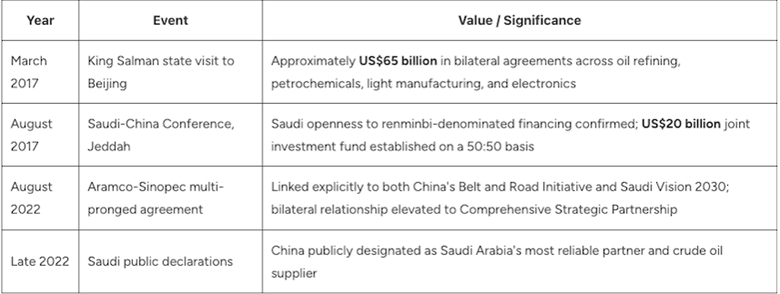
Another pivotal event was the IPO of Saudi Aramco, the largest oil company in the world, in 2019. While major stock exchanges including New York and London were reluctant to participate in the initial public offering on Riyadh’s terms, China offered to buy the entire 5% stake scheduled for the IPO.
“The offer was ultimately declined, but the gesture registered deeply with the architect of Saudi Vision 2030. That single act of financial solidarity opened the door to a decade of deepening institutional ties.
“The trajectory of agreements that followed illustrates just how systematically Beijing built its influence”:
The US is a paper tiger
The Economist states:
It has become clear—in Iraq, Afghanistan and, more recently, Iran—that military capability alone does not guarantee military success. All those aircraft-carriers cannot prevent Iran from choking off the passage of oil through the Strait of Hormuz or stop China from limiting access to rare earths.
Indeed, despite overwhelming US military dominance, and Trump’s threats on social media, the United States climb-down on Iran, and the failure to meet its opaque objectives from the war, show that the country is a “paper tiger”.
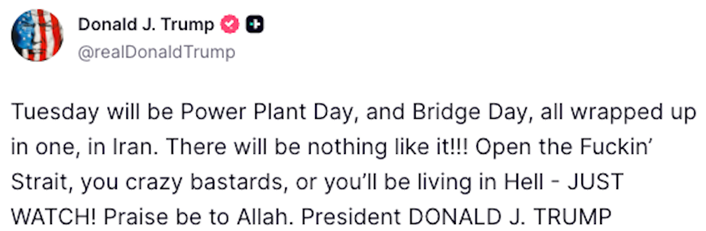
The first sign of US weakness was Trump’s’ declaration in March that “I’m not putting troops anywhere.” Instead, he claimed he “will do whatever’s necessary to keep the price” of oil down (The Hill), proving that the real reason for the Feb. 28 attack was, like in Venezuela, to take control of Iran’s oil.
(Media reported the Trump administration was considering deploying thousands of troops to support its operation in the region. The administration also discussed sending ground forces to Kharg Island, which holds 90% of Iran’s oil exports. Another possibility was to deploy US forces to secure Iran’s stock of highly enriched uranium, despite Trump in 2025 claiming it was destroyed by US bombs.)
The fact that only air power was used, and no ground troops sent, showed the world the limits of US willingness to project military force abroad. No doubt these decisions were influenced by the unpopularity of the war with the American public. According to one source, “Polling shows that Trump’s latest military adventure is even less well-liked than the Vietnam War.”
Arguably it would take an extremely good reason — something akin to another 9/11 — for Americans to tolerate US soldiers being returned to the US homeland in body bags. Iran just proved it.
US Vice-President JD Vance said during an event marking 250 years of the US military that “The president’s not going to send our military back in unless he has to, unless there’s a clearly defined purpose for it.”
Most commentary now views the US war with Iran as a complete failure. Let’s count them. Failure to bring down the regime and “free the people”; stop Iran’s nuclear program; destroy Iran’s ballistic missiles; and end Iran’s support for its proxies like Hezbollah.
Moreover, while the Strait of Hormuz has re-opened, it looks like Iran is sticking to its guns of controlling the strait jointly with Oman. Under an interim deal, Iran agreed to let ships transit the strait free for 60 days, after which it would charge fees for passage. This upends decades of practice in the waterway and hands Iran a major economic victory.
Here’s Arms Control Today on Trump’s “$100 billion Iran War Mistake”:
The U.S.-Israeli war on Iran has proven to be a disaster that has failed to advance U.S. strategic goals, including non-proliferation objectives, and inflicted widespread humanitarian consequences on untold millions of people in Iran, its region, and beyond.
This expensive war of choice has already likely incurred more than $100 billion in direct military costs.
The Atlantic Council headlined ‘A misguided war, a flawed deal and a dangerous future. Here’s what to do next on Iran.’ An excerpt:
Unfortunately, Trump did not learn from his own experiences with Iran and take advantage of this generational opportunity. Instead, he repeated many of his predecessors’ mistakes by launching a misguided war and compounding the error by agreeing to a deeply flawed ceasefire agreement…
Can Trump do that?
Despite the Constitution granting Congress the sole power to declare war, it also designates the president as “Commander in Chief of the Army and Navy of the United States,” giving the executive authority to direct the military once conflict has been authorized.
Presidents have long sent US forces into combat without a formal declaration of war (NPR). Trump did not seek Congressional approval before bombing Iran’s nuclear facilities in 2025, nor before attacking Iran with Israel on Feb. 28, 2026.
Article II of the Constitution vests the president with executive power over the government. Campaign Legal Center created a running list of notable actions taken by President Trump that he does not, in fact, have the authority to take.
A video by Bloomberg Law says Trump has been using executive orders to reshape government and society in ways that no other president has before. Trump’s orders have attempted to bar some major law firms from doing business with the government, drastically cut back the Department of Education, shuttered USAID, challenged a common understanding of the Constitution to end birthright citizenship, and sought to reshape requirements to vote in elections, just to name a few.
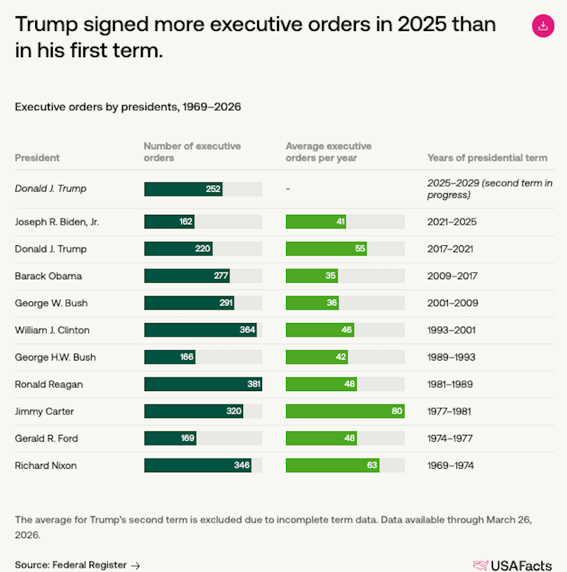
Interactions with Congress. The US president’s normal deference towards Congress has been turned on its head by Trump, who despite having Republican majorities in both the House and the Senate, has treated the legislative branch of government with disdain. Look no further than Trump’s recent clash with Senators Susan Collins and Bill Cassidy.
During a closed-door lunch with Senate Republicans on Capitol Hill, Donald Trump directed sharp criticism at Senator Susan Collins, along with Lisa Murkowski, Rand Paul, and Bill Cassidy, for joining Democrats on a war powers resolution regarding Iran. The meeting, which was arranged by Senator Rick Scott, rapidly escalated into a highly contentious confrontation.
While Collins and other targeted senators received a share of the president’s anger, the most volatile moment of the event was a shouting match between Trump and Senator Bill Cassidy. Cassidy confronted Trump about the administration’s handling of the conflict, and when Trump told the Louisiana Republican to sit down and called him a “lunatic,” Cassidy held his ground and refused, criticizing Trump for failing to be transparent with the American public about the situation.
The contentious Capitol Hill luncheon followed an abrupt move by Trump to cancel a bipartisan housing affordability bill signing ceremony. He had demanded that Congress first act on his priority elections and voter identification legislation before he would advance any of their achievements.
Canada. Canadians’ respect for the United States has been shattered since Trump in his second term included Canada in a global trade war. Trump’s provocative statements about making Canada the 51st state and calling Prime Minister Carney “Governor” have brought about a “Buy Canadian” movement that eschews the purchase of US goods and travel state-side. On April 2, 2025, so-called “Liberation Day”, a 10% tariff on non-CUSMA-compliant potash and energy products was imposed, along with a 25% tariff on cars and trucks not built in the US. This was followed by a 50% tariff on aluminum and steel imports from all countries including Canada. On Canada Day, July 1st, the Trump administration announced that it will not renew the Canada-United States-Mexico Agreement. The pact will remain in force for another decade, but the decision risks added uncertainty for companies producing goods across North America. Not renewing the deal also opens the door to years of negotiations over the rules governing supply chains and tariff levels. (BNN Bloomberg)
Sovereignty violations. Donald Trump clearly relishes sending the US military to flex his prerogatives around the world. He removed Venezuela’s president and has hinted he’d do the same in Colombia, suggested he’ll deploy troops to hunt drug cartels inside Mexico, vowed to seize control of Greenland “whether they like it or not,” put himself at the center of Gaza’s uneasy future, and boasted about a plan to go into Nigeria “guns-a-blazing.” (Bloomberg) Trump has said he plans to take over Venezuela’s oil industry and asked American companies to revitalize it. His administration put Delcy Rodriguez in charge — President Maduro’s vice-president — despite her being worse than Maduro, whom the US captured and brought back to the United States to face drug trafficking charges. Rodríguez has been sanctioned by the United States, the European Union, Canada, the United Kingdom, and several other countries. Those governments have accused her of helping undermine democratic institutions, participating in corruption, and being associated with human rights abuses carried out by the Maduro government.
De-dollarization
There is no doubt that Trump’s antics, narcissistic personality and crass attempts at self-promotion have also accelerated the move by countries away from the US dollar known as de-dollarization.
According to The Economist, the dollar’s share of global foreign-exchange reserves has been on a decades-long decline, to 57% last year.
Research by J.P. Morgan found that de-dollarization is unfolding in central bank FX reserves, where the share of USD has slid to a two-decade low.
The share of foreign ownership in the US Treasury market has also fallen over the last 15 years, pointing to reduced reliance on the dollar.
De-dollarization is most visible in commodity markets, where a large and growing proportion of energy is being priced in non-dollar-denominated contracts.
Gold officially exceeded US Treasury securities as a central bank reserve asset at the end of 2025, marking the first time in roughly three decades that gold became a larger holding than US debt. By early 2026, bullion accounted for 27% of global central bank reserves, compared to 22% for US Treasuries.
Also, a recent survey found that for the first time, more central banks plan to cut dollar allocations than increase them in the coming decade as political risks associated with the US currency rise.
Meanwhile, US money is increasing at the fastest pace in five years.
In May 2026, M2 money supply reached a record $23.05 trillion, expanding by 5.58% year over year. According to Crypto Briefing, “The growth rate… points to potential inflationary pressures that could influence the Federal Reserve’s monetary policy decisions.
“The acceleration in money supply growth is consistent with market concerns about future inflation, which may prompt the Federal Reserve to consider rate cuts.”
As the economist Milton Friedman famously summarized, “Inflation is always and everywhere a monetary phenomenon.” The Friedman dictum holds that persistent price rises are a choice made by the central bank (to print money — Rick).
At the end of the day, people need to understand that inflation is a symptom of excessive money-printing disease.
Can, will the Federal Reserve lower rates? — Richard Mills
Debt disaster
We wrote about new Fed Chair Warsh potentially lowering rates. We concluded that as long as the war is on, and Warsh thinks it’s a microeconomic oil supply shock, we’re not going to get a cut.
What could change Warsh’s mind and lead to a rate decrease?
First and foremost is the interest the federal government must pay on the national debt, currently sitting at $39.3 trillion. The average interest paid on its national debt obligations, including US Treasuries, is 3.39%. Current annual interest payments run at a seasonally adjusted $1.2 trillion and consume roughly 14% of the federal budget.
But the pressure on the US government is about to increase. That’s because it’s facing a massive maturity wall, with roughly $10 trillion in Treasury debt coming due and requiring rollover. This equates to approximately one-third of all outstanding marketable federal debt.
Warsh plus Friedman equals lowering rates – Richard Mills
This is the main reason the government (i.e. Trump) requires lower interest rates, especially with mid-term elections coming up in November. The only reason we don’t have them already is because of the war, and the inflation that is “baked in the cake”.
Think of the debt as a runaway train the US government will have a great deal of difficulty in stopping.
An article by Fortune notes the $39T debt is set to surpass its post-war peak, and the math says Washington can’t simply cut its way out.
The debt’s previous peak, 106% of GDP, was in 1946. A new book titled ‘Spending, Taxes, and Deficits: A Book of Charts’, finds the federal debt held by the public is projected to reach 137% of GDP within a decade.
The gross national debt itself crossed $39 trillion in March in less than five months after it hit $38 trillion and is what the Peter G. Peterson Foundation called a “staggering” pace of accumulation with few precedents outside wartime.
“Borrowing trillion after trillion at this rapid pace with no plan in place is the definition of unsustainable,” Peterson Foundation CEO Michael Peterson told Fortune when the milestone hit.
The only reason the US government can go so far in debt, and
keep financing it, is due to privileges inherently granted the US dollar, being the world’s reserve currency.
At the rate it’s going, the annual deficit is projected to grow from roughly $2 trillion today to $4.4 trillion by 2036. The increase in annual deficits is largely due to shortfalls in two bottomless-pit social programs: Social Security and Medicare.
The shortfalls are so big — the two retirement programs run a combined $157 trillion deficit — the 2036 budget will be virtually impossible to balance. Even if every program besides Medicare and Social Security were cut to zero it still wouldn’t balance.
Taxing the rich won’t close the gap, either. According to Fortune, even the most aggressive proposals raise modest sums relative to the long-term shortfall.
As usual, the problem with such high debt levels and borrowing is how much the government is forced to pay in interest. Fortune says this year, the federal government will spend more on interest than defense — a “milestone” reached in 2024. Within a decade, interest is projected to consume more than 30% of federal revenues. By 2040, it would be the largest item in the federal budget, eclipsing even Social Security.
What are the biggest risks to this predicament? Fortune lays out four: interest rates, the bond market, trust fund insolvency, and reserve currency risk. For the sake of brevity, let’s take interest rates and the reserve currency. From the article:
Interest rates. The CBO’s “rosy” baseline assumes the average interest rate on federal debt levels off at 3.9% and never rises above 4.2% over 30 years. Each one-percentage-point increase above that adds $3.3 trillion to the decade’s borrowing—and roughly $57 trillion (about 60% of GDP) to the 30-year debt. If rates merely return to 5.9%—a level the U.S. saw in the 1980s—annual deficits hit nearly $5.4 trillion by 2036 instead of $4.4 trillion.
Reserve currency risk. JPMorgan Chase CEO Jamie Dimon, in earlier remarks reported by Fortune, framed the long-run question starkly: “If we are not the preeminent military and the preeminent economy in 40 years, we will not be the reserve currency. That’s a fact. Just read history.”
Conclusion
The US dollar has been the world’s reserve currency since the 1940s. The dollar has driven international trade and reinforced the status of the United States as an economic superpower.
But as Jamie Dimon makes clear, USD dominance hinges on the US being the leading military power and the leading economy.
In 2025, Christine Lagard, president of the European Central Bank, said “History teaches us that regimes seem enduring – until they no longer are. Shifts in global currency dominance have happened before.”
The British pound lost its position as the world’s reserve currency because Britain’s economic power collapsed while the United States’ economic power surged, especially between World War I and II.
Both wars left Britain heavily indebted, with weakened industrial output. By contrast, the US emerged from WW I and II economically stronger and largely undamaged. Two other reasons knocked the pound off its perch: Britain could no longer sustain the gold standard due to debt and declining reserves; and as Britain’s empire weakened and countries gained independence, the demand for the pound fell.
The Roman denarius failed due to continuous government debasement. To pay for wars, administration and the military, emperors secretly reduced the coin’s silver content from nearly 95% down to just 2%. This caused hyperinflation, wiped out public trust, and forced Romans to resort to barter.
The reserve currency confers on its issuer an “exorbitant privilege”.
The US dollar is the most important unit of account for international trade, the main medium of exchange for settling international transactions, and the store of value for central banks.
Because of the dollar’s position, the US can borrow money cheaply, American companies can conveniently transact business using their own currency, and when there is geopolitical tension, central banks and investors buy US Treasuries, keeping the dollar high and the United States insulated from the conflict. A government that borrows in a foreign currency can go bankrupt; not so when it borrows from abroad in its own currency i.e. through foreign purchases of US Treasury bills.
In recent years, however, some countries have expressed opposition to the US dollar’s longstanding economic dominance.
The BRICS economic bloc, named for its founding members, Brazil, Russia, India, China, and South Africa, has actively sought to reduce its reliance on the US dollar. China has even pushed for “de-dollarization”, by promoting its currency, the yuan, and forming currency swap agreements with other countries. (Aljazeera)
De-dollarization has primarily been driven by the fear, mostly of developing countries, that their dollar reserves could be confiscated by the US like Russia’s was following its invasion of Ukraine.
The de-dollarization movement has gained so much force that central banks now hold more gold than US Treasuries.
In this article we asked the question: Does the United States deserve to have the reserve currency?
To summarize, the United States increasingly lacks the reputation and global influence needed to justify its role as the world’s hegemon. Paradoxically, an American-led world order has buoyed other countries, namely China and Russia.
In 1945 America produced about half of the world’s manufactured goods; by 2024, it accounted for about 15%, with China’s share of manufacturing more than twice that.
We see signs of shifting alliances in the Middle East. The petrodollar is under increasing threat from Persian Gulf countries that are seeking to diversify their strategic partnerships. When the UAE announced its departure from OPEC, it also said that it may begin selling oil in currencies other than the USD.
There are also cracks forming in the US-Saudi relationship. Under the 1974 United States-Saudi Arabian Joint Commission on Economic Cooperation, the US would purchase oil from Saudi Arabia and furnish it with American military aid and equipment, and the Saudis would invest their oil proceeds in US Treasury bonds.
The petrodollar convention made sense in the 1970s when the Saudis had a lot of money and little domestic capacity to absorb it. Sopping up US Treasuries was a system of mutual benefit.
The situation today is different. First, the United States has become a net exporter of crude oil and no longer relies on imports from Saudi Arabia. Second, Saudi Arabia no longer has a surplus of money it needs to recycle into Treasuries. The US’s decline on the international stage has prevented Saudi Arabia and other Gulf States from taking Trump’s demands to join the Abraham Accords seriously.
The fact that only air power was used in the Iran war, and no ground troops sent, showed the world the limits of US willingness to project military force abroad, when fighting wars that are unpopular at home.
Most commentary now views the US war with Iran as a complete failure. None of the objectives were met, in fact Iran is stronger because it controls the Strait of Hormuz including charging fees to cross it.
Despite its overwhelming military superiority, the United States is increasingly viewed as a “paper tiger.”
It started with President Biden’s withdrawal of US troops from Afghanistan. Disturbing evidence of Biden’s dementia put the Democrats on the back foot. They bear responsibility for hiding Biden’s cognitive decline which symbolized America’s growing weakness.
Kamala Harris was no match for Trump 2.0.
There is no doubt that Trump’s narcissistic personality and crass attempts at self-promotion have accelerated de-dollarization.
Examples of Trump’s retreat from global leadership include pulling out of international organizations, gutting foreign aid, berating allies, rejecting free trade through imposition of tariffs, acting unilaterally (e.g. attacking Iran), disrespecting sovereignty (Greenland, Canada), and acting “unpresidential”.
One of the responsibilities of the world’s reserve currency holder is the Triffin Dilemma. To provide global liquidity, the US must run massive permanent trade deficits. Critics argue US fiscal deficits and the resulting domestic debt have grown to unsustainable levels.
Indeed, out of all the reasons we’ve discussed for the US being undeserving of the reserve currency, the uncontrollable US debt is the most pressing.
This year, the federal government will spend more on interest servicing the $39 trillion national debt than defense. If the debt trajectory continues, by 2040, interest would be the largest item in the federal budget, eclipsing even Social Security.
The annual deficit is projected to grow from roughly $2 trillion today to $4.4 trillion by 2036. The debt is simply the accumulation of current and prior deficits. As the debt increases, bond holders including foreign governments will demand higher interest rates for shouldering a higher risk of a sovereign debt default.
A growing US national debt undermines the US dollar by fueling expectations of inflation, increasing reliance on money creation to service the debt, and eroding global confidence.
The U.S. dollar maintains its global reserve status largely due to the formidable network effects and deep entrenchment within structural global economic systems and payment rails, rather than just the strength and perception of the U.S. economy and government. Because the system is already built around the dollar, it is incredibly costly and inefficient for the international community to transition to an alternative.
For now, the US dollar’s influence is unmatched by any other currency. But the US government itself has sowed the seeds of a failed reserve currency.
Richard (Rick) Mills
aheadoftheherd.com

Legal Notice / Disclaimer
Ahead of the Herd newsletter, aheadoftheherd.com, hereafter known as AOTH.Please read the entire Disclaimer carefully before you use this website or read the newsletter. If you do not agree to all the AOTH/Richard Mills Disclaimer, do not access/read this website/newsletter/article, or any of its pages. By reading/using this AOTH/Richard Mills website/newsletter/article, and whether you actually read this Disclaimer, you are deemed to have accepted it.