 RSS Subscribe
Bullfrog Gold: A unicorn in the world-famous Walker Lane Trend – Richard Mills
2026.06.16
The Walker Lane Trend stands out as one of North America’s most prospective yet still-underexplored gold belts.
The 800-kilometer-long mineral belt stretches from southern Oregon through western Nevada into California.
Unlike the well-known Carlin and Cortez trends, which are primarily associated with sediment-hosted gold deposits, the Walker Lane is renowned for its diversity of mineral occurrences, including epithermal gold-silver deposits and porphyry copper systems. This geological variety offers explorers a wider range of potential discoveries. (Investing News Network)
One with a compelling story to tell is Bullfrog Gold (TSXV:FROG), which holds a 100% interest in the South Bullfrog gold project, located in the Walker Lane Trend near the town of Beatty, Nevada.
The Beatty District is at the southern margin of the Walker Lane Trend. It was consolidated between 2021 and 2025 by AngloGold Ashanti (NYSE:AU) through the acquisitions of Corvus Gold, Coeur Sterling, and Augusta Gold. (more on that below)
Claims acquisition
South Bullfrog consists of 488 Bureau of Land Management (BLM) claims covering 10,050 acres in the heart of the Beatty District.
How did Bullfrog Gold manage to stake out such a large land position, and own 100% of it, in such a prolific gold district as the Walker Lane Trend?
“Dan likes to say he loves finding things that are hiding in plain sight,” says CEO Ian Slater, referring to geologist Daniel MacNeil, who was appointed VP Exploration of Bullfrog Gold effective June 1.
MacNeil staked the South Bullfrog Project in 2021 — beating the previous incarnation of Bullfrog Gold and Corvus Gold to the punch.
The founder of Vector Geological Solutions has supervised all exploration at South Bullfrog to date.
Outcrop Silver & Gold (TSX:OCG) spun off its interest in South Bullfrog by selling it to Applied Graphite Technologies. Applied Graphite acquired Bullfrog Gold in May 2026, renamed itself Bullfrog Gold Corp, and trades on the TSX Venture under the ticker FROG.
AngloGold’s consolidation
The significance of MacNeil’s staking coup becomes apparent when we outline what happened next.
AngloGold Ashanti consolidated the Beatty District by making three acquisitions in 2021 and 2025: Corvus Gold (USD$371 million), Coeur Sterling ($150M) — a subsidiary of Coeur Mining (NYSE:CDE) — and Augusta Gold ($197M), for a total investment of $718 million.
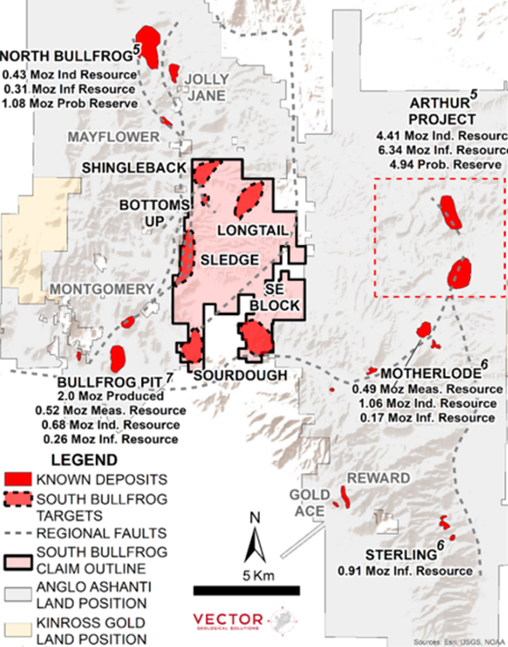
One can see the extent of the Colorado-based major miner’s land position in the areas marked in grey on the map above.
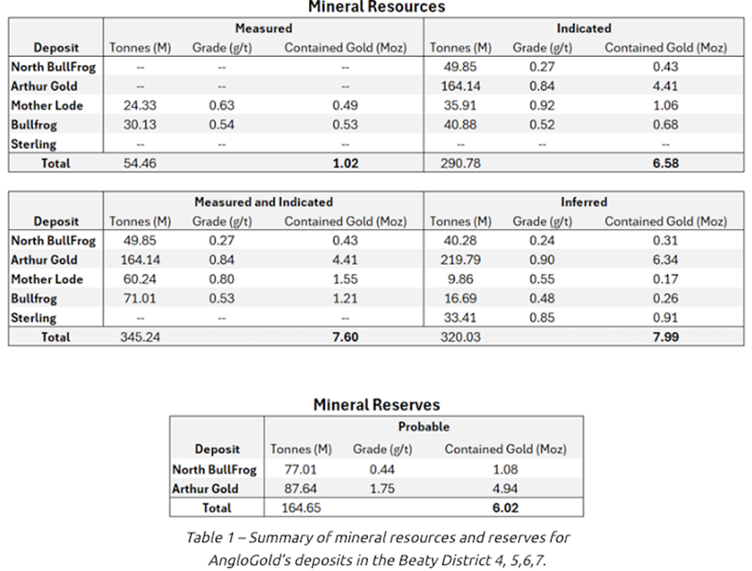
AngloGold announced a pre-feasibility study in March that includes the first-ever gold reserves at the Arthur Project. The PFS outlines 4.9 million ounces from two deposits, with the potential to support an initial nine-year mine with average annual gold production of 500,000 ounces.
The acquisitions allowed AngloGold Ashanti to operate a unified, standalone mining district in south-central Nevada.
With South Bullfrog (in pink) right in the middle of it.
The projectis wedged between AngloGold’s Bullfrog, North Bullfrog and Arthur development projects, which have Probable gold reserves of 6 million ounces, and gold resources of 7.6Moz (Measured & Indicated) plus 8Moz Inferred.
“We had the foresight to stake South Bullfrog in 2021 prior to consolidation of the district by AngloGold and despite its central location in the district, favorably oriented faults, and widespread adits, shafts and workings from historical mining, South Bullfrog had not seen modern exploration methods,” Bullfrog Mining’s CEO Ian Slater stated in a June 4 news release. “South Bullfrog has now been systematically explored and has the foundational geological mapping, geochemical sampling, satellite alteration, and geophysical data sets required to position Bullfrog Gold for discovery in 2026.”
South Bullfrog Project
South Bullfrog hosts a low-sulfidation epithermal gold system within a highly prospective volcanic and structural setting. The project exhibits many of the key geological signatures linked to mineralization in the district. Alteration, brecciation, silicification, quartz veining, and pathfinder geochemistry all support the project’s exploration thesis, while areas of shallow cover suggest potential for concealed targets that may not have been adequately tested by earlier work.
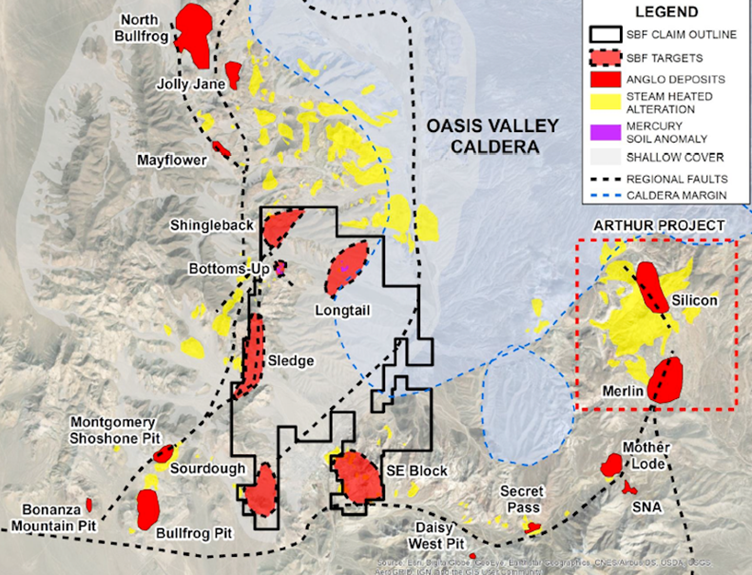
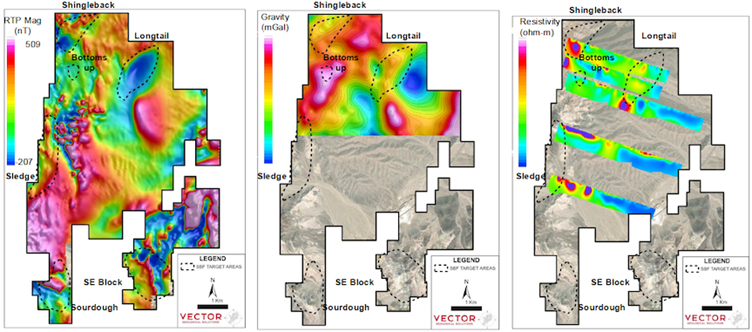
A range of modern exploration techniques, including geological mapping, geochemical surveys, airborne geophysics, IP, gravity, LiDAR, and hyperspectral analysis has been used to refine and prioritize targets across the property. This work has generated multiple targets with coinciding structural, geochemical and geophysical indicators.
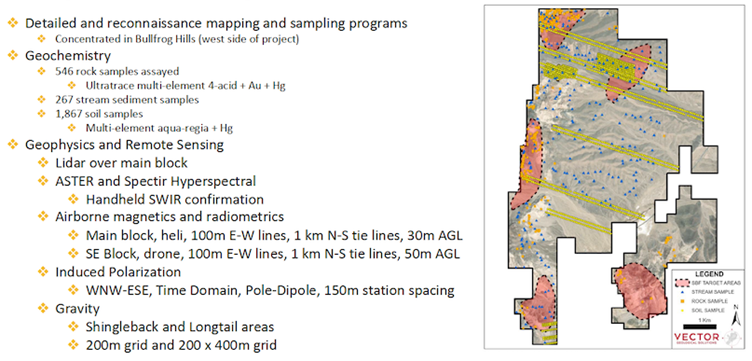
South Bullfrog is fully permitted with five drill-ready gold targets supported by historical workings, surface pathfinder rock and soil geochemistry, surface alteration, magnetic, electromagnetic and gravity geophysics, and favorable host rocks.
The original Bullfrog mine operated between 1904 and 1910. The site briefly boomed, driving a massive mining rush that established the surrounding district. After the initial rush, Barrick Gold (NYSE:ABX) operated a more modern open-pit mine from 1994 to 1999.
Along the western edge of the South Bullfrog property run two north-south faults. The faults contain the same high-grade veins that Barrick was chasing at the Bullfrog mine, and Corvus was following at North Bullfrog, now owned by AngloGold Ashanti.
Five targets
Longtail
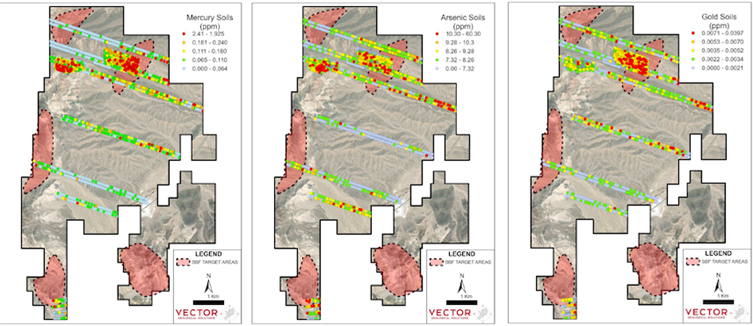
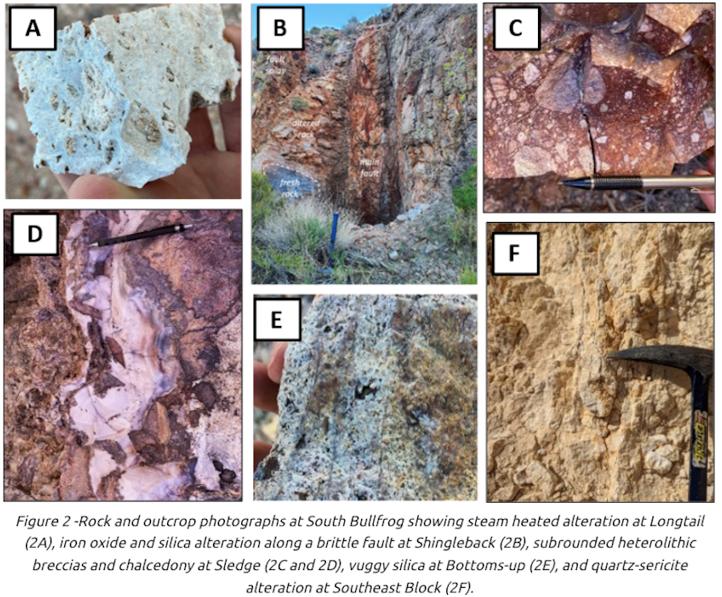
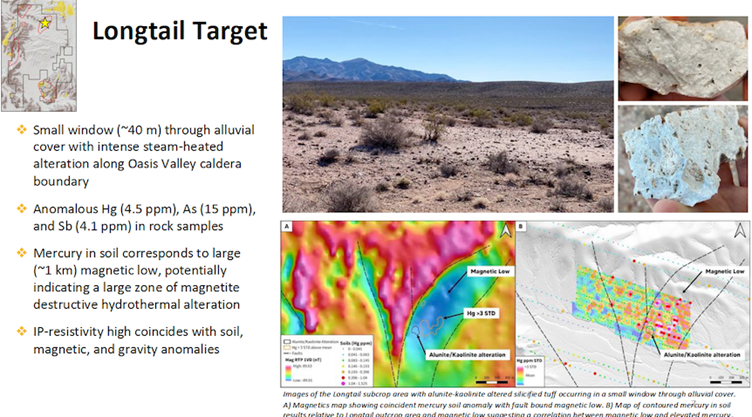
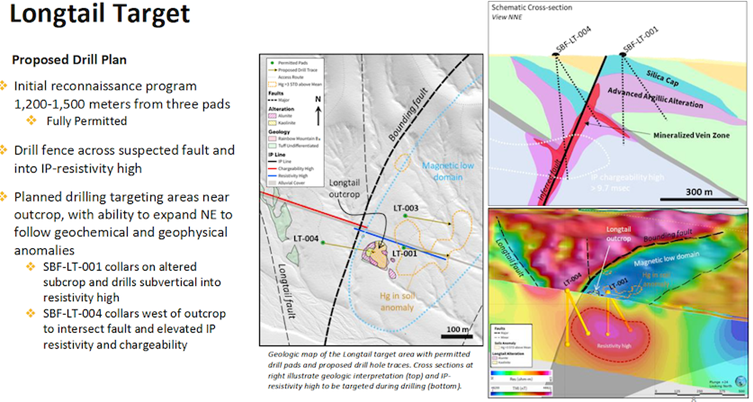
The Longtail target area is obscured by colluvium but contains discontinuously outcropping siliceous float and a window of exposed bedrock displaying intense steam-heated alteration (alunite–kaolinite-silica; Fig. 2A) that is similar to what is observed at AngloGold’s Arthur Project (Silicon) on the other side of the caldera. The target is defined by rock and soil pathfinder geochemistry (including arsenic, antimony, and mercury), and magnetic, electromagnetic (IP) and gravity-derived geophysical features that have potential for gold mineralization at depth.
Shingleback
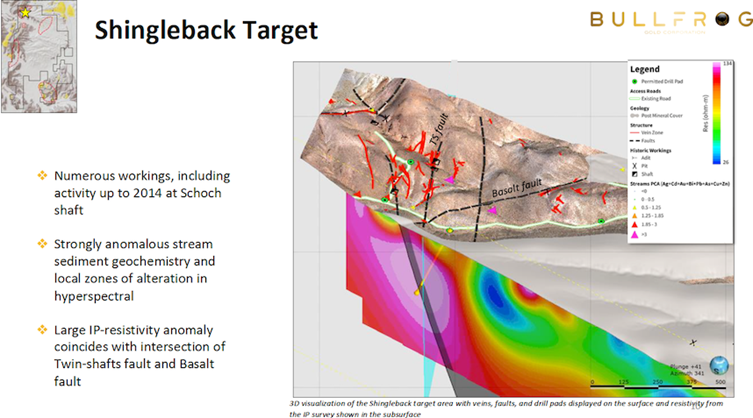
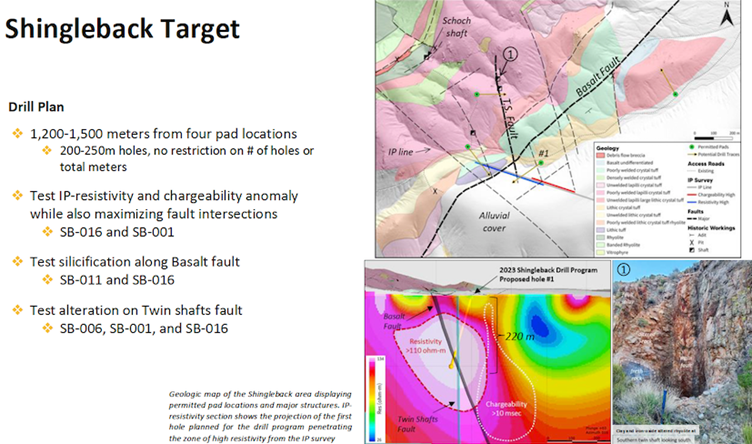
The Shingleback target area contains historical workings and alteration consistent with structurally controlled hydrothermal activity (Fig. 2B). Stream sediment geochemistry is anomalous for pathfinder elements and hyperspectral data indicate localized zones of acid alteration. A large IP resistivity feature coincides with the interpreted intersection of the Twin-Shafts and Basalt faults. The convergence of geochemical anomalies, alteration signatures and geophysical responses suggests that this structural intersection may have acted as a conduit for hydrothermal fluid flow and represents a priority exploration target.
Sledge
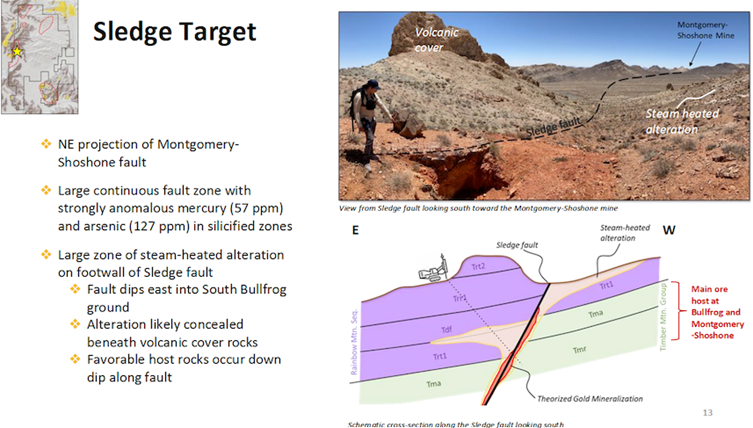
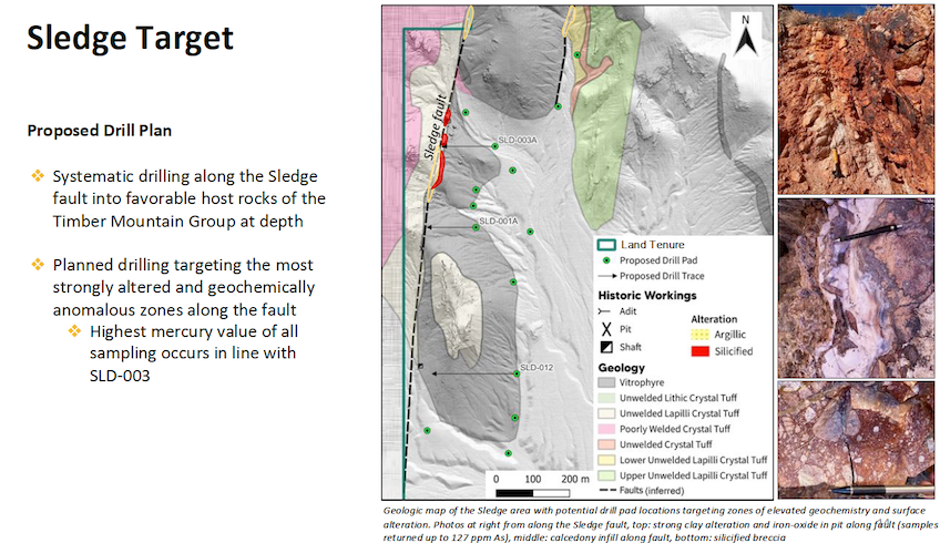
The Sledge target area contains hydrothermal breccia, chalcedonic silica, and clay alteration along a major fault zone interpreted to represent the northeast projection of the Montgomery–Shoshone structure that focusses mineralization at AngloGold’s Bullfrog deposit. Mercury and arsenic pathfinder element enrichment occurs in silicified zones along the fault (2C-D). Field observations and geochemical results indicate focused hydrothermal fluid flow along this structure, which dips eastward and is likely to cut reactive volcanic host rocks at depth. The structural setting and alteration style are consistent with fault-controlled epithermal systems documented elsewhere in the Beatty Mining District.
Bottoms-up
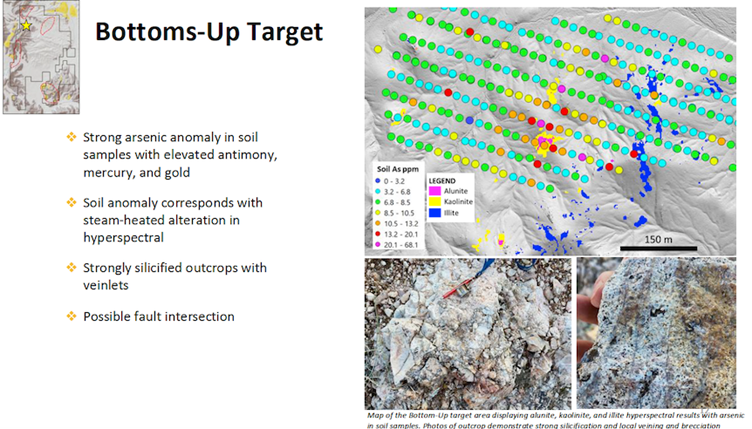
The Bottoms-up target area is defined by elevated soil geochemistry including arsenic, antimony, and mercury. The Bottoms-up target coincides with steam-heated alteration associated with silicified outcrops containing quartz veinlets and brecciation (2E). These features occur at an interpreted, geophysical defined structural intersection and may represent geochemical leakage from a deeper hydrothermal system concealed beneath shallow cover.
Southeast Block
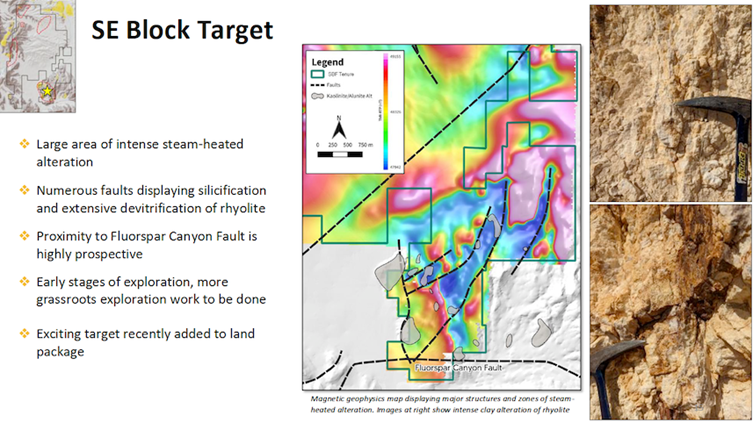
The Southeast block target area contains silicified rhyolitic ridges, a vitrophyric cap unit, oxidized volcanic rocks, bleached rhyolites, and a deeper brittle unit displaying green alteration, suggesting hydrothermal processes affecting multiple levels of the volcanic sequence (2F). Numerous faults contain silicification and devitrification of rhyolite, especially along the Fluorspar Canyon fault zone. The distribution of alteration and structural features suggests the presence of a broad hydrothermal system developed along major structures within this portion of the property.
2026 exploration
Bullfrog Gold announced on June 16 that it has commenced a field exploration program at South Bullfrog designed to evaluate and refine drill target locations at Longtail, Shingleback, Sledge and Bottoms-up. The program will also aim to advance targets at the highly prospective SE Block ahead of exploration drilling.
Highlights:
- Bullfrog Gold initiates confirmatory surface exploration program designed to derisk drill targets at Longtail, Shingleback, Sledge and Bottoms-up.
- Widespread, intense, silica-clay alteration and numerous historical adits at SE Block highlights the significant upside exploration potential of South Bullfrog. Mapping, sampling and prospecting will be conducted at SE Block to advance this target to the drill-testing phase.
Surface exploration at South Bullfrog started on June 3, and includes geological mapping (lithological, structural and alteration) and rock chip sampling (geochemical assays and short-wave infrared alteration analyses) at Longtail, Shingleback, Sledge, Bottoms-up and SE Block. The exploration program is designed to enhance Bullfrog Gold’s understanding of the geological architecture of the target areas and will also refine drill target locations.
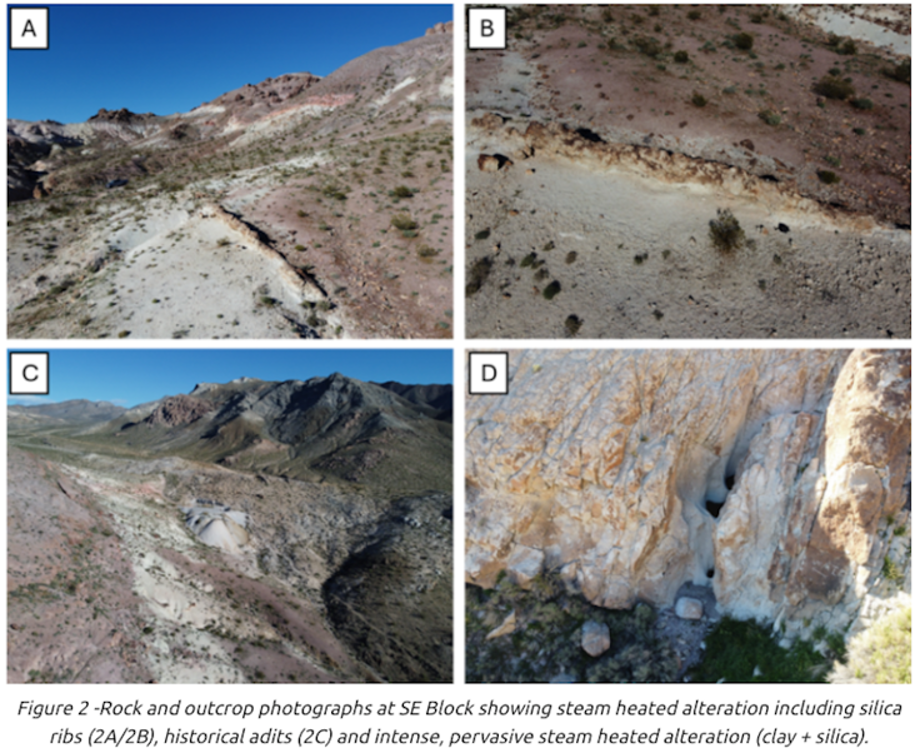
SE Block was staked after the acquisition of most of the South Bullfrog land position in 2022 and has not had sufficient mapping and prospecting despite having widespread steam-heated alteration and historical workings (Figure 2).
The SE Block target area contains silicified and clay-altered coherent and fragmental rhyolite lavas, breccias and silica ribs (Figure 2A/B). Brittle damage zones (faults) align zones of silicification and devitrification of rhyolite, especially along the Fluorspar Canyon fault zone (2C). The distribution of alteration and structural features suggests the presence of a broad hydrothermal system developed along major structures within this portion of the property.
Conclusion
Bullfrog Gold has bagged a unicorn in a whopper of a gold district: the South Bullfrog Project in the Walker Lane Trend of Nevada, which has historically produced over 50 million gold ounces, plus about 700 million ounces of silver and 4 million tons of copper.
Head geologist Daniel MacNeil managed to stake 488 claims covering 10,050 acres from under the noses of previous owners and AngloGold Ashanti — which subsequently consolidated the Beatty District with a $718 million investment.
Large mining companies don’t spend that kind of money unless they expect to produce some gold.
AU’s North Bullfrog deposit hosts just over a million ounces in Probable reserves.
A prefeasibility study at AU’s Arthur Project outlines 4.9 million ounces from two deposits, enough to support an initial nine-year mine with average annual gold production of 500,000 ounces.
Meanwhile, Bullfrog Gold just closed a CAD$1,500,000.00 private placement that it plans to put towards exploration at South Bullfrog, with five drill-ready targets identified and permits in hand.
The latter shouldn’t be underestimated. Nevada is one of the best jurisdictions in the world for mining investment — ranking first on that metric in the latest (2025) Fraser Institute Annual Survey of Mining Companies.
Nevada’s mining taxes and regulations are protected by the state’s constitution, offering extreme policy stability and shielding operators from the nationalization risks common in overseas markets.
Despite its central location in the district, favorably oriented faults, and widespread adits, shafts and workings from historical mining, South Bullfrog had not seen modern exploration methods. Until now.
“South Bullfrog has now been systematically explored and has the foundational geological mapping, geochemical sampling, satellite alteration, and geophysical data sets required to position Bullfrog Gold for discovery in 2026,” says CEO Ian Slater.
Bullfrog has the key ingredients I like to see in an early-stage junior, including: a highly prospective project in a prime location surrounded by known gold deposits; insider buying; a tight share structure; and about CAD$1.2 million in the bank.
In the west, Bullfrog is chasing the same high-grade veins as the Bullfrog mine in the south and AngloGold’s North Bullfrog in the north. In the east, Bullfrog is chasing the same bulk tonnage targets as AngloGold’s Silicon and Merlin projects.
Geophysical and geochemical studies suggest similar alteration and the same pathfinder minerals, i.e., arsenic, antimony and mercury.
Work also recently started on the SE Block, with a team of geologists mobilized to do mapping and take geochemical samples to ready the new target for drilling.
I’m looking forward to news from the field as the company moves its five targets towards drilling.
Bullfrog Gold Corp
TSXV:FROG
2026.06.16 Share Price: Cdn$0.145
Shares Outstanding: 83.9m
Market Cap: Cdn$5.9m
website: FROG
Richard (Rick) Mills
aheadoftheherd.com
Subscribe to AOTH’s free newsletter
Richard does not own shares of Bullfrog Gold Corp (TSXV:FROG)
FROG is a paid advertiser on his site aheadoftheherd.com
This article is issued on behalf of FROG.
Legal Notice / Disclaimer
Ahead of the Herd newsletter, aheadoftheherd.com, hereafter known as AOTH.Please read the entire Disclaimer carefully before you use this website or read the newsletter. If you do not agree to all the AOTH/Richard Mills Disclaimer, do not access/read this website/newsletter/article, or any of its pages. By reading/using this AOTH/Richard Mills website/newsletter/article, and whether you actually read this Disclaimer, you are deemed to have accepted it.