 RSS Subscribe
Gold repatriation wave, gold is the smoke detector signaling that currency debasement is underway – AOTH

A return to a strict 19th-century style gold standard where you can exchange paper money for gold coins at a bank is highly unlikely. Modern economies are simply too large and complex to be restricted by the physical supply of a single metal.

U.S. Congressman Introduces Gold Standard Bill as Inflation Spirals Out of Control
However, gold is actively returning to the global monetary system in a different way: as structural collateral and back-end backing. Instead of replacing fiat currencies, gold is increasingly used to anchor them.
A strict gold standard prevents central banks from expanding the money supply during recessions or financial crises. If the economy grows faster than the amount of gold being mined, it triggers severe, chronic deflation, suppressing wage growth and deepening depressions.
The global fixed-income and equity markets are valued in hundreds of trillions of dollars. There is simply not enough physical gold in existence to fully back modern global trade and credit systems without repricing gold to absurd, destabilizing heights.
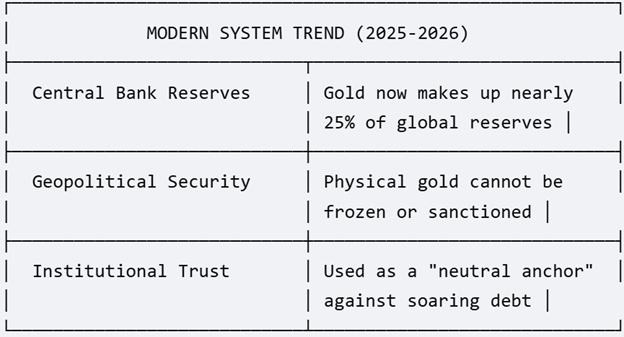
While you won’t see a gold-backed consumer currency in your retail bank account, central banks are treating gold as the ultimate neutral asset.

Dollar collapse will happen ‘gradually, then suddenly’
The Unit
The most realistic “backing” is happening at the wholesale trade layer. For instance, the BRICS nations have advanced framework testing for a cross-border digital token called “The Unit.” Rather than a currency everyday citizens spend, it is a backend settlement instrument backed 40% by physical gold and 60% by a basket of local currencies, designed purely to bypass the US dollar in international trade.
The BRICS “Unit” is a digital, blockchain-based framework developed to handle cross-border wholesale trade settlement.
It is crucial to understand that The Unit is not a consumer currency. You cannot use it to buy groceries, and it does not replace the national currencies of the participating BRICS member countries. Instead, it is an international “clearing tool” designed for central banks and large corporations to settle massive multi-billion-dollar trade imbalances (like energy, grain, and metals) without routing transactions through the U.S. dollar or Western banking channels like SWIFT.
The goal is to guarantee global trust without allowing a single nation to dominate the system, the Unit uses a 40% physical gold and 60% fiat currency composition.
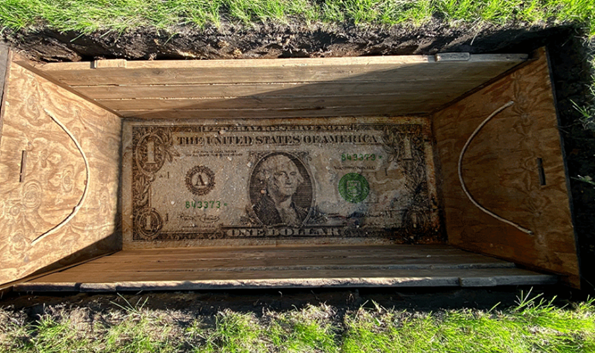
Does the US deserve to have the world’s reserve currency
This ties the Unit to real-world economic output. The basket utilizes an equal weight of 12% each from five core member currencies: the Chinese yuan, Russian ruble, Indian rupee, Brazilian real, and South African rand.
The project remains an evolutionary, pilot-phase deployment. An initial prototype framework was introduced by research organizations late last year to test the architecture. Rather than an officially mandated, overnight replacement for the global reserve system, it is scaling incrementally as a “layered, non-sanctionable” alternative option for Global South trade.
Beyond the experimental BRICS “Unit” concept, several real-world sovereign, state-level, and trade-based gold-backed monetary frameworks exist or are being deployed. These range from fully circulating legal tender to state-backed electronic payment rails.
ZiG
The most prominent example of a modern, circulating gold-backed fiat currency is the ZiG, issued by the Reserve Bank of Zimbabwe.
Introduced to halt hyperinflation, the ZiG is explicitly backed by physical commodities held in central bank vaults, including roughly 4.2 tons of physical gold and over $1.1 billion in foreign exchange reserves.
In April 2026, Zimbabwe released an upgraded series of physical ZiG banknotes (including 10, 20, and 50 ZiG denominations). Reinforced by surging foreign currency inflows, the central bank maintains reserves equal to roughly six times the circulating ZiG base money to protect its value
United States
In the United States, several states are bypassing the Federal Reserve system by legalizing gold and silver as transactional money under Article 1, Section 10 of the U.S. Constitution. Texas is leading this infrastructure buildout.
Texas law formally recognizes privately procured gold and silver bullion as legal tender. The state has authorized an electronic payment system where users can spend fractional amounts of gold or silver digitally. The physical metal backing these digital tokens is stored securely in the state-operated Texas Bullion Depository.
Physical gold and silver became voluntary legal tender in Texas on September 1, 2026. The state-backed electronic “digital gold” payment system is legally authorized to implement its public rollout on May 1, 2027. Other states like Louisiana and Oklahoma have proposed similar architecture.
Trade currencies
Rather than a currency everyday people spend, some countries have built temporary bilateral “trade currencies” using gold to buy vital resources.
Faced with a shortage of U.S. dollars, the Bank of Ghana launched a program where the government used locally mined, physically refined gold to pay international suppliers directly for imported refined petroleum products.
While it successfully built Ghana’s physical gold reserves up to 32 tonnes, the structural project faced severe operational challenges – opaque private corridors, and massive exchange losses. The program was officially terminated and suspended to shift focus purely toward internal gold reserve accumulation.

Special Drawing Right
While no international organization like the IMF has proposed a new standalone, global consumer currency to replace the U.S. dollar global institutions have actively promoted and upgraded supranational units of account and decentralized network frameworks to shift the financial world away from its singular reliance on the greenback.
These institutional alternatives function behind the scenes to structurally alter how central banks and countries manage trade.
The most notable alternative officially maintained by the International Monetary Fund (IMF) is the Special Drawing Right (SDR).
The SDR is not a currency you can hold in your wallet; it is an international reserve asset and unit of account. It acts as a “synthetic currency” whose value is tied to a basket of the world’s most powerful currencies.
Historically, the SDR basket was completely dominated by Western currencies. To facilitate a more multipolar global economy, the IMF structurally broke this monopoly by elevating the Chinese Renminbi (Yuan) into the SDR basket. The basket includes the U.S. dollar, Euro, Chinese Yuan, Japanese Yen, and British Pound.
Nations like China have explicitly petitioned the IMF to transform the SDR into a fully functional, super-sovereign reserve currency completely unlinked from any single nation’s internal economic problems. Proponents want the IMF to issue SDRs backed by physical commodities—effectively reviving economist John Maynard Keynes’s famous 1944 proposal for a world clearing asset known as the “Bancor.”

Global official institutions purchase a staggering 289 tonnes of net gold in Q2 2026
Project mBridge
While the IMF manages reserve balances, the Bank for International Settlements (BIS), often called the “central bank for central banks”—has co-developed the most aggressive alternative to the dollar payment system: Project mBridge.
Instead of proposing a brand-new currency, mBridge is a multi-country, multi-central bank digital ledger designed to completely bypass Western correspondent banks.
It allows central banks (such as those in China, the UAE, Thailand, and Hong Kong) to directly exchange their respective Central Bank Digital Currencies (CBDCs) with each other instantly.
This network framework effectively serves the function of an international trade currency because it eliminates the need to route funds through the U.S. financial system or convert local money into greenbacks before settling cross-border debts.
US Dollar
Data compiled by the IMF’s Currency Composition of Official Foreign Exchange Reserves (COFER) tracks the dollar’s steady two-decade slide, showing it now sits near historical lows.
However, rather than fleeing to a new global currency designed by a world committee, central bank reserve managers are diversifying into a decentralized web of nontraditional reserve currencies. Money is shifting toward the Australian dollar, Canadian dollar, South Korean won, and Singaporean dollar because modern digital liquidity management systems make handling a diverse basket of national currencies easier than ever before.
The structural erosion of the U.S. dollar’s dominance in global foreign exchange reserves is one of the most significant macro shifts in modern finance.
According to official IMF COFER data, the U.S. dollar’s share of global foreign exchange reserves sits at 56.70%. While still the world’s preeminent reserve currency, this represents a multidecade slide down from over 70% in the late 1990s and a 30-year low
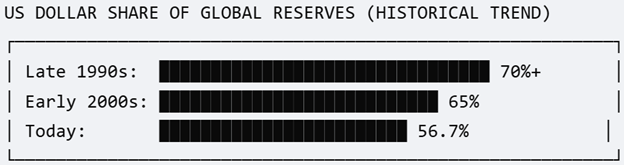
The data shows that central banks are not fleeing the dollar for traditional major rivals like the Euro, British Pound, or Japanese Yen. Instead, they are actively pursuing portfolio diversification into two specific areas: nontraditional safe-haven currencies and physical gold.
The primary catalyst forcing central banks to rethink their dollar dependency is the weaponization of the Western financial system.
When the U.S. and its allies froze roughly $300 billion of Russia’s foreign reserves, it sent a shockwave through global central banking. Sovereign managers realized that holding “dollars” really means holding a digital balance sheet at the Federal Reserve, which can be turned off by U.S. political decree.
Central banks
Central banks especially in the Global South and emerging markets, are reducing their vulnerabilities by rotating out of U.S. Treasuries and shifting toward assets that cannot be digitally frozen or sanctioned.
Long-term institutional trust in the fiscal health of the United States has steadily weakened.
Staggering U.S. national debt levels and persistent trade deficits mean the U.S. must issue massive amounts of new government debt. Central banks worry about long-term stability, domestic political gridlock, and potential inflation debasement if the U.S. prints money to service its obligations.
A comprehensive institutional survey by the Official Monetary and Financial Institutions Forum (OMFIF) revealed that a record 74% of central banks expect to lower their dollar holdings over the next five years, specifically citing rising political risks in the United States.
Historically, central banks held dollars because the market for U.S. debt was the only one deep and liquid enough to absorb trillions of dollars in trade surpluses. Modern financial technology has stripped away that structural monopoly.
Algorithmic liquidity management and multi-currency clearing platforms have made it cheap, fast, and secure to trade in smaller, secondary currencies.
Instead of shifting to a single replacement currency, central bank reserves have fragmented across a highly diversified basket. Capital is moving actively into the Canadian dollar, Australian dollar, South Korean won, Singaporean dollar, and Norwegian crown, alongside a modest increase in the Chinese Renminbi (Yuan).
Despite this steady erosion, the U.S. dollar is nowhere near a total collapse. It continues to maintain what economists call its “exorbitant privilege” due to structural realities in private trade.
While central banks are holding fewer dollars in their vaults, international corporations still price 40% to 45% of all global trade invoices in USD (rising to over 60% if you exclude internal European Union trade).
The dollar remains aggressively involved in nearly 90% of all global foreign exchange transactions.
Alternative sovereign currencies face internal limitations. The Eurozone lacks a unified single bond market, and China’s Renminbi is heavily constrained by strict domestic capital controls, meaning foreign investors cannot freely withdraw their wealth at will.
The global financial architecture is shifting away from a “Dollar Monopoly” and gradually re-organizing into a multipolar reserve system where nations hold a balanced mix of localized currencies, sovereign debts, and physical bullion.

The sharp rise in BRICS behaves as a direct accounting mirror and a strategic hedge against the drop in U.S. dollar reserves. This relationship is not a coincidence; it represents a fundamental change in how central banks manage financial risk.
When a central bank decides to lower its exposure to the U.S. dollar, it cannot simply hold its local paper currency; it must convert those excess dollars into alternative global reserve assets.

Data shows that central banks are aggressively choosing physical gold over traditional sovereign debt currencies. According to the Official Monetary and Financial Institutions Forum (OMFIF) Global Public Investor Survey, 82% of central banks now hold physical gold, up dramatically from 71% just a year prior. In fact, gold has officially surpassed U.S. Treasuries to take a larger portion of total global reserve allocations.
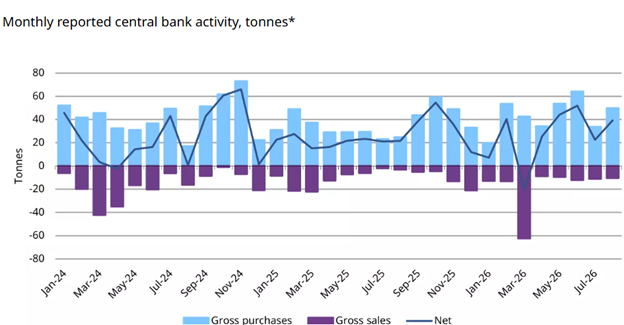
If a central bank rotates out of the U.S. dollar and buys Euros or Japanese Yen, it is merely trading one government’s political and inflationary risk for another’s. Gold represents a “natural destination” because it is a completely neutral asset that carries zero counterparty or policy risk.
Since the freezing of Western-held sovereign fiat reserves in recent years, central banks have deliberately targeted physical assets that can be held domestically. According to the World Gold Council Central Bank Survey, 49% of central banks now prioritize domestic vaulting of their physical bullion to ensure total protection against external financial sanctions.
The connection between the dollar’s decline and gold’s rise is amplified by a financial mechanism known as the valuation effect.
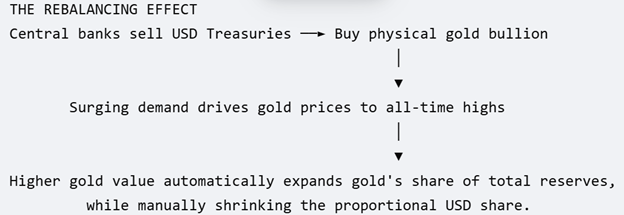
As central banks sell off chunks of their U.S. dollar assets to buy physical gold, the massive institutional demand drives gold prices to record all-time highs. Because foreign exchange reserve portfolios are calculated based on current market values, the surging price of gold automatically causes the total percentage share of gold in global reserves to swell.
This creates an ongoing mathematical squeeze: even if a central bank stops actively buying gold, the rising price of the bullion it already owns continuously forces the proportional share of U.S. dollars in its portfolio downward.
Gold repatriation wave
Governments and central banks are actively bringing their physical gold home in what financial analysts describe as a historic “gold repatriation wave“.
Historically, nations kept their gold bars safely tucked away in the deep subterranean vaults of the Federal Reserve Bank of New York or the Bank of England because those cities were the primary hubs for global financial liquidity and trade settlement. Today, that calculus has completely flipped.
Central banks used to prioritize liquidity; now they prioritize sovereign custody. Since the unilateral freezing of Russia’s offshore fiat currency reserves by Western nations, global reserve managers have realized that any asset stored in an overseas jurisdiction can be subject to a political “kill switch”. Physical gold inside your own borders is the only asset that cannot be digitally blocked, frozen, or confiscated via a foreign court order.
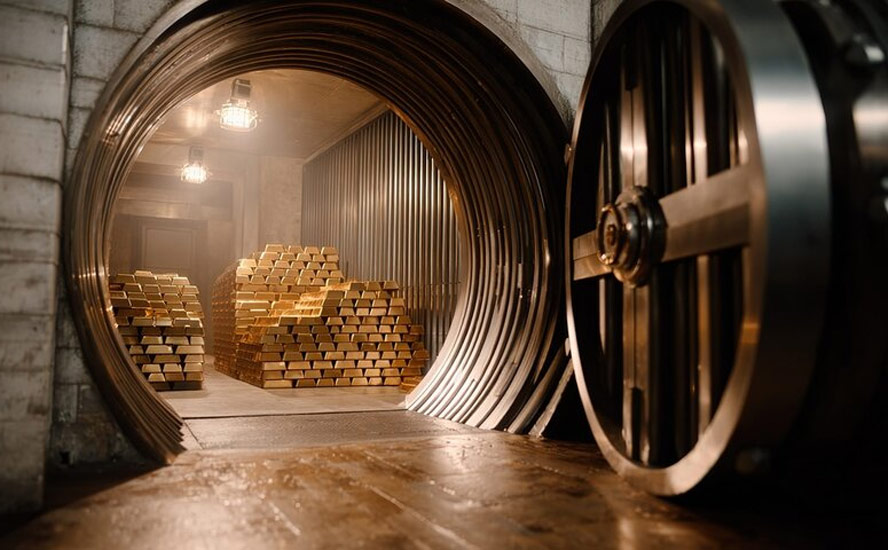
Control of the gold market is moving
As the global trading infrastructure splits into distinct economic blocs (such as Western systems vs. BRICS alignment), having your gold trapped in a rival bloc’s vault presents a massive logistical threat. Central banks want their gold within arm’s reach so they can use it immediately as untethered emergency collateral for trade or currency defense during severe geopolitical black swan events.
With Western superpowers printing immense debt to keep up with economic realities, global central bankers view physical custody of gold as the ultimate neutral baseline protection against fiat money debasement. It is an explicit statement of self-reliance: trusting your own vaults more than a foreign country’s balance sheet.
Conclusion
Gold behaves as an early warning system for the economy. When you see gold prices climbing rapidly, it means large institutions and central banks are anticipating that the purchasing power of paper currency is about to drop.
Consumer price increases are driven by structural economic inputs, such as surging crude oil prices hitting $100+ a barrel, manufacturing supply chain bottlenecks, rising corporate wages, or an oversupply of printed fiat currency chasing too few goods.

Dumpster fire economics, consumers red-lined
When those exact inflationary pressures (like high energy costs) start cooking under the surface, investors and central banks run to gold as a historical safe haven. This mass migration pushes gold prices up. Therefore, gold isn’t the fire causing everyday inflation; it is the smoke detector signaling that currency debasement is underway.

In a K-shaped recovery consumers feel squeezed
Financial markets look forward. If consumers and institutional investors expect prices for everyday goods to keep rising over the next few years, they will aggressively purchase gold to preserve their long-term wealth before the official government inflation data is even published.

Gold interest rate trade dead, long live the debasement trade
The relationship can get highly volatile when central banks step in to fight everyday inflation. For instance, when high consumer inflation forces central banks to raise interest rates, yield-bearing assets like 10-year Government Treasuries become highly attractive. Because physical gold pays no dividend or interest, a aggressive interest rate spike can temporarily pressure gold prices down—even while everyday inflation remains high.

Western investors hoover up $18 billion in gold ETFs; Asians prefer bars and coins
Ultimately, when gold breaks away from its traditional patterns and remains historically elevated despite high interest rates, it sends a macroeconomic message: global institutional trust in sovereign debt and fiat currency purchasing power is shrinking.

Legal Notice / Disclaimer
Ahead of the Herd newsletter, aheadoftheherd.com, hereafter known as AOTH.Please read the entire Disclaimer carefully before you use this website or read the newsletter. If you do not agree to all the AOTH/Richard Mills Disclaimer, do not access/read this website/newsletter/article, or any of its pages. By reading/using this AOTH/Richard Mills website/newsletter/article, and whether you actually read this Disclaimer, you are deemed to have accepted it.